SLIDE 1
NOTE: These slides contain both Sections 3.1 and 3.2.
3.1 Introduction to Determinants
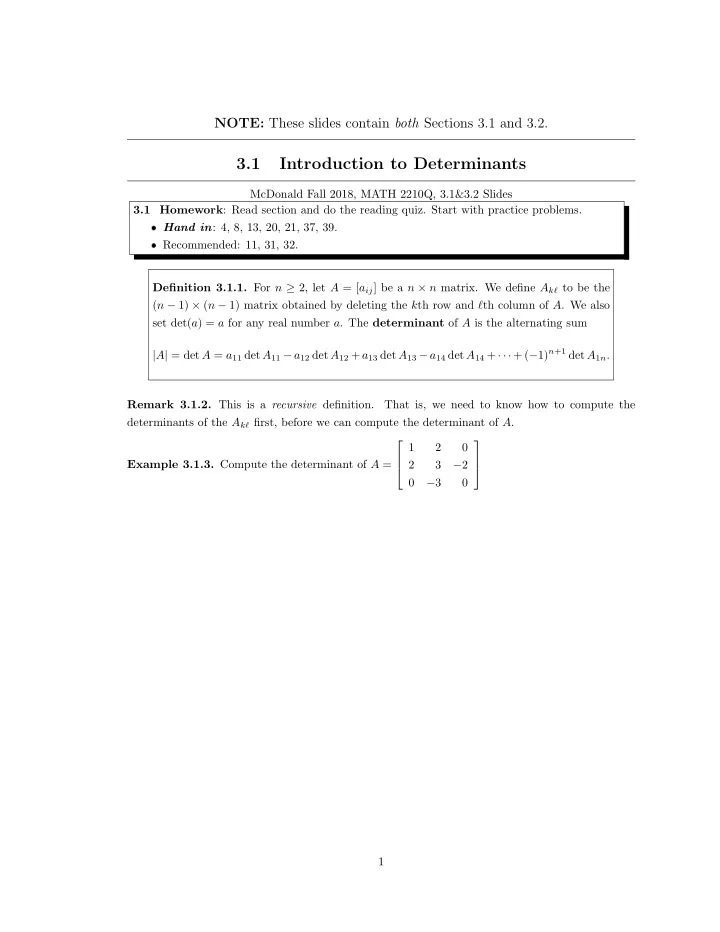
McDonald Fall 2018, MATH 2210Q, 3.1&3.2 Slides 3.1 Homework: Read section and do the reading quiz. Start with practice problems. ❼ Hand in: 4, 8, 13, 20, 21, 37, 39. ❼ Recommended: 11, 31, 32. Definition 3.1.1. For n ≥ 2, let A = [aij] be a n × n matrix. We define Akℓ to be the (n − 1) × (n − 1) matrix obtained by deleting the kth row and ℓth column of A. We also set det(a) = a for any real number a. The determinant of A is the alternating sum |A| = det A = a11 det A11 − a12 det A12 + a13 det A13 − a14 det A14 + · · · + (−1)n+1 det A1n. Remark 3.1.2. This is a recursive definition. That is, we need to know how to compute the determinants of the Akℓ first, before we can compute the determinant of A. Example 3.1.3. Compute the determinant of A = 1 2 2 3 −2 −3 1
SLIDE 2
Definition 3.1.4. Given A = [aij], the (i, j)-cofactor of A is the number Cij = (−1)i+j det Aij Theorem 3.1.5. The determinant of an n × n matrix A can be computed by a cofactor expansion across any row or down any column. The expansion of across the ith row is |A| = det A = ai1Ci1 + ai2Ci2 + · · · + ainCin. The cofactor expansion down the jth column is |A| = det A = a1jC1j + a2jC2j + · · · + anjCnj. Example 3.1.6. Use a cofactor expansion across the third row to compute det A where A = 1 2 2 3 −2 −3 2
SLIDE 3
Example 3.1.7. Compute the determinant of A = 3 1 −2 6 1 2 5 −2 3 1 2 2 3 −2 −3 Theorem 3.1.8. If A is an n × n triangular matrix, then det A = a11a22a33 · · · ann. Remark 3.1.9. This suggests a nice strategy. Turn A into a triangular matrix! We could try to reduce A to echelon form, U. How are determinants affected by row operations? 3
SLIDE 4
3.2 Properties of Determinants
3.2 Homework: Read section and do the reading quiz. Start with practice problems. ❼ Hand in: 8, 10, 16, 17, 20, 27, 34. ❼ Recommended: 2, 3, 26, 32, 40. Theorem 3.2.1 (Row Operations). Let A be a square matrix. (a) If a multiple of one row of A is added to another to produce B, then det B = det A. (b) If two rows of A are interchanged to produce B, then det B = − det A. (c) If one row of A is multiplied by k to produce B, then det B = k det A. Example 3.2.2. Compute det A where A = 1 −4 2 −2 8 −9 −1 7 4
SLIDE 5 Example 3.2.3. Compute det A, where A = 2 −8 6 8 3 −9 5 10 −3 1 −2 1 −4 6 . Suppose an n × n matrix A can be reduced to echelon form U using only row replacements and row
- interchanges. Since U is in echelon form, it is triangular, so det U = u11u22u33 · · · unn.
Proposition 3.2.4. If an n × n matrix A can be reduced to echelon form U using only row replacements and k row interchanges, then det A = (−1)ku11u22u33 · · · unn. 5
SLIDE 6
Theorem 3.2.5. A square matrix A is invertible if and only if det A = 0. Example 3.2.6. Compute det A, where A = 3 −1 2 −5 5 −3 −6 −6 7 −7 4 −5 −8 9 . Example 3.2.7. Compute det A, where A = 1 2 −1 2 5 −7 3 3 6 2 −2 −5 4 −2 . 6
SLIDE 7 Theorem 3.2.8. If A and B are n × n matrices, then det AB = (det A)(det B). Example 3.2.9. Verify Theorem 3.2.8 for A =
2 5
2 3 4
Example 3.2.10. Let A and P be square matrices with P invertible, and show that det(PAP −1) = det A. 7
SLIDE 8
Theorem 3.2.11. If A is an n × n matrix, then det AT = det A. Remark 3.2.12. This means we can perform operations on the columns of a matrix in the same way that we perform row operations, and expect the same effect on the determinant. Example 3.2.13. Compute det A, where A = −5 2 2 2 3 3 5 −4 4 −2 2 −2 . Theorem 3.2.14 (“Column” Operations). Let A be a square matrix. (a) If a multiple of one column of A is added to another to produce B, then det B = det A. (b) If two columns of A are interchanged to produce B, then det B = − det A. (c) If one column of A is multiplied by k to produce B, then det B = k det A. 8