Abstract : Economic, social and demographic determinants that affect - - PDF document

abstract economic social and demographic determinants
SMART_READER_LITE
LIVE PREVIEW

Abstract : Economic, social and demographic determinants that affect - - PDF document

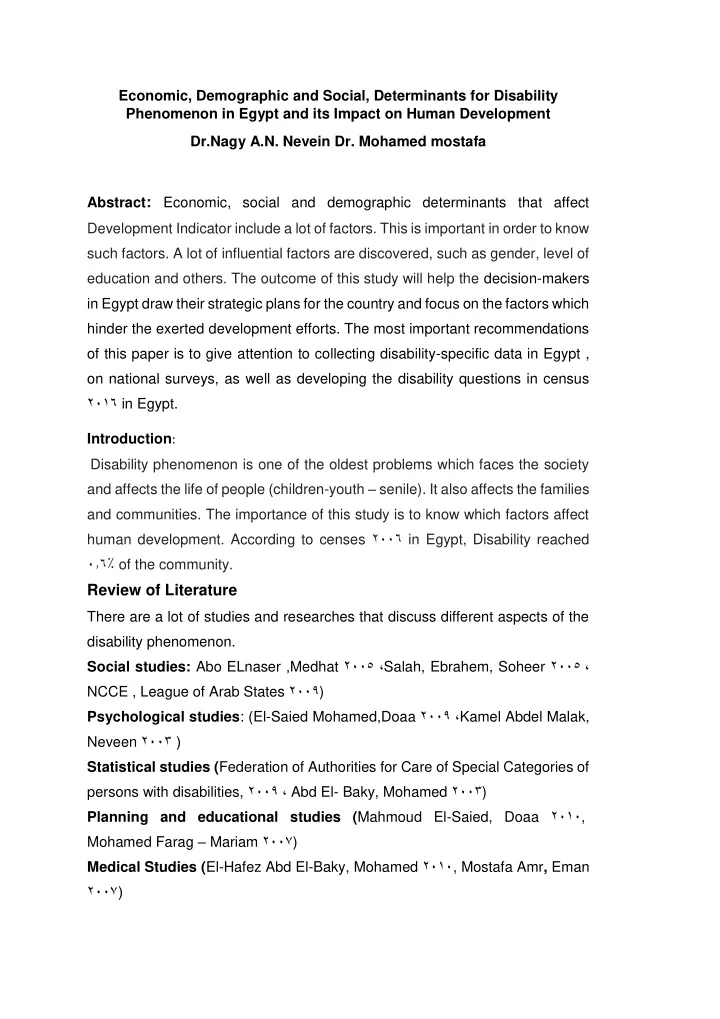
Economic, Demographic and Social, Determinants for Disability Phenomenon in Egypt and its Impact on Human Development Dr.Nagy A.N. Nevein Dr. Mohamed mostafa Abstract : Economic, social and demographic determinants that affect Development


slide-1
SLIDE 1

Economic, Demographic and Social, Determinants for Disability Phenomenon in Egypt and its Impact on Human Development Dr.Nagy A.N. Nevein Dr. Mohamed mostafa Abstract: Economic, social and demographic determinants that affect Development Indicator include a lot of factors. This is important in order to know such factors. A lot of influential factors are discovered, such as gender, level of education and others. The outcome of this study will help the decision-makers in Egypt draw their strategic plans for the country and focus on the factors which hinder the exerted development efforts. The most important recommendations

  • f this paper is to give attention to collecting disability-specific data in Egypt ,
  • n national surveys, as well as developing the disability questions in census

2016 in Egypt. Introduction: Disability phenomenon is one of the oldest problems which faces the society and affects the life of people (children-youth – senile). It also affects the families and communities. The importance of this study is to know which factors affect human development. According to censes 2006 in Egypt, Disability reached 0.6% of the community.

Review of Literature

There are a lot of studies and researches that discuss different aspects of the disability phenomenon. Social studies: Abo ELnaser ,Medhat 2005 ،Salah, Ebrahem, Soheer 2005 ، NCCE , League of Arab States 2009) Psychological studies: (El-Saied Mohamed,Doaa 2009 ،Kamel Abdel Malak, Neveen 2003 ( Statistical studies (Federation of Authorities for Care of Special Categories of persons with disabilities, 2009 ، Abd El- Baky, Mohamed 2003) Planning and educational studies (Mahmoud El-Saied, Doaa 2010, Mohamed Farag – Mariam 2007) Medical Studies (El-Hafez Abd El-Baky, Mohamed 2010, Mostafa Amr, Eman 2007(

slide-2
SLIDE 2

Law Studies: (El-Zubair, Abd Alla 2010 ،Program of Action of the International Conference on Population and Development 1994) Although there are a lot of studies that discuss the disability issue in Egypt from different angles and disciplines, there are no studies that tackle the relation between disability and development and the impact of disability on human

  • development. Therefore, this study is interested in this point.

Study problem

The population age structure reflects the future labor force. Disability among children is the mirror that reflects the state and productivity of the labor force - not only this - child disability is imposed on one of the parents and affects them. This could lead to the loss of the productive capacity of the labor force on one hand, and on the other hand, the burden of dependency on their families. Furthermore, disability among youth is a development obstacle since youth are the active element in labor force which negatively affects economic growth and

  • development. Moreover, disability among the elderly is a real problem for

themselves, their families and the community as a whole. Disability in this category is due to ageing, acquired disability (e.g. accident, illnesses …) Keywords: Development indicator, strategy planning, disability Operational definition Disability: is an umbrella term covering impairments, activity limitation and participation restriction. Impairment is a problem in body function or structure. Activity limitation is a difficulty encountered by an individual in involvement in life situation. Development indicators: Usually a numerical measure of quality of life in a

  • country. Indicators are used to illustrate progress of a country in meeting a

range of economic, social, and environmental goals. Strategic planning: is an organization's process of defining its strategy, or direction, and making decisions on allocating its resources to pursue this

  • strategy. It may also extend to control mechanisms for guiding the

implementation of the strategy. Strategic planning became prominent in corporations during the 1960s and remains an important aspect of strategic

  • management. It is executed by strategic planners or strategists, who involve
slide-3
SLIDE 3

many parties and research sources in their analysis of the organization and its relationship to the environment in which it competes. Strategy has many definitions, but generally involves setting goals, determining actions to achieve the goals, and mobilizing resources to execute the actions. A strategy describes how the ends (goals) will be achieved by the means (resources). The senior leadership of an organization is generally tasked with determining strategy. Strategy can be planned (intended) or can be observed as a pattern of activity (emergent) as the organization adapts or to or competes with its environment. Strategy includes processes of formulation and implementation; strategic planning helps coordinate both. However, strategic planning is analytical in nature (i.e., it involves "finding the dots"); strategy formation itself involves synthesis (i.e., "connecting the dots") via strategic thinking. As such, strategic planning occurs around the strategy formation activity Paper Objective: is to determine the impact of economic, social and demographic factors on human development indicator in Egypt Paper Hypotheses: There is an impact of the disability phenomenon on human development indicator (Such as education, work, disability types and place of

residence)

Methodology and Data We used data of the social contract, 2005 (29375 case) of 6000 households,1000 of them from the poorest villages – used data census, 2006 sample 10% ( 47640 case) – used human development indicator 2008, Egypt. It is known that there is problem in the undeveloped countries in general and special disability data ( data collection – and the people ) Ordinal logistic regression and multinomial logistic regression analysis have been used to predict the future consequences of disability on human development. (Yi)=Exp(B 0i+∑BijXij)/{ 1+ ∑Exp( B0i+∑BijXij)} , where Y is the human development indicator. We will use spss techniques for data analysis.

Results:

slide-4
SLIDE 4

We find that the model of Multinomial logistic regression of censes data 2006 explains the development indicator by 78% and also classifies the disabled in a correct and good way by 81% as shown in table (2), while we find that the model

  • f Multinomial logistic regression of contract data 2005 explains the results

significantly by 83% as table (1) and also classifies the disabled in a correct way by 82%. We find that the model of Multinomial logistic regression of censes data 2006 had a lot of significant factors such as: (Disability Type–Age –Wealth Index – Education - Residence Place –urban – rural residence) as shown in table(3) at the Development indicator. We find that the model of Ordinal logistic regression of social contract data 2005 explains the result by 27% as shown in table (5) while the model of Ordinal logistic regression of censes data 2006 explains the result by 70% as shown in table (6). We find that the model of Ordinal logistic regression of censes data 2006 had shown a lot of significant factors such as: (Disability Type – Disability cause - Age- Gender – Wealth Index – Education - Residence Place - urban, rural residence ) as shown in table (6) at the Development indicator. Recommendations Giving attention to collecting disability-specific data ,

  • n national surveys,

and also Development of the disability questions in census 2016 in Egypt. Table ( 1)

slide-5
SLIDE 5

Goodness of Fit - Social contract 2005 Percent correct Nagelkerke R square Cox & snell R square

  • 2 loglikihood

0,82 0.834 0.737 378,190

Calculate by the researcher

Table (2) Goodness of Fit – censes 2006 Percent correct Nagelkerke R square Cox & snell R square

  • 2 loglikihood

0.81 .778 .660 26367.847

Calculate by the researcher

slide-6
SLIDE 6

Table (3) Multinomial logistic regression Census2006

2006 Census B Wald Sig Ex(B) B Wald Sig Ex(B)

Low Development Middle Development

Disability cause 0.003 0.000 0.986 1.003

  • 0.085

0.439 0.508 0.918 Congenital Circumstance related by birth

  • 0.04

0.051 0.822 0.961

  • 0.057

0.126 0.722 0.945 Epidemic / other diseases 0.297 3.842 0.05 1.346

  • 0.01

0.006 0.94 0.99 Physical abuse

  • 0.411

2.865 0.091 0.663

  • 0.06

0.083 0.773 0.942 Accidents and injuries

  • 0.221

2.042 0.153 0.802

  • 0.133

0.926 0.336 0.876 Elderly

  • 0.04

0.057 0.811 0.961

  • 0.128

0.749 0.387 0.88 Type of disability 0.385 18.495 0.000 1.47

  • 0.028

0.116 0.733 0.973 Blind / eyed- one eye أ Deaf / mute / deaf-mute 0.386 16.42 0.000 1.471 0.042 0.232 0.63 1.042 Mentally retarded 0.209 5.469 0.019 1.233 0.003 0.002 0.967 1.003 A lost arms and legs, or both 0.393 9.583 0.002 1.481 0.004 0.001 0.97 1.004 Total or partial paralysis - polio 0.412 27.794 0.000 1.51

  • 0.038

0.299 0.584 0.963 Age

  • 0.004

6.623 0.01 0.996

  • 0.001

0.498 0.48 0.999 Gender 0.011 0.044 0.834 1.011

  • 0.097

3.998 0.046 0.908 Male Wealth quintile 1.028 37.506 0.000 2.796 0.725 24.368 0.00 2.066 poorest middle 0.346 6.616 0.01 1.414 0.151 1.88 0.17 1.163 Residence Place

  • 26.908

0.994

  • 26.403

0.000 0.989 Urban Governorates Lower Egypt

  • 22.431

0.985 1.553 1152.671 0.000 4.724 Frontier Governorates

  • 27.077

.

  • 26.228

0.997 Educational Status

  • 0.35

2.92 0.087 0.705

  • 0.511

0.185 0.006 0.6 Below the age school No education

  • 0.365

3.992 0.046 0.694

  • 0.54

10.749 0.001 0.583 Some primary

  • 0.498

6.496 0.011 0.608

  • 0.757

18.683 0.000 0.469 Some secondary

  • 0.386

3.891 0.049 0.68

  • 0.292

2.742 0.098 0.747 secondary

  • 0.318

2.728 0.099 0.728

  • 0.373

4.642 0.031 0.688 More than secondary

  • 0.251

0.607 0.436 0.778

  • 0.271

0.889 0.346 0.763

Urban – rural residence

  • 0.278

22.187 0.000 0.757 0.562 112.523 0.000 1.754 Urban Employment Status (not working)

  • 0.099

1.98 0.159 0.906

  • 0.061

0.918 0.338 0.94 constant 1.535 30.727 0.000 2.081 72.64 0.000

Calculate by the researcher

slide-7
SLIDE 7

7 Table(4) Multinomial logistic regression Social contract 2005

Calculate by the researcher

Social contract 2005 B Wald Sig Exp(B) B Wald Sig Exp(B)

Low Development Middle Development

constant

  • 0.209

1

  • 26.553

0.993 Urban – rural residence 34.209 0.993 7.188E+1 4 30.367 0.99 1.543E+13 rural Gender 12.449 0.984 254943.46

  • 0.436

1.007 0.316 0.646 female residential Place

  • 35.043

0.994 11.452 0.997 94067.007 Urban Governorates Lower Egypt (urban)

  • 27.985

0.996 14.266 0.996 1569834.3 Lower Egypt (rural )

  • 61.675

0.001 0.98

  • 16.383

0.993 Upper Egypt (urban) 34.978 0.995 1.552E+1 5 30.411 0.995 1.611E+13 Wealth quintile 17.299 0.986 32582392 0.257 0.139 0.709 1.292 lowest second 0.004 0.998 1.004

  • 0.229

0.132 0.717 0.795 middle 0.344 0.035 0.851 1.41

  • 0.645

1.093 0.296 0.525 fourth 13.927 0.985 1117538.1

  • 0.235

0.144 0.704 0.791 age

  • 0.015

0.152 0.697 0.985 0.005 0.244 0.621 1.005 Employment Status

  • 16.803

. . 13.481 . . 715975.69 no working Type of disability 1.948 2.031 0.154 7.016

  • 0.015

0.002 0.969 0.985 Senses disability Rehabilitation of the disabled 13.761 0.984 946572.5

  • 0.186

0.055 0.814 0.83 fitted for Educational Status 0.067 0.001 0.972 1.069

  • 0.24

0.096 0.757 0.787 Educational Status Below the age school 1.07 0.273 0.601 2.916

  • 0.004

0.996 0.996 No education 0.352 0.027 0.87 1.422

  • 0.362

0.18 0.672 0.696 Some primary 14.759 0.992 2568881.6 0.432 0.105 0.746 1.541

slide-8
SLIDE 8

8 Table (5) Ordinal logistic regression social contract data 2005 Model

Estimate Wald Test

  • P. value

Odds Ratios Constant part: Low Development

  • 32.682

0.001 0.972

15-10*4.4

Middle Development 4.392 0.995 80.8 Wealth quintile lowest 0.004 0.992 1.004 middle 0.673 1.726 0.189 1.96 Age Age

  • 0.004

0.119 0.731 0.996 Education No education

  • 0.033

0.005 0.943 0.967 Less than secondary

  • 0.186

0.153 0.696 0.83 Place of residence

Urban Governorates

16.664 0.001 0.972 17261687

Lower Egypt (urban)

13.709 0.001 0.977 898965.56

Lower Egypt (rural )

38.203 0.002 0.96 1016*3.9

Upper Egypt (urban)

  • 24.571

0.002 0.967

11-10*2.1

Disability type Hearing disability 0.263 0.259 0.611 1.3008 Visual disability

  • 0.21

0.176 0.675 0.81 Mental disability 0.441 0.55 0.458 1.554 Urban – rural residence (rural)

  • 24.193

0.002 0.968

11-10*3.11

Gender female

0.211 0.239 0.625 1.234

Work (no working)

  • 10.443

0.001 0.98 2.915

Have Rehabilitation of the disabled

0.051 0.005 0.943 1.05 R2 Nagelkerke=.279

Calculate by the researcher

slide-9
SLIDE 9

9

Table (6 )

Ordinal logistic regression censes data 2006

Model Estimate Wald Test

  • P. value

Odds Ratios

Constant part: Low Development

  • 0.792

56.88 0.000 0.452

Middle Development

4.205 1490.348 0.000 67.02

Wealth quintile (poorest)

  • 0.438

32.605 0.000 0.645

middle

  • 0.164

6.369 0.012 0.848

Labor sector Below the age

  • 0.016

0.058 0.809 0.984

Government / public / business

  • 0.022

0.198 0.657 0.978

Special / cooperative

  • 0.026

0.435 0.509 0.974

Age Age

0.003 10.654 0.001 1.003

Disability cause Congenital

  • 0.062

0.78 0.377 0.939

Circumstance related by birth

  • 0.028

0.105 0.746 0.972

Epidemic / other diseases

  • 0.241

10.691 0.001 0.785

Physical abuse

0.137 1.408 0.235 1.146

Accidents and injuries

0.062 0.66 0.417 1.063

Elderly

  • 0.039

0.231 0.631 0.961

Education No education

  • 0.017

0.195 0.659 0.983

Less than secondary

0.09 3.245 0.072 1.094

Place of residence Urban Governorates

29.192 0.992 1012*4.7

Lower Egypt

2.246 5279.82 0.000 9.449

Type of disability Blind / eyed- one eye

  • 0.294

42.192 0.000 0.745

أ Deaf / mute / deaf-mute

  • 0.265

31.447 0.000 0.767

Mentally retarded

  • 0.138

9.69 0.002 0.871

A lost arms and legs, or both

  • 0.264

18.019 0.000 0.767

Total or partial paralysis - polio

  • 0.306

62.027 0.000 0.736 Urban – rural residence (urban) 0.411 222.822 0.000 1.508 Gender ( male)

  • 0.05

3.657 0.056 0.951 R2 Nagelkerke=.700

Calculate by the researcher

slide-10
SLIDE 10

10

Reference Abd Alla, El-Zubair( 2010) legal organization to run the special needs and protect them . Doaa ,Mahmoud El-Saied( 2010) multimedia computer program impact on handicaps developed cognitive processes in intellectual education school . (Doaa , Mohamed El-Saied( 2009) psychological strikes for both brothers of mentally handicapped masters, Cairo university Eman, Mustafa Omer Ahmed (2009) Quality of life among elderly client with arthritis in garintric homes ( Cairo Government )‚college of nursing ‚ master degree ‚ Cairo University‚ (Federation of Authorities for Care of Special Categories of persons with disabilities( 2009) disability problem size in Egypt ,exploratory study. Mariam Farag, Mohamed( 2007) a combination of manual textile raw materials to develop the consenting to learn (mentally handicapped) skills and expressions, masters, faculty

  • f specific education , Cairo university.

Mohamed, El hafiz Abdel Baky (2010) Disability in Work places ‚Faculty of medical ‚Cairo university. Mohamed Abd El- Baky (2003) the relation between special needs care and development field study Elfayoum, master, Cairo university. Medhat, Abo ELnaser (2005) mentally handicapped(Concept ,Kind, Care program ) the Arab Nile group . NCCE , League of Arab States (2009)Reproductive health and culture family – Aguide,LAC press. Neveen Malak ,Kamel Abdel( 2003 ( a comparative study to mentally handicapped Daron , master college of literature ,psychology department Ain shams university. Program of Action of the International Conference on Population and Development (1994) Soheer Salah, Ebrahem( 2005) disability media needs on T.V programs PHD. Faculty of media & Mass , radio section Cairo university . www.who.int/topics/disability/en/disability http://www.greenfacts.org/glossary/def/development-indicators.htm https://en.wikipedia.org/wiki/Strategic_planning