Social Determinants of Health Kimberly Calero, Alexandra Diaz, Cary - - PowerPoint PPT Presentation

social determinants of health
SMART_READER_LITE
LIVE PREVIEW

Social Determinants of Health Kimberly Calero, Alexandra Diaz, Cary - - PowerPoint PPT Presentation

Social Determinants of Health Kimberly Calero, Alexandra Diaz, Cary Shindell Project Lead: Dr. Alexandra Cooper Project Managers: Liann Tucker & Joseph Quinn Introduction Goal According to the CDC, social determinants of health (SDOH) are


slide-1
SLIDE 1

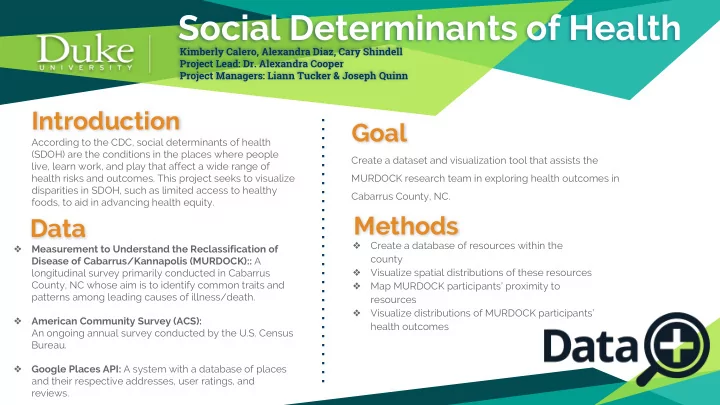
Social Determinants of Health

Kimberly Calero, Alexandra Diaz, Cary Shindell Project Lead: Dr. Alexandra Cooper Project Managers: Liann Tucker & Joseph Quinn

Introduction

According to the CDC, social determinants of health (SDOH) are the conditions in the places where people live, learn work, and play that affect a wide range of health risks and outcomes. This project seeks to visualize disparities in SDOH, such as limited access to healthy foods, to aid in advancing health equity.

Goal

Create a dataset and visualization tool that assists the MURDOCK research team in exploring health outcomes in Cabarrus County, NC.

Data

❖ Measurement to Understand the Reclassification of Disease of Cabarrus/Kannapolis (MURDOCK):: A longitudinal survey primarily conducted in Cabarrus County, NC whose aim is to identify common traits and patterns among leading causes of illness/death. ❖ American Community Survey (ACS): An ongoing annual survey conducted by the U.S. Census Bureau. ❖ Google Places API: A system with a database of places and their respective addresses, user ratings, and reviews.

Methods

❖ Create a database of resources within the county ❖ Visualize spatial distributions of these resources ❖ Map MURDOCK participants’ proximity to resources ❖ Visualize distributions of MURDOCK participants’ health outcomes

slide-2
SLIDE 2

Using data from the ACS and the database compiled in Phase I, we created an interactive mapping application using R Leaflet and Shiny packages that provide a visual distribution of resources within Cabarrus county. Users can toggle which underlying demographic from the ACS and resource from the database they want to view.

Phase I: Database Creation Phase II: Resource Distribution

Social Determinants of Health

Figure 1: An image of the tool, currently showing the distribution of total population in the county by census tract, overlaid by grocery store locations. A database of the resources within Cabarrus County was compiled using Yelp and Google Places’ API. There were 17 categories for the resources compiled, ranging from grocery stores and schools, to Starbucks locations and vape stores. Each entry was then flagged using a binary system based on which categories the entry belonged to. This was done to facilitate efficient subsetting of the data. Table 1: An example of how the database is organized and the information it contains.

id name rating rev. count lat / lon. add. sourc e cat. 1 cat. 2 cat. 3 12 ABC 4.2 97 x,y add. 1 Yelp 1 34 XYZ 3.1 6 x,y add. 2 Googl e 1

slide-3
SLIDE 3

Voronoi mapping was used to determine which resource was closest to each address. Each polygon represents a resource’s region of influence. The dots represents the location of the resource

  • itself. The polygons, voronoi cells, indicate the resource the

addressee is most likely going to use.

Phase III: Determine Proximity

Figure 2: A voronoi diagram

  • f grocery stores,

clipped to the shape of Cabarrus county. Using Google’s API, the driving/walking time and distance from an addressee to their closest resource was determined. Table 1: A database

  • f addresses and

their respective distances to two types of resources.

ADD ID MI TO R1 MIN TO R1 MI TO R2 TIME TO R2 43428 4.3 15 2.4 7 42349 3.7 10 1.8 5

Next Steps:

1. Determine MURDOCK participants’ proximity to all of the resources compiled in Phase I. 2. Map the distribution of health outcomes in Cabarrus county, such as prevalence of diabetes, heart disease, and depression.

Social Determinants of Health

Acknowledgments:

Our team would like to thank our Project Managers, Joe Quinn and Liann Tucker for working closely with us throughout the

  • summer. We would also like to thank our Project Lead, Dr.

Alexandra Cooper, for her ongoing support. A special thank you to Paul Bendich for giving our team the idea to use Voronoi Mapping as part of Phase III of this project and for his continued support to the Data+ program. Thank you to the MURDOCK team for your collaboration and guidance.