2D Rotation lecture 2 - model transformations (rotations, - - PowerPoint PPT Presentation

2d rotation lecture 2 model transformations rotations
SMART_READER_LITE
LIVE PREVIEW

2D Rotation lecture 2 - model transformations (rotations, - - PowerPoint PPT Presentation

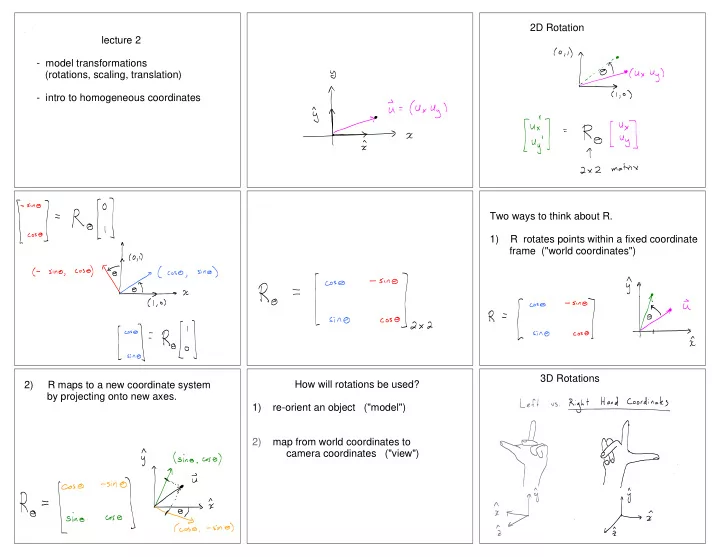
2D Rotation lecture 2 - model transformations (rotations, scaling, translation) - intro to homogeneous coordinates Two ways to think about R. 1) R rotates points within a fixed coordinate frame ("world coordinates") 3D

slide-1
SLIDE 1

lecture 2

  • model transformations

(rotations, scaling, translation)

  • intro to homogeneous coordinates

2D Rotation Two ways to think about R. 1) R rotates points within a fixed coordinate frame ("world coordinates") 2) R maps to a new coordinate system by projecting onto new axes. How will rotations be used? 1) re-orient an object ("model") 2) map from world coordinates to camera coordinates ("view") 3D Rotations

slide-2
SLIDE 2

counter-clockwise (assuming eye is looking in the -z direction and the coordinates are righthanded) Example: rotate about z axis

slide-3
SLIDE 3

Problem Example 4 Find a rotation matrix that rotates by around an axis and that is composed of a sequence

  • f rotations only around axes

Example solution: (think this through for yourself )

  • 1. Rotate around x axis to bring p to the xy plane.
  • 2. Rotate around z axis to bring p to the y axis.
  • 3. Rotate by

around y axis.

  • 4. Apply inverse rotation of 2.
  • 5. Apply inverse rotation of 1.

ASIDE: Representations of rotations

(very important for Computer Animation)

1) Axis-Angle -> OpenGL's glRotate() 2) Euler angles (Rz Rx Ry) 3) Quaternions

https://www.youtube.com/watch?v=syQnn_xuB8U&list=PL2y2aRaUaygU2zXme_Z11GyJUslwgaeUD https://www.youtube.com/watch?v=zc8b2Jo7mno

slide-4
SLIDE 4

This is called a "homogeneous coordinates" representation. Trick: use a 4th coordinate. In computer graphics, we always use a 4D representation to transform points. rotation scaling

Homogeneous Coordinates We represent (x,y, z) by (x, y, z, 1). Now define an equivalence: (x, y, z, 1 ) (w x, wy, wz, w) for any w 0. This takes each line { (wx, wy, wz, w) } in R^4 and associates it with the 3D point (x, y, z).

Careful:

The above is an abuse of notation. It is meant to express that:

slide-5
SLIDE 5