Ro Rotation Im Impact on on W. W.Wheat Ro Rotation Im Impact on on - - PowerPoint PPT Presentation

ro rotation im impact on on w w wheat ro rotation im
SMART_READER_LITE
LIVE PREVIEW

Ro Rotation Im Impact on on W. W.Wheat Ro Rotation Im Impact on on - - PowerPoint PPT Presentation

6/12/2018 Ro Rotation Im Impact on on W. W.Wheat Ro Rotation Im Impact on on W. W.Wheat Dak Dakota Lak Lakes Re Research Fa Farm Yields in Yi in 2002 2002 Rotation Yield Precip* Corn Pea WW 2006 60 7.9 Rotation WW Yield SB


slide-1
SLIDE 1

6/12/2018 1

Ro Rotation Im Impact on

  • n W.

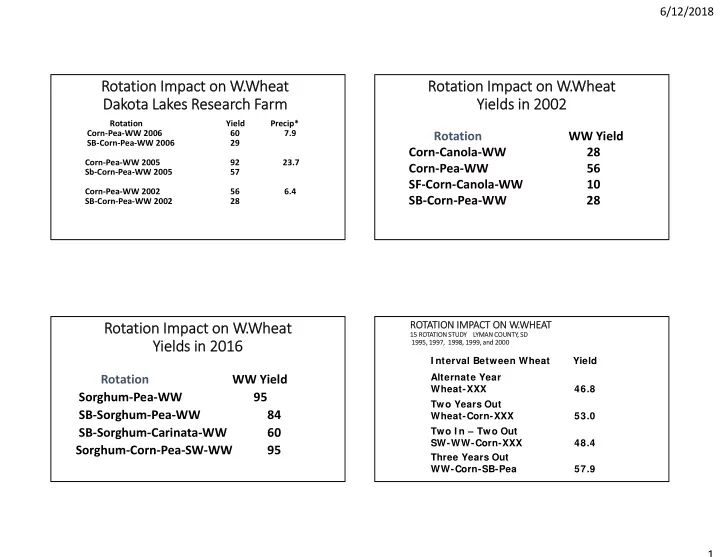
W.Wheat Dak Dakota Lak Lakes Re Research Fa Farm

Rotation Yield Precip* Corn‐Pea‐WW 2006 60 7.9 SB‐Corn‐Pea‐WW 2006 29 Corn‐Pea‐WW 2005 92 23.7 Sb‐Corn‐Pea‐WW 2005 57 Corn‐Pea‐WW 2002 56 6.4 SB‐Corn‐Pea‐WW 2002 28

Ro Rotation Im Impact on

  • n W.

W.Wheat Yi Yields in in 2002 2002

Rotation WW Yield Corn‐Canola‐WW 28 Corn‐Pea‐WW 56 SF‐Corn‐Canola‐WW 10 SB‐Corn‐Pea‐WW 28

Ro Rotation Im Impact on

  • n W.

W.Wheat Yi Yields in in 2016 2016

Rotation WW Yield Sorghum‐Pea‐WW 95 SB‐Sorghum‐Pea‐WW 84 SB‐Sorghum‐Carinata‐WW 60 Sorghum‐Corn‐Pea‐SW‐WW 95

RO ROTATI TION IM IMPACT ON ON W. W.WHEAT

15 15 RO ROTATIO TION ST STUDY LY LYMAN COU COUNTY TY, SD SD 1995, 95, 1997 1997, 1998, 998, 1999, 99, and and 2000 2000

I nterval Between Wheat Yield Alternate Year Wheat-XXX 46.8 Two Years Out Wheat-Corn-XXX 53.0 Two I n – Two Out SW-WW-Corn-XXX 48.4 Three Years Out WW-Corn-SB-Pea 57.9

slide-2
SLIDE 2

6/12/2018 2

W. W.Wheat Cost/Unit of

  • f Produc
  • duction

tion 199 1994‐19 1995 95 & 199 1997‐199 1999 Ly Lyman Coun County ty Rotation Cost in $/bu. WW‐Fallow $4.60 WW‐Corn‐Fallow $3.79 WW‐Corn‐Pea $2.45 SW‐WW‐Corn‐SB $2.64

Rotation Impact on Spring Wheat WCS 2002

  • Rotation

SW Yield

  • Wheat-Canola

15.4

  • Wheat-Fallow

20.7

  • Wheat-Corn-Fallow

23.7

  • Wheat-Corn-Pea

25.8

  • Wheat-Corn-Soybean

8.9

Com Commonality

  • nality Among

Among Ti Tillag llage To Tools

  • All Tillage Tools Destroy Soil Structure.
  • All tillage tools decrease water infiltration
  • All tillage tools reduce organic matter
  • All tillage tools increase weeds.

27,0 27,000 gallo allons of

  • f wa

water pr provid ides es 1 in inch of

  • f wa

water on

  • n 1 acr

acre. Ther There ar are 1,800,000 1,800,000 lb lbs of soil soil in in 1 acr acre 6 in inches deep deep. If If 1% 1% OM OM ther there is is 18,0 18,000 lb lbs. s. If If 4% 4% OM OM ther there is is 72,0 72,000 lb lbs. s.

slide-3
SLIDE 3

6/12/2018 3

OM OM hold holds 5 to to 10 10 tim times its its we weight ht in in wa water In In top top 6 in inches tot total wa water held held on

  • n

the the OM OM alo alone wi with th 1% 1% OM OM is is 0.39 0.39 to to 0.78 0.78 in inches 4% 4% OM OM is is 1.5 1.5 to to 3.1 3.1 inc inches OM OM hold holds 5 to to 10 10 tim times its its we weight ht in in wa water In In top top 12 12 in inches tot total wa water held held

  • n
  • n the

the OM OM alo alone wi with th 1% 1% OM OM is is 0.78 0.78 to to 1.56 1.56 in inches 4% 4% OM OM is is 3.0 3.0 to to 6.2 6.2 inc inches

“Within all textural groups, as

  • rganic matter increased from 1 to

3%, the available water capacity approximately doubled. When

  • rganic matter content increased to

4%, it then accounted for more than 60% of total AWC“.8 When soil water storage capacity is low, much of the rain that falls during extended periods of precipitation is

  • lost. In contrast, a high water storage

capacity, combined with the effective capture of rain and snowmelt over the fall, winter and spring can support a crop through an extended dry period.

slide-4
SLIDE 4

6/12/2018 4 2013 2013 Yi Yield Da Data Dak Dakota Lak Lakes Re Research Fa Farm

  • C – SB rotation (Cover Crops historically

increases soybean yield 7.3 bu/a on average vs no CC in this rotation).

  • Yield 2013: Soybean with WW CC 62.9

bu/a. We would have expected around 55.6 bu/a without CC.

2013 2013 Yi Yield Da Data Dak Dakota Lak Lakes Re Research Fa Farm

  • C – C – SB – Wheat ‐ SB rotation
  • 1st year SB yield ‐ NO cover crop = 76.3

bu/ac

  • 2nd SB yield – Cover Crop = 81.2 bu/ac

2013 2013 Yi Yield Da Data Dak Dakota Lak Lakes Re Research Fa Farm

  • Cover crop increased SB yield (7.3 bu/ac),

but more importantly crop diversity increased SB yield by 15.9 bu/ac. C – SB rotation = 62.9 C – C – SB – Wheat – SB = 78.8 bu/ac

  • CONTINUOUS CORN
  • 203 bu/a
  • CORN‐SOYBEAN
  • 217 bu/a
  • C‐C‐SB‐W‐SB
  • 235 Corn

DI DIVER VERSITY ITY IM IMPACT IF IF 5,000 5,000 ACRE ACRES

slide-5
SLIDE 5

6/12/2018 5

  • CONTINUOUS CORN
  • 1,015,000 corn, 0 soybean, 0 wheat
  • CORN‐SOYBEAN
  • 542,500 Corn, 157,250, 0 Wheat
  • C‐C‐SB‐W‐SB
  • 470,000 Corn, 157 ,600, 120,000 Wheat

DI DIVER VERSITY ITY IM IMPACT IF IF 5,000 5,000 ACRE ACRES

Pio 33P67 C‐SB 2005.

Nitrogen Starter Pop-up Yield Moisture 28% TOP Surface Yes 194 23.2 Urea Side Yes Yes 207 21.7 Urea Side Yes Surface 202 23.3 Urea Side Surface Yes 197 23.6

Pio 33P67 W/cc 2005.

Nitrogen Starter Pop-up Yield Moisture Urea Side Surface Yes 207 23.7 Urea Side Yes Yes 212 24.4 Urea Side Yes Surface 215 23.1 28% TOP Surface Yes 200 23.7

Pioneer 33W44 Diverse Pinto 2005

Nitrogen Starter Pop-up Yield Moisture 28% Surface Yes Yes 220 18.5 28% Surface Surface Yes 223 19.3 Urea Side Yes Yes 223 18.6

slide-6
SLIDE 6

6/12/2018 6

Starter Response by Corn in Different Tillage Systems in Indiana

Number of Average Type of responses response tillage

  • ut of 11

(all sites) bu/A Conv. 1 0.9 No‐till 8 7.8

Pio 0448 AM1 Corn II Diverse 2013 Olsen P less than 5 ppm

Nitrogen Starter P Pop-up Yield 60 N side Yes Yes 217 60 N side Yes No 214 60 N Over row Over row Yes 198 60 N Middle Middle Yes 197

Mycogen 2T498 Corn II Diverse 2013 Olsen P less than 5 ppm

Nitrogen Starter P Pop-up Yield 60 N side Yes Yes 206 60 N side None Yes 212 60 N side Yes None 206 60 N side None None 204

Fertility Management

  • Some starter P with the seed.
  • Other nutrients placed near row at

seeding or on soil surface after crop canopy.

  • broadcast fertilizer before or at

seeding encourages weeds.

  • Three key factors

–1 Available Nutrient –2 Moisture –3 Roots