
SLIDE 1
Office of the Chief Economist
Robert Johansson Chief Economist, USDA Feb 2019
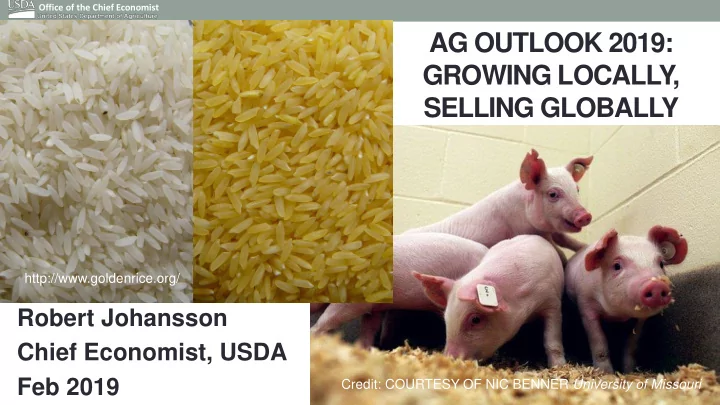
AG OUTLOOK 2019: GROWING LOCALLY, SELLING GLOBALLY
http://www.goldenrice.org/ Credit: COURTESY OF NIC BENNER University of Missouri
AG OUTLOOK 2019: GROWING LOCALLY, SELLING GLOBALLY - - PowerPoint PPT Presentation
Office of the Chief Economist AG OUTLOOK 2019: GROWING LOCALLY, SELLING GLOBALLY http://www.goldenrice.org/ Robert Johansson Chief Economist, USDA Feb 2019 Credit: COURTESY OF NIC BENNER University of Missouri Office of the Chief Economist
Office of the Chief Economist
http://www.goldenrice.org/ Credit: COURTESY OF NIC BENNER University of Missouri
Office of the Chief Economist Office of the Chief Economist
https://www.cnbc.com/2018/06/07/
https://finance.yahoo.com/chart
2
Office of the Chief Economist Office of the Chief Economist
3.00 3.50 4.00 4.50 5.00 5.50 2015 2016 2017 2018 2019 2020 2021 2022
April 2018 forecast October 2018 forecast January 2019 interim forecast
Percent change
Growth forecasts less optimistic --- global purchasing power falls by $0.7 trillion (cumulative from 2019 – 2022)
World GDP
3
Data: IMF 3.00 3.50 4.00 4.50 5.00 5.50 2015 2016 2017 2018 2019 2020 2021 2022
April 2018 forecast October 2018 forecast January 2019 interim forecast
Percent change
Emerging Markets and Developing Countries
Office of the Chief Economist Office of the Chief Economist
4
Dollar up year-over-year, but mixed over the last few months
Data: Thomson Reuters Datastream 1% 4% 5% 6% 7% 7% 10% 14% 17% 18%
0% 5% 10% 15% 20%
Japan yen Mexico peso Korea won Taiwan dollar China yuan Canadian dollar Euroland euro Australia dollar Russia ruble Brazil real Argentina peso
US$ appreciation over last 12 months
95%
Last 6 months
36%
4% 3% 2% 1%
0%
2%
Office of the Chief Economist Office of the Chief Economist
Real farm income settles; equity shows slight decline
$- $500 $1,000 $1,500 $2,000 $2,500 $3,000 $- $20 $40 $60 $80 $100 $120 $140 $160 1960 1962 1964 1966 1968 1970 1972 1974 1976 1978 1980 1982 1984 1986 1988 1990 1992 1994 1996 1998 2000 2002 2004 2006 2008 2010 2012 2014 2016 2018F Net farm income Equity Billion dollars ($2018) Billion dollars ($2018)
Data: USDA-ERS
5
Office of the Chief Economist Office of the Chief Economist
50 100 150 200 250 300 350 400 450 50 100 150 200 250 300 350 400 450 1960 1962 1964 1966 1968 1970 1972 1974 1976 1978 1980 1982 1984 1986 1988 1990 1992 1994 1996 1998 2000 2002 2004 2006 2008 2010 2012 2014 2016 2018F
Borrowing against real estate equity fuels debt growth
Data: USDA-ERS
Total debt Real estate debt Non-real estate debt Billion dollars (2018$) Billion dollars (2018$)
6
Office of the Chief Economist Office of the Chief Economist
Debt-to-assets remain low --- 13.5% but debt financing highest since 1988
Data: USDA-ERS
0% 10% 20% 30% 40% 50% 60% 70% 0% 10% 20% 30% 40% 50% 60% 70% Debt financing Debt-to-Asset ratio
25% 13.5%
7
Office of the Chief Economist Office of the Chief Economist
AL AR AZ CA CO CT DE FL GA IA ID IL IN KS KY LA MD ME MI MN MO MS MT NC ND NE NH NJ NM NV NY OH OK OR PA RI SC SD TN TX UT VA VT WA WI WV WY 1 2 3 4 5 6 7 8 1 2 3 4 5 6 7 8 Number of bankruptcies in 2018 per 10,000 farms 10-year average of bankruptcies per 10,000 farms
8
Nationally, 2.35 bankruptcies per 10,000 farms 10 x’s lower than peak in 1987
Data: USDA-ERS, U.S. Courts
Office of the Chief Economist Office of the Chief Economist
How optimistic are you about economic prospects over the next 6 months?
Data: USDA, UofMich, Purdue, Fed Reserve, NAHB, Creighton.
60 70 80 90 100 110 120 60 70 80 90 100 110 120 Feb 2018 = 100 Feb 2018 = 100 Purdue Creighton Corn price NAHB Michigan
9
Office of the Chief Economist Office of the Chief Economist
https://www.agweek.com/business/agriculture/4512383-moisture-snow-has-really-hampered-harvest
10
Office of the Chief Economist Office of the Chief Economist
Real prices trend down, as crop production outstrips demand
100 200 300 400 500 600 700 800 1960 1970 1980 1990 2000 2010 2020
Real Crop Prices
Corn Soybeans Rice Wheat
30 60 90 120 150 180 210 240 1960 1970 1980 1990 2000 2010 2020
World Crop Production
Corn Soybeans Rice Wheat
Data: USDA, BLS 2005=100 2005=100
Corn price down 59% since 1960, soybeans by 52%, rice by 70%, and wheat by 65%. Corn output has risen 435% since 1960, soybeans by 1,190%, rice by 225%, and wheat by 215%.
11
Office of the Chief Economist Office of the Chief Economist
Global stocks in days of use: tightening market for corn and soybeans
12
40 60 80 100 120 140 1990 1993 1996 1999 2002 2005 2008 2011 2014 2017 2020 2023 2026 Days of use Wheat Corn Rice Soybeans
Data: USDA
Office of the Chief Economist Office of the Chief Economist
13
U.S. soybeans prices fall under trade dispute
270 290 310 330 350 370 390 410 430 450
China retaliates against U.S. soybeans U.S. & China 90 day truce, China pledges U.S. soybean purchases
Data: IGC, FOB prices
$/MT
Office of the Chief Economist Office of the Chief Economist
14
1.2 0.4 0.3 3.4 1.9 1.1
Year over Year Change (mmts)
Alternative markets for U.S. soybeans up, but not enough to recover exports to China
U.S. exports for 2018/19 are 13.5 mmts behind last year
Data: USDA *Marketing Year to Date (Sept to Feb)
14
Office of the Chief Economist Office of the Chief Economist
Stocks overhang will take years to unwind
Data: USDA
0% 5% 10% 15% 20% 25% 5 10 15 20 25 2007/08 2008/09 2009/10 2010/11 2011/12 2012/13 2013/14 2014/15 2015/16 2016/17 2017/18 2018/19 2019/20 2020/21 2021/22 2022/23 2023/24 2024/25 2025/26 2026/27 2027/28 2028/29 U.S. Soybean Ending Stocks with USDA Baseline 10 year Projections
Soybean stocks Stocks-to-Use Tariffs imposed July 2018
Million MTs Stocks-to-use (%)
15
Office of the Chief Economist Office of the Chief Economist
16
Crop 2019F %∆ (YoY) Soybeans ($/bu) 8.80 +2.3% Corn ($/bu) 3.65 +1.4% All Rice ($/cwt) 12.20 +0.8% Wheat ($/bu) 5.20 +1.0% Cotton ($/lb) 0.67
Data: USDA
5 year low 2019F 5 Year high
Some prices expected to edge up into 2019
Office of the Chief Economist Office of the Chief Economist
17
Crop 2019F (mil. acres) %∆ (YoY) Corn 92.0 +3.3% Soybeans 85.0
Wheat 47.0
All cotton 14.3 +1.1% Rice 2.7
Data: USDA
Corn and bean area at parity, wheat holding
5 year low 2019F 5 Year high
Office of the Chief Economist Office of the Chief Economist
Photograph: Rachel Doyle
18
Office of the Chief Economist Office of the Chief Economist
Real prices trend down, as U.S. livestock production outstrips demand
50 100 150 200 250 300 350 400 1960 1970 1980 1990 2000 2010 2020 Real U.S Livestock, Poultry, and Milk Prices Steers Chicken Milk Hogs 30 60 90 120 150 1960 1970 1980 1990 2000 2010 2020 U.S. Meat and Milk Production Beef Chicken Pork Milk Data: USDA, BLS 2005=100 2005=100
Steer price down 44% since 1960, hogs by 68%, milk by 52%, and chicken by 56% (from 1964). Beef output has risen 87% since 1960, pork by 143%, milk by 77%, and chicken by 1,050%.
19
Office of the Chief Economist Office of the Chief Economist
Source: USDA-APHIS Data: CME.
20
40 45 50 55 60 65 70 75
U.S. Hog Futures
Aug 2018, China confirms first
Cents/lb
China 301 retaliation & Mexico 232 retaliation China 232 retaliation
Office of the Chief Economist Office of the Chief Economist
Livestock 2019F %∆ (YoY) Steers ($/cwt) 118.50 +1.2% Hogs ($/cwt) 42.50
Broilers ($/cwt) 97.00
Milk ($/cwt) 17.25 +6.5% 5 year low 2019F 5 Year high
Data: USDA
Low prices for steers and hogs in 2019
21
Office of the Chief Economist Office of the Chief Economist
Item 2019F (billion lbs) %∆ (YoY) Beef 27.6 +2.7% Pork 27.3 +3.8% Broilers 43.1 +1.4% Total1 104.7 +2.3% Milk 220.1 +1.1%
Data: USDA
5 year low 2019F 5 Year high
22
1Total red meat and poultry
Office of the Chief Economist Office of the Chief Economist
23
Office of the Chief Economist Office of the Chief Economist
Agricultural export values expected to remain flat in 2019, China share down sharply
Data: USDA
0% 2% 4% 6% 8% 10% 12% 14% 16% 18% 20%
40 60 80 100 120 140 160 Canada Mexico China Other % of China Share Billion dollars
24
Office of the Chief Economist Office of the Chief Economist
Global demand drives growth in U.S. livestock and dairy exports
Data: USDA
2 4 6 8 10 2000 2002 2004 2006 2008 2010 2012 2014 2016 2018 2020 2022 2024 2026 2028 Billons of pounds Beef Pork Chicken 10 20 30 40 50 60 2000 2002 2004 2006 2008 2010 2012 2014 2016 2018 2020 2022 2024 2026 2028 Billions of pounds Dairy, Fat-Basis Dairy, Skim Solids-Basis
25
Office of the Chief Economist Office of the Chief Economist
Data: USDA
… and drives growth in U.S. feed grain exports
Million metric tons Million metric tons
26
20 30 40 50 60 70 80
20 30 40 50 60 70 80
1996/97 1997/98 1998/99 1999/00 2000/01 2001/02 2002/03 2003/04 2004/05 2005/06 2006/07 2007/08 2008/09 2009/10 2010/11 2011/12 2012/13 2013/14 2014/15 2015/16 2016/17 2017/18 2018/19 2019/20 2020/21 2021/22 2022/23 2023/24 2024/25 2025/26 2026/27 2027/28 2028/29
Corn Wheat Soybeans
Office of the Chief Economist Office of the Chief Economist
New FTAs may impact U.S. access into top export markets
Canada $21 b Mexico $19 b EU $11 b Japan $12 b China $20 b ROW $55 b
Canada $34 b Mexico $27 b EU $130 b Japan $52 b China $118 b ROW $342 b
Top 5 U.S. Export Markets FTAs (excl. U.S.) Canada-EU (CETA) EU-Mexico EU-Japan CPTPP (TPP-11) Australia-China New Zealand-China U.S.-FTAs with Top 5 Export Markets NAFTA (in effect) USMCA (signed) Proposed: U.S.-Japan, U.S.-EU, U.S.-UK Global ag imports (2017) $703 billion (excl. U.S.)
Data: Global Trade Atlas
Total U.S. ag exports (2017) $138 billion
27
Office of the Chief Economist Office of the Chief Economist
USMCA strengthens North American market integration
NEXT STEPS
legislation package to Congress
Committees, the House and Senate vote on the bill
implemented by proclamation
Data: USDA-FAS
84% 96% 65% 82% 87% 83% 77% 99% 91% 91% 68%
0% 20% 40% 60% 80% 100% 120%
$0.0 $0.5 $1.0 $1.5 $2.0 $2.5 $3.0
United States Rest of World U.S. share of Mexico’s Ag Imports, 2017
$ bil.
28
Office of the Chief Economist Office of the Chief Economist
29
Office of the Chief Economist Office of the Chief Economist
2018 Farm Bill outlay = $428 billion over 5 years
Nutrition $326.0 b Crop Insurance $38.0 b Commodity Programs (CCC) $31.4 b Conservation $29.3 b Other $3.5 b
year over the 2014 Farm Bill for FY2019 - FY2023
remains at 76% but with more funding for employment training
funding of $365 mil. over 5 years
Data: CBO
30
Office of the Chief Economist Office of the Chief Economist
5 10 15 20 25 30 35 40 45
1985 1987 1989 1991 1993 1995 1997 1999 2001 2003 2005 2007 2009 2011 2013 2015 2017 2019f
Billion dollars
Coupled Partially decoupled Decoupled Emergency Conservation Crop insurance
Data: USDA, fiscal year.
Characteristics of US farm programs changing over time; crop insurance increasing in importance
MFP
10-year average = $18.7 billion per year
31
WHIP
Office of the Chief Economist Office of the Chief Economist
ARC/PLC payments per base acre expected to change under 2018 Farm Bill
*Uses 80% of generic base acres enrolled in 2015. Official estimates of seed cotton base acres are not yet available.
Data: CBO
Farm 2014 Bill: June 2017 Baseline 2018 Farm Bill: January 2019 Baseline Corn $98.85 $106.93 Soybeans $34.16 $42.67 Wheat $75.10 $60.90 Seed Cotton* Not Applicable $172.59 Rice $440.78 $738.21 Peanuts $881.21 $713.11
covered commodity under the Bipartisan Budget Act of 2018 (BBA)
made to Agriculture Risk Coverage (ARC) and Price Loss Coverage (PLC) in the 2018 Farm Bill.
32
Office of the Chief Economist Office of the Chief Economist
Dairy operations are decreasing in number, as herd sizes grow
8.8 8.9 9.0 9.1 9.2 9.3 9.4 9.5 10,000 20,000 30,000 40,000 50,000 60,000 70,000 80,000 Dairy Cattle (millions) Licensed Operations Licensed Operations (Left axis) Total Inventory (Right axis)
Data: USDA-NASS 275 570 900 500 1000 2002 2007 2012 Number of cattle
Median dairy herd size
33
Office of the Chief Economist Office of the Chief Economist
Net benefits for a median-sized dairy (900 cows ≈ 19.5M pounds)
Data: USDA
34
5-year average MPP (2014 Farm Bill) 5-year average DMC (2018 Farm Bill) Premium for $8.00/cwt margin $230,184 $268,396 Premium for $9.50/cwt margin NA $7,500 (for first 5M lbs only) Average annual net payment
NA
$40,421
Note: Applies MPP and DMC provisions to 2014-2018 data.
Office of the Chief Economist Office of the Chief Economist
3rd 5th 1st 1st 33% 7% 34% 16% 20% 11% 0% 20% 40% 60% 80% 100% Corn Wheat Soybeans Cotton Beef Pork
U.S. Global Share of Production
United States ROW
Conclusion ---- Growing Locally and Selling Globally
Data: USDA
1st ($9B) 1st ($6B) 2nd ($22B) 2nd ($6B) 2nd ($6B) 1st ($7B) 1st 3rd 37% 15% 33% 35% 14% 32% 0% 20% 40% 60% 80% 100% Corn Wheat Soybeans Cotton Beef Pork
U.S. Global Share of Exports
United States ROW
35
Office of the Chief Economist Office of the Chief Economist
Growing economies, growing supplies, and falling real food prices improve food security
2018 = 21.1% food insecure 2028 = 10.4% food insecure
Source: USDA-ERS.
36