2D Pattern and 3D Contour Damien Rohmer, Marie-Paule Cani, Stefanie - - PowerPoint PPT Presentation

2d pattern and 3d contour
SMART_READER_LITE
LIVE PREVIEW

2D Pattern and 3D Contour Damien Rohmer, Marie-Paule Cani, Stefanie - - PowerPoint PPT Presentation

Folded Paper Geometry from 2D Pattern and 3D Contour Damien Rohmer, Marie-Paule Cani, Stefanie Hahmann, Boris Thibert Grenoble & Lyon University, INRIA, France Folded Papers are rare in video-games & CG Movies Few available modeling


slide-1
SLIDE 1

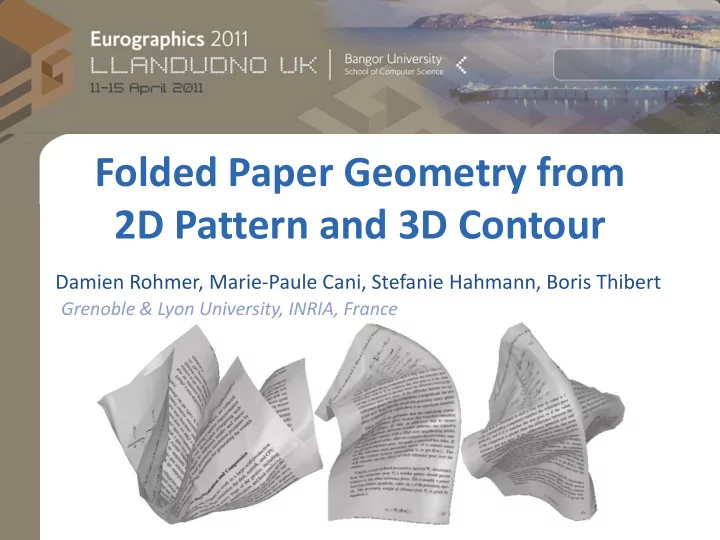
Folded Paper Geometry from 2D Pattern and 3D Contour

Grenoble & Lyon University, INRIA, France

Damien Rohmer, Marie-Paule Cani, Stefanie Hahmann, Boris Thibert
slide-2
SLIDE 2

Folded Papers are rare in video-games & CG Movies

  • Few available modeling tools!

– Non smooth – Isometry preserving

Real pictures

  • Goal:

2D pattern 3D boundary

+

slide-3
SLIDE 3

Related Work

  • Physically based modeling

Cloth simulators Thin plates from folds Specific spring-mass system [Choi, Ko; TOG 02] [English, Bridson; TOG 08] [Thomaszewski et al.; CGF 09]

Slow, Smooth surface

[Burgoon et al.; C&A 06]

Folds are user defined

[Kang et al.; CASA 09]

Folds along existing edges

slide-4
SLIDE 4

Related Work

  • Geometric approaches

Developable construction Mesh deformation Procedural generation [Frey; CAD 04] [Rose et al.; SGP 07]

Restricted to the convex hull

[Tang, Chen; TVCG 09] [Popa et al.; CGF 09]

Slow, smooth surface

[Decaudin et al.; CGF 06]

Limited range of deformation

slide-5
SLIDE 5

Our Key Idea

  • New subdivision improving length preservation
  • Automatic generation of folding curves

Folding curves

3D Pattern

Preserved isometry Input

slide-6
SLIDE 6

Overview

  • Divide & Conquer approach

– Localize one fold – Compute optimal 3D profile – Divide

Input = 2D pattern + 3D boundary curve Subdivision steps … Final folded surface Folding curve 3D profile

slide-7
SLIDE 7
  • Algorithm

1. Localize fold curve 2. Split into two separated parts 3. Restart at 1. on the two parts

Recursive subdivision

  • Input

– 2D Pattern = convex polygon – 3D Boundary = 3D polyline Part 1 Part 2 Loop until isometry is reached pattern 3D

splitting

slide-8
SLIDE 8

Localizing fold line : straight line

  • Localize = Find good pair of vertices

=> 2D line mapped in 3D straight line

Case 1: L=L0

Case 2: L<L0 : 3D profile is not a straight line !

L0

L

slide-9
SLIDE 9

Localizing fold line: curved folds

  • Localize = Find pair of vertices with least compression

Case 2: L<L0

profile = cubic polynomial

  • precise: good approximation of conical section
  • robust: does not oscillate
  • fast: limited degrees of freedom
slide-10
SLIDE 10

Computing folding profile

Goal: Improve length preservation => Find the best profile improving length preservation

Several possible curves Delaunay triangulation

Error in length E= S (L-L0)2

slide-11
SLIDE 11

Computing folding profile

Goal: Improve length preservation => Find the best profile improving length preservation

Best profile = minimize the error before subdivision:

  • Optimization = non linear minimization E=f(curve)
  • 6 degrees of freedom per curve (2 tangents)
  • Curve is considered if E1<E0
slide-12
SLIDE 12

Final surface

2D Delaunay triangulation 3D mapping

Computed 3D curves

slide-13
SLIDE 13

Results : Band strip

Input Subdivision Our textured result

slide-14
SLIDE 14

Results : comparison to real sheet

Input Subdivision Our result Real example

slide-15
SLIDE 15

Results : folded paper

Input Subdivision Our result Real paper Spring-mass

slide-16
SLIDE 16

Results: complex folded paper

Input Subdivision Our result Real paper Spring-mass

slide-17
SLIDE 17

Results: complex folded paper

slide-18
SLIDE 18

Results: Real time capture

slide-19
SLIDE 19

Results: Residual error

Error Length 0.09 (0.21) 0.21 (0.25) 1.12 (2.2) 1.28 (2.5) Error Angle 0.16 (1.4) 0.35 (1.9) 2.52 (18.3) 2.89 (22.8) Error Area 0.7 (1.1) 1.3 (1.1) 6.0 (18) 8.0 (18) Time <0.1s <0.1s 0.2s 0.6s

slide-20
SLIDE 20

Results: Extension to metal material

Input Our result

slide-21
SLIDE 21

Results: Robustness to extended/compressed 3D boundary

Artificial compression Artificial extension 2D pattern 2D pattern 3D curve 3D curve Plausible folds Flat surface

slide-22
SLIDE 22
  • Input
  • Self collision
  • Error residual
  • Static only

Limitations

Positional constraints Global linear relaxation

slide-23
SLIDE 23

New subdivision algorithm

  • creates paper looking surface
  • almost isometry preserving

Main ideas:

  • Localize the folds : least compression bw vertices
  • Find the best profile : minimizing length error

+ Fast + Non smooth surface + Adapted mesh

Conclusion

slide-24
SLIDE 24

Thank you