2018 MODEL INFORMATION CONCEPT AND ADVANTAGES ---- P.2 TECHNICAL - - PowerPoint PPT Presentation

2018 model information
SMART_READER_LITE
LIVE PREVIEW

2018 MODEL INFORMATION CONCEPT AND ADVANTAGES ---- P.2 TECHNICAL - - PowerPoint PPT Presentation

2018 MODEL INFORMATION CONCEPT AND ADVANTAGES ---- P.2 TECHNICAL DETAILS ENGINE -------------------------- P.9 CHASSIS ---------------------- P.14 ELECTRONICS ----------------- P.25 COLOUR(S) ------------------------ P.26 SPECIFICATIONS


slide-1
SLIDE 1

1

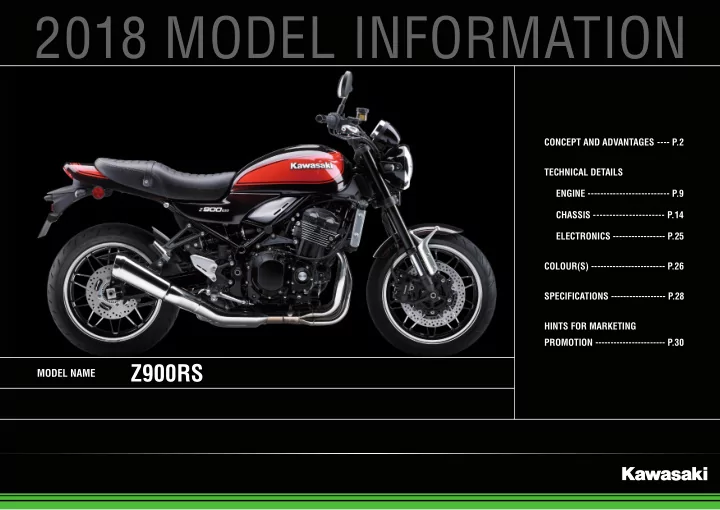
2018 MODEL INFORMATION

MODEL NAME

Z900RS

CONCEPT AND ADVANTAGES ---- P.2 TECHNICAL DETAILS ENGINE -------------------------- P.9 CHASSIS ---------------------- P.14 ELECTRONICS ----------------- P.25 COLOUR(S) ------------------------ P.26 SPECIFICATIONS ------------------ P.28 HINTS FOR MARKETING PROMOTION ----------------------- P.30

slide-2
SLIDE 2

CONCEPT AND ADVANTAGES

2 2 0 1 8 M Y Z 9 0 0 R S M o d e l I n f o r m a t i o n

CONCEPT

KAWASAKI’S NEWEST Z: A RETRO SPORT MODEL IN HOMAGE TO THE LEGENDARY Z1

choice that makes the Z900RS unique in this category. The newest Z is a synthesis of the traditional and the modern. An engine with a traditional In-Line Four configuration is backed by Kawasaki’s latest rider support technology, the engine and frame design both benefit from the latest in advanced analysis technology, and carefully crafted styling elements are complemented by high-tech features like LED lighting and digital instrumentation. Great pains were taken to achieve the Z900RS’ look and feel, with each component meticulously selected and every setting carefully

  • considered. A synchronous ride feel combines the smooth response
  • f an In-Line Four tuned for low-mid range torque, a deep rumbling

exhaust note crafted to deliver additional rider enjoyment, and neutral handling that enables both leisurely and sporty riding. This is complemented by timeless looks that blend Z1-inspired styling with modern technology and craftsmanship techniques, and an attention to detail and high level of fit-and-finish to rival that of the Z1 itself. For riders searching for a bike with character and a rich history, the Z900RS offers both in abundance, while providing an opportunity to slow down, look around and enjoy the simple things that life can bring. Kawasaki makes its long-awaited entry into the retro category with the all-new Z900RS. Conceived as an homage to the legendary Z1, it is powered by a liquid-cooled 900cc-class In-Line Four – an engine

1972 Z1

slide-3
SLIDE 3

3 2 0 1 8 M Y Z 9 0 0 R S M o d e l I n f o r m a t i o n

CONCEPT AND ADVANTAGES

ADVANTAGES

SYNCHRONOUS RIDE FEEL

1 Thanks to its smooth In-Line Four tuned for strong low-mid range torque, and unhurried handling care of its lightweight trellis frame, the ride feel of the Z900RS is unique in the retro category. Both engine and chassis response were carefully designed to not be too quick, making it easier to feel at one with the bike. The resultant stress-free riding is complemented by a crafted exhaust note that enriches the riding experience from the time the rider thumbs the ignition – features that will enable riders to enjoy their machine for many long years. The Z900RS’ refined character is reminiscent of the legendary Kawasaki bikes of yesteryear: it is happy to run at a leisurely pace, but is more than capable of accommodating more spirited riding should the mood arise.

While Kawasaki In-Line Four engines are historically renowned for their great-sounding exhausts, this the first time that Kawasaki has conducted sound research to craft a model’s ideal exhaust note. Designed to elicit rider response, the sound tuning focused on the engine’s initial roar to life, idling and low-speed riding where the rider is best able to enjoy the exhaust’s deep rumble. Like the Z1, the Z900RS features a 900cc-class In-Line Four – an engine configuration that inherently offers a great balance of power and

  • manageability. Tuning focuses
  • n the low-mid range. Revs

build in a measured, but very determined manner, giving the rider a sense of connectedness between the throttle and rear wheel.

Strong, Smooth In-Line Four Engine Kawasaki’s First Tuned Exhaust Note

* Kawasaki’s experience with sound tuning started with the 2014-2016 Z1000 and 2017 Z900. The know-how gained from those models was brought to bear when designing the Z900RS. However, where those two models had crafted intake howls, it was the sonorous exhaust note of Z900RS that was tuned.

slide-4
SLIDE 4

4 2 0 1 8 M Y Z 9 0 0 R S M o d e l I n f o r m a t i o n

CONCEPT AND ADVANTAGES

Complementing a light overall weight (noticeable as soon as the bike is lifted off its side-stand), frame rigidity and chassis geometry tuning were selected to deliver light, natural handling. Like the engine, the chassis responds to rider input predictably, going where the rider wants it to without resistance. In keeping with its retro sport model character, the Z900RS’ stance is less forward-leaning than the Z900. Unlike the twin rear shocks of the Z1, the Z900RS features Kawasaki’s Horizontal Back- Link rear suspension. This choice of modern suspension (also featured on Kawasaki’s supersport and Supernaked models) offers a higher level

  • f sporty riding potential –

something that Kawasaki engineers were not willing to

  • sacrifice. Like the fork, the

linked suspension delivers a balance of ride comfort and sporty performance. Large-diameter inverted fork contributes to excellent ride comfort and sporty riding potential. Response is unhurried, offering reassuring handling in riding situations ranging from in- town to winding roads. The high-grade fork features compression and rebound damping adjustability, enabling precise settings to suit rider preference and riding style.

Lightweight Trellis Frame Horizontal Back-Link Rear Suspension ø 41 mm Inverted Fork

ø300 mm front discs gripped by radial-mount calipers provide sure, strong stopping

  • power. Radial-pump front

brake master cylinder contributes to brake touch and control.

Radial-Mount Front Brakes

slide-5
SLIDE 5

5 2 0 1 8 M Y Z 9 0 0 R S M o d e l I n f o r m a t i o n

CONCEPT AND ADVANTAGES

Whether navigating city streets or winding through the hills, the Z900RS’ relaxed riding position, more upright than that of the Z900, offers both comfort and control, accommodating both leisurely riding or running at a more spirited pace.

With a seamless blend of Z1-inspired styling elements and modern craftsmanship – from the iconic teardrop fuel tank to the innovative

  • val LED taillight – the Z900RS offers timeless good looks with an

exquisite attention to detail and superb fit-and-finish that results in a very high-quality appearance. Functional beauty was a priority, with a simple, yet refined design pursued. In contrast to the sharp, edgy design of the Z Supernaked models, the Z900RS uses rounded elements to emulate the retro-style design of classic motorcycles.

ADVANTAGES

TIMELESS STYLING

2

Race-inspired clutch technology offers both a much lighter feel at the lever, as well as a back-torque limiting function that helps prevent rear-wheel hop when downshifting. Contributing to rider reassurance, the Z900RS is equipped with advanced Kawasaki rider support technology. KTRC features two modes that cover a wide range of riding conditions, offering either enhanced sport riding performance or the peace of mind to negotiate slippery surfaces with confidence.
Relaxed Riding Position Assist & Slipper Clutch KTRC (Kawasaki TRaction Control)

slide-6
SLIDE 6

6 2 0 1 8 M Y Z 9 0 0 R S M o d e l I n f o r m a t i o n

CONCEPT AND ADVANTAGES

Simple, Uncluttered Engine Design

With a naked bike, the engine is an important styling element, and with its simple, uncluttered design the engine adds to the Z900RS’

  • presence. Stylish engine

fins built into the cylinder head create the image of an air-cooled engine, and are complemented by an engine design featuring many Z1

  • motifs. The engine cover

design is reminiscent of traditional naked models. An insistence that all the engine covers be die-cast aluminium pieces adds to the high-quality appearance.

Iconic Teardrop Tank

The centrepiece of the Z900RS’ design, the beautiful teardrop fuel tank is reminiscent of the Z1. The frame was completely redesigned to accommodate the tank’s ideal position and slim shape. Only after the fuel tank position was fixed were the seat length, tandem seat and tail cowl length all balanced for the optimal retro sport model proportions.

Carefully Considered Exhaust Shape, Construction, Material, Finish

When designing the exhaust system over 20 variations were considered before arriving at the final design,

  • ne that emphasises the

presence of the In-Line Four engine. Double-walled header pipes give the exhaust a more powerful appearance, while making it more difficult for the headers to become discoloured over time. A lack

  • f connector pipes or exhaust

devices ensures clean lines. A short megaphone silencer contributes to the Z900RS’ retro sport image. The header pipes, pre-chamber and silencer are all formed from high-quality stainless steel, and are treated to a buff finish.

slide-7
SLIDE 7

7 2 0 1 8 M Y Z 9 0 0 R S M o d e l I n f o r m a t i o n

CONCEPT AND ADVANTAGES

Round LED Headlamp

A blend of retro and modern designs, the large ø170 mm LED headlamp casts a bright, white light for great night- time visibility. It features six chambers (four for low- beam, two for high-beam). Position lamps in the high- beam chambers ensure the whole lamp appears lit, like a retro-style bulb headlamp. Details like a convex lens and chromed headlamp ring add to the high-quality, retro sport design.

Z1-Inspired Tail Cowl and LED Taillight Dual-Dial Instrumentation with Multi-Function LCD

The flowing design of the rear cowl was inspired by the duck-bill tail cowl of the Z1. Likewise, the oval design of the LED taillight is another homage to the Z1. Unlike standard LED taillights that appear as a collection of dots, the surface-emitting LED taillight lights up as a solid surface, creating a design that is both retro and modern. Analogue-style speedometer and tachometer dials are complemented by a multi- functional LCD screen, balancing retro-style looks with modern functionality. The LCD has an easy-to-read, negative (white letters on a black background) display. Bullet-shaped dial cases are a fitting touch for a retro sport model, while a spindle finish

  • n the dial faces adds to their

high-quality design.

slide-8
SLIDE 8

8 2 0 1 8 M Y Z 9 0 0 R S M o d e l I n f o r m a t i o n

CONCEPT AND ADVANTAGES

Meticulous Attention to Detail Numerous Accessories Spoke-Style Cast Wheels

From the top-quality paint chosen for the fuel tank to the high-grade coating selected for the bolts, attention to the smallest detail, carefully considered wire routing, and a clean fit-and-finish contribute to the Z900RS’ high-quality appearance. Original cast wheels feature flat spokes designed to look like classic wire-spoked

  • wheels. Designed using

Kawasaki’s advanced analysis technology, the wheels offer a balance of light weight and stylish looks, contributing to both handling and a design suited to the retro category. Machining on the spokes further contributes to a high- quality image.

slide-9
SLIDE 9

9 2 0 1 8 M Y Z 9 0 0 R S M o d e l I n f o r m a t i o n

TECHNICAL DETAILS: ENGINE

ENGINE

Strong, Smooth In-Line Four Engine

Like the Z1, the Z900RS features a 900cc-class In-Line Four – an engine configuration that inherently offers a great balance of power and manageability. Tuning focuses on the low-mid range. Revs build in a measured, but very determined manner, giving the rider a sense of connectedness between the throttle and rear wheel.

* The liquid-cooled, DOHC, 16-valve 948 cm

3 In-line Four engine unit

is based on that of the Z900, but for the Z900RS Kawasaki engineers wanted to create an engine character completely different from its Supernaked counterpart. While the Z900 engine has a sharp, quick- revving nature that encourages high-rpm operation, the Z900RS was tuned for low-mid range, delivering strong torque that facilitates control for riders of all skill levels. Below 7,000 min

  • 1, the engine pulls more

strongly than the Z900. * Downdraft throttle bodies allow intake air to travel to the engine in the shortest possible distance, contributing to performance. * Typical of a Kawasaki In-Line Four engine, good over-rev characteristics mean that power does not drop off suddenly at high rpm. * Airbox design contributes to the Z900RS’ ride feel. The diameter, length, and bend of the intake funnels were also carefully selected for their contribution to the bike’s ride feel. * ø36 mm throttle bodies are complemented by ECU-controlled sub- throttles, ensuring silky smooth response. * Cam profiles with shorter intake (270

  • >> 248
  • ) and exhaust (256
  • >>

244

  • ) duration focus engine performance on the low-mid rpm range.

Strong and smooth response gives the engine a very manageable

  • character. Redesigned ramps on the intake cams help reduce

mechanical noise. * Complementing the shorter-duration cam profiles, the compression pressure was lowered to 10.8:1 (compared to 11.8:1 on the Z900).

slide-10
SLIDE 10

10 2 0 1 8 M Y Z 9 0 0 R S M o d e l I n f o r m a t i o n

TECHNICAL DETAILS: ENGINE

* Lightweight and rigid, the pistons are formed using a unique casting process (similar to forging process) that sees unnecessary material removed and hollows created to achieve the ideal thickness (the same process used to form the Ninja H2/H2R pistons). This enables a light weight on par with forged pistons. * A V-groove on the piston’s 2nd land helps control pressure between the piston rings by idealising the gas volume between them. This helps prevent fluttering of the top ring, so a better gas seal is maintained, reducing blow-by gas and oil consumption. * Die-cast cylinder offers an ideal balance of weight and rigidity. Its open- deck design contributes to weight savings. * Connecting passageways between the cylinders help reduce pumping loss, contributing to efficient engine performance. * Crankshaft with a heavier flywheel mass (increased approximately 12% versus the Z900) contributes to the Z900RS’ strong and smooth character. * A secondary balancer, driven off a gear on the 6th web of the crankshaft, eliminates excess vibration. Of course, a certain amount of engine vibration was desired as part of the bike’s character (vibration contributes to the feeling of acceleration, increasing linearly with rpm), so vibration was not totally eliminated. * With a naked bike, the engine is an important styling element, and with its simple, uncluttered design the engine adds to the bike’s presence. * Stylish engine fins built into the cylinder head create the image of an air- cooled engine – a nod to the Z900RS’ heritage, which traces back to the Z1. * The Z900RS’ engine cover design is reminiscent of traditional naked

  • models. The clutch cover and many other parts of the engine’s design

feature Z1 motifs. * All the engine covers are die-cast aluminium pieces, contributing to the Z900RS’ high-quality design. * The engine covers are finished in black paint, adding to the high-quality

  • appearance. The covers can also be polished to a high sheen.
slide-11
SLIDE 11

11 2 0 1 8 M Y Z 9 0 0 R S M o d e l I n f o r m a t i o n

TECHNICAL DETAILS: ENGINE

1 * Compact megaphone- style silencer design contributes to the Z900RS’ retro sport

  • design. (Photo 1)

Carefully Considered Exhaust System Design

When designing the exhaust system over 20 variations were considered before arriving at the final design, one that emphasises the presence

  • f the In-Line Four
  • engine. Double-walled

header pipes give the exhaust a more powerful appearance, while making it more difficult for the headers to become discoloured over

  • time. A lack of connector pipes or exhaust devices ensures clean
  • lines. A short megaphone silencer contributes to the Z900RS’ retro

sport image.

* The exhaust system features a 4-into-1-pre-chamber-into-silencer

  • layout. The header pipes and pre-chamber are unitised.

* The exhaust headers feature a double-wall construction. The inner pipes are slimmer than the Z900 (ø35 mm >> ø28.6 mm), contributing to the low-mid range focused performance. The outer pipes measure ø38.1 mm, adding to the presence of the In-Line Four engine. * The double-wall construction helps prevent heat from discolouring the high-quality finish of the exhaust headers. Even if the headers do change colour, the change will look attractive, rather than simply looking burnt. * Pre-chamber contributes to environmental performance, enables a smaller silencer design (contributing to mass centralisation), and contributes to the carefully crafted exhaust note. * Catalysers in the collector pipe contribute to clean emissions, ensuring Euro 4 regulations are cleared. * Connector pipes were avoided, as was an exhaust device, meeting a styling directive to ensure clean lines for the exhaust system. * The header pipes, pre-chamber and silencer are all formed from high- quality stainless steel, and are treated to a buff finish. The three-stage buffing process (1. as individual parts, 2. once assembled, 3. final buffing) results in a lustrous finish that contributes to the Z900RS’ high- quality appearance.

slide-12
SLIDE 12

12 2 0 1 8 M Y Z 9 0 0 R S M o d e l I n f o r m a t i o n

TECHNICAL DETAILS: ENGINE

Kawasaki’s First Tuned Exhaust Note Transmission & Gearing

Gearing was optimised for the Z900RS’ engine character.

* Kawasaki’s experience with sound tuning started with the 2014-2016 Z1000 and 2017 Z900. The know-how gained from those models was brought to bear when designing the Z900RS. However, where those two models had crafted intake howls, it was the sonorous exhaust note

  • f Z900RS that was tuned.

* To ensure both performance and the desired sound were achieved, every aspect of the exhaust system – exhaust pipe length, collector design, where to position the bends, even the density of the glass wool fibres in the silencer – was carefully considered. * Clever internal construction of the pre-chamber (patent pending) achieves a balance of sound and performance. At low-rpm, the exhaust escapes in a straight line; at high-rpm the exhaust is routed through an additional passage. * Inside the silencer, construction is essentially a straight pipe. The glass wool packing method and fibre density were both designed according to strict specifications to achieve the exhaust’s deep characteristic note. * Relative to the Z900, a shorter 1st gear (35/13 >> 35/12) facilitates moving off from a stop. The engine’s strong low-end torque makes the Z900RS difficult to stall when first starting to move. * Longer 6th gear (30/29 >> 29/30) contributes to ride comfort when touring or cruising at highway speeds. Enabling the engine to run a lower rpm results in lower vibration and better fuel economy. * A longer final gear ratio (44/15 >> 42/15) ensures smooth departure from stop while contributing to ride comfort when touring (much like the longer 6th gear benefits).

While Kawasaki In-Line Four engines are historically renowned for their great-sounding exhausts, this the fjrst time that Kawasaki has conducted sound research to craft a model’s ideal exhaust note. Designed to elicit rider response, the sound tuning focused on the engine’s initial roar to life, idling and low-speed riding where the rider is best able to enjoy the exhaust’s deep rumble.

slide-13
SLIDE 13

13 2 0 1 8 M Y Z 9 0 0 R S M o d e l I n f o r m a t i o n

TECHNICAL DETAILS: ENGINE

Assist & Slipper Clutch

* Assist & Slipper Clutch uses two types

  • f cams (an assist

cam and a slipper cam), offering two functions not available

  • n a standard clutch.

(Photo 2, Illustration A)

* When the engine is

  • perating at normal

rpm the assist cam functions as a self- servo mechanism, pulling the clutch hub and operating plate together to compress the clutch

  • plates. This allows

the total clutch spring load to be reduced, resulting in a lighter clutch lever pull when

  • perating the clutch.

* When excessive engine braking occurs – as a result of quick downshifts (or an accidental downshift) – the slipper cam comes into play, forcing the clutch hub and operating plate apart. This relieves pressure on the clutch plates to reduce back-torque and help prevent the rear tyre from hopping and skidding. 2 A

slide-14
SLIDE 14

14 2 0 1 8 M Y Z 9 0 0 R S M o d e l I n f o r m a t i o n

TECHNICAL DETAILS: CHASSIS

CHASSIS

Lightweight Trellis Frame

Complementing a light

  • verall weight (noticeable

as soon as the bike is lifted off its side-stand), frame rigidity and chassis geometry tuning were selected to deliver light, natural handling. Like the engine, the chassis responds to rider input predictably, going where the rider wants it to without resistance. In keeping with its retro sport model character, the Z900RS’ stance is less forward-leaning than the Z900.

* A product of Kawasaki’s advanced analysis technology, the frame had to be completely redesigned to accommodate the slim teardrop fuel tank and offer a handling character optimal for enjoyable riding at a more measured pace. * Compared to the aggressive, forward-leaning stance of the Z900, the Z900RS has a neutral, or even, stance. This was achieved by raising the front and lowering the rear. * A new upper-triple clamp increases the steering offset by 6 mm (from 28 mm to 34 mm), which reduces trail. This tends to have the effect of quickening the steering; in the case of the Z900RS it contributes to light

  • peration.

* Frame’s two upper rails were moved closer together to enable the slim tank design to be realised. The overall form of the bike and the proportions of its various components were all considered when designing the new frame. * Components of the high-tensile steel trellis frame follow the ideal pipe

  • line. The lines of the frame were made as straight as possible, and

when bends were necessary their angles were made as small as possible, resulting in a design that disperses stress extremely well. * Frame design trims all unnecessary material, resulting in an extremely lightweight frame. * Rigid-mounted at five points (forward and aft of the cylinder head, behind the cylinder, at the top and bottom of the crankcases), the engine is a stressed member, greatly contributing to the light weight of the frame and chassis. * Extruded aluminium swingarm weighs only 3.9 kg, contributing to low unsprung weight, which in turn contributes to the bike’s light handling. * Unlike the upswept tail of the Supernaked Z models, the rear frame extends at a relatively flat angle, contributing to the Z900RS’ retro sport styling. * Twin-tube type rear frame contributes to the bike’s low seat height and easy reach to the ground. Its simple design uses primarily straight lines, and helps minimise vibration transferred through the seat.

slide-15
SLIDE 15

15 2 0 1 8 M Y Z 9 0 0 R S M o d e l I n f o r m a t i o n

TECHNICAL DETAILS: CHASSIS

Inverted Front Fork & Horizontal Back-Link Rear Suspension

* ø41 mm inverted front fork contributes to excellent ride comfort and sporty riding

  • potential. Response

is unhurried, offering reassuring handling in riding situations ranging from in-town to winding roads. The high-grade fork features compression (10-way) and rebound (12-way) damping adjustability as well as stepless preload adjustability, enabling precise settings to suit rider preference and riding style. (Photo 3) * Unlike the twin rear shocks of the Z1, the Z900RS features Kawasaki’s Horizontal Back- Link rear suspension. This choice of modern suspension (also featured

  • n Kawasaki’s

supersport and Supernaked models)

  • ffers a higher level
  • f sporty riding potential – something that Kawasaki engineers were not

willing to sacrifice. Like the fork, the linked rear suspension delivers a balance of ride comfort and sporty performance. (Photo 4) * Rear suspension positions the shock unit and linkage above the

  • swingarm. This arrangement contributes to mass centralisation, while

ensuring that the suspension is located far enough from the exhaust that operation is not affected by heat. * The rear shock features stepless rebound damping and stepless preload adjustability. 4 3

slide-16
SLIDE 16

16 2 0 1 8 M Y Z 9 0 0 R S M o d e l I n f o r m a t i o n

TECHNICAL DETAILS: CHASSIS

Brakes/Wheels/Tyres

5 * The rear brake features a single piston, pin-slide caliper gripping a ø250 mm disc (effective diameter: ø216 mm). * Sintered brake pads front and rear contribute to the control and feel. * For added braking reassurance, ABS is a standard feature on the

  • Z900RS. The ABS unit is a compact and lightweight Nissin motorcycle

ABS unit. 6 * At the front, ø300 mm brake discs (effective diameter: ø267 mm are gripped by opposed 4-piston radial-mount monobloc calipers. The monobloc front brake calipers offer a firm initial touch, the level of brake force is very easy to control, and overall brake performance is superb. (Photo 5) * The machined monobloc calipers feature an alumite

1 coating and are

laser-etched with a Kawasaki logo, adding to the bike’s high-quality sporty looks. * Radial-pump front brake master cylinder also contributes to the superb control and feel offered by the

  • calipers. (Photo 6)
slide-17
SLIDE 17

17 2 0 1 8 M Y Z 9 0 0 R S M o d e l I n f o r m a t i o n

TECHNICAL DETAILS: CHASSIS

7 8 * Machining on the spokes contributes to the bike’s high-quality image. * Low unsprung weight (thanks to parts like the swingarm and wheels) greatly contributes to the light, natural handling. * Dunlop GPR-300 tyres contribute to retro sport looks. * Original cast wheels feature flat spokes designed to look like classic wire- spoked wheels. Designed using Kawasaki’s advanced analysis technology, the wheels offer a balance of light weight and stylish looks, contributing to both handling and a design suited to the retro category.

(Photos 7-8)

* The relationship between pegs, seat and handlebars was designed to enhance communication between rider and machine, giving the rider a confidence-inspiring feeling of control that complements its light, natural handling. * Upper-triple clamp is positioned 40 mm higher, contributing to the higher handle position and a more upright riding position than the Z900.

Relaxed Riding Position

Whether navigating city streets or winding through the hills, the Z900RS’ relaxed riding position, more upright than that

  • f the Z900, offers both

comfort and control, accommodating both leisurely riding or running at a more spirited pace.

slide-18
SLIDE 18

18 2 0 1 8 M Y Z 9 0 0 R S M o d e l I n f o r m a t i o n

TECHNICAL DETAILS: CHASSIS

* Compared to the Z900, the footpegs are 20 mm lower and 20 mm farther forward, contributing to an even more relaxed riding position. * Handlebar features rubber-mounted bar-ends to dampen vibrations. * Both clutch and brake levers are 5-way adjustable, able to accommodate a variety of hand sizes for increased comfort. * Stepped seat offers a wide seating area for good ride comfort for both rider and

  • passenger. The seat

is slimmer at the front, facilitating the rider’s reach to the ground. The seat can be removed without tools,

  • ffering easy access

to the battery, fuse box and tool kit.(Photo 10) * An accessory ERGO- FIT low seat reduces the seat height 35 mm. (Photo 11) * The fat bar features a chromed finish, adding to the high-quality image. * Slim fuel tank is narrow at the rear, making it easy for riders to grip the bike with their knees. * Thanks to the low seat height and the bike’s slim overall design, it’s easy to keep both feet firmly on the ground when stopped, an important consideration for many riders. 835 mm seat height enables a wide range of riders to enjoy the Z900RS with confidence. * The narrow frame and engine create a narrow overall package, allowing the rider to keep his or her knees and feet close together. * Wide, flat handlebar contributes to the retro sport styling while offering a wide grip to facilitate

  • control. Relative to

the Z900, the handle grips are 30 mm wider (total), and 65 mm higher and 35 mm back (closer to the rider), offering a more upright riding

  • position. A wide 35
  • steering angle facilitates low-speed manoeuvring.

(Photo 9)

9 10 11

slide-19
SLIDE 19

19 2 0 1 8 M Y Z 9 0 0 R S M o d e l I n f o r m a t i o n

TECHNICAL DETAILS: CHASSIS

* Rider footpegs feature rubber pads to reduce vibration transmitted through the feet.

Timeless Styling

With a seamless blend

  • f Z1-inspired styling

elements and modern craftsmanship – from the iconic teardrop fuel tank to the innovative oval LED taillight – the Z900RS

  • ffers timeless good

looks with an exquisite attention to detail and superb fit-and-finish that results in a very high- quality appearance. Functional beauty was a priority, with a simple, yet refined design pursued. In contrast to the sharp, edgy design

  • f the Z Supernaked models, the Z900RS uses rounded elements

to emulate the retro-style design of classic motorcycles. From the top-quality paint chosen for the fuel tank to the high-grade coating selected for the bolts, attention to the smallest detail, carefully considered wire routing, and a clean fit-and-finish contribute to the Z900RS’ high-quality appearance.

* In order to preserve the elegant curves of the teardrop tank, indentations for the knees were not added. Complementing the rich paint used on the tank, immersion graphics result in a design that does not leave a raised surface, resulting in a high-quality finish that is pleasing to the touch. * The 17 litre fuel tank actually extends down behind the side covers, a layout that realises the slim design of the tank while offering the tank volume to enable a cruising range over 320 km (WMTC mode). * Side covers were designed to flow naturally from the tank. Emblems on the side covers contribute to the retro sport styling. * Knee grip covers, located forward of the side covers, are pressed aluminium pieces. A clear alumite

1 coating ensures an attractive, long-

lasting finish. * The centrepiece of the Z900RS’ design, the beautiful teardrop fuel tank is reminiscent

  • f the Z1. The frame

was completely redesigned to accommodate the tank’s ideal position and slim shape. Only after the fuel tank position was fixed were the seat length, tandem seat and tail cowl length all balanced for the optimal retro sport model proportions. (Photo 12) 12

slide-20
SLIDE 20

20 2 0 1 8 M Y Z 9 0 0 R S M o d e l I n f o r m a t i o n

TECHNICAL DETAILS: CHASSIS

* Forged aluminium shift lever and brake pedal are a nod to the Z900RS’ functional beauty. * Stylish fuel tank cap complements the elegant lines of the tank. * A blend of retro and modern designs, the large ø170 mm LED headlamp casts a bright, white light for great night-time

  • visibility. It features

six chambers (four for low-beam, two for high-beam). Position lamps in the high- beam chambers ensure the whole lamp appears lit, like a retro-style bulb headlamp. Details like a convex lens and chromed headlamp ring add to the high-quality, retro sport

  • design. (Photo 13)

13 * Three-piece front fender uses die-cast aluminium fender supports, adding a high-quality touch and enhancing the retro sport image. The supports are extremely thin, measuring only 1.7 mm thick, to keep weight down.

(Photo 15)

* Stylish two-tone seat uses different materials for the top and sides to create a high-quality design. Double-stitching adds to the high-quality

  • image. (Photo 16)

* LED turn signals contribute a modern touch. * Round mirrors were styled after those of the Z1 and Z2, contributing to stunning retro sport looks while ensuring good rearward

  • visibility. (Photo 14)

14 15 16

slide-21
SLIDE 21

21 2 0 1 8 M Y Z 9 0 0 R S M o d e l I n f o r m a t i o n

TECHNICAL DETAILS: CHASSIS

* Convenient luggage hooks on the tail cowl and rear flap were designed to stick out, helping to prevent bungy nets or tie-down ropes from rubbing on the elegant bodywork. 17 18 * Flowing design of the rear cowl was inspired by the duck-bill tail cowl of the Z1.

(Photo 17)

* An accessory grab bar with a chromed finish adds another retro-style touch.

(Photo 18)

* The oval design of the LED taillight is another homage to the Z1. Unlike standard LED taillights that appear as a collection of dots, the surface-emitting LED taillight lights up as a solid surface, creating a design that is both retro and

  • modern. (Photo 19)

19

slide-22
SLIDE 22

22 2 0 1 8 M Y Z 9 0 0 R S M o d e l I n f o r m a t i o n

TECHNICAL DETAILS: CHASSIS

* Gear position indicator increases shifting precision and confidence. * In addition to the gear position indicator, display functions include:

  • dometer, dual trip meters, fuel gauge, remaining range, current and

average fuel consumption, coolant temperature, external temperature, clock and the Economical Riding Indicator. * The Economical Riding Indicator appears on the LCD screen to indicate favourable fuel consumption. Paying attention to conditions that result in the mark appearing can assist riders to maximise their fuel efficiency. This handy feature is active all the time, although to be effective, the rider must ride in a gentle manner. * A hazard switch is located on the left handlebar. * LCD screen features a negative display (white letters on a black background), adding to the instrument cluster’s sporty, modern appearance. * Analogue-style speedometer and tachometer dials are complemented by a multi-functional LCD screen, balancing retro-style looks with modern functionality.

(Photo 20)

* Bullet-shaped dial cases are a fitting touch for a retro sport model, while a spindle finish on the dial faces adds to their high- quality design.

(Photo 21)

Dual-Dial Instrumentation with Multi-Function LCD

20 21

slide-23
SLIDE 23

23 2 0 1 8 M Y Z 9 0 0 R S M o d e l I n f o r m a t i o n

TECHNICAL DETAILS: CHASSIS

24 26 28 23 25 27

* Other available accessories include: heated grips, tank emblem, tank pad, indicator cover, meter cover, front fork caps, radiator screen, front axle sliders, frame sliders, oil filler cap, centre stand, side grip (to help manoeuvre the bike onto the centre stand), and grab bar. (Photo 23-34)

Numerous Accessories

* ERGO-FIT low- seat reduces the seat height 35 mm,

  • ffering an easier

reach to the ground. Like the ERGO-FIT high seat, it features two-tone leather and double-stitching.

(Photo 22)

22

A number of Kawasaki genuine accessories allow riders to customise the Z900RS’ timeless looks or offer added comfort or convenience for long rides. (Available accessories vary by market.)

slide-24
SLIDE 24

24 2 0 1 8 M Y Z 9 0 0 R S M o d e l I n f o r m a t i o n

TECHNICAL DETAILS: CHASSIS

30 32 34 29 31 33

* A DC outlet located under the seat provides a convenient power source.

slide-25
SLIDE 25

25 2 0 1 8 M Y Z 9 0 0 R S M o d e l I n f o r m a t i o n

TECHNICAL DETAILS: ELECTRONICS

ELECTRONICS

KTRC (Kawasaki Traction Control)

* Riders can choose from two modes. Mode 1 prioritises maximum forward acceleration. Mode 2 provides rider reassurance by facilitating smooth riding on slippery surfaces. Riders may also elect to turn the system off. * In Mode 1, highly sophisticated programming allows a degree of slip – a certain amount of slip is required to maximise acceleration. The ideal slip ratio varies according to conditions. The system looks at a number

  • f parameters to get an accurate real-time picture of what is going on:

front and rear wheel speed (slippage) and various engine, machine and rider input parameters are monitored. * Because the sophisticated software bases its dynamic analysis on the chassis’ orientation relative to the track surface (rather than relative to a horizontal plane), it is able to take into account corner camber, gradient, etc, and adapt accordingly. It also automatically adjusts for tyre wear, different tyre profiles, high-grip tyres, and numerous other factors that setting-type systems treat as fixed parameters. * Using complex analysis, the system is able to predict when traction conditions are about to become unfavourable. By acting before slippage exceeds the range for optimal traction, drops in power can be minimised, resulting in ultra-smooth operation. * Conditions are confirmed every 5 milliseconds, and control via ignition timing allows extremely quick reaction. * In Mode 2 (the more intrusive of the two modes) the same logic and control as in Mode 1 is employed during normal operation. However, when excessive rear wheel spin is detected, Mode 2 switches to three- way control – governing ignition timing, fuel delivery and airflow (via the sub-throttles) – and engine output is reduced to a level that allows the rear wheel to regain grip. It is the control of the sub-throttles that enables smooth operation. This fine control results in a very natural feeling: engagement is smooth, on/off transition is smooth, and stability is maintained during extended operation. * In Mode 2, KTRC effectively enables riders to negotiate both short slippery patches (train tracks or manhole covers) and extended stretches of bad road (wet pavement, cobblestone, gravel, etc). Wheel spin is also limited when starting on a slippery surface. * The system is also able to distinguish between torque wheelies, which are smooth, and other wheelies. In Mode 1, torque wheelies are allowed as long as acceptable acceleration is maintained. Other wheelies trigger system intervention. In Mode 2, all wheelies are prevented. * The system uses minimal hardware but complex software. Apart from the engine ECU, the system relies on only front and rear wheel speed sensors – which means minimal additional weight (none, in the case

  • f an ABS-equipped model like the Z900RS, which already has wheel

speed sensors). * By default, KTRC is always ON when the engine is started. (The mode will be the same as when the engine was turned off, or in Mode 1 if the system had been turned off.) To ride with KTRC off, riders must consciously turn the system OFF (using the mode button on the left grip).

The Z900RS is equipped with traction control. Two modes cover a wide range of riding conditions, offering either enhanced sport riding performance or the peace of mind to negotiate slippery surfaces with confidence.

slide-26
SLIDE 26

26 2 0 1 8 M Y Z 9 0 0 R S M o d e l I n f o r m a t i o n

COLOUR(S)

* Metallic Flat Spark Black * Candytone Brown

slide-27
SLIDE 27

27 2 0 1 8 M Y Z 9 0 0 R S M o d e l I n f o r m a t i o n

COLOUR(S)

1Alumite: an anodic oxidation finishing treatment for aluminium resulting in a coloured, corrosion/scratch-resistant film coating.

* Metallic Matte Covert Green / Flat Ebony

slide-28
SLIDE 28

28 2 0 1 8 M Y Z 9 0 0 R S M o d e l I n f o r m a t i o n

SPECIFICATIONS

DIMENSIONS PERFORMANCE DRIVETRAIN ENGINE

Overall length Overall width Overall height Wheelbase Road clearance Seat height Curb mass Fuel tank capacity Type Bore x Stroke Displacement Compression ratio Fuel Supply Lubrication system Starting system Ignition system

  • Max. power
  • Max. torque

Driving system Transmission Gear ratios: 1st 2nd 3rd 4th 5th 6th Primary reduction ratio Final reduction ratio Clutch type (Primary) 82.0 kW {111 PS} / 8,500 min

  • 1

98.5 N·m {10.0 kgƒ·m} / 6,500 min

  • 1

Chain 6-speed, return 2.917 (35/12) 2.059 (35/17) 1.650 (33/20) 1.409 (31/22) 1.222 (33/27) 0.967 (29/30) 1.627 (83/51) 2.800 (42/15) Wet, multi-disc 2,100 mm 865 mm 1,150 mm 1,470 mm 130 mm 835 mm

215 kg

17 litres 4st, 4-cyl, DOHC, W/C 73.4 x 56.0 mm 948 cm

3

10.8:1 Fuel injection (ø36 x 4) Forced Lub. Wet

  • EL. Starter

B&C (TCBI EL. ADV. D.)

slide-29
SLIDE 29

29 2 0 1 8 M Y Z 9 0 0 R S M o d e l I n f o r m a t i o n

SPECIFICATIONS

The specifications mentioned here apply to and have been achieved by production models under standard operating conditions. We intend only to give a fair description of the vehicle and its performance capabilities but these specifications may not apply to every machine supplied for

  • sale. Kawasaki Heavy Industries, Ltd. reserves the right to alter specifications without prior notice.

Equipment illustrated and specifications may vary to meet individual markets. Available colours may vary by market.

FRAME

Type Suspension: Front Rear Wheel travel: Front Rear Caster (Rake angle) Trail Steering angle (left/right) Tyre: Front Rear Brake: Front Type

  • Effect. dia

Rear Type

  • Effect. dia

Tubular, diamond Telescopic fork (upside-down) Horizontal Back-link SWG. ARM 120 mm 140 mm 25.0

  • 98 mm

35

  • / 35
  • 120/70ZR17 M/C (58W)

180/55ZR17 M/C (73W) Dual disc 267 mm Single disc 216 mm