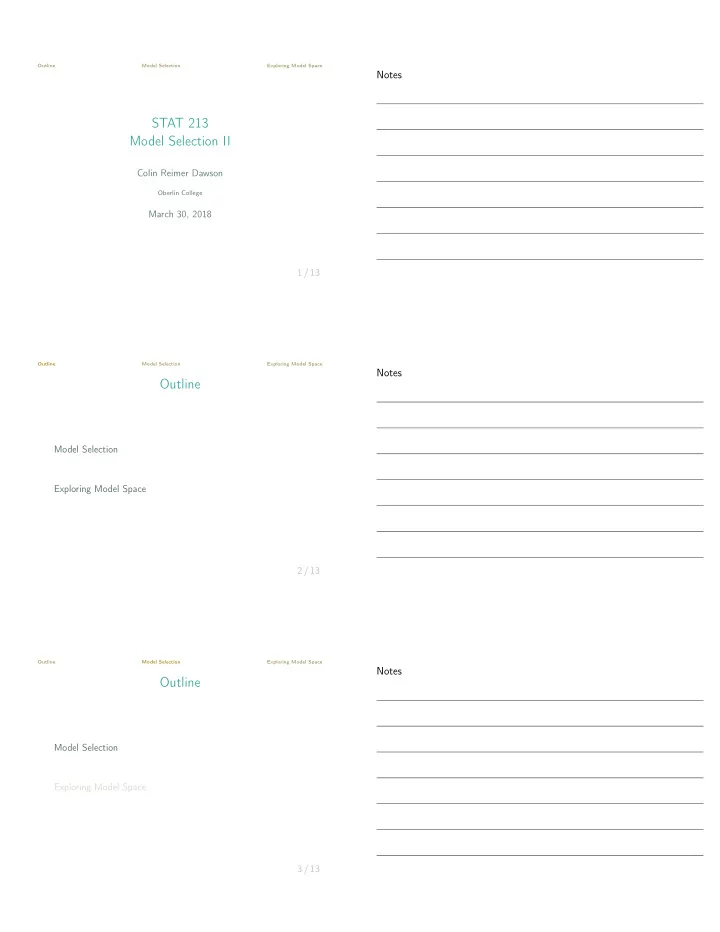
STAT 213 Model Selection II Colin Reimer Dawson Oberlin College - - PDF document

stat 213 model selection ii
SMART_READER_LITE
LIVE PREVIEW

STAT 213 Model Selection II Colin Reimer Dawson Oberlin College - - PDF document

Outline Model Selection Exploring Model Space Notes STAT 213 Model Selection II Colin Reimer Dawson Oberlin College March 30, 2018 1 / 13 Outline Model Selection Exploring Model Space Notes Outline Model Selection Exploring Model


slide-1
SLIDE 1

Outline Model Selection Exploring Model Space

STAT 213 Model Selection II

Colin Reimer Dawson

Oberlin College

March 30, 2018 1 / 13

Outline Model Selection Exploring Model Space

Outline

Model Selection Exploring Model Space 2 / 13

Outline Model Selection Exploring Model Space

Outline

Model Selection Exploring Model Space 3 / 13

Notes Notes Notes

slide-2
SLIDE 2

Outline Model Selection Exploring Model Space

So many models...

  • How to decide among all these models?
  • 1. Understand the subject area! Build sensible models.
  • 2. Nested F-tests
  • 3. Model quality measures

4 / 13

Outline Model Selection Exploring Model Space

What Makes a Good Model?

Fit High R2 Small SSE Large F Validity Strong evidence for predictors Simple (Parsimonious) Generalizes outside sample 5 / 13

Outline Model Selection Exploring Model Space

Why Does Parsimony Matter?

Don’t we just care about good predictions? Not exclusively...

  • We also use models to understand the world (harder with

more complexity) And even so...

  • We really care about making predictions for data we

haven’t seen yet. 6 / 13

Notes Notes Notes

slide-3
SLIDE 3

Outline Model Selection Exploring Model Space

Criteria to “score” models

  • 1. high R2/low SSE/low ˆ

σ2

ε: always prefers more complex

models

  • 2. Adj. R2: balances fit and complexity
  • 3. Mallow’s Cp / Akaike Information Criterion (AIC):

estimates mean squared prediction error based on ˆ σ2

ε from

a “full” model

  • 4. Out-of-sample predictive accuracy (next time)

7 / 13

Outline Model Selection Exploring Model Space

Mallow’s Cp / AIC

Two measures that reduce to the same thing in the case of MLR with independent, equal variance, Normal residuals. For a “reduced” model with preduced total parameters (including the intercept) which is nested in a “full” model with pfull parameters, both fit using n observations: Cp = SSEreduced MSEfull + 2preduced − n (1) = preduced + SSEdiff MSEfull (2) where smaller values indicate a simpler model (smaller preduced) and/or a better fit (smaller SSEdiff) 8 / 13

Outline Model Selection Exploring Model Space

Outline

Model Selection Exploring Model Space 9 / 13

Notes Notes Notes

slide-4
SLIDE 4

Outline Model Selection Exploring Model Space

Model Selection

Five predictor-selection methods:

  • 1. Domain knowledge (+ a few F-tests)
  • 2. Best subset
  • 3. Forward selection
  • 4. Backward selection
  • 5. Stepwise selection

10 / 13

Outline Model Selection Exploring Model Space

Automated exploration of predictor subsets

  • 1. Best subset: consider all possible combinations (2K)
  • 2. Forward selection: start with null model, and consider

adding one predictor at a time

  • 3. Backward elimination: start with full model and consider

removing one predictor at a time

  • 4. Stepwise regression: consider both additions and

subtractions at each iteration Note: Choose best step based on adj-R2 or Cp/AIC, not based

  • n P-values

11 / 13

Outline Model Selection Exploring Model Space

Model Selection

“Scoring” R2

adj.

Cp CV Error (next time) “Search” Domain Knowledge Best Subset Forward Selection Backward Selection Stepwise Selection 12 / 13

Notes Notes Notes

slide-5
SLIDE 5

Outline Model Selection Exploring Model Space

Example: Baseball Win % Demo

13 / 13

Notes Notes Notes