2017 Hilo Harbor Stormwater Awareness Training M LAMA I KE KAI - - PowerPoint PPT Presentation

2017 hilo harbor stormwater awareness training
SMART_READER_LITE
LIVE PREVIEW

2017 Hilo Harbor Stormwater Awareness Training M LAMA I KE KAI - - PowerPoint PPT Presentation

2017 Hilo Harbor Stormwater Awareness Training M LAMA I KE KAI Protect our Harbor Waters Hilo Harbor Plays a Crucial Role In Our Island Economy Revenue by Imports Exports Industry is & 12% Dominated by Exports Passengers Fiscal


slide-1
SLIDE 1

MĀLAMA I KE KAI Protect our Harbor Waters
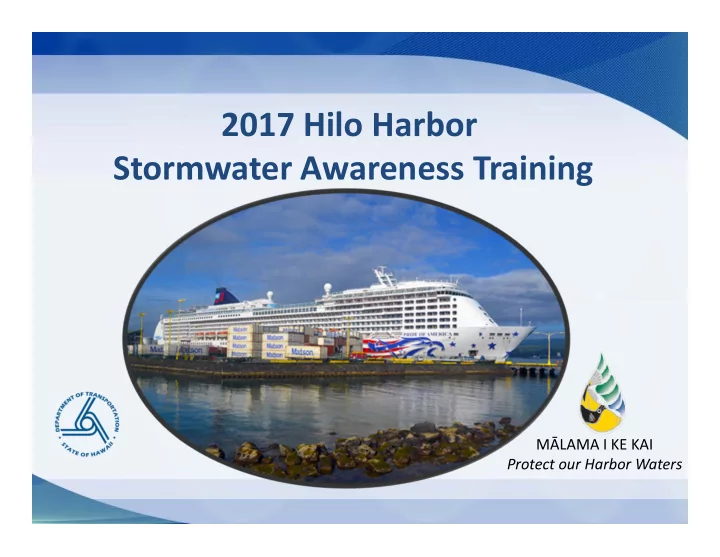
2017 Hilo Harbor Stormwater Awareness Training

slide-2
SLIDE 2

MALAMA I KE KAI ‐ PROTECT OUR HARBOR WATERS

Revenue by Industry is Dominated by Passengers and Containerized Cargo

(Fiscal Years 2012-2016)

Imports & Exports

Fiscal Years 2012-2016

Exports 12% Imports 88% Short Tons of Cargo Exports 29% Imports 71% Containerized Cargo

Hilo Harbor Plays a Crucial Role In Our Island Economy

Cargo Volumes Slumped Following the Recession and Are Now Recovering

slide-3
SLIDE 3

MALAMA I KE KAI ‐ PROTECT OUR HARBOR WATERS

Agenda

1) Welcome & Stormwater Pollution Introduction

‐Spencer Yim, Environmental Section, Engineering Branch, DOT Harbors Division

2) Pollutants, Sources & Impacts 3) Environmental Goals & Regulations 4) Break (15 min) 5) Best Management Practices (BMPs) 6) Quiz/Review/Questions . . .

slide-4
SLIDE 4

MALAMA I KE KAI ‐ PROTECT OUR HARBOR WATERS

Stormwater Pollution

  • Also called non‐point source pollution

– Natural and manmade – Much greater quantities than point sources

  • Stormwater Pollutants

– Any type of material or waste that degrades water quality and affects public health, the environment or the beneficial uses of receiving waters. – From urbanization, erosion and natural processes – Many are naturally occurring in surface waters, but are damaging at elevated levels

slide-5
SLIDE 5

MALAMA I KE KAI ‐ PROTECT OUR HARBOR WATERS

Pollutant Categories

3 Categories: Physical, Chemical and Biological

  • Physical Pollutants

– Sediment

  • Sources: Construction Sites, Erosion, Urban Areas,

Container Yards & Agricultural Practices

  • Negative Impacts:

– Reduce light transmission – Smother habitat – Impair recreational use of water bodies – Also, transport other pollutants

slide-6
SLIDE 6

MALAMA I KE KAI ‐ PROTECT OUR HARBOR WATERS

Physical Pollutants (Continued)

  • Temperature (aka Thermal Pollution)

– Sources: Power plants, industries, removal of trees along streams, impervious (paved) areas heat up water flowing to streams – Impacts: Threat to stream insects & fish species

  • Gross Solids (Garbage, Trash, Plastics, etc.)

– Source: Human activities – Impacts: Threat to aquatic life; impair recreational uses, expensive to clean up

slide-7
SLIDE 7

MALAMA I KE KAI ‐ PROTECT OUR HARBOR WATERS

Chemical Pollutants

  • Nutrients (Nitrogen & Phosphorus)

– Sources: Atmosphere, fertilizers, sewage leaks – Impacts: Algae blooms, Blue Baby disease – Nitrogen forms: Ammonia, Nitrate/Nitrite, TKN – Phosphorus forms: Orthophosphates, Total P

slide-8
SLIDE 8

MALAMA I KE KAI ‐ PROTECT OUR HARBOR WATERS

Chemical Pollutants

  • Metals

– Sources: streets & highways, buildings, materials, industrial activities, atmospheric deposition – Impacts: toxic to aquatic life, bioaccumulation, threat to human health – Forms of Metal Pollutants (Can be dissolved or solid)

  • Copper
  • Zinc
  • Lead
  • Chromium
  • Cadmium
  • Iron
  • Aluminum
  • Others
slide-9
SLIDE 9

MALAMA I KE KAI ‐ PROTECT OUR HARBOR WATERS

Honolulu Pier 29 Sediment Characteristics

Note: SG = Specific Gravity

slide-10
SLIDE 10

MALAMA I KE KAI ‐ PROTECT OUR HARBOR WATERS

Chemical Pollutants (Continued)

  • Hydrocarbons
  • Forms of Hydrocarbons

– Oil and Grease – Fuels – Hydraulic Fluids

  • Sources

– Streets, highways, container yards – Fueling sites, emissions – Illegal dumping – Leakages (vehicles & equipment)

  • Impacts

– Threat to aquatic life – Threat to human health

slide-11
SLIDE 11

MALAMA I KE KAI ‐ PROTECT OUR HARBOR WATERS

Chemical Pollutants (Continued

  • Organic Compounds

– Paints & paint thinners – Solvents – Degreasing agents – Curing agents – Sealing compounds – PCBs (polychlorinated biphenyls)

  • Sources: Construction sites, industrial & maintenance

facilities, illicit discharges, poor storage & handling of materials

  • Impacts:

– Threat to aquatic life, Bioaccumulation, Human health risks

slide-12
SLIDE 12

MALAMA I KE KAI ‐ PROTECT OUR HARBOR WATERS

Chemical Pollutants (Continued

  • Pesticides

– Herbicides – Rodenticides – Insecticides

  • Sources:

– Agriculture – Urban landscaping

  • Impacts:

– Threat to aquatic life – Bioaccumulation – Human health risk

slide-13
SLIDE 13

MALAMA I KE KAI ‐ PROTECT OUR HARBOR WATERS

Biological Pollutants

  • Bacteria and Viruses: E. coli, Fecal coli, etc.
  • Sources:

– Leaking septic/sewer systems (sewage) – Illicit connections – Animal wastes

  • Impacts:

– Human health risk of diseases – Threat to aquatic life

slide-14
SLIDE 14

MALAMA I KE KAI ‐ PROTECT OUR HARBOR WATERS

Secondary Pollutant Forms

  • Oxygen Demand, pH, Algae, Chlorophyll

– Oxygen Demand Forms:

  • Dissolved Oxygen (DO)
  • Biochemical Oxygen Demand (BOD)
  • Chemical Oxygen Demand (COD)

– Oxygen Demand Sources: Sediment, nutrients,

  • rganics and other pollutants as particles and soluble

phases (e.g., molasses & fire fighting foam/FFF)

– Oxygen Demand Impacts:

  • Reduced Dissolved Oxygen levels harm aquatic life
  • Fish kills
slide-15
SLIDE 15

MALAMA I KE KAI ‐ PROTECT OUR HARBOR WATERS

Honolulu Harbor Molasses Spill, Sept. 2013

slide-16
SLIDE 16

MALAMA I KE KAI ‐ PROTECT OUR HARBOR WATERS

YB Top Pick Fire Cleanup @ Honolulu Pier 40, Dec. 19, 2016

slide-17
SLIDE 17

MALAMA I KE KAI ‐ PROTECT OUR HARBOR WATERS

Hilo Harbor Spills

slide-18
SLIDE 18

MALAMA I KE KAI ‐ PROTECT OUR HARBOR WATERS

Source Control

It is less costly and less time consuming to stop pollutants at their source rather than to remove them from stormwater

  • nce they have entered the drainage system.
slide-19
SLIDE 19

MALAMA I KE KAI ‐ PROTECT OUR HARBOR WATERS

Clean Water Healthy Reefs Sustainable Environment

Environmental Goals

slide-20
SLIDE 20

MALAMA I KE KAI ‐ PROTECT OUR HARBOR WATERS

Environmental Goals

Healthy Environment  Health Family!!!

slide-21
SLIDE 21

MALAMA I KE KAI ‐ PROTECT OUR HARBOR WATERS

Prevention

How can we prevent this?

slide-22
SLIDE 22

MALAMA I KE KAI ‐ PROTECT OUR HARBOR WATERS

Pollution Pathways?

Storm Drains are designed to carry untreated stormwater directly into the Harbor

slide-23
SLIDE 23

MALAMA I KE KAI ‐ PROTECT OUR HARBOR WATERS

Permits & Requirements

National Pollutant Discharge Elimination System (NPDES) Permits & HAR Title 11 Chapters 54 & 55

slide-24
SLIDE 24

MALAMA I KE KAI ‐ PROTECT OUR HARBOR WATERS

Allowable Discharges

1. Daily Operations

– Water line flushing – Air conditioning condensate – Landscape irrigation – Discharges from potable water sources and foundation drains

2. Groundwater

– Rising groundwater (tidal intrusion) – Uncontaminated groundwater infiltration – Uncontaminated pumped groundwater

3. Natural Origin

– Springs

4. Emergencies

– Discharge from fire fighting activities

Permitted by DOH/EPA:

slide-25
SLIDE 25

MALAMA I KE KAI ‐ PROTECT OUR HARBOR WATERS

Pollution Prevention & Good Housekeeping

  • Proper Labeling and Handling of Cleaners,

Solvents, and Chemicals

  • Organized Chemical Storage
  • Proper Disposal of Chemicals
  • Covering Stored Metals
  • Proper Equipment/Material Storage
  • Regular/Timely Equipment Maintenance
  • Site cleaning procedures should be in place
slide-26
SLIDE 26

MALAMA I KE KAI ‐ PROTECT OUR HARBOR WATERS

Know the Regulations

  • 1. Industrial NPDES
  • 2. Vessel General Permit
  • 3. Harbors Washing

Approval

  • 4. Spill Prevention,

Control, and Counter Measure (SPCC)

  • 5. Tier II
  • 6. Hazardous Waste
  • 7. Good Housekeeping
slide-27
SLIDE 27

MALAMA I KE KAI ‐ PROTECT OUR HARBOR WATERS

  • 1. Industrial NPDES Permits
  • Material Handling and Storage
  • Equipment Cleaning
  • Maintenance and Repair
  • Fueling
  • Washing
  • Sanding and Painting

Allows the discharge of stormwater associated with industrial activities, such as: Conditions of the Permit:

  • Storm Water Pollution Control Plan (SWPCP)
  • Stormwater sampling
slide-28
SLIDE 28

MALAMA I KE KAI ‐ PROTECT OUR HARBOR WATERS

  • 2. Vessel General Permit

Section 401 WQC Discharges from Non‐Recreational Vessels

https://www.epa.gov/npdes/vessels

slide-29
SLIDE 29

MALAMA I KE KAI ‐ PROTECT OUR HARBOR WATERS

  • 3. SPCC Plan

Required if >1,320 gallons

  • f oil and oil

products are stored and used 40 CFR 112

Make sure you have a SPCC Plan and FOLLOW IT!

slide-30
SLIDE 30

MALAMA I KE KAI ‐ PROTECT OUR HARBOR WATERS

Be aware of the storm drains at your facility.

  • 4. SPCC Plan
slide-31
SLIDE 31

MALAMA I KE KAI ‐ PROTECT OUR HARBOR WATERS

  • 5. Hazardous Waste

Make sure you label and store drums correctly! HAR 11‐260

slide-32
SLIDE 32

MALAMA I KE KAI ‐ PROTECT OUR HARBOR WATERS

  • 6. Universal Waste

Examples:

  • Fluorescent

lamps,

  • Batteries, and
  • Anything with

mercury

HAR 11‐273

slide-33
SLIDE 33

MALAMA I KE KAI ‐ PROTECT OUR HARBOR WATERS

Short Break (15 min)

slide-34
SLIDE 34

MALAMA I KE KAI ‐ PROTECT OUR HARBOR WATERS

Short Film (8 min)

http://portofpt.com/preventing‐zinc‐pollution‐in‐stormwater/

slide-35
SLIDE 35

MALAMA I KE KAI ‐ PROTECT OUR HARBOR WATERS

Good Housekeeping

slide-36
SLIDE 36

MALAMA I KE KAI ‐ PROTECT OUR HARBOR WATERS

Hand Washing

Keep It Contained

slide-37
SLIDE 37

MALAMA I KE KAI ‐ PROTECT OUR HARBOR WATERS

Fueling

Remain Vigilant

Be Prepared

slide-38
SLIDE 38

MALAMA I KE KAI ‐ PROTECT OUR HARBOR WATERS

Drain Inlet Protection

Filter Fabric

slide-39
SLIDE 39

MALAMA I KE KAI ‐ PROTECT OUR HARBOR WATERS

Permanent BMPs

KRAKEN

slide-40
SLIDE 40

MALAMA I KE KAI ‐ PROTECT OUR HARBOR WATERS

Maintenance

Conduct Maintenance Under Cover

Remember to practice good housekeeping around your facility.

slide-41
SLIDE 41

MALAMA I KE KAI ‐ PROTECT OUR HARBOR WATERS

Vehicle and Equipment Storage

Remember to use a drip pan under vehicles!

slide-42
SLIDE 42

MALAMA I KE KAI ‐ PROTECT OUR HARBOR WATERS

What is the potential deficiency?

What good housekeeping practice can be implemented to avoid a deficiency?

slide-43
SLIDE 43

MALAMA I KE KAI ‐ PROTECT OUR HARBOR WATERS

Illicit Discharges

Any non‐stormwater discharge that poses a risk to the environment.

slide-44
SLIDE 44

MALAMA I KE KAI ‐ PROTECT OUR HARBOR WATERS

Illicit (Illegal)Discharges

Common sources of illicit discharges include:

  • Leaking sewage
  • Collection and transmission lines
  • Commercial carwash and laundry wastewater
  • Floor washing to shop drains
  • Commercial Vehicle and Equipment washwater
  • Potable line flushing that runs across hardscapes
  • Pumping of vaults or trenches
  • Construction activities
  • Liquid wastes containing oil, paint, and process water
  • Waste water from manufacturing or equipment processes
  • Pesticides, herbicides, and other industrial chemicals
slide-45
SLIDE 45

MALAMA I KE KAI ‐ PROTECT OUR HARBOR WATERS

Illicit Discharges

Uncontained materials over a trench drain and near pier’s edge.

slide-46
SLIDE 46

MALAMA I KE KAI ‐ PROTECT OUR HARBOR WATERS

Illicit Discharges

slide-47
SLIDE 47

MALAMA I KE KAI ‐ PROTECT OUR HARBOR WATERS

Illicit Discharge

Be sure to regularly inspect your facility to identify and clean any oil stains.

slide-48
SLIDE 48

MALAMA I KE KAI ‐ PROTECT OUR HARBOR WATERS

Illicit Discharge?

Unpolluted air conditioning condensate is NOT an illicit discharge.

slide-49
SLIDE 49

MALAMA I KE KAI ‐ PROTECT OUR HARBOR WATERS

Illicit Discharge?

Do not dump mop water into a storm drain

slide-50
SLIDE 50

MALAMA I KE KAI ‐ PROTECT OUR HARBOR WATERS

Illicit Discharge?

Soapy water is an illicit discharge Remember to get Harbors approval to wash!

slide-51
SLIDE 51

MALAMA I KE KAI ‐ PROTECT OUR HARBOR WATERS

Suspected Illicit Discharge Reporting

slide-52
SLIDE 52

MALAMA I KE KAI ‐ PROTECT OUR HARBOR WATERS

Suspected Illicit Discharge Report

slide-53
SLIDE 53

MALAMA I KE KAI ‐ PROTECT OUR HARBOR WATERS

Spill Response

  • 1. Assess the Risk
  • 2. Select PPE
  • 3. Confine the

Spill

  • 4. Stop the Source
slide-54
SLIDE 54

MALAMA I KE KAI ‐ PROTECT OUR HARBOR WATERS

Spill Response

  • 5. Clean‐up
  • 6. Decontaminate

and Dispose of Wastes

  • 7. Complete

Required Report

slide-55
SLIDE 55

MALAMA I KE KAI ‐ PROTECT OUR HARBOR WATERS

Notification List for Oil Spills (Hawaii Island)

slide-56
SLIDE 56

MALAMA I KE KAI ‐ PROTECT OUR HARBOR WATERS

Short Film (4 min)

https://www.youtube.com/watch?v=hKFV9IquMXA https://www.youtube.com/watch?v=hKFV9IquMXA https://www.youtube.com/watch?v=hKFV9IquMXA

https://www.youtube.com/watch?v=hKFV9IquMXA

slide-57
SLIDE 57

MALAMA I KE KAI ‐ PROTECT OUR HARBOR WATERS

Questions

  • Harbors Stormwater Website:

http://hidot.hawaii.gov/harbors/library/storm‐water‐management/ * Today’s Power Point slides will be posted on this website.

  • Harbors Division Engineering Environmental Contacts:

– Spencer Yim, P.E., 587‐1963 Spencer.K.Yim@hawaii.gov – Joy Zhang, P.E.: 587‐1960, ying.j.zhang@hawaii.gov

slide-58
SLIDE 58

MALAMA I KE KAI ‐ PROTECT OUR HARBOR WATERS

1. Which of the following activities can generate stormwater pollutants? a. Off‐site tracking of sediment on paved roads. b. Uncontained aggregate handling between vessels and the shore. c. Uncontained equipment washing. d. All of the above. 2. True or False? Stormwater runoff normally discharges through the storm drain system and empties into the harbor without any treatment. a. True b. False 3. Which of the following are permitted to be discharged into the storm drain? a. Unpolluted AC condensate water. b. Gasoline, diesel, used oil, and paints. c. Rainwater d. a and c. 4. What is the definition of an illicit discharge? a. An illegal forward pass. b. A non‐stormwater discharge that poses a risk to the environment. c. Use of a stolen credit card. d. An indecent cargo movement. 5. The picture below is a good example of a Best Management Practice (BMP) because: a. Drums are inside and under cover. b. Oil is not a pollutant. c. Drums are properly marked and equipped with secondary containment. d. None of the above. 6. True or False? Every tenant that handles chemicals should have a spill kit on‐site to promptly respond to spills that may occur. a. True b. False 7. True or False? Hand washing water can be discharged to the ground as long as there is just soap in it. a. True. b. False. 8. True or False? Mud and dirt on the ground should be washed down the storm drain using a water hose. a. True. b. False. 9. Common forms of hydrocarbon pollutants are: a. Zinc, iron and aluminum b. Oil & grease, fuels and hydraulic fluids c. Garbage, trash and plastics d. Sediment, nutrients and organics e. None of the above.

  • 10. Which of the following are good examples of

BMPs? a. Pick up litter on the ground b. Promptly responding to a spill c. Using a drip pan for a leaking vehicle until maintenance can be completed d. All of the above

Training Quiz

slide-59
SLIDE 59

MALAMA I KE KAI ‐ PROTECT OUR HARBOR WATERS

1. Which of the following activities can generate stormwater pollutants? a. Off‐site tracking of sediment on paved roads. b. Uncontained aggregate handling between vessels and the shore. c. Uncontained equipment washing. d. All of the above. 2. True or False? Stormwater runoff normally discharges through the storm drain system and empties into the harbor without any treatment. a. True b. False 3. Which of the following are permitted to be discharged into the storm drain? a. Unpolluted AC condensate water. b. Gasoline, diesel, used oil, and paints. c. Rainwater d. a and c. 4. What is the definition of an illicit discharge? a. An illegal forward pass. b. A non‐stormwater discharge that poses a risk to the environment. c. Use of a stolen credit card. d. An indecent cargo movement. 5. The picture below is a good example of a Best Management Practice (BMP) because: a. Drums are inside and under cover. b. Oil is not a pollutant. c. Drums are properly marked and equipped with secondary containment. d. None of the above. 6. True or False? Every tenant that handles chemicals should have a spill kit on‐site to promptly respond to spills that may occur. a. True b. False 7. True or False? Hand washing water can be discharged to the ground as long as there is just soap in it. a. True. b. False. 8. True or False? Mud and dirt on the ground should be washed down the storm drain using a water hose. a. True. b. False. 9. Common forms of hydrocarbon pollutants are: a. Zinc, iron and aluminum b. Oil & grease, fuels and hydraulic fluids c. Garbage, trash and plastics d. Sediment, nutrients and organics e. None of the above

  • 10. Which of the following are good examples of

BMPs? a. Pick up litter on the ground b. Promptly responding to a spill c. Using a drip pan for a leaking vehicle until maintenance can be completed d. All of the above

Training Quiz Review

slide-60
SLIDE 60

MALAMA I KE KAI ‐ PROTECT OUR HARBOR WATERS

Please turn in your completed quiz and training evaluation form before you leave