Chapter 06 A Shifting Mosaic: Rain Forest Development and Dynamics - - PowerPoint PPT Presentation

chapter 06
SMART_READER_LITE
LIVE PREVIEW

Chapter 06 A Shifting Mosaic: Rain Forest Development and Dynamics - - PowerPoint PPT Presentation

Chapter 06 A Shifting Mosaic: Rain Forest Development and Dynamics PLATE 6-1 Landslides such as this along a forested area on an Ecuadorian mountainside sometimes result in soil removal, and this results in slow primary succession. If soil


slide-1
SLIDE 1

Chapter 06

A Shifting Mosaic: Rain Forest Development and Dynamics

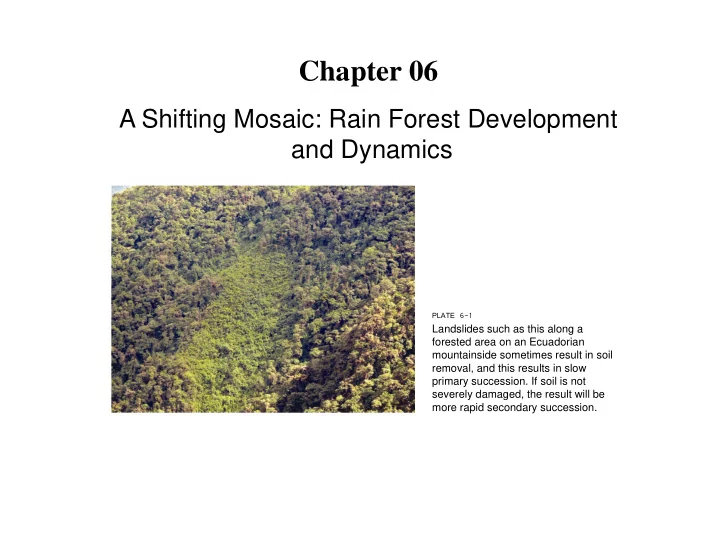
PLATE 6-1 Landslides such as this along a forested area on an Ecuadorian mountainside sometimes result in soil removal, and this results in slow primary succession. If soil is not severely damaged, the result will be more rapid secondary succession.

slide-2
SLIDE 2

FIGURE 6-1 General description of Neotropical secondary successions. Numbers on curves represent Phases 1-4 (see text).

slide-3
SLIDE 3

PLATE 6-2 Early secondary succession in the tropics is characterized by dense cover of sun-demanding species. From Ecuador. PLATE 6-3 This disturbed gap in Ecuador experiences an abundance

  • f sunlight, ideal for species such as this flowering

heliconia.

slide-4
SLIDE 4

PLATE 6-5 This abandoned house in Belize has become literally vine-covered as secondary succession has reclaimed the abandoned site. Cecropia trees are seen

  • vertopping the house.

PLATE 6-4 This field adjacent to a rural village in Belize, now abandoned, is undergoing secondary succession. The large-leaved plants are bananas.

slide-5
SLIDE 5

PLATE 6-6 This example of secondary succession reflects what the term jungle means in the ecological sense. Note how dense the vegetation is. The plant on the right is a tree fern.

slide-6
SLIDE 6

PLATE 6-7 Leaf area index measures the density of leaves from ground to canopy. The leaf area index of this well-shaded Amazonian forest would be high.

slide-7
SLIDE 7

FIGURE 6-2 Early secondary succession trends in community attributes of trees greater than 1.5 meters in height at Marquéz de Comillas, Southern Mexico. (a) Species density (number of species per 500 square meters. (b) Fraction of total number of trees belonging to shade-tolerant species. (c) Smith and Wilson’s measure of evenness (Evar). Black circles: census 1; brown circles: census 2. The bold continuous and dashed lines give the linear regressions of the variables of census 1 and 2, respectively, on fallow age.

slide-8
SLIDE 8

FIGURE 6-3 (a) Quickbird satellite imagery taken in 2004 showing the coverage of second-growth forest (green) and old-growth forest (dark gray) within La Selva Biological Field Station, Costa Rica. The two study sites, Lindero El Peje (LEP) and Lindero Occidental (LOC), are indicated by arrows. The horizontal bar represents 1 kilometer. (b) Map of genotyped trees in the 35-hectare LEP site. The curved line shows the boundary between the old-growth (OG) and the second-growth (SG) forest. The dashed line separates the far and near second-growth forest zones. The two reproductively dominant trees are A166 and A149. Reproductively active trees are labeled OG-R. Map positions of full-sib and half-sib (half-166

  • r half-149) offspring of the reproductively dominant trees are indicated. (c) Map of genotyped trees in the 8-hectare LOC site.
slide-9
SLIDE 9

FIGURE 6-4 Reproductive contribution of parental trees to founding adult tree generation of second-growth forest in (a) LEP and (b) LOC sites. Black arrows indicate reciprocal long-distance contributions from (a) four parents found in the LOC site and (b) nine parents in the LEP site. LG represents parents in the old-growth portion of the LOC site. PLATE 6-8 CHESTNUT-MANDIBLED TOUCAN (RAMPHAASTOS SWAINSONII)

slide-10
SLIDE 10

FIGURE 6-5 Absolute changes in total tree density (trees greater than 5 centimeters DBH) in four second-growth permanent sample plots from 1997 to 2003. FIGURE 6-6 Percentage change in density of three diameter size classes from 1997 to 2003 in four second-growth permanent sample plots.

slide-11
SLIDE 11

FIGURE 6-7 Regression of mean annual mortality rate of trees greater than 10 centimeters DBH

  • n dry-season rainfall (total rainfall between January and April) across six years.

Data are means for four second-growth plots.

slide-12
SLIDE 12

PLATE 6-9 Flowering heliconia in the understory of an Ecuadorian rain forest. Note the colorful bracts. The flower is barely visible within the second bract from the bottom.

slide-13
SLIDE 13

PLATE 6-10 This cluster of Piper in Belize is ready for a nocturnal visit by piperphile bats.

slide-14
SLIDE 14

PLATE 6-11 MIMOSA PIGRA PLATE 6-12 Clusters of cecropia trees are a common sight in sunny areas throughout the Neotropics.

slide-15
SLIDE 15

PLATE 6-13 Cecropias have large palmate leaves and flowers and fruits that dangle like fingers below the leaves, attracting numerous bird species.

slide-16
SLIDE 16

PLATE 6-14 Azteca ants on the bole of a cecropia. The brown bodies beneath the leaf axils supply the food for the ants.

slide-17
SLIDE 17

PLATE 6-15 Ceiba pentandra, the kapok or silk-cotton tree, is one of the most striking tropical trees.

slide-18
SLIDE 18

PLATE 6-16 Pastures such as this one in Panama have the capacity to undergo secondary succession and return to forest. The bird perched atop the cow is a smooth-billed ani (Crotophaga ani).

slide-19
SLIDE 19

PLATE 6-17 Tikal as it appears today.

slide-20
SLIDE 20

FIGURE 6-8 Charcoal mass (in grams per square meter) of soil charcoal summed for all depths (0 to 150 centimeters) and all subplots at 11 plots along the elevational gradient (240 per plot, means ± 2SE). Site 60-meter data are average of two separate sites at each elevation.

slide-21
SLIDE 21

PLATE 6-18 Peat fire in Borneo in summer 2009.

slide-22
SLIDE 22

PLATE 6-19 The invasive grass Saccharum spontaneum.

slide-23
SLIDE 23

FIGURE 6-9 Sequence of crops that would mimic successional patterns. See text for explanation.

slide-24
SLIDE 24

PLATE 6-20 (a) Manioc and (b) bananas are common components of the plots described earlier. (a) (b)

slide-25
SLIDE 25

PLATE 6-21 Fallen trees such as this former member of the canopy are the main cause of gaps.

slide-26
SLIDE 26

FIGURE 6-10 This figure shows vegetation height profiles for forest plots at El Verde, Puerto Rico, before and after Hurricane Hugo. Note how the hurricane reduced percent cover, opening a huge gap in the forest. PLATE 6-22 Gaps open the forest to high levels of sunlight, stimulating both germination of seeds in the soil bank as well as growth spurts of saplings already present.

slide-27
SLIDE 27

PLATE 6-23 Trema micrantha, a rapid gap colonizer.

slide-28
SLIDE 28

FIGURE 6-11 Distribution of light gaps and sapling species richness superimposed on a topographic map of the 50-hectare permanent forest plot on Barro Colorado Island (BCI), Panama. Contour intervals are 2 meters. (a) Distribution of light gaps in the 1983 canopy census. Each small square represents an area of 5 meters by 5 meters, the smallest gap censused. A c2 analysis between habitat type and gap abundance showed no correlation between gaps and topographic features of the plot in 1983 or in any later year. (b) Distribution of sapling species richness in the 20- meter by 20-meter quadrats in the 50-hectare BCI plot (1,250 total quadrats), showing the relationship between topography and species

  • richness. Yellow: < 29 species per 400 square meters. Blue: 30 to 39

species per 400 square meters. Orange: 40 to 49 species per 400 square meters. Reddish orange: > 50 species per 400 square meters. The central plateau and the small seasonal swamp (center and left, respectively) have 22% to 64% fewer species than slope areas to the east, south, and west. Note the lack of correlation with the 1983 gap sites in (a). A similar lack of correlation between species richness and gap disturbances also exists in the other years. FIGURE 6-12 Distribution of species richness per quadrat for all 20- by 20-meter quadrats containing 1983 gaps after 13 years (solid line) and for quadrats in nongap control areas that remained in mature, high-canopy forest over the entire 13-year period of the study (dashed line).
slide-29
SLIDE 29

FIGURE 6-13 Evidence for dispersal limitation in BCI trees from a 10-year seed trap study using 200 traps in the 50-hectare plot. Seeds of a total of 260 species of the 314 species in the plot census were collected at least once. (a) Frequency distribution of the number of species captured per trap during the 10-year trapping period (1987–1996). The average number of species per trap was 30.8 ± 7.5 SD. (b) The total number of traps into which each species dispersed at least

  • ne seed during the 10-year trapping period.
slide-30
SLIDE 30

FIGURE 6-14 Frequency histograms for (a) the coefficient of skewness of the logarithm of DBH (g1); (b) wood density; (c) fecundity quantified as the number of seeds produced per square meter of basal area per year; (d) percentage of sapling recruits located in tree-fall gaps; (e) seed establishment probability; (f) first-year seedling mortality; (g) relative sapling DBH growth; and (h) sapling mortality for large canopy tree species from Barro Colorado Island, Panama. The distributions are approximately normal or log-normal. Note the x-axis log scales in panels c to e, g, and h.

slide-31
SLIDE 31

PLATE 6-24 Palms are a common component of gaps in many tropical areas. PLATE 6-25 DIPTERYX PANAMENSIS

slide-32
SLIDE 32

PLATE 6-26 WHITE-LIPPED PECCARIES