2017-10-29 The IgE 50 years celebration in Stockholm No latent - - PDF document

2017 10 29
SMART_READER_LITE
LIVE PREVIEW

2017-10-29 The IgE 50 years celebration in Stockholm No latent - - PDF document

2017-10-29 The IgE 50 years celebration in Stockholm No latent atopic vulnerabilit y Non dust mite 6th of October 2017. Multiple Early Dust mite Multiple Late Part I: History and epidemiology Epidemiology; past and present Henry


slide-1
SLIDE 1

2017-10-29 1

sth@soton.ac.uk

Part I: History and epidemiology

Epidemiology; past and present The IgE 50 years’ celebration in Stockholm 6th of October 2017.

Stephen T Holgate Clinical & Experimental Sciences Faculty of Medicine University of Southampton, UK

Multiple Early No latent atopic vulnerabilit y Non dust mite Dust mite Multiple Late

Lausanne 1968 Henry Hyde Salter (1823-71) On asthma: Its Pathology and Treatment, 1860 Charles Harrison Blackley (1820-1900) Experimental Researches on the Causes and Nature of Catarrhusaestiuus, 1873 Otto Carl Prausnitz (1876-1963) Prausnitz C, KűstnerH. Studieniibu die Heberernpfindlickeit. Zbl Bakt Abt I Orig 1921; 86: 160-9 Heinz Küstner (1897-1963) Alfred William Frankland Treatment of chronic asthma with prednisolone: significance of eosinophils in the sputum Morrow Brown H:

  • Lancet. 1958: 2; 1245-7

Harry Morrow-Brown S Gunnar O Johansson

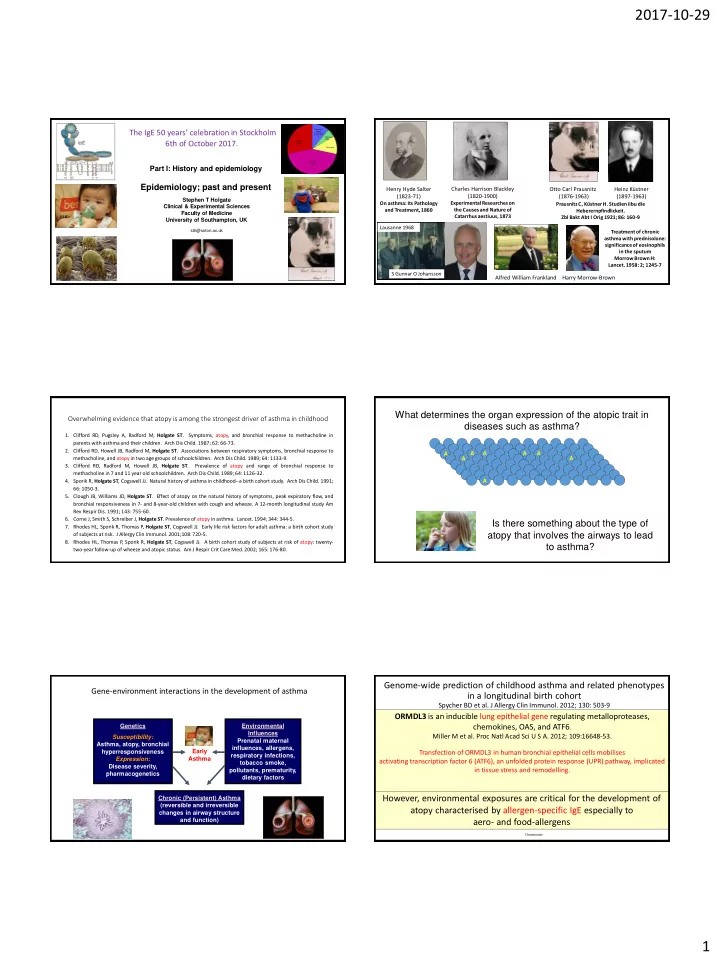
Overwhelming evidence that atopy is among the strongest driver of asthma in childhood

  • 1. Clifford RD, Pugsley A, Radford M, Holgate ST.

Symptoms, atopy, and bronchial response to methacholine in parents with asthma and their children. Arch Dis Child. 1987; 62: 66-73.

  • 2. Clifford RD, Howell JB, Radford M, Holgate ST. Associations between respiratory symptoms, bronchial response to

methacholine, and atopy in two age groups of schoolchildren. Arch Dis Child. 1989; 64: 1133-9.

  • 3. Clifford RD, Radford M, Howell JB, Holgate ST.

Prevalence of atopy and range of bronchial response to methacholine in 7 and 11 year old schoolchildren. Arch Dis Child. 1989; 64: 1126-32.

  • 4. Sporik R, Holgate ST, Cogswell JJ. Natural history of asthma in childhood--a birth cohort study. Arch Dis Child. 1991;

66: 1050-3.

  • 5. Clough JB, Williams JD, Holgate ST. Effect of atopy on the natural history of symptoms, peak expiratory flow, and

bronchial responsiveness in 7- and 8-year-old children with cough and wheeze. A 12-month longitudinal study Am Rev Respir Dis. 1991; 143: 755-60.

  • 6. Corne J, Smith S, Schreiber J, Holgate ST. Prevalence of atopy in asthma. Lancet. 1994; 344: 344-5.
  • 7. Rhodes HL, Sporik R, Thomas P, Holgate ST, Cogswell JJ. Early life risk factors for adult asthma: a birth cohort study
  • f subjects at risk. J Allergy Clin Immunol. 2001;108: 720-5.
  • 8. Rhodes HL, Thomas P, Sporik R, Holgate ST, Cogswell JJ. A birth cohort study of subjects at risk of atopy: twenty-

two-yearfollow-up of wheeze and atopic status. Am J Respir Crit Care Med. 2002; 165: 176-80. A A A A A A A

Is there something about the type of atopy that involves the airways to lead to asthma?

A

What determines the organ expression of the atopic trait in diseases such as asthma?

Gene-environment interactions in the development of asthma

Early Asthma Environmental Influences Prenatal maternal influences, allergens, respiratory infections, tobacco smoke, pollutants, prematurity, dietary factors Genetics Susceptibility: Asthma, atopy, bronchial hyperresponsiveness Expression: Disease severity, pharmacogenetics Chronic (Persistent) Asthma (reversible and irreversible changes in airway structure and function)

Genome-wide prediction of childhood asthma and related phenotypes in a longitudinal birth cohort

Spycher BD et al. J Allergy Clin Immunol. 2012; 130: 503-9

ORMDL3 IL33

ORMDL3 is an inducible lung epithelial gene regulating metalloproteases, chemokines, OAS, and ATF6.

Miller M et al. Proc Natl Acad Sci U S A. 2012; 109:16648-53. Transfection of ORMDL3 in human bronchial epithelial cells mobilises activating transcription factor 6 (ATF6), an unfolded protein response (UPR) pathway, implicated in tissue stress and remodelling.

However, environmental exposures are critical for the development of atopy characterised by allergen-specific IgE especially to aero- and food-allergens

slide-2
SLIDE 2

2017-10-29 2

Meta-analysis identifies seven susceptibility loci involved in the atopic march.

Marenholz I et al. Nat Commun. 2015 Nov 6;6: 8804 Association results of the meta-GWAS on the atopic march

  • Two novel loci specific for the combined eczema plus

asthma phenotype, which are associated with allergic disease rs9357733 in EF-hand domain-containing protein 1 on chromosome 6p12.3 (OR 1.27; P=2.1 × 10⁻⁸) and rs993226 between TMTC2 and SLC6A15 on chromosome 12q21.3 (OR 1.58; P=5.3 × 10⁻⁹).

  • Additional susceptibility loci identified at genome-wide

significance are FLG (1q21.3), IL4/KIF3A (5q31.1), AP5B1/OVOL1 (11q13.1), C11orf30/LRRC32 (11q13.5) and IKZF3 (17q21). Eczema often precedes the development of asthma in the 'atopic march'. Genetcs - multi-stage GWAS on infantile eczema followed by childhood asthma in 12 populations of 2,428 cases and 17,034 controls. Predominantly eczema loci increase the risk for the atopic march. Eczema may play an important role in the development of asthma after eczema - ?allergen sensitisation through the skin.

However, environmental exposures are critical for the development of atopy characterised by allergen-specific IgE especially to aeroallergens

Exposure to house-dust mite allergen (Der p I) and the development of asthma in

  • childhood. A prospective study in genetically at risk children; 1979-89.

Sporik R, Holgate ST, Platts-Mills TA, Cogswell JJ. N Engl J Med. 1990; 323: 502-7.

Levels of the House-Dust Mite Antigen, Der p I, in Dust Collected from Various Sites in the Homes of 59 Children in 1978. Relation between the Highest Concentration of Der p I Measured in House Dust in 1978 and the Four Clinical Groups in 1989.

No History

  • f Wheezing

History of Wheezing Active Wheezing & BHR Receiving Medication Der p1 (mg/g of dust) 1 10 100 Living Room Bedroom Mattress 4.34 18.4

Der p1 (mg/g of dust)

1 10 100 0.1 Geometric mean 2.4 Geometric mean

  • No. of children

13.6 23 18.O 36 22.8 13 26.0 7

Tom Platts-Mills Richard Sporik The presence of atopy predicted the development of childhood asthma, while non-atopics grow out of their wheeze Atopic n=94 Non-atopic n=59 Age (years) Prevalence (%)

Perennial allergen sensitisation early in life and chronic asthma in children: a birth cohort study

Allergens Growing out of “asthma” Illi S et al. Lancet 2006 Erika von Mutius

House dust mites proliferate in damp “sealed” homes: are they responsible for the rising asthma trends in asthma?

10 year prevalence survey of Wagga Wagga and Belmont: Peat JK et al. BMJ 1994; 308:1591 “We suggest that exposure to higher allergen levels has increased airway abnormalities in atopic children or that mechanisms that protected airways of earlier generations of children have been altered by new environmental factors”.

  • But what are those environmental factors?
  • Contrary to expectations draconian allergen reduction strategies failed to

impact on either the origins of asthma in high risk children or established asthma!

  • By reducing dust mite exposure, are we reducing other critical elements of

exposure in the environment?

Anne Woolcock

Bronchial mucosal manifestations of atopy: a comparison of markers of inflammation between atopic asthmatics, atopic non-asthmatics and healthy controls

Djukanović R, et al. Eur Respir J. 1992; 5: 538-44

  • Endobronchial biopsies in 13 symptomatic atopic asthmatics, 10 atopic nonasthmatics

and 7 normals.

  • Numbers of mast cells in submucosa no different between groups, but e.m. showed

mast cell degranulation, although less marked in atopic non-asthmatics, was a feature

  • f atopy in general.
  • Numbers of eosinophils greatest in asthmatics, low or absent in normals and

intermediate in atopic non-asthmatics.

  • Subepithelial basement membrane thickness on e.m. thickest in asthmatics,

intermediate in atopic non-asthmatics and thinnest in normals. Airways eosinophilia, degranulation of eosinophils and mast cells and increased subepithelial collagen are a feature of atopy in general and that the degree of change may determine the clinical expression of this immune disorder.

Ratko Djukanovic

What happens to airway inflammation and remodelling as adolescents “grow out” of asthma? The Isle of Wight Birth Cohort (1989/90 Study)

Children born on the Isle of Wight between 1st January 1989 and 28th February 1990 were recruited at birth to allow the monitoring of the natural history of asthma and allergies. The children were followed up at one, two, four, 10 and 18 years of age.

slide-3
SLIDE 3

2017-10-29 3

Asthma changes between age 10 and 18 years

Number Total Percent Persistent 125 181 (asthma at age 10 yrs.) 69.06% Remission 56 181 (asthma at age 10 yrs.) 30.94% New onset 56 198 (asthma ta age 18 yrs.) 28.28%

Asthma transition from age 10-18 years

Asthma remission was defined as having asthma at age 10 years but no asthma at 18 years; no symptoms, medication or BHR

p = 0.032 p = 0.029 P=0.015 PA AR NA PA AR NA FEV1 Tissue eosinophils Salbutamol reversibility

Persistent asthma Asthma remission No asthma

PA AR NA

Persistent asthma Asthma Remission No asthma

While early allergen sensitisation is important in predisposing to asthma, what are the features of this? Beyond atopy: multiple patterns

  • f sensitization in relation to

asthma in a birth cohort study

Simpson A et al. Am J Respir Crit Care Med. 2010; 181: 1200-6

  • To redefine the atopic phenotype by identifying latent structure within a complex

dataset, taking into account the timing and type of sensitization to specific allergens, and relating these novel phenotypes to asthma.

  • In a population-based birth cohort in which multiple skin and IgE tests have been

taken throughout childhood, machine learning approach used to cluster children into multiple atopic classes in an unsupervised way.

  • Reviews at age 1, 3, 5 and 8 years; 1030 children reviewed at age 8 years (87%)
  • SPTs and IgE (8 common inhalant & food allergens) measured at each follow-up visit
  • Then investigated the relationship between these classes and asthma (symptoms,

hospitalisations, lung function and airway reactivity).

M a n c h e t s t e r e A A s t d h n m a a l l r g y S u d y Acquired Sensitization at Age 1 Acquired Sensitization at Age 3 Acquired Sensitization at Age 5 Acquired Sensitization at Age 8 Skin Test at Age 1 Skin Test at Age 3 Skin Test at Age 5 Skin Test at Age 8 Sensitization Class Probability of Sensitization at Age 1 Probability of Gaining Sensitization Probability of Retaining Sensitization Probability of Positive Skin Test Given Sensitized Children (1053) Allergens Probability of Positive Skin Test Given NOT Sensitized Probability of Positive IgE Test Given Sensitized Probability of Positive IgE Test Given NOT Sensitized Switch Between Sensitization Classes 3 intervals (1-3, 3-5, 5-8) IgE Test at Age 1 IgE Test at Age 3 IgE Test at Age 5 IgE Test at Age 8

Adnan Custovic

M a n c h e t s t e r e A A s t d h n m a a l l r g y S u d y

Simpson et al. Am J Respir Crit Care Med. 2010

Latent Atopic Vulnerability Classes and Asthma

Likelihood of developing asthma age 8 years (odds ratio)

Jackson DJ. et al. Am J Respir Crit Care Med. 2008

N=73

N=186 No virus RV RSV PIV FLU CV MPV AdV EnV No virus RV RSV PIV FLU CV MPV AdV EnV

No asthma at 6 years Asthma at 6 years

Year1 Year 2 Year 3

Mean wheezing illnesses per year Virus detected

Wheezing rhinovirus illnesses in early life predict asthma development in high-risk children

  • Define the relationship between specific viral illnesses

and early childhood asthma development.

  • 259 children were followed prospectively from birth to

6 yrs of age.

  • Viral aetiologies were identified in 90% of wheezing

illnesses.

  • By age 3 yrs, wheezing with rhinovirus “RV” (OR,

25.6) was much more strongly associated with asthma at age 6 years than allergen sensitization (OR, 3.4).

  • Nearly 90% (26 of 30) of children who wheezed with

“RV” in yr 3 had asthma at 6 yrs. Robert Lemanske

Cellular mechanisms for the induction of asthma

Hit 1 Hit 2 Holgate ST. Nature Med. 2012;18: 673-83

Persistent activation of interlinked Th2-airway epithelial gene networks in sputum- derived 3 cells from aeroallergen-sensitized symptomatic atopic asthmatics

Jones AC et al. bioRxiv preprint first posted online Jul. 13, 2016; doi: http://dx.doi.org/10.1101/063602.

Vast majority of atopics do not develop asthma-related wheeze, despite ongoing exposure to aeroallergens to which they are strongly sensitised, indicating that additional pathogenic mechanism(s) operate in conjunction with Th2 immunity to drive asthma pathogenesis.

  • Systems analyses to identify gene networks operative at baseline in sputum-derived RNA from HDM-sensitised

subjects with/without wheezing history; identify networks characteristic of the ongoing asthmatic state.

  • HDM sensitised-nonwheezers displayed baseline gene expression in sputum including IL-5, IL-13 and CCL17.
  • HDM sensitized wheezers showed equivalent expression of these classical Th2-effector genes, but their overall

baseline sputum signatures were more complex, comprising hundreds of Th2-associated and epithelial- associated genes, networked into two separate co-expression modules:

  • The first module was connected by the hubs EGFR, ERBB2, CDH1 and IL-13.
  • The second module was associated with CDHR3, and contained genes that control

mucociliary clearance.

slide-4
SLIDE 4

2017-10-29 4

Reconstruction of the mucociliary clearance module identifies CDHR3 as a hub.

The molecular mechanism(s) that determine susceptibility to asthma amongst these subjects involve interactions between Th2- and epithelial function-associated genes within a complex co-expression network, which is not operative in equivalently sensitised/exposed atopic non-asthmatics.

Expression of CDHR3 in bronchial epithelial cells from HDM sensitised atopics with asthma and non-atopic controls Impaired innate immunity Epithelial “set point” altered Epithelial cell “injury” Barrier function breached Engagement of adaptive immunity Allergen sensitisation Inflammation with release of mediators IgE, mast cell, eosinophil Ineffective resolution of inflammation Persistence (tolerance ↓, apoptosis↓, cytotoxicity↑) Exacerbation Initiation of fibrosis/smooth muscle↑ Modelling Consolidation of fibrosis/smooth muscle Remodelling

Mechanisms for the induction and consolidation of asthma

Changing worldwide trends in asthma

  • Asthma and related allergic diseases have increased markedly in Western countries over

the past 50 years, and this has been attributed to urbanization and associated changes to diet and lifestyle1.

  • The urban-rural gradient in prevalence demonstrated most strongly in children who grow

up in environments with a wide range of microbial exposures (e.g. traditional livestock farms or in families who have adopted a more ‘naturalistic’ diet and lifestyle), who are protected from childhood asthma and atopy in proportion to their level of exposure to bacterial and fungal microbes2.

  • This protective effect against the onset of asthma in children is even more apparent if the

microbial exposure (for example, working with animals or drinking unpasteurized milk)3

  • ccurred throughout the mother’s pregnancy4.
  • 1. Alfvén T. et al. Allergy. 2006 Apr;61(4):414-21. 2. Ege MJ, et al. N Engl J Med. 2011 Feb 24;364(8):701-9.
  • 3. Ege MJ, et al. J Allergy Clin Immunol. 2007 May;119(5):1140-7. 4. Ege MJ, et al. J Allergy Clin Immunol. 2008 Aug;122(2):407-12, 412.e1-4.

The Karelia Allergy Study: younger generations are more allergic in Finland but not in Russia

5 10 15 20 25 30 35 40 45 1944- 1948 1949- 1953 1954- 1958 1959- 1963 1964- 1968 1969- 1973 1974- 1978 1979- 1983

Total IgE

FIN RUS 5 10 15 20 25 30 35 40 45 1944- 1948 1949- 1953 1954- 1958 1959- 1963 1964- 1968 1969- 1973 1974- 1978 1979- 1983

Birch

FIN RUS 5 10 15 20 25 30 35 40 45 1944- 1948 1949- 1953 1954- 1958 1959- 1963 1964- 1968 1969- 1973 1974- 1978 1979- 1983

Cat

FIN RUS 5 10 15 20 25 30 35 40 45 1944- 1948 1949- 1953 1954- 1958 1959- 1963 1964- 1968 1969- 1973 1974- 1978 1979- 1983

Timothy grass

FIN RUS

Laatikainen T, et al. Allergy 2011; 66: 886-92. Tari Haahtela

Bavarian women milking cows and their offspring exposed to a unique inhaled and food environment

Erika von Mutius

Prevalence of asthma and atopy among children living on farms as compared with reference groups

Ege MJ, et al. N Engl J Med. 2011; 364: 701-9 The PARSIFAL study population included 6843 school-age children 6 to 13 years of age, and the GABRIELA study population included 9668 children between 6 and 12 years of age. Calculations of prevalence in GABRIELA were weighted on the basis of the total number of children who were eligible for inclusion in the study (34,491 children).

slide-5
SLIDE 5

2017-10-29 5

Relationship between microbial exposure and the probability of asthma

Ege MJ, et al. N Engl J Med. 2011; 364: 701-9. In both the PARSIFAL study and GABRIELA, the range of microbial exposure was inversely associated with the probability of asthma.

Innate immunity and asthma risk in Amish and Hutterite farm children

Stein MM, et al. N Engl J Med. 2016; 375: 411-21 Analysis of genetic association Endotoxin levels in airborne dust from 10 Amish and 10 Hutterite homes

Hutterite Amish PC1 PC1

EU/m2

Amish Homes Hutterite Homes

P<0.001

Despite the similar genetic ancestries of Amish and Hutterite children, prevalence of asthma and allergic sensitization was 4 and 6 times as low in the Amish, whereas median endotoxin levels in Amish house dust was 6.8 times as high.

Communal branch of Anabaptists from Austrian province of Tyrol trace their roots to the Radical Reformation of the 16th century Proportions of peripheral-blood leukocytes and cell-surface-marker phenotypes in Amish and Hutterite children

Neutrophils Eosinophils Monocytes

Cell-Surface Markers on Neutrophils CXCR4 CD11b CD11c Cell-Surface Markers on Monocytes HLA-DR ILT3

Gene-Expression profiles in peripheral-blood leukocytes from Amish and Hutterite children Network of differentially expressed genes in untreated blood leukocytes Volcano plot; differences in baseline Gene expression in blood leukocytes from Amish and Hutterite children H>A A>H Innate immunity and asthma risk in Amish and Hutterite farm children Stein MM, et al. N Engl J Med. 2016; 375: 411-21

Microbial sensing receptors of the innate immune response

Determine healthy immune response

Innate immunity shapes adaptive immunity PAMP=Pathogen-associated molecular patterns PRR= Pathogen recognition receptors

  • Scalable triggering of innate immunity, as a principal determinant of allergy, is attractive.
  • In different environments, ambient air concentration of the TLR4 agonist, lipopolysaccharide,

can vary by as many as 5 logs, with the highest levels being encountered in association with livestock farming and pet ownership.

  • But are there other possible explanations?

Inflammation in adults, tolerance in babies and infants

Gene-environment interaction for childhood asthma and exposure to farming in Central Europe

Ege MJ et al. J Allergy Clin Immunol. 2011; 127: 138-44

  • The genome-wide interaction study did not reveal any significant interactions with SNPs within

genes in the range of interacting allele frequencies from 30% to 70%, for which our study was well powered.

  • Among rarer SNPs, 15 genes identified (e.g. glutamate receptor encoded by the “metabotropic 1”

gene) with strong interactions for asthma or atopy in relation to farming, contact with cows and straw, or consumption of raw farm milk.

Atopy

Farming/asthma Farming/atopic asthma Farming/ non-atopic asthma Genes represented by ≥ 2SNP P=0.05

Microbiome and exposome programming of metabolome

Non pathogenic and diverse microbes Farm/Rural Diet, inhaled and skin environment Metabolites Immunological tolerance Urban westernised diet, air pollution, smoking, chemical exposure Loss of immunological tolerance; Adjuvant

Asthma No Asthma

Different & less diverse microbes

Stress Hormones

slide-6
SLIDE 6

2017-10-29 6

Childhood allergies and asthma: New insights on environmental exposures and local immunity at the lung barrier.

Smits HH, et al. Curr Opin Immunol. 2016; 42: 41-7.