2. Welcome and Introductions 3. Approval of Minutes 4. Mike Schutz, - - PDF document

2 welcome and introductions 3 approval of minutes 4 mike
SMART_READER_LITE
LIVE PREVIEW

2. Welcome and Introductions 3. Approval of Minutes 4. Mike Schutz, - - PDF document

Indiana Land Resource Council Wednesday, November 15, 2017 1:30 p.m. 3:30 p.pm Agricultural Innovation Center 698 Ahlers Dr. West Lafayette, IN 47906 Members Present: Jeff Healy Kara Salazar Beth Tharp Jeff Page Steve Eberly Matt


slide-1
SLIDE 1

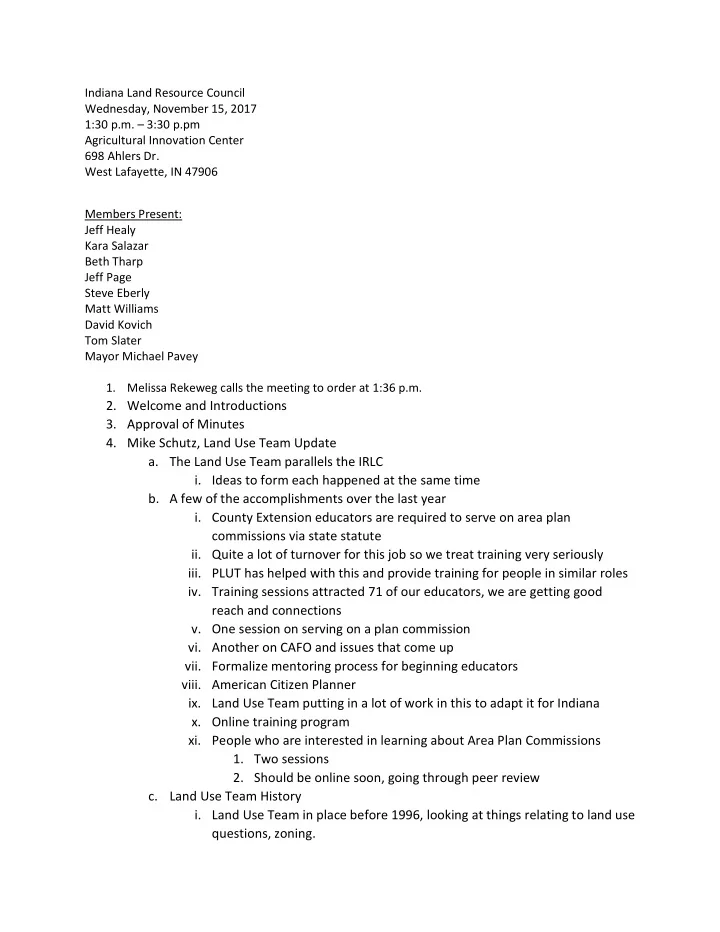
Indiana Land Resource Council Wednesday, November 15, 2017 1:30 p.m. – 3:30 p.pm Agricultural Innovation Center 698 Ahlers Dr. West Lafayette, IN 47906 Members Present: Jeff Healy Kara Salazar Beth Tharp Jeff Page Steve Eberly Matt Williams David Kovich Tom Slater Mayor Michael Pavey

  • 1. Melissa Rekeweg calls the meeting to order at 1:36 p.m.
  • 2. Welcome and Introductions
  • 3. Approval of Minutes
  • 4. Mike Schutz, Land Use Team Update
  • a. The Land Use Team parallels the IRLC
  • i. Ideas to form each happened at the same time
  • b. A few of the accomplishments over the last year
  • i. County Extension educators are required to serve on area plan

commissions via state statute

  • ii. Quite a lot of turnover for this job so we treat training very seriously
  • iii. PLUT has helped with this and provide training for people in similar roles
  • iv. Training sessions attracted 71 of our educators, we are getting good

reach and connections

  • v. One session on serving on a plan commission
  • vi. Another on CAFO and issues that come up
  • vii. Formalize mentoring process for beginning educators
  • viii. American Citizen Planner
  • ix. Land Use Team putting in a lot of work in this to adapt it for Indiana
  • x. Online training program
  • xi. People who are interested in learning about Area Plan Commissions
  • 1. Two sessions
  • 2. Should be online soon, going through peer review
  • c. Land Use Team History
  • i. Land Use Team in place before 1996, looking at things relating to land use

questions, zoning.

slide-2
SLIDE 2
  • ii. Over time, the team lost some momentum
  • iii. Started a brand new team instead of repopulating
  • iv. Period of 5-6 years when not much was happening, not many people left

to take the leadership

  • v. Jason Henderson and others saw the importance of re-establishing the

team

  • vi. Handed it to extension educators and specialists
  • vii. Key departments and extension areas are represented
  • viii. Goal is to help educators and others involved with land use issues
  • d. David: What is the size of the team?
  • i. 18-20 members, 1 from each area, 2 from each district and some

specialists

  • e. Melissa: How many times a year does the team meet?
  • i. About monthly
  • f. Jeff: What are some of the major projects?
  • i. ILRC project for Comprehensive Planning Guidance Document
  • ii. A number of publications
  • iii. 1 this last year and 8 others in progress
  • iv. CAFO website stocked with 12 new publications
  • v. Establishing Advisory Board
  • vi. Continued internal training for educators
  • 1. 18 months since last face to face training
  • 2. Time to revisit that
  • vii. Enough resources to start looking at additional public meetings for

decision makers and those that participate in planning commissions

  • viii. Webinar series for outreach
  • 1. Topics include bylaws and rules of procedures
  • 2. Findings of Fact
  • 3. New publications and some for revision
  • g. Melissa: Can you tell us a little more about what the trainings entail? What are

your educators taking away from these trainings?

  • i. Tamara: Few different audiences, those that don’t know anything about

it, have come into a whole new role

  • ii. Basics of how plan commissions operate and why it is available for

counties and municipalities in Indiana

  • iii. Reviewing site plans, going over hot topics and how commissions are

handling it, study committees for new ordinances

  • iv. Hiring consultants could be upcoming topics
  • v. Helping new members get comfortable
  • vi. Helping older members gain more knowledge and dive deeper into topics
  • h. Melissa: How do you measure success?
slide-3
SLIDE 3
  • i. By asking educators
  • ii. Going forward, work on some more external programs
  • iii. Are the programs we are doing, making a difference?
  • iv. Kara: We do have evaluation and survey research
  • i. David: Will you work with APC in the future?
  • i. Tamara: If we did, we would develop survey questions
  • ii. Surveying extension educators more informally through mentoring

process

  • iii. Evaluation tool after webinar as well
  • j. Jeff H: launch next year?
  • i. Kara: APC next year, webinars soon as well. We will put notices out

when those things are ready

  • ii. Citizen Planner is based on the speed of the group able to upload all the

content

  • 5. Discussion on location of future ILRC meetings
  • a. Plenty of places we can go, but is Indianapolis a good place? For you folks

coming from other areas and public as well?

  • b. Central Indiana
  • c. Within 2 hours from council members home base
  • 6. Update on Summer Study Committee
  • a. Tasked with studying CAFOs
  • i. Proximity to and interaction of CAFOs with suburban and urban areas,

issue relating to transformation of traditional farms to CAFOs, and the need for special regulations

  • b. Made up of House and Senate members from both parties
  • c. Met 3 times
  • d. Testimony heard from ISDA, IDEM, Indiana Soybean/Corn Growers, Indiana Pork,

citizens, farmers, HSUS, ACI, HEC, OISC

  • e. Odor and siting were primary reasons for this committee meeting.
  • f. Short answer on digesters was they are a solution but not the solution
  • g. Zoning and Home Rule also brought up
  • h. Lots of misconceptions on the authority of locals in siting CAFOs
  • i. Locals have as much control as they want to have
  • j. Committee heard from a lot of people and a lot of perspectives
  • k. Committee recommended,
  • i. Additional resources for IDEM
  • 1. Would allow for more periodic inspections
  • 2. Paul: more resources for complaints and response
  • ii. What’s reasonable notice? Called for review of that rule
  • 1. Greater radius and more notification
  • l. Could expect a bill that includes these recommendations
slide-4
SLIDE 4
  • m. Our new project deals with livestock issues and this summer study committee

brings up new relevance and renewed discussion. Wanted to give a lay of the land from a legislative standpoint and then have some additional information from Tamara and Paul

  • n. Legislature doesn’t seem as interested in new authority for IDEM, do what they

have the authority to do but do it better. Don’t want to encroach on local control either

  • 7. Additional ISDA policy updates
  • a. ISDA is doing a cleanup bill in their statute
  • b. FSMA Produce Rule proposal with Indiana State Department of Health
  • c. Keeping track of everything else as well
  • d. Study Committee was civil, well conducted, collaborative
  • e. David: inspection reports online?
  • i. Jeff: Yes, all available online. In fact someone testified on a legislator’s

record of inspection for his own CAFO

  • ii. Constituent: this legislator was 9 years out, not in compliance
  • iii. Jeff H. You mention odor? It is very subjective, did anyone testify on

that? Any recommendation on odor?

  • iv. Jeff: Ultimately, no recommendation. Setbacks and buffers can fix this,

digesters were brought up on this. What is the answer here, probably not just one answer

  • v. Jeff Page: Odor and siting were the reason for this hearing?
  • vi. Jeff: The concerns on this were driven by constituents contacting

legislators about the location of these barns so it started as odor and siting but also moved to IDEM, pollution, water quality, property values.

  • vii. Jeff Page: How does their recommendation correct the initial complaint?

Dumping additional resources into regulatory body

  • viii. Jeff: So much misconception. As it went on, legislators realized local

control, zoning, model zoning ordinances

  • ix. Setbacks not the silver bullet, locals do have other options
  • x. Jeff Page: IDEM process complaint driven? Is there an audit on how that

is effectively working? To see if people are using it for nonconstructive purposes

  • xi. Jeff: State Chemist addressed that in testimony. They investigate every
  • complaint. There was no discussion on whether those complaints bore

fruit or if they were malicious. Not sure if the agency could come up with a way to track the kinds of complaints etc.

  • xii. Melissa: Average interval of 5 years, and obviously someone got missed.

Agency report on them missing this?

slide-5
SLIDE 5
  • xiii. Jeff, you can see each inspection report and the gap between them. Not

sure of an agency operating metric. 5 years not a requirement, just their current average.

  • xiv. Jeff Healy: A lot of resources for something to monitor inspection metric.

Such as the owner requesting an inspection.

  • xv. Jeff C: There was also discussion on IDEM responding to complaints

about unregulated facilities. Small unregulated operations are complained on as well.

  • 8. Confined Feeding Operation Ordinances Research at Purdue – Tamara Ogle and Paul

Ebner (Presentation slides attached)

  • a. Background
  • b. What we did
  • i. Surveyed educators
  • ii. Identified who has planning and zoning and who doesn’t
  • iii. After we collected ordinances, identified common components
  • iv. We asked educators a series of questions about the ordinances
  • v. Did they feel like there were adequate resources?
  • c. What resulted was this report: County Regulation of Confined Feeding

Operations in Indiana: an Overview

  • i. Available online
  • d. January 2016 Report
  • i. Counties use a few different tools
  • ii. Site scoring
  • iii. Neighbor’s approval
  • iv. Homesteading
  • v. Straight standards, i.e. odor standards
  • vi. You can see what may be some issues in that county, based on the
  • rdinance specifics
  • vii. Most distances were somewhat arbitrary
  • viii. Very little to indicate which provisions, or standards are effective. No

research that says ½ mile is effective.

  • e. County Regulation of Confined feeding Operations in Indiana: Progress Report
  • i. What stuck out was arbitrary numbers, are their provisions that are more

effective than others?

  • f. Our findings were limited by
  • i. Small sample size
  • ii. Randomness of data
  • 1. No true mean of a residential use buffer in Indiana
  • 2. Correlation does not mean cause and effect
  • g. Number of permitted farms in a county, as they increase, the number of

complaints lowers

slide-6
SLIDE 6
  • h. If a county has a CFO ordinance, less likely to have conflict
  • i. Going to look at changes over time
  • j. County demographics
  • k. All this data was not very accessible, tried to take the data and put it in a more

visual form

  • l. Heat maps
  • i. Assign county to a percentile/color
  • ii. (See map in presentations)
  • iii. Something that was tabled was the amount of buffers you have, how that

affects the land that is buffered

  • m. Does population density matter? If it is highly concentrated in cities and towns,

test these variables on GIS maps of six Indiana counties

  • n. Inventory of Ordinances Update
  • . Data will be useful 5, 10, 20 years from now as we collect it
  • p. We have had a county adopt planning since then
  • q. Hope to update every few years
  • r. Where everything can be found
  • i. https://ag.purdue.edu/cfo
  • s. Questions:
  • i. David: Are there things that you say, “Every county should be that way”
  • r are all counties very independent and will what they want to do
  • ii. Tamara: They can do what they want to do, and some were very

different but others adopted other county language

  • 1. Wouldn’t expect them to all be the same because they are facing

different issues

  • 2. You can be too livestock friendly to the point that you are not

friendly to current producers

  • 3. All face different issues, probably why Study committee found it is

all local control and is best that way.

  • 4. We don’t take a normative approach to policy. We show
  • alternatives. Research on efficacy could help us get to that point
  • iii. Citizen: Have you considered factoring in property values?
  • 1. Paul: We did not, there are a lot that have though.
  • 2. 2007 or 2008 paper by Purdue
  • iv. Melissa: Did you go back to the counties and present that data? Curious

about reactions?

  • 1. Tamara: No, but we did share the factsheets with all the counties

and presented at APA

  • 2. Counties did review all their factsheets to make sure we

characterized them correctly and fairly.

slide-7
SLIDE 7
  • 3. We did hear that a lot had looked at the study and were looking at

how they fit in with others

  • v. Citizen: Did you run into counties that did not have participation by the

extension educator?

  • 1. Tamara: State statute if it is an advisory commission they are
  • required. Area commissions are not require. Only required if it is

an advisory board.

  • vi. Citizen: Did you study the 303 impaired waters list? Seems like this

should be a big concern as we the taxpayers have to pay to clean this up. What you say and what you present affects siting around our waters and may motivate IDEM changes.

  • 1. Tamara: Our intent only to look at what ordinances are currently
  • ut there. Nothing about regulations,
  • vii. Citizen: Did you ask about maybe that’s why they have certain
  • rdinances?
  • 1. Yes, but didn’t go that in depth on the question. More of a

general question

  • viii. Beth: How prevalent are site scoring systems?
  • 1. 5 of them for CFOs
  • 9. Group Discussion: Model Zoning ordinances, or what has been discussed here.
  • a. Group 1: Jeff Healy, Tom Slater, Steve Eberly
  • i. Steve: Reality is there is a lot of opportunity for economic development,

could lead to education. Local control and BZA. In a period of learning, especially for old ordinances and lack of standards.

  • 1. Special Exception process historically has led to arbitrary
  • comments. It is a disservice to everyone. Defined standards need

to be a rock solid starting point. The discussions need to happen in a different venue instead of putting small group of locally elected officials in that setting. It is the wrong place to bring those up.

  • ii. Melissa: Defined standards came up in a first meeting but we didn’t think

we were at that point. Do we feel like we are now?

  • iii. Jeff Healy: Late 80s, early 90s there was collaborative group that did

come up with standards, maybe something this group could advocate for?

  • iv. Steve: Clearly this group is bigger than livestock issues. Standards do

create a starting point where people can discuss alternatives to a standard in a civil manner.

  • b. Group 2: Kara, Mayor Pavey, Matt
  • i. Mayor Pavey: I am a mayor in an Ag community. Large number of

counties in a decline, some in heavy decline. Mine is in that heavy

slide-8
SLIDE 8
  • decline. Balance is important. One side comes on too strong and takes
  • ver. Our county has housing scoring and CFO scoring. We broke from

that in an order to try and be more successful. 40 acre rule to build a

  • house. It is tough to market our community because someone has to buy

40 acres. Some people say “we always give the exception” Sure but how do we market this? Don’t have to always approve Ag things just make sure we appear “pro-ag”. We need that balance. What Jeff said that we have to have conversations about this before it reaches a vote. Before people have to vote on an issue. People get emotions up and get very serious.

  • ii. Kara: Best practices for engagement and getting those conversations
  • together. Including those in this guidance document
  • iii. Matt: In my perspective working with TNC, we have an extensive effort

under way to reduce nutrients, especially Wabash River. I would be interested at looking where are the fields that this manure will be applied, close to ditches, field tile etc.

  • iv. Mayor: Conversations in my community are best facilitated by Purdue
  • University. They are trusted in the Ag community. Purdue offers a

balance,

  • c. Group 3: David, Jeff Page, Beth Tharp
  • i. Beth: Setback recommendations, how were these derived I wonder?
  • 1. Paul: Some counties copied others, some are arbitrary
  • 2. Tamara: Other things have buffers and setbacks. Often efficacy

isn’t the goal, it is just what we want in our community.

  • ii. David: You can see both sides of a lot of things.
  • 10. New Business:
  • a. Kara: Feedback on Overview Curriculum that was submitted to council. Team

has met twice. Looking at robust draft in January and finishing initial draft this spring and then to peer review. You can send comments or other ideas to me. We will be in conversations with APA about the new sections in their guide. We want to compliment not duplicate.

  • b. Standard guidelines?
  • c. Ag and Biological Systems department at Purdue and IDEM were leads in

previous efforts decades ago

  • d. Steve: standard guidelines in terms of animal agriculture or more general?
  • i. Group: more general
  • e. Katie will look for standard guidelines and send to council if found
  • f. Jeff Healy: Ohio has interesting Right to Farm vs. Indiana Right to Farm
  • g. Jeff Cummins: Legislative session starting in January, we are thinking late March
  • r April for next meeting
  • 11. Audience Comments
slide-9
SLIDE 9
  • a. Citizen: Are there minutes from Purdue land Use team online?
  • b. Kara: not sure, I don’t think they are online.
  • c. Citizen: Does the Land Team review any meetings that are held at the local

level? Do you see how the APC is working? Do they work in specific counties?

  • i. Not in specific counties. We educate on procedural rules but not on how

to vote.

  • d. Citizen: One thing that could stop most conflict is to make the setbacks from

property lines. That is what I hear the most from people. When your son can’t build on your own property that you are paying taxes because of setbacks from CAFO

  • e. Citizen: Indiana Right to Farm act being contested in Hendricks County case.

Result of that will be important. Right to Farm Act protects farmers from liability when that is not what it should be about. There was a lot of misrepresentation in front of the legislators. Such as the 5 year inspection average. If you go online and actually average it out, it is more like 7 or 8 years. If you are advising the state on CAFOs, someone should go in and look at this. It was brought up that complaints are followed up. You can go online and look at how long it takes IDEM to respond to complaints. One of them is 30 days. If monitoring isn’t done immediately, and it is in a creek, it is gone before they get there. Any assessment done about CAFOs has to take into account property values. Studies say your property values will decline 40-80%. Only thing worse than CAFO next to you is landfill next to you. As a land use council, you should address this.

  • 12. Council adjourns meeting at 3:40
slide-10
SLIDE 10

PURDUE UNIVERSITY EXTENSION

Conf Confined F ined Feeding Operation eeding Operation Or Ordinance dinance Resear esearch at h at Pur Purdue ue

Indiana Land Resource Council, November 2017

Paul Ebner, Associate Professor, Department of Animal Sciences Tamara Ogle, Community Development Regional Director Yingying Hong, Project Director, Department of Animal Sciences Tanya Hall, Community Development Regional Director Larry DeBoer, Professor, Department of Agricultural Economics

slide-11
SLIDE 11

Back Backgr ground.

  • und.
  • In May 2015, Purdue Extension was commissioned

by the State of Indiana to characterize zoning

  • rdinances across Indiana as they apply to CFOs.

Conf Confined F ined Feeding Operation R eeding Operation Resear search ch at at Pur Purdue due

Indiana Land Resource Council, November 2017

slide-12
SLIDE 12

What w What we did. did.

  • Collected zoning ordinances from counties

identified as having standards or provisions for confined feeding operations (CFOs).

  • Identified and compared common zoning tools

used by counties to regulate CFOs.

Conf Confined F ined Feeding Operation R eeding Operation Resear search ch at at Pur Purdue due

Indiana Land Resource Council, November 2017

slide-13
SLIDE 13

What w What we did. did.

  • Surveyed plan directors and Purdue Extension

Educators regarding:

  • Provisions and standards for CFOs in their

counties

  • Recent or proposed changes to zoning
  • rdinances
  • Level of discourse regarding zoning issues

related to CFOs

Conf Confined F ined Feeding Operation R eeding Operation Resear search ch at at Pur Purdue due

Indiana Land Resource Council, November 2017

slide-14
SLIDE 14

PURDUE UNIVERSITY EXTENSION

County R County Regulation of Confined gulation of Confined Feeding Operations in Indiana: eeding Operations in Indiana: An Overview

JANUARY 2016 REPORT

Paul Ebner, Associate Professor, Department of Animal Sciences Tamara Ogle, Community Development Regional Director Tanya Hall, Community Development Regional Director Larry DeBoer, Professor, Department of Agricultural Economics Jason Henderson, Director and Associate Dean, Purdue University Extension

slide-15
SLIDE 15

Januar January 20 y 2016 R Repor port.

  • Characterization of provisions for CFOs across

counties:

  • 80 counties with P & Z; 64 with CFO ordinance
  • Review and approval process
  • Setbacks and buffers
  • Additional common standards (e.g., required

lot sizes, odor control, etc.)

Conf Confined F ined Feeding Operation R eeding Operation Resear search ch at at Pur Purdue due

Indiana Land Resource Council, November 2017

slide-16
SLIDE 16

Conf Confined F ined Feeding Operation R eeding Operation Resear search ch at at Pur Purdue due

Indiana Land Resource Council, November 2017

slide-17
SLIDE 17

Januar January 20 y 2016 R Repor port.

  • Preliminary observations:
  • Very little uniformity across counties
  • The provisions for CFOs in the zoning ordinance

indicated some of the issues or factors concerning individual counties.

  • Most distances are somewhat arbitrary, most
  • ften fitting ¼, ½, or mile increments.
  • Very little to indicate which provisions,

standards, or distances are effective from a land use perspective (review of literature).

Conf Confined F ined Feeding Operation R eeding Operation Resear search ch at at Pur Purdue due

Indiana Land Resource Council, November 2017

slide-18
SLIDE 18

PURDUE UNIVERSITY EXTENSION

County R County Regulation of Confined gulation of Confined Feeding Operations in Indiana: eeding Operations in Indiana: Progress Report

MARCH 2017

Paul Ebner, Associate Professor, Department of Animal Sciences Yingying Hong, Project Director, Department of Animal Sciences Tamara Ogle, Community Development Regional Regional Director Tanya Hall, Community Development Regional Director Larry DeBoer, Professor, Department of Agricultural Economics

slide-19
SLIDE 19

Our Objectiv Our Objective.

  • Use data from our previous research to identify

which CFO standards or provisions are effective at reducing conflict between CFOs and other land uses.

  • Contribute to the broad aim of measuring the

efficacy of policy, providing research to decision makers, and improving the quality of debate related to CFOs and zoning ordinances

Conf Confined F ined Feeding Operation R eeding Operation Resear search ch at at Pur Purdue due

Indiana Land Resource Council, November 2017

slide-20
SLIDE 20

What w What we did. did.

  • Catalogued CFO related violations as a proxy

measurement of conflict

  • Measured the “tone” of discourse surrounding CFO

siting in different Indiana counties

  • Measured opinions (plan directors, Extension

educators) as to the difficult of CFO siting compared to other zoning issues in different Indiana counties

Conf Confined F ined Feeding Operation R eeding Operation Resear search ch at at Pur Purdue due

Indiana Land Resource Council, November 2017

slide-21
SLIDE 21

What w What we did. did.

  • Cross‐referenced and compared the different variables to

determine if any of them are correlated

  • Number of permitted farms
  • IDEM enforcements
  • OISC violations
  • Complaints to OISC
  • Planning and zoning
  • CFO ordinance
  • Extended setbacks/buffers
  • Ag clause/reciprocal buffers
  • Difficulty/”Tone” of CFO siting

Conf Confined F ined Feeding Operation R eeding Operation Resear search ch at at Pur Purdue due

Indiana Land Resource Council, November 2017

slide-22
SLIDE 22

What w What we f found (correlations). und (correlations).

Correlations Identified at Time of Report Independent Variable Dependent Variable Relationship Number of permitted farms  Average enforcements/violations (IDEM and OISC) per permitted farm in the county Negative  OISC investigations resulting from anonymous/residential complaints per permitted farm in the county Negative CFO Ordinance  OISC investigations resulting from anonymous/residential complaints per permitted farm in the county Negative Number of Buffer Categories  OISC investigations resulting from anonymous/residential complaints per permitted farm in the county Negative Residential Use Setback  OISC investigations resulting from anonymous/residential complaints per permitted farm in the county per permitted farm in the county Negative Approval Process  OISC Violations Negative Difficulty of CFO Siting  “Tone” of Discourse Positive

Conf Confined F ined Feeding Operation R eeding Operation Resear search ch at at Pur Purdue due

Indiana Land Resource Council, November 2017

slide-23
SLIDE 23

Im Implications. plications.

  • Data set is established and we are interested in hearing

what other types of comparisons may be helpful

  • Changes over time
  • Impact of county demographics

Conf Confined F ined Feeding Operation R eeding Operation Resear search ch at at Pur Purdue due

Indiana Land Resource Council, November 2017

slide-24
SLIDE 24

PURDUE UNIVERSITY EXTENSION

Thir Thirty ty-se

  • seven

en Fact ctors that could

  • rs that could

Af Affect CF ct CFO Siting in Indiana – O Siting in Indiana – Com Comparison of Counties arison of Counties

MARCH 2017

Paul Ebner, Associate Professor, Department of Animal Sciences Yingying Hong, Project Director, Department of Animal Sciences Tamara Ogle, Community Development Regional Director Tanya Hall, Community Development Regional Director Larry DeBoer, Professor, Department of Agricultural Economics

slide-25
SLIDE 25

Com Comparing all the f aring all the fact ctor

  • rs.

s.

  • Attempt to make the data more

accessible/reader‐friendly

  • Compared 37 factors that could

affect CFO siting across all Indiana counties

  • Heat maps
  • Places each county in a

percentile

  • Assigns color to each

percentile

Color' Percentile' !!

Top!20%!

!!

Top!40%!

!!

Top!60%!

!!

Bottom!40%!

!!

Bottom!20%!

!

No!standard!or!provision

Conf Confined F ined Feeding Operation R eeding Operation Resear search ch at at Pur Purdue due

Indiana Land Resource Council, November 2017

slide-26
SLIDE 26
slide-27
SLIDE 27

Conf Confined F ined Feeding Operation R eeding Operation Resear search ch at at Pur Purdue due

Indiana Land Resource Council, November 2017

slide-28
SLIDE 28

Mapping CF Mapping CFO Zoning Or O Zoning Ordinances dinances

Dispersed Land Uses 500 ft. Buffer 1,000 ft. Buffer 2,000 ft. Buffer

9% 56% 23%

Percent Land Area Protected

Conf Confined F ined Feeding Operation R eeding Operation Resear search ch at at Pur Purdue due

Indiana Land Resource Council, November 2017

slide-29
SLIDE 29

Mapping CF Mapping CFO Zoning Or O Zoning Ordinances dinances

Concentrated Land Uses 500 ft. Buffer 1,000 ft. Buffer 2,000 ft. Buffer

3% 13% 6%

Percent Land Area Protected

Conf Confined F ined Feeding Operation R eeding Operation Resear search ch at at Pur Purdue due

Indiana Land Resource Council, November 2017

slide-30
SLIDE 30

Mapping CF Mapping CFO Zoning Or O Zoning Ordinances dinances

  • Variables that affect Percent of Land Area Protected
  • Land Area of County
  • Population / Number of Protected Land Uses
  • Concentration / Dispersion of Land Uses
  • Buffer Radius
  • Measure hypothesized relationships between these

variables and percent protected

  • For example, each 500 feet in added buffer adds x% to percent

protected, given land area, population and concentration

  • Test the effects of these variables on GIS maps of six

Indiana counties

Conf Confined F ined Feeding Operation R eeding Operation Resear search ch at at Pur Purdue due

Indiana Land Resource Council, November 2017

slide-31
SLIDE 31

In Invent ntor

  • ry of Or

y of Ordinances U dinances Updat date

  • Surveys being collected to capture changes or

additions to in Indiana counties’ zoning ordinance related to CFOs.

  • County factsheets will be updated and a report

issued on findings.

Conf Confined F ined Feeding Operation R eeding Operation Resear search ch at at Pur Purdue due

Indiana Land Resource Council, November 2017

slide-32
SLIDE 32

Where e Where ever erything can be f ything can be found. und.

  • https://ag.purdue.edu/cfo
  • Additional information for planning professionals, Extension

Educators, others involved with or interested in CFO siting and regulation

  • Basic Info
  • Tools for Planners
  • State of Research
  • Information from Purdue

and other land grant schools

Conf Confined F ined Feeding Operation R eeding Operation Resear search ch at at Pur Purdue due

Indiana Land Resource Council, November 2017

slide-33
SLIDE 33

Questions/Present Questions/Presenter Contact Inf r Contact Info.

  • Paul Ebner, pebner@purdue.edu, 765‐494‐4820
  • Tamara Ogle, togle@purdue.edu, 317‐523‐8804
  • Tanya Hall, tjhall@purdue.edu, 812‐723‐7107
  • Larry DeBoer, ldeboer@purdue.edu, 765‐494‐4314

Conf Confined F ined Feeding Operation R eeding Operation Resear search ch at at Pur Purdue due

Indiana Land Resource Council, November 2017