2. Identify and order up to five existing practices and techniques - - PDF document

2 identify and order up to five existing practices and
SMART_READER_LITE
LIVE PREVIEW

2. Identify and order up to five existing practices and techniques - - PDF document

Enabling the TCNs and Collaborators Breakout Group #4: Label Capture & Post-Processing Facilitator Name: Jim Hanken Scribe Name: Grant Godden Time Allotted: 150 minutes Group Participant List: Corinna Gries, Umberto Ravaioli, Robert Naczi, Alan


slide-1
SLIDE 1

Enabling the TCNs and Collaborators Breakout Group #4: Label Capture & Post-Processing

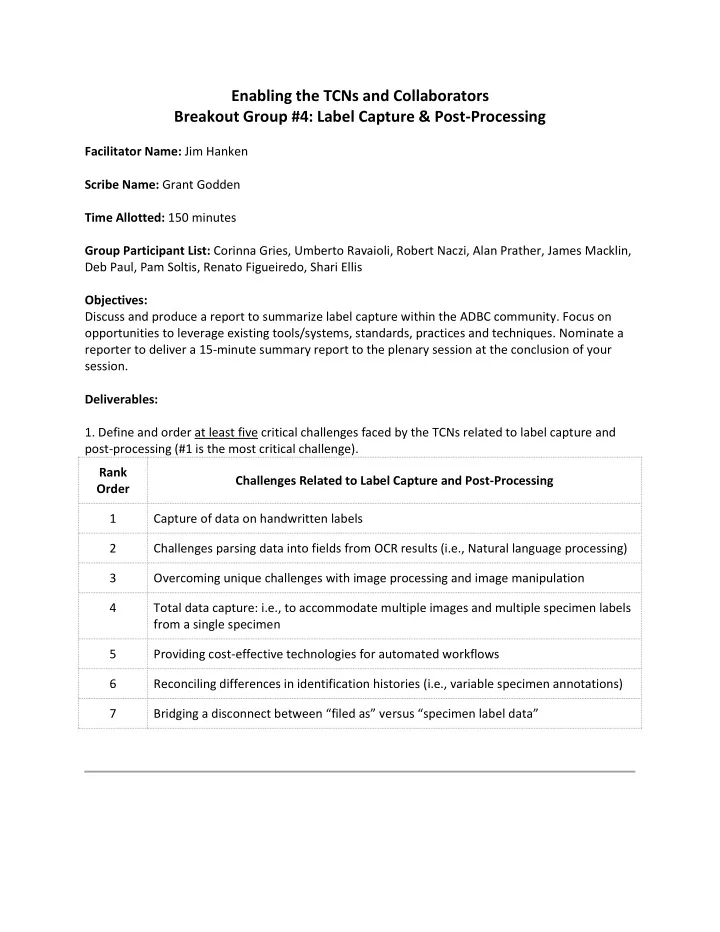
Facilitator Name: Jim Hanken Scribe Name: Grant Godden Time Allotted: 150 minutes Group Participant List: Corinna Gries, Umberto Ravaioli, Robert Naczi, Alan Prather, James Macklin, Deb Paul, Pam Soltis, Renato Figueiredo, Shari Ellis Objectives: Discuss and produce a report to summarize label capture within the ADBC community. Focus on

  • pportunities to leverage existing tools/systems, standards, practices and techniques. Nominate a

reporter to deliver a 15-minute summary report to the plenary session at the conclusion of your session. Deliverables:

  • 1. Define and order at least five critical challenges faced by the TCNs related to label capture and

post-processing (#1 is the most critical challenge). Rank Order Challenges Related to Label Capture and Post-Processing 1 Capture of data on handwritten labels 2 Challenges parsing data into fields from OCR results (i.e., Natural language processing) 3 Overcoming unique challenges with image processing and image manipulation 4 Total data capture: i.e., to accommodate multiple images and multiple specimen labels from a single specimen 5 Providing cost-effective technologies for automated workflows 6 Reconciling differences in identification histories (i.e., variable specimen annotations) 7 Bridging a disconnect between “filed as” versus “specimen label data”

slide-2
SLIDE 2
  • 2. Identify and order up to five existing practices and techniques that can be leveraged for label

capture and post-processing (#1 is the most preferred practice/technique). If more than five, focus

  • n the five that are currently the most viable, commonplace, and applicable to the needs of the

TCNs and collaborators, while keeping a list of all references to existing practices. Rank Order Label Capture and Post-Processing Practices and Techniques 1 Borrow from existing commercial/proprietary software and practices used by industry/government (CAPTCHA) 2 Imaging (pen camera, gigapan, etc.) 3 Image enhancement and manipulation 4 Multi-keying (crowd-sourcing)

  • 3. Identify and order up to five existing standards that can be leveraged for label capture and post-
  • processing. If more than five, focus on the five that are currently the most viable, commonplace,

and applicable to the needs of the TCNs and collaborators. Explain the choices. Rank Order Label Capture/Processing Standards Explanation of Selections 1 DARWINCORE/ABCD 2 AUDUBONCORE 3 OGC: Open Geospatial Consortium 4 Controlled taxon name authority (ITIS, CoL, etc.) 5 ISO Standard (Geography) Other (non- prioritized) Other controlled names (phenology, etc.)

slide-3
SLIDE 3
  • 4. Identify and order up to five existing tools/systems that can be leveraged for label capture and

post-processing (#1 is the most preferred tool/system). If more than five are proposed, focus on the five that are currently the most viable and beneficial to the greatest number of stakeholders. Explain the choices. Link tools/systems to the practices/techniques (identified in Deliverable #2) and standards (identified in Deliverable #3) that each enables or supports. Rank Order Label Capture and Post- Processing Tools Explanation of Selections Linked Practices/ Techniques (Line Numbers) Linked Standards (Line Numbers) 1 APIARY / SALIX 2 Data Management Systems: SYMBIOTA, SPECIFY, BGbase, etc. 3 SGR (Scatter Gather Reconcile) / FP (Filtered Push) 4 GeoLocate; Geomancer 5 ABBYY OCR (commercial); TESSERACT OCR; Adobe OCR

  • 5. Define specific gaps that exist within each of the identified tools/systems (e.g., functionality

problems, scalability limitations, availability, licensing issues, cost, lack of standard usage, missing features). Rank Order Label Capture and Post- Processing Tools (list 1-5 from table above) Gaps, Issues and Opportunities for Improvement 1 APIARY / SALIX Licensing for OCR; May work better with proprietary OCR software; Accommodation of handwriting 2 Data Management Systems: SYMBIOTA, SPECIFY, BGbase, etc. Gaps associated with the components 3 SGR (Scatter Gather Reconcile) / FP (Filtered Push) Clustering algorithm improvement; Not ready for deployment (FP) 4 GeoLocate; Geomancer Ability to store and reuse changes 5 ABBYY OCR (commercial); TESSERACT OCR; Adobe OCR Handwriting; Licensing costs

slide-4
SLIDE 4
  • 6. Identify the critical implementation date for HUB appliances that would enable/enhance label

capture and post-processing based upon TCN project plans. Explain why this date is critical. Critical Implementation Date (Appliance) Explanation TSTB--TTD: 7/1/12 Subcontracts for entomology begin on this date (7/1/12). For botany, their contracts begin 1/1/13. LBCC: ASAP Work is already underway; if it’s not available from HUB, we will have to complete the work ourselves. IN: 1/1/13 Efforts now are concerned with imaging/raw data capture.

  • 7. Produce documentation related to the development/implementation of a label capture and post-

processing appliance to serve the needs of the ADBC community. Functional Requirements: Image processing, image management (local storage/management and transfer to HUB) and text processing. Modular components (for some) vs. total “do-it-all” package (for others); Estimated computational resource requirements (computation, storage, network capacity): Storage space -- are label images stored here?

  • TBD. Requires additional knowledge of how

appliance will be configured/deployed. Specific items the HUB needs to deliver to enable/enhance label capture and post- processing: Post-processing appliances; packages/workflows -- what will be hosted at TCN vs. what will reside at HUB Image data management mechanism Feedback/tagging mechanism (for OCR) Useful tool: image “segmentation” software Quality assurance/control module Specific items the TCNs needs to deliver to enable/enhance label capture and post- processing: Unique to a TCN: TTD: lightbox -- share best practices Applicable to more than 1 TCN: Best practices for imaging activities

slide-5
SLIDE 5

Provide a risk assessment related to this label capture and post-processing appliance. Likelihood of Occurrence: 1 = Highly Likely, 2 = Somewhat Likely, 3 = Not Likely Impact of Occurrence: 1 = Significant Impact, 2 = Moderate Impact, 3 = Little/No Impact Risk Name Brief Description Likelihood of Occurrence Impact of Occurrence Potential Mitigation Strategies Data error Incorrect data capture by OCR 1 1-3 controlled vocabularies; post- processing curation (e.g., crowd-sourcing, etc.) Destructive imaging From handling 2 1-3 training modules;

  • versight; best

practices Data loss e.g., corruption during file processing/transfer 2-3 1-3 “versioning”; backup (redundant storage) Data integrity Lack of adherence to standards or best practices; Verbatim vs. Interpretation metadata tags 1 1-3 Best practices, standards, versioning Software sustainability Software provider goes

  • ut of business or

discontinues software 1-3 1-3

  • 8. Other notes, comments and details not captured elsewhere.