2. Continuous point heat source in infinite body: If the heat is - - PowerPoint PPT Presentation

2 continuous point heat source in infinite body
SMART_READER_LITE
LIVE PREVIEW

2. Continuous point heat source in infinite body: If the heat is - - PowerPoint PPT Presentation

2. Continuous point heat source in infinite body: If the heat is liberated at the rate dQ= P.dt from t = t to t = t+ dt at the point (x, y, z), the temperature at (x, y, z) at time t is found by integrating above equation,


slide-1
SLIDE 1
  • 2. Continuous point heat source in infinite body:

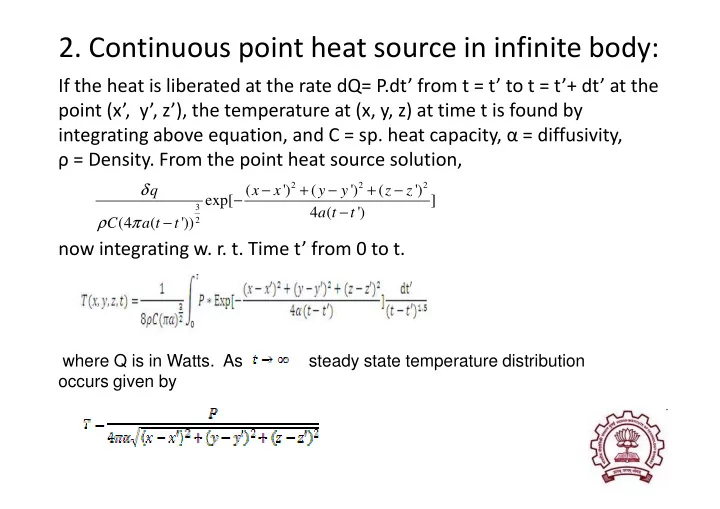
If the heat is liberated at the rate dQ= P.dt’ from t = t’ to t = t’+ dt’ at the point (x’, y’, z’), the temperature at (x, y, z) at time t is found by integrating above equation, and C = sp. heat capacity, α = diffusivity, ρ = Density. From the point heat source solution, now integrating w. r. t. Time t’ from 0 to t.

2 2 2 3 2

( ') ( ') ( ') exp[ ] 4 ( ') (4 ( ')) q x x y y z z a t t C a t t δ ρ π − + − + − − − −

now integrating w. r. t. Time t’ from 0 to t.

where Q is in Watts. As steady state temperature distribution

  • ccurs given by
slide-2
SLIDE 2
slide-3
SLIDE 3

Initial laser location (x’, y’, z’) in both fixed and moving coordinate system At time t’, laser location in fixed coordinate system and moving system (x’, y’, z’) (x’ +vt’, y’, z’)

X Y Z ,Y ,Z

Location of moving Coordinate system at time t’

Moving point heat source in semi-infinite body

Moving laser source along X-axis in a semi -infinite body Coordinate system at time t’

( )

2 2 2 3 2

2 ( ' ') ( ') ( ') ' , , , exp[ ] 4 ( ') (4 ( ')) q x vt x y y z z dT x y z t a t t C a t t δ ρ π − − + − + − = − − −

( )

2 2 2 3 2

2 ( ') ( ') ( ') ' , , , exp[ ] 4 ( ') (4 ( ')) q X x Y y Z z dT x y z t a t t C a t t δ ρ π − + − + − = − − −

In moving coordinate system: In fixed coordinate system:

' q Pdt δ =

Note that

slide-4
SLIDE 4

Moving point heat source:

Consider point heat source P heat units per unit time moving with velocity v on semi- infinite body from time t’= 0 to t’= t. During a very short time heat released at the surface is dQ = Pdt’. This will result in infinitesimal rise in temperature at point (x, y, z) at time t given by, The total rise in of the temperature can be obtained by integrating from t’=0 to t’= t

( )

2 2 2 3 2

2 ( ' ') ( ') ( ') ' , , , exp[ ] 4 ( ') (4 ( ')) q x vt x y y z z dT x y z t a t t C a t t δ ρ π − − + − + − = − − −

slide-5
SLIDE 5

Line heat source in infinite body:

Temperature for the line heat source can be obtained directly by integrating the solution of the moving point source in the moving coordinate system.

  • Moving line source in moving coordinate:

Line source parallel to z-axis and passing through point (x’ , y’). The temperature

  • btained by integrating , where C = sp. heat capacity, ρ = Density, K = thermal
  • conductivity. Here Ql = heat per unit length

For infinite body

( )

2 2 2 3 2

( ') ( ') ( ') ' , , , exp[ ] 4 ( ') (4 ( ')) q X x Y y Z z dT x y z t a t t C a t t δ ρ π − + − + − = − − −

X= x-vt’, Y=y and Z=z

  • Moving line heat source in fixed coordinates:
  • Fig. keyhole model (W. Steen)

2

(4 ( ')) C a t t ρ π −

( )

2 2 2 3 2

( ') ( ') ( ') ' , , exp[ ] 4 ( ') (4 ( ')) q X x Y y Z z dT x y t dz a t t C a t t δ ρ π

∞ −∞

− + − + − = − − −

slide-6
SLIDE 6

Plane heat source:

Surface heat source:

  • Area (circular, rectangular heat source)
  • Applied on x-y plane.
  • Applied on x-y plane.
  • Temperature depends on intensity.
  • Application: surface hardening,

surface cladding etc.

slide-7
SLIDE 7

Gaussian moving circular heat source:

Gaussian heat source intensity In moving coordinate system,

( )

2 2 2 3 2

2 ( ') ( ') ( ') ' , , , exp[ ] 4 ( ') (4 ( ')) q X x Y y Z z dT X Y Z t a t t C a t t δ ρ π − + − + − = − − −

2 2 2

2 ' ( ') ( ') ( ') ' ( ', ') ' 'exp[ ] dt X x Y y Z z dT I x y dx dy − + − + − = −

Moving heat source. Where P = laser power, σ = beam radius, v = scanning velocity, a = diffusivity, t =time.

3 2

' ( ', ') ' 'exp[ ] 4 ( ') (4 ( ')) dT I x y dx dy a t t C a t t ρ π = − − −

3 2 2 2 2 2 2 2 2 2 2

4 ' '( ) (4 ( ')) 2 ' 2 ' ' 2( ) ' ( ) ' 2 ' ' 'exp[ ( )] 4 ( ') Pdt dT t C a t t x y x X x X y Yy Y Z dx dy a t t πσ ρ π σ

∞ ∞ −∞ −∞

= × − + − + + − + + − + −

slide-8
SLIDE 8

Rewriting the solution for fixed coordinate system,

2 2 2 2 3 2 2 2 2

4 ' 4 ( ') 2(( ') ) '( ) exp[ ] 8 ( ') 8 ( ') 4 ( ') (4 ( ')) Pdt a t t x vt y z dT t a t t a t t a t t C a t t πσ σ σ πσ ρ π − − + = − − + − + − − −

Rewriting the solution for fixed coordinate system,

' 0.5 2 2 2 2 2 ' 0

4 '( ') 2(( ') ) exp[ ] 8 ( ') 8 ( ') 4 ( ') 4

t t t

P dt t t x vt y z T T a t t a t t a t t C a σ σ ρ π π

= − =

− − + − = − − + − + − −

  • Similarly circular heat source can be found
  • ut.
slide-9
SLIDE 9

Modeling Gaussian heat source:

Material and process parameters: for EN18 steel Laser power = 1300W Diffusivity = 5.1mm^2/sec Scanning velocity = 100/6 mm/sec Density = 0.000008 kg/mm^3 Interaction time = 0.18sec. Sp. Heat capacity = 674 J/kg k Beam Radius = 1.5mm Temperature distribution X-Y plane Temperature along X-Z plane.

slide-10
SLIDE 10

Uniform intensity:

  • Uniform circular moving heat source:

In the Uniform heat source, Q is defined by the magnitude q and the distribution parameter σ. The heat distribution, Q, is given by, Where A = π*σ2 for circular heat source integrating with space variables,

2 3

2 ' ( ) exp[ ] 4 ( ') Pdt Z dT t a t t = − × −

Now final temperature equation is obtained by integrating with time from 0 to t,

2 2 2 2

2 2 ' 2 2 '

4 ( ') 8 ( ( ')) ( ') ( ') exp[ ] ' exp[ ] ' 4 ( ') 4 ( ')

x x

a t t C a t t X x Y y dx dy a t t a t t

σ σ σ σ

ρ πσ π

− − − −

− − − − − − − −