Heat Program Challenge: Risk Perception Source: NOAA, ADHS - - PowerPoint PPT Presentation

heat program challenge risk perception
SMART_READER_LITE
LIVE PREVIEW

Heat Program Challenge: Risk Perception Source: NOAA, ADHS - - PowerPoint PPT Presentation

NOAA/National Weather Service Heat Program Challenge: Risk Perception Source: NOAA, ADHS Challenge: Risk Perception Source: NOAA, ADHS Challenge: Visual Threat Challenge: Visual Threat Before Heat Wave After Heat Wave 75 F 115 F


slide-1
SLIDE 1

NOAA/National Weather Service
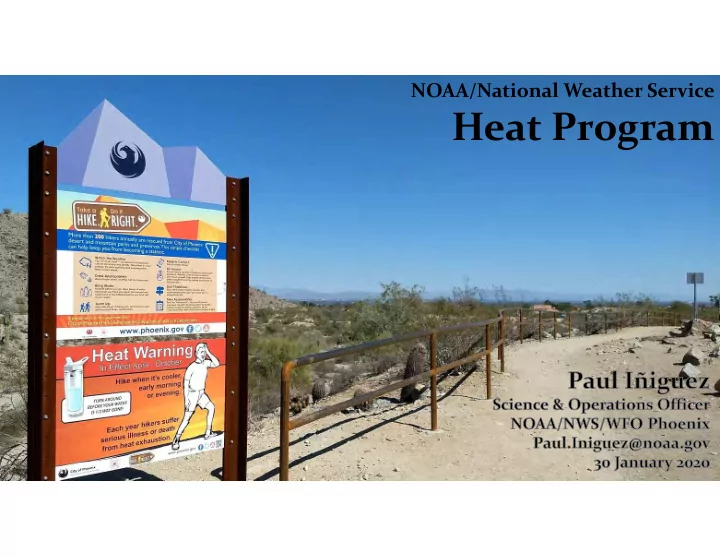
Heat Program

slide-2
SLIDE 2

Challenge: Risk Perception

Source: NOAA, ADHS

slide-3
SLIDE 3

Challenge: Risk Perception

Source: NOAA, ADHS

slide-4
SLIDE 4

Challenge: Visual Threat

slide-5
SLIDE 5

Before Heat Wave After Heat Wave

75 °F 115 °F

Challenge: Visual Threat

slide-6
SLIDE 6

Challenge: Arizona is Hot!

PHX averages ~110 days of 100+ °F each year. Normal high temperature for July is 106 °F. Average 8 days with a low temperature of 90+ °F.

slide-7
SLIDE 7

Challenge: Getting Hotter

slide-8
SLIDE 8

Challenge: Getting Hotter

slide-9
SLIDE 9

Challenge: Getting Hotter

Last Record Low: Aug. 28, 2008

slide-10
SLIDE 10

To address these challenges, NOAA/NWS conducts a number of activities and offers a number of services.

– Temperature Forecast

  • Includes HeatRisk product

– Social Media – Partner (Email) Briefings – Official Alerts -- “Biggest Bells” to Ring – Extensive Partner Interaction

NOAA/NWS Heat Services

slide-11
SLIDE 11

Weather.Gov/Phoenix

Temperature Forecasts

slide-12
SLIDE 12

1-mile by 1-mile Grid ~800 in Phoenix Area 3,783 in Maricopa County 47,083 in Arizona

Temperature Forecasts

slide-13
SLIDE 13

Temperature Forecasts

slide-14
SLIDE 14

https://www.wrh.noaa.gov/wrh/heatrisk/

HeatRisk

  • A flexible Framework
  • Puts NWS forecast high & low

temperatures into a climatological context based on location & time of year.

  • Considers duration of expected

heat.

  • Humidity is indirectly accounted

for in elevated low temperatures.

  • Official method for determining

when & where to issue official heat alerts across the Western U.S.

slide-15
SLIDE 15
slide-16
SLIDE 16

How Does HeatRisk Work?

Red (High)

~95th Percentile

Yellow (Low)

CDC Collaboration

Orange (Mod)

Seasonal Split

Similar Process for Low Temperatures

slide-17
SLIDE 17

How Does HeatRisk Work?

Yellow Orange Red HeatRisk High Temperature Thresholds – July 4

slide-18
SLIDE 18

How Does HeatRisk Work?

Thresholds Official NWS Forecast

(High & Low Temperature)

NWS HeatRisk

None Low Mod High Very High

slide-19
SLIDE 19

HeatRisk - 2019

Alpine Flagstaff Phoenix

slide-20
SLIDE 20

Heat & Drought

slide-21
SLIDE 21

The NOAA/NWS HeatRisk product is used to determine our messaging tone and actions across Arizona.

– Verbiage in social media/briefing material – When & where to issue official heat alerts

NOAA/NWS Heat Policy

slide-22
SLIDE 22

NWS Heat Alerts

  • Excessive Heat Warning

– High Confidence (80%+) – HeatRisk of High (red) or Very High (magenta) – High/Very High Impact Level (e.g., increased morbidity) Expected – May be preceded by “Excessive Heat Watch” (confidence 50%)

  • Heat Advisory

– High Confidence (80%+) – For AZ, High Elevation Areas Only (~5,000’+) – HeatRisk of Moderate (orange) – Moderate/High Impact Level Expected

slide-23
SLIDE 23

Frequency of Heat Alerts

Heat Warnings (2017-2019) Heat Advisory (2017-2019)

slide-24
SLIDE 24
  • Nearly 350 (250) daily MaxT

(MinT) temperature records were tied and almost 800 (800) were broken across the West.

  • Impacts: power disruptions,

flight cancelations, and an increase in heat morbidity/mortality.

  • In Maricopa County, AZ alone

(location of Phoenix), roughly 50 heat-related deaths

  • ccurred.

Historical SW June 2017

slide-25
SLIDE 25

HeatRisk & NWS Alerts

Note Excellent Coordination/Consistency Across the Southwest!

EXCESSIVE HEAT WATCH EXCESSIVE HEAT WARNING HEAT ADVISORY

Historical SW June 2017

slide-26
SLIDE 26

Partner Usage of HeatRisk

slide-27
SLIDE 27

Messaging Heat

slide-28
SLIDE 28

This summer will be hot! There will be extreme heat! Be prepared!

Paul.Iniguez@noaa.gov | Weather.Gov