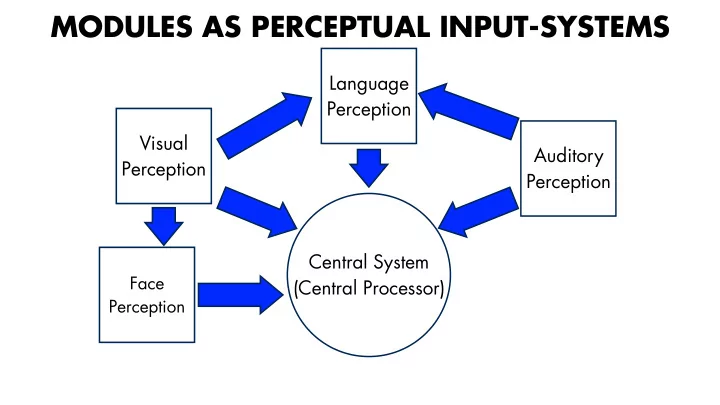
SLIDE 1
Central System (Central Processor) Language
Perception Visual Perception
MODULES AS PERCEPTUAL INPUT-SYSTEMS
Face Perception
Auditory Perception
SLIDE 2 SEMANTIC COMPETENCE SYNTACTIC COMPETENCE PHON. COMPETENCE PARSER SEMANTIC COMPOSITION PRAGMATIC INFERENCE FACULTY OF LANGUAGE CENTRAL SYSTEMS Computes the structure of linguistic input Uses the structure to compute the meaning. Uses the meaning to infer speaker’s message. BELIEFS, MEMORY, ETC.
SPEECH COMPREHENSION
MODULES AND SUB-MODULES
FACE PERCEPTION Face Recognition Expression Perception Lip Reading
SLIDE 3 FODOR-MODULAR PROCESSES CENTRAL PROCESSES
- informationally encapsulated
- limited central accessibility
- domain-specific
- fast, mandatory
- (characteristic breakdown patterns)
- (fixed neural architecture)
- isotropic
- general-purpose
- slow, effortful (sometimes)
- abductive
SLIDE 4
SLIDE 5
SLIDE 6
SLIDE 7
SLIDE 8
“I should like to propose a generalization; one which I fondly hope will some day come to be known as ‘Fodor’s First Law of the Nonexistence of Cognitive Science’. It goes like this: the more global (e.g. the more isotropic) a cognitive process is, the less anybody understands it” (Fodor, 1983, p. 107).
SLIDE 9
By saying that confirmation is isotropic, I mean that the facts relevant to the confirmation of a scientific hypothesis may be drawn from any- where in the eld of previously established empirical (or, of course, demonstrative) truths. Crudely: everything that the scientist knows is, in principle, relevant to determining what else he ought to believe. In principle , our botany constrains our astronomy, if only we could think of ways to make them connect. (Fodor, Modularity of Mind)
SLIDE 10
Central System (Central Processor) Language
Module Visual Perception Motor
Control
MODULES AS INPUT–OUTPUT SYSTEMS
SLIDE 11