12/6/2019 Agenda Presentation to the School District Apportionment - - PDF document

12 6 2019
SMART_READER_LITE
LIVE PREVIEW

12/6/2019 Agenda Presentation to the School District Apportionment - - PDF document

12/6/2019 Agenda Presentation to the School District Apportionment Process Boundary Appeals Board (SDBAB) on the Assets and Liabilities Proposed Dissolution of the Palmyra-Eagle Area School District (PEASD) State Aids and Revenue


slide-1
SLIDE 1

12/6/2019 1

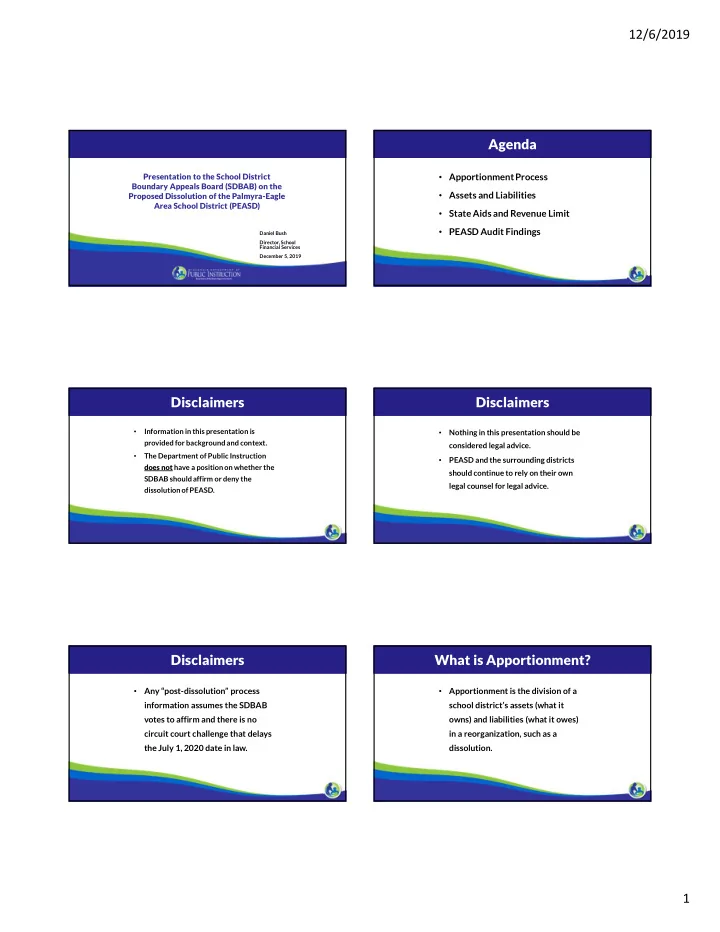
Presentation to the School District Boundary Appeals Board (SDBAB) on the Proposed Dissolution of the Palmyra-Eagle Area School District (PEASD)

Daniel Bush Director, School Financial Services December 5, 2019

Agenda

  • Apportionment Process
  • Assets and Liabilities
  • State Aids and Revenue Limit
  • PEASD Audit Findings

Disclaimers

  • Information in this presentation is

provided for background and context.

  • The Department of Public Instruction

does not have a position on whether the SDBAB should affirm or deny the dissolution of PEASD.

Disclaimers

  • Nothing in this presentation should be

considered legal advice.

  • PEASD and the surrounding districts

should continue to rely on their own legal counsel for legal advice.

Disclaimers

  • Any “post-dissolution” process

information assumes the SDBAB votes to affirm and there is no circuit court challenge that delays the July 1, 2020 date in law.

What is Apportionment?

  • Apportionment is the division of a

school district’s assets (what it

  • wns) and liabilities (what it owes)

in a reorganization, such as a dissolution.

slide-2
SLIDE 2

12/6/2019 2 Tension in State Law

  • Wis. Stats. § 117.10(4): An order by the SDBAB

to affirm the dissolution shall assign assets and liabilities under Wis. Stats. § 66.0235(2c).

  • Wis. Stats. § 66.0235(2c) & (5): Apportionment

process starts with the dissolution order.

What comes first, the order or the apportionment of assets and liabilities?

Tension in State Law

  • An order by the SDBAB to affirm

the dissolution identifies assets and liabilities, and then the apportionment process begins.

Who Decides?

  • Apportionment Board

All members of affected school boards, OR Members of committees appointed by the affected school boards. Includes the PEASD school board.

  • Wis. Stats. § 66.0235(5)

Who Decides?

  • PEASD school board continues to exist

throughout the apportionment process.

  • Spring 2020 election held as usual.
  • Members as of 6/30/2020 continue in
  • ffice until apportionment is complete.
  • Wis. Stats. § 66.0235(5)

How Does it Work?

  • Default is by shares of equalized

property values.

  • Alternative could be approved by ¾

votes of all affected boards no later than October 29, 2020.

  • Wis. Stats. § 66.0235(2c)

How Does it Work?

  • 1. Boundary changes are

communicated up the chain.

  • Wis. Stats. § 66.0235(2c)

Village Clerks Town Clerks County Clerks PEASD Board Clerk SDBAB Order

slide-3
SLIDE 3

12/6/2019 3 How Does it Work?

  • 2. Local governments certify latest

assessed values to DOR & DPI.

  • Wis. Stats. § 66.0235(2c)

Village Clerks Town Clerks County Clerks

How Does it Work?

  • 3. DOR converts assessed values

to equalized values.

  • Wis. Stats. § 66.0235(2c)

How Does it Work?

  • 4. Districts assuming territory get

equalized values from DOR.

  • Wis. Stats. § 66.0235(2c)

District A District B

How Does it Work?

  • 5. Districts provide values to the

Apportionment Board.

  • Wis. Stats. § 66.0235(2c)

District A District B Apportionment Board

How Does it Work?

  • 6. Apportionment board adopts a

final agreement and files it with all state agencies that pay state aid funds to PEASD.

  • Wis. Stats. § 66.0235(5)

How Does it Work?

7. Final disposition of assets and liabilities takes place, after which both the PEASD school board and the apportionment board will cease to exist.

  • Wis. Stats. § 66.0235(5)
slide-4
SLIDE 4

12/6/2019 4 Practical Considerations

  • 2019-20 fiscal year would need to be

reconciled, audited, and closed out.

  • September 2020 debt payments would

need to be made from calendar 2020 tax levy dollars.

Practical Considerations

  • Calendar 2020 taxes and retirement

would need to be reported to IRS, DOR, and ETF.

  • Best practice: Adopt a fiscal agent

agreement with a district/CESA, or hire a vendor/consultant, to close out finances.

Assets and Liabilities

  • Assets: What the district owns.
  • Liabilities: What the district owes.

Assets and Liabilities

Assets Liabilities Real Property Long-Term Debt Vehicles & Equipment Payables Other Property Other Post-Employee Benefits Financial Assets State Aids

Real Property

  • School sites and buildings:

Eagle Elementary Palmyra Elementary Palmyra-Eagle Middle/High School and District Office

Real Property

  • Q: What is a school worth?
  • A: “The value of the use of the

buildings and sites.”

  • Wis. Stats. § 66.0235(3)(b)
slide-5
SLIDE 5

12/6/2019 5 Real Property

  • “Value in Use is the value of a property

assuming a specific use, which may or may not be the property’s highest and best use…[and] may or may not be equal to market value but is different conceptually.

Wisconsin Department of Revenue, Wisconsin Property Appraisal Manual (Madison, Wis.: 2019), 9-7.

Vehicles, Equipment & Other Property

  • Example: In Wisconsin, agricultural

land is valued for tax purposes based on rental for agricultural use, not fair market value or the land’s highest and best use.

  • Wis. Stats. § 70.32(2r)

Real Property

  • Use value is different from the

book value shown in the district’s audit reports.

Book value is original cost minus depreciation

  • ver time.

Vehicles, Equipment & Other Property

  • Values are determined by the

apportionment board “from the best information obtainable.”

  • Wis. Stats. § 66.0235(7)(a)

Vehicles, Equipment & Other Property

  • Considerations:

Most PEASD vehicles and equipment have been fully depreciated ($0 book value) but could have value at sale or auction. Non-capital items (books, supplies, desks, etc.) aren’t included in the district’s book value.

Financial Assets

  • Cash and investments
  • Taxes receivable

August 2020 final settlement from counties

  • Other receivables

Accounts receivable Outstanding 2019-20 federal grant & Medicaid claims

slide-6
SLIDE 6

12/6/2019 6 Financial Assets

  • Custodial assets: Money held by but not

belonging to PEASD.

Would mostly be scholarships & student activities not under administrative control. Need to analyze purposes and original donor instructions, some may have to be refunded. Does not include fundraising under district supervision.

Long-Term Debt

  • PEASD debt principal as of

6/30/2019: $12,888,650

MS/HS construction referendum: $3,990,000 Energy efficiency project: $7,965,000 Other non-referendum debt: $705,000 Technology leases: $228,650

$0 $250,000 $500,000 $750,000 $1,000,000 $1,250,000 $1,500,000 $1,750,000 2020 2021 2022 2023 2024 2025 2026 2027 2028 2029 School Year MS/HS Refi #1 MS/HS Refi #2 Energy Eff. Proj. Other Non-Ref. Tech Leases

Debt Principal & Interest Due by Year Payables

  • Accounts payable
  • Payroll payables
  • Nearly all resolved early in the

apportionment process

PEASD board would likely have expenses for the apportionment process and winding down.

Other Post-Employee Benefits (OPEB)

  • Post-retirement HRA

contributions:

Eligibility based on longer service. Closed to new entrants.

Other Post-Employee Benefits (OPEB)

  • Retiree buy-in to health plan:

Retiree pays full premium to district. Reduced cost for buying coverage through the district rather than on the private market is called “implicit rate subsidy.”

slide-7
SLIDE 7

12/6/2019 7 Other Post-Employee Benefits (OPEB)

  • Leave payouts:

Accrued sick leave payout at resignation or retirement from district. Unused vacation time paid out at year-end.

State Aids

  • DPI and other agencies pay state

aids that would be due to PEASD in 2020-21, which “have the same force and effect as if” there was no dissolution.

  • Wis. Stats. § 66.0235(5)

State Aids

  • Who’s paid depends on where

we’re at in the process:

While the apportionment board is working, the PEASD board receives & holds funds.

  • Wis. Stats. § 66.0235(5)

State Aids

  • Who’s paid depends on where

we’re at in the process:

After the apportionment agreement is filed, districts assuming territory are paid directly in shares specified by the agreement.

  • Wis. Stats. § 66.0235(5)

State Aids

  • Estimated $4.7 million due from

DPI in 2019-20 under aid programs PEASD would be eligible for in 2020-21.

Nearly all are based on prior year data.

State Aids in 2020-21

  • General Aids: No less than 85% of $3.5

million.

  • Per Pupil Aid: About 2/3 of $770,000.
  • Common School Fund (Library) and

Transportation Aid: Less than $100,000.

slide-8
SLIDE 8

12/6/2019 8 State Aids in 2020-21

  • Special Education Aids:

2019-20 estimate is about $400,000. Money would have to go into a district’s Special Education Fund and could not be used for a different purpose (“same force and effect” clause).

  • Wis. Stats. § 66.0235(5)

What About Federal Funds?

  • Federal grant programs are current year

allocations.

  • Without students, there would be no

2020-21 PEASD eligibility.

  • Unused “carryover” from 2019-20 would

not be part of the apportionment.

Source: DPI federal grant staff

Revenue Limits

  • A district’s revenue limit is:

GENERAL STATE AIDS PROPERTY TAXES

+

Revenue Limits

  • Statewide, 81% of

school district revenues fall under revenue limits.

Property Taxes 42% General State Aids 38% Other State Aids 9% Federal Funds 7% Other Local Sources 4%

Revenue Limits

  • Based on “revenue per member.”
  • “Membership” is resident students

who are the district’s financial responsibility to educate.

Revenue Limits

  • Revenue limit membership is a

“3-year rolling average”:

  • Sept. 2019 Average = Sept. 2017 + Sept. 2018 + Sept. 2019

3

slide-9
SLIDE 9

12/6/2019 9 Revenue Limits After a Dissolution

  • Resident students appear in their

new district after dissolution.

  • Nothing in law lets the new district

count them for previous years.

Revenue Limits After a Dissolution

  • 1st year: New resident student adds

1/3 to membership.

  • 2nd year: New resident student adds

2/3 to membership.

  • 3rd year onward: Fully counted.

Revenue Limits After a Dissolution

  • Districts assuming territory can

request a one-time “transfer of territory” exemption to increase their revenue limits.

  • Wis. Stats. § 121.91(4)(b)1

Revenue Limits After a Dissolution

  • Transfer of territory is for

“the cost of extending services to the attached territory,” as determined by DPI.

  • Wis. Stats. § 121.91(4)(b)1

PEASD Audit Findings

  • DPI SFS Team asked by SDBAB to

review the district’s last three audited financial statements.

  • PEASD received findings common

to small and medium-sized districts.

PEASD Audit Findings

  • 1. Segregation of duties: Are there

enough employees involved in different aspects of district finances as would be ideal?

slide-10
SLIDE 10

12/6/2019 10 PEASD Audit Findings

2. Preparation of financial statements: Does the district have CPA level expertise in-house to prepare financial statements under GAAP and GASB requirements?

PEASD Audit Findings

  • 3. Material audit adjustments:

Did the year-end audit identify items that needed to be reported differently?

PEASD Audit Findings

4. Expenditures above budget: Did the district amend its budget to account for all unplanned expenditures?

Total in 2018-19: $184,000 (1.6%).

PEASD Audit Findings

  • 5. Were all special ed staff

properly licensed?

Program compliance item, not financial. Can be as much a DPI issue as a district one.

PEASD 2018-19 Audit Report

  • Emphasis of Matter: “Substantial

doubt about the district’s ability to continue as a going concern.”

Reason: PEASD board’s vote to dissolve.

Reminder!

  • The Department of Public Instruction does not

have a position on whether the SDBAB should affirm or deny the dissolution of PEASD.

  • This presentation was about what happens

next if the SDBAB affirms the dissolution of PEASD.

slide-11
SLIDE 11

12/6/2019 11 Contact

  • Daniel Bush

Director, School Financial Services 608-266-6968 daniel.bush@dpi.wi.gov