11/14/2017 Sup upervis isio ion: Financial : Financial - - PDF document

11 14 2017
SMART_READER_LITE
LIVE PREVIEW

11/14/2017 Sup upervis isio ion: Financial : Financial - - PDF document

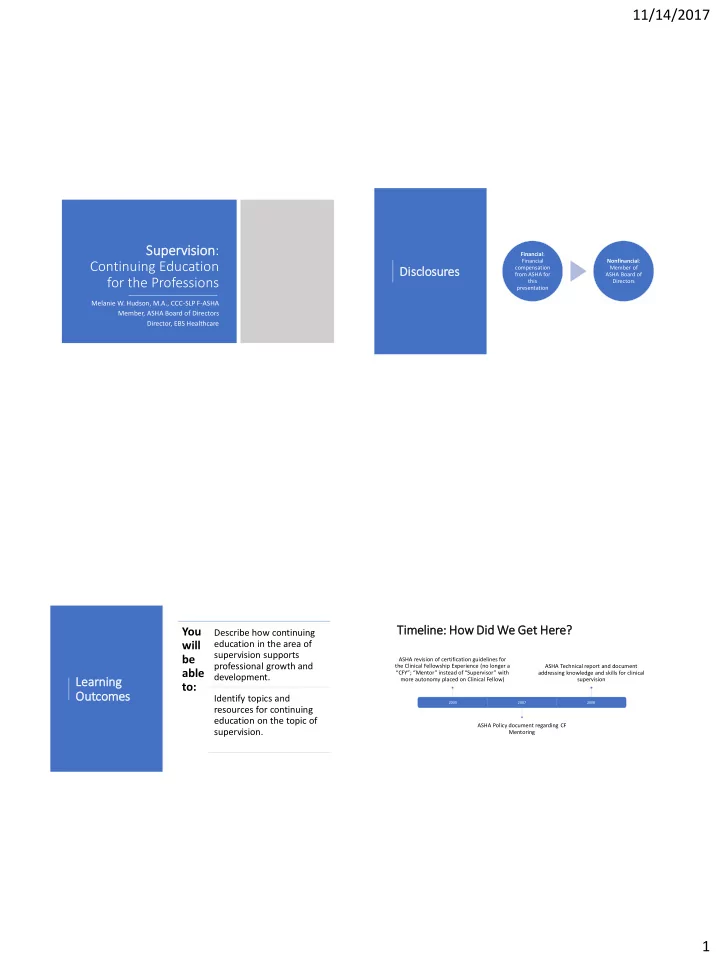
11/14/2017 Sup upervis isio ion: Financial : Financial Nonfinancial : Continuing Education compensation Member of Disclosures from ASHA for ASHA Board of for the Professions this Directors presentation Melanie W. Hudson, M.A.,


slide-1
SLIDE 1

11/14/2017 1

Sup upervis isio ion: Continuing Education for the Professions

Melanie W. Hudson, M.A., CCC-SLP F-ASHA Member, ASHA Board of Directors Director, EBS Healthcare

Disclosures

Financial: Financial compensation from ASHA for this presentation Nonfinancial: Member of ASHA Board of Directors

Lear earning Out utcomes

You will be able to:

Describe how continuing education in the area of supervision supports professional growth and development. Identify topics and resources for continuing education on the topic of supervision.

Timeline: How

  • w Did We

e Get et Her ere?

2005

ASHA revision of certification guidelines for the Clinical Fellowship Experience (no longer a “CFY”; “Mentor” instead of “Supervisor” with more autonomy placed on Clinical Fellow)

2007

ASHA Policy document regarding CF Mentoring

2008

ASHA Technical report and document addressing knowledge and skills for clinical supervision

slide-2
SLIDE 2

11/14/2017 2

AS ASHA Positi tion Statement on n Kno nowle ledge e and nd Skil ills in n Cli linical Sup upervision (20 2008)

11 Core areas that should be acquired by supervisor: 1. Preparation for supervisory experience 2. Interpersonal communication and supervisor-supervisee relationship 3. Development of supervisee’s critical thinking and problem-solving skills 4. Development of supervisee’s clinical competence in assessment 5. Development of supervisee’s clinical competence in intervention 6. Supervisory conferences or meetings of clinical teaching teams 7. Evaluating growth of supervisee both as clinician and as professional 8. Diversity 9. Documentation 10. Ethical, regulatory, legal requirements 11. Principles of mentoring

Tim imeline: How Did id We e Get et Her ere?

2010 ASHA Policy document regarding ethical issues pertaining to supervision of students now American Board

  • f Audiology and

most states now have specific supervision requirements for beginning clinicians 2013 ASHA Policy Document on Supervision of Assistants 2013 ASHA Ad Hoc Committee on Supervision 2013 CAPCSD White Paper on Supervision 2015 ASHA Ad Hoc Committee on Training in Supervision

Ad Hoc

  • c

Com

  • mmittee on

n Sup upervision Trai aining (AH AHCST) 201 016 Fin inal Rep eport

Knowledge and skills needed to supervise 4 targeted groups:

Graduate students in university training programs or off-campus externship settings Audiology students in final externship Clinical Fellows Support Personnel Transitioning professionals

Whe here Are e We e Tod

  • day?

Expanded scope of practice Personnel shortages Sustained influx of new professionals Increased use of support personnel Increased focus on supervision as a distinct area of practice Increase in requirements for continuing education at state level ASHA requirement for continuing education in 2020

slide-3
SLIDE 3

11/14/2017 3 Foc

  • cus on
  • n Lear

arnin ing

This Photo by Unknown Author is licensed under CC BY-NC-SA

AS ASHA Positi tion Statement on n Kno nowledge and nd Skil ills s in n Cli linical Sup upervisio ion (200 2008)

11 Core areas that should be acquired by supervisor:

Preparation for supervisory experience Interpersonal communication and supervisor-supervisee relationship Development of supervisee’s critical thinking and problem-solving skills Development of supervisee’s clinical competence in assessment Development of supervisee’s clinical competence in intervention Supervisory conferences or meetings of clinical teaching teams Evaluating growth of supervisee both as clinician and as professional Diversity Documentation Ethical, regulatory, legal requirements Principles of mentoring

Val alues Inc ncorporated into the he Suc uccessful Sup upervisory Rela elatio ionship

Trust Self-Disclosure Diversity awareness Boundary management Appropriate balance of power Recognition of the value of both parties in the relationship Validation of strengths Support and advocacy Active listening Open communication

Non

  • n-Clinical Top
  • pics

Licensure/credentialing/Liability Navigating the workplace/policies and procedures Working with other professionals: Teambuilding Managing time and resources effectively Dealing with stress and avoiding burnout Managing conflict in the workplace Cultural competence

slide-4
SLIDE 4

11/14/2017 4

Resource ces for Co Continu nuing Educ ducation

  • n
  • ASHA Web site: convention

speakers

  • State association convention

speakers

  • University Web sites: courses

and corresponding faculty instructor

  • Recent articles from ASHA and
  • ther professional publications
  • State licensure board members
  • Other?

This Photo by Unknown Author is licensed under CC BY-SA

Critical Thinking

This Photo by Unknown Author is licensed under CC BY

Crit itic ical Thi hinkin ing

The clinical educator must not only teach critical thinking skills but also nurture the disposition toward clinical thinking

(Gavett & Peapers, 2007)

slide-5
SLIDE 5

11/14/2017 5

Cr Critical Think hinking

"Educational and professional success require developing one's thinking skills and nurturing

  • ne's consistent internal motivation to use

those skills." (Facione, 2000)

Crit itic ical Thi hinking

“Most clinical educators recognize the significance of, and implications for implementing teaching methods which foster critical thinking. However, many clinical educators demonstrate uncertainty about which methods to employ and how to implement such methods.” (Procaccini, S., Carlino, N., Joseph, D., 2016).

Refle lective Pr Prac acti tice

One in which… “individuals take the initiative, with or without the help

  • f others,” to diagnose their learning

needs, formulate learning goals, identify resources for learning, select and implement learning strategies, and evaluate learning

  • utcomes (Knowles, 1975).

Self-determined goals are relevant to job performance or professional development (Flood, 1998).

Ethic hical al Issues in n Sup upervision

slide-6
SLIDE 6

11/14/2017 6

Resources on Ethics in Supervision

https://www.asha.org/Practice/ethics/Supervision-of- Student-Clinicians/ https://www.asha.org/Practice/ethics/Ethical-Issues- Related-to-Clinical-Services-Provided-by-Audiology-and- Speech-Language-Pathology-Students/ https://www.asha.org/Practice/ethics/Responsibilities-

  • f-Individuals-Who-Mentor-Clinical-Fellows-in-Speech-

Language-Pathology/ https://www.asha.org/Practice/ethics/Speech- Language-Pathology-Assistants/

Self-Asse sess ssmen ent of

  • f

Com

  • mpet

eten encies es in Super ervisi sion

  • Developed by ASHA Ad Hoc Committee on

Supervision Training (AHCST), 2016

  • A self-rating tool designed to develop training

goals to improve clinical abilities as clinical educator, preceptor, mentor, or supervisor

Top

  • pics

cs for

  • r

Con

  • nti

tinuing Edu ducation

This Photo by Unknown Author is licensed under CC BY-NC-SA

  • I. Sup

Superv rviso sory Proce cess and and Clin linical l Edu ducation

slide-7
SLIDE 7

11/14/2017 7

  • II. Rela

lati tionship De Development and and Com

  • mmunic

icatio ion Skills Skills

III.

  • I. Es

Esta tablishmen ent/Im t/Implem emen entati tion

  • f Goals
  • IV. Ana

naly lysis is and and Evalu luati tion

  • V. Clin

linical l and and Performance De Decis isio ions

slide-8
SLIDE 8

11/14/2017 8

  • VI. Spe

pecific ic Addit itio ional l Com

  • mpetencie

ies s for

  • r

Clin inic ical l Educ ducators of Grad aduate Students

  • VII. Spe

pecific ic Addit itio ional l Com

  • mpetencie

ies s for

  • r

Preceptors of Aud udio iolo logy Ex Externs

  • VIII. Spe

pecific ic Addit itio ional l Com

  • mpetencie

ies s for

  • r

Me Mentors s of Clin inic ical al Fe Fell llows

  • IX. Spe

pecific ic Com

  • mpetencie

ies s for

  • r

Sup uperv rviso sors s of Sup upport Personnel

slide-9
SLIDE 9

11/14/2017 9

  • X. Speci

ecific ic Add ddit ition ional l Com

  • mpetencie

cies for

  • r Sup

upervis isors

  • f Indiv

ndivid iduals Tra ransiti ition

  • nin

ing to to a New ew Area ea of Pr Practi tice ce or Reen eenter erin ing the he Pr Prof

  • fessio

ion

References and nd Resources

American Speech-Language-Hearing Association. (n.d.). Clinical Education and Supervision (Practice Portal). Available from http://www.asha.org/Practice- Portal/Professional-Issues/Clinical- Education-and-Supervision/ American Speech-Language-Hearing Association. (2013). Knowledge, skills and training consideration for individuals serving as supervisors [Final report, Ad Hoc Committee on Supervision]. Available from http://www.asha.org/uploadedFiles/Supervisors-Knowledge-SkillsReport.pdf [PDF] American Speech-Language-Hearing Association. (May 2016). A plan for developing resources and training opportunities in clinical supervision [Final report, Ad Hoc Committee on Supervision Training]. Available from www.asha.org Anderson, J.L. (1988). The supervisory process in speech language pathology and audiology. Boston: College-Hill Press. ASHA Strategic Pathway to Excellence, June 2017 retrieved from http://www.asha.org/uploadedFiles/ASHA-Strategic-Pathway-to-Excellence.pdf Facione, P. A. (2000). The disposition toward critical thinking: Its character, measurement, and relationship to critical thinking skill. Informal Logic, 20(1), 61–84. Flood, Steven C. (1998). American Academy of Family Physicians. Available from www.aafp.org/fpm. Gavett, E., & Peapers, R. (2007). Critical thinking: The role of questions. Perspectives on Issues in Higher Education, 10, 3–5. Knowles, M. (1975). Self-directed learning: A guide for learners and teachers. New York: Association Press Procaccini, S., Carlino,N., Joseph, D., Clinical Teaching Methods for Stimulating Students' Critical Thinking. Perspectives of the ASHA Special Interest Groups, April 2016,

  • Vol. 1 (SIG 11), 3-17.