11/1/2017 Environmental Risk Assessments at the Pest Management - - PDF document

11 1 2017
SMART_READER_LITE
LIVE PREVIEW

11/1/2017 Environmental Risk Assessments at the Pest Management - - PDF document

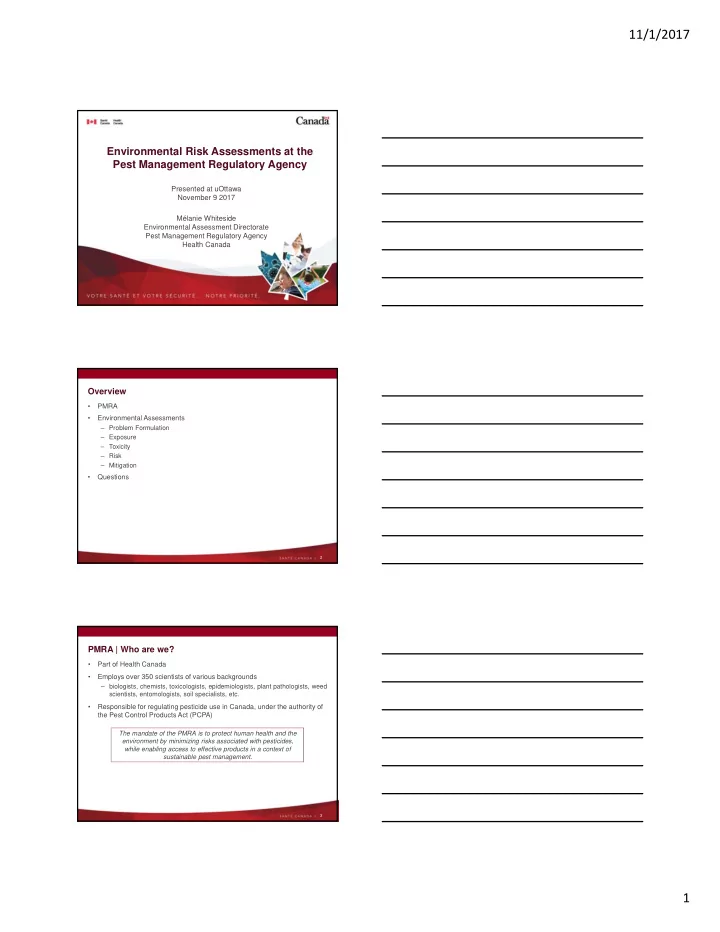
11/1/2017 Environmental Risk Assessments at the Pest Management Regulatory Agency Presented at uOttawa November 9 2017 Mlanie Whiteside Environmental Assessment Directorate Pest Management Regulatory Agency Health Canada Overview


slide-1
SLIDE 1

11/1/2017 1

Presented at uOttawa November 9 2017 Mélanie Whiteside Environmental Assessment Directorate Pest Management Regulatory Agency Health Canada

Environmental Risk Assessments at the Pest Management Regulatory Agency

Overview

  • PMRA
  • Environmental Assessments

– Problem Formulation – Exposure – Toxicity – Risk – Mitigation

  • Questions

2

PMRA | Who are we?

  • Part of Health Canada
  • Employs over 350 scientists of various backgrounds

– biologists, chemists, toxicologists, epidemiologists, plant pathologists, weed scientists, entomologists, soil specialists, etc.

  • Responsible for regulating pesticide use in Canada, under the authority of

the Pest Control Products Act (PCPA)

3

The mandate of the PMRA is to protect human health and the environment by minimizing risks associated with pesticides, while enabling access to effective products in a context of sustainable pest management.

slide-2
SLIDE 2

11/1/2017 2

PMRA | What do we do?

  • Register new pesticides and new uses

– Science-based evaluations, based on information provided by the applicant (hundreds of studies are required for agricultural uses!)

  • Monitor the use of registered pesticides

– Verify that uses are compliant, and take appropriate action in situations of non-compliance – Receive and review incident reports

  • Re-evaluate registered pesticides to ensure they continue to meet current

scientific standards – 15-year cycle – Considers recent assessment methods and all relevant information made available since the initial registration

4

PMRA | What is considered?

5

A pesticide is registered when it is found to have value and its use does not pose unacceptable risks to the health of Canadians or to the environment.

Environment

Fate in the environment, effects on plants and animals

Risk Management / Décision Human Health

Health of workers, consumers and residents

Value

Efficacy, social and economic benefits, sustainability

Environmental Assessments | General Framework

6

Exposure Toxicity Risk characterization Risk mitigation options Problem formulation

slide-3
SLIDE 3

11/1/2017 3

The problem formulation defines the scope of the evaluation

  • in which environmental

compartments the pesticide can be found after its application

  • which non-target organisms could

be affected

7

Environmental Assessments | Problem Formulation

During this phase of the assessment:

  • Understand the use

– type of pesticide (herbicide, insecticide, fungicide, etc.) – site of application (agriculture, forest, aquatic, industrial, residential, materials, structures, buildings, pools, etc.) – application method (foliar spray, soil spray, soil incorporation, soil injection, tree injection, seed treatment, bait, etc.) – application rate and number of applications per season

  • Scan of the submitted data

– the number of studies and type of data that are provided depends on the potential for environmental exposure

8

Environmental Assessments | Problem Formulation Environmental Assessments | Exposure

9

The potential for exposure is a key concept which depends on several parameters, including

  • the properties of the pesticide
  • how the pesticide is used
slide-4
SLIDE 4

11/1/2017 4

Pesticide properties

  • solubility, vapour pressure, routes of transformation, etc.

Use pattern

  • the site of application

– environmental exposure is expected when pesticides are used outdoors (varying exposure levels depending on the use) – environmental exposure is generally minimal for indoor uses, although possible in certain cases (e.g. greenhouse effluent)

  • the amount applied

– for a given pesticide use, exposure increases when more is applied (high application rate, several seasonal applications)

  • the application method

– spot treatment vs. broadcast – drift

10

Environmental Assessments | Exposure

Terrestrial environment:

  • A pesticide can enter the

terrestrial environment following

– a direct application to soil or foliage – deposition of spray drift on terrestrial habitats adjacent to the treatment area – leaching from treated material (such as treated seeds or treated wood) into the surrounding soil

11

Environmental Assessments | Exposure

  • Non-target terrestrial organisms

can then be exposed to the pesticide

– earthworms in the treated field – bees coming in contact with spray droplets during application

  • r consuming pollen and nectar

containing the pesticide – birds and small mammals feeding on plants (foliage, seed, fruit) or invertebrates containing the pesticide – non-target plants that serve as habitat (such as hedgerows and shelterbelts)

12

Environmental Assessments | Exposure

slide-5
SLIDE 5

11/1/2017 5

Aquatic environment:

  • A pesticide can enter the

aquatic environment following

– deposition of spray drift from a terrestrial application – runoff from the field – application to a water body or its shoreline – discharge of effluent – leaching from treated material (such as treated seeds or treated wood) into the surrounding water

13

Environmental Assessments | Exposure

  • Non-target aquatic organisms

can then be exposed to the pesticide

– fish, aquatic invertebrates, algae and aquatic plants – in the water column or in sediments

14

Environmental Assessments | Exposure

Atmospheric environment:

  • The presence of a pesticide in air

is primarily based on its inherent physical and chemical properties

  • The atmospheric environment

includes

– air in the vicinity of the site of application – long-range atmospheric transport and subsequent deposition to areas away from the application site

15

Environmental Assessments | Exposure

slide-6
SLIDE 6

11/1/2017 6

Information most commonly used to characterise environmental fate:

  • Physicochemical properties
  • Laboratory studies of transformation
  • Laboratory studies of mobility
  • Field dissipation studies

16

Environmental Assessments | Exposure

Physicochemical properties

  • Can be indicative of certain aspects of the fate and behaviour of the

pesticide in the environment

  • Aid in the interpretation of laboratory studies
  • Requested data:

17

Environmental Assessments | Exposure

Laboratory studies of transformation

  • Provide information on the probable routes of dissipation in the

environment, the rates of transformation (t½, DT50) and transformation products

  • Requested data:

18

Environmental Assessments | Exposure

slide-7
SLIDE 7

11/1/2017 7

Laboratory studies of mobility

  • Provide information on the potential for a pesticide to migrate away from

the site of application into other environmental compartments

  • Requested data:

19

Environmental Assessments | Exposure

Field dissipation studies

  • Provide a better understanding of the persistence and movement of the

pesticide under more realistic conditions

  • Substantiate the information provided in the laboratory studies
  • In terrestrial or aquatic environments

20

Environmental Assessments | Exposure

  • Should be representative of

Canadian conditions For example, for terrestrial studies, the studied site can be in Canada or in another country, as long as in a relevant ecological region Leaching potential

  • The potential for leaching of a pesticide increases when

– soluble in water – low volatility – low adsorption to soil organic matter – transforms slowly (long half-life)

  • Leaching can be observed in field studies (dissipation studies, lysimeter

studies or prospective groundwater studies)

  • Concentrations of the pesticide in groundwater can be estimated with

predictive models

  • Leaching can also be confirmed using monitoring data (sampling of

groundwater)

21

Environmental Assessments | Exposure

slide-8
SLIDE 8

11/1/2017 8

Environmental Assessments | Exposure

22

Summary

phototransformation hydrolysis phototransformation biotransformation adsorption-desorption hydrolysis biotransformation adsorption-desorption leaching to groundwater volatilisation run-off long-range transport drift

Environmental Assessments | Toxicity

23

The toxicity data that are considered in our risk assessments encompass several non-target species, either terrestrial or aquatic

  • dose-response studies
  • mostly lab, but sometimes field
  • short-term (acute)

EC50, LC50, LD50, LR50

  • long-term (chronic)

NOEC, NOEL EC50 : concentration at which an adverse effect is observed for 50% of the test population LC50 : concentration at which mortality is observed for 50% of the test population LD50 : dose at which mortality is observed for 50% of the test population LR50 : application rate at which mortality is observed for 50% of the test population NOEC: no-effect concentration NOEL: no-effect level

Environmental Assessments | Toxicity

24

Terrestrial invertebrates

slide-9
SLIDE 9

11/1/2017 9

Environmental Assessments | Toxicity

25

Terrestrial vertebrates

Environmental Assessments | Toxicity

26

Terrestrial vascular plants

Environmental Assessments | Toxicity

27

Freshwater species

slide-10
SLIDE 10

11/1/2017 10

Environmental Assessments | Toxicity

28

Saltwater species (estuarine or marine environments)

29

During the risk characterization, information on the exposure and toxicity are integrated in a risk quotient: The RQ is then compared to a level of concern (LOC = 1 in most cases)

Environmental Assessments | Risk

RQ = Exposure Toxicity

Environmental Assessments | Risk

30

A step-wise approach is used:

  • Initially, a screening level risk assessment is performed to quickly identify

– uses that are not of concern – groups of organisms for which there may be a potential risk

  • The screening level assessment relies on simple methods, conservative

exposure scenarios and sensitive toxicity endpoints

  • If the screening level RQ is below the level of concern:

– the risk is considered negligible and no further risk characterization is necessary

  • If the screening level RQ is equal to or greater than the level of concern:

– a more refined assessment is conducted to further characterize the risk

slide-11
SLIDE 11

11/1/2017 11

Environmental Assessments | Risk

31

Screening level - Toxicity

  • Acute toxicity endpoints are divided by an uncertainty factor to account for

– potential differences in species sensitivity – varying protection goals for the different organisms (population, community, individual)

  • A different uncertainty factor is used according to the group of organism

– a factor of 2 for aquatic and terrestrial invertebrates, algae and aquatic vascular plants – a factor of 10 for terrestrial and aquatic vertebrates

  • Chronic endpoints are not adjusted

Screening level – Exposure

  • Calculation of estimated environmental exposure concentrations (EEC)

– concentration in soil (earthworms) – concentration in water (fish, invertebrates, plants and algae) – concentration on/in plants (birds, mammals, bees and other beneficial insects)

  • Based on conservative assumptions, for example:

– direct application – maximum application rate – short interval between applications (since calculations account for transformation between applications)

32

Environmental Assessments | Risk Environmental Assessments | Risk

33

A refined assessment takes into account

  • more realistic exposure scenarios, for example:

– drift to non-target habitats – modelling of concentrations in surface water due to run-off – monitoring data (concentrations measured in water bodies)

  • different endpoints

– results from field or mesocosm studies – probabilistic risk assessment methods (species sensitivity distribution (SSD))

Refinements to the risk assessment may continue until the risk is adequately characterized or no further refinements are possible

slide-12
SLIDE 12

11/1/2017 12

Environmental Assessments | Mitigation

34

Risk mitigation measures are necessary when a risk of concern is identified in the assessment. Several risk mitigation options are available.

Environmental Assessments | Mitigation

35

  • Include precautions on the label

– Inform the user of the toxicity of the product to certain groups of organisms – Provide specific instructions to protect the environment

Environmental Assessments | Mitigation

36

  • Define the conditions of use

– Restrictions on the application rate or the number of seasonal applications (while maintaining efficacy) – Not allowing applications in consecutive years – Not allowing applications by air – Restricting the application timing to certain times of the year or of the day – Require immediate soil incorporation – Buffer zones for the protection of sensitive terrestrial or aquatic habitats – Distance between the point of application and the closest downwind edge of the habitat – The distance is a function of risk – Is specific to each product and each treated crop

slide-13
SLIDE 13

11/1/2017 13

Environmental Assessments | Questions?

37

Website: http://www.hc-sc.gc.ca/cps-spc/pest/index-fra.php Information service: 1-800-267-6315 pmra.infoserv@hc-sc.gc.ca