10/7/2016 Cybersecurity: isnt that up to the geeks? Why the - - PDF document

10 7 2016
SMART_READER_LITE
LIVE PREVIEW

10/7/2016 Cybersecurity: isnt that up to the geeks? Why the - - PDF document

10/7/2016 Cybersecurity: isnt that up to the geeks? Why the clinician should care Delaware Valley ANIA Conference Richard Schreiber, MD, FACP Diplomate, Clinical Informatics Chief Medical Informatics Officer Holy Spirit HospitalA


slide-1
SLIDE 1

10/7/2016 1

1

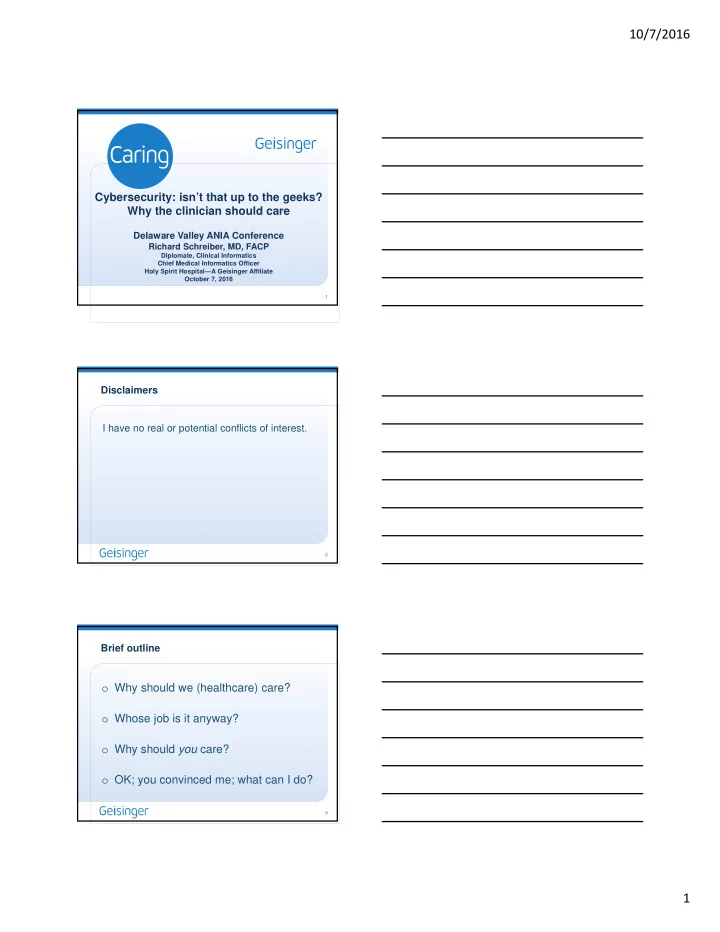
Cybersecurity: isn’t that up to the geeks? Why the clinician should care

Delaware Valley ANIA Conference

Richard Schreiber, MD, FACP

Diplomate, Clinical Informatics Chief Medical Informatics Officer Holy Spirit Hospital—A Geisinger Affiliate October 7, 2016

2

Disclaimers I have no real or potential conflicts of interest.

3

Brief outline

  • Why should we (healthcare) care?
  • Whose job is it anyway?
  • Why should you care?
  • OK; you convinced me; what can I do?
slide-2
SLIDE 2

10/7/2016 2

4

Which of these is real? Hack into car’s throttle system and stall out the car Change a sniper rifle’s target

5

Which of these is real? Use a washing machine to transmit files Let a Roomba, your dog, or a fan do the “walking”

6

Which of these is real?

“Nazir's associate gains access to Walden's pacemaker and accelerates his heartbeat, inducing a heart attack.”

Season 2, episode 10

“Medtronic, one of the most security-conscious companies in the field, concedes that hacking its pacemakers, while difficult, is nevertheless possible.” “[Vice President] Cheney's cardiologist revealed that in 2007, he'd asked Medtronic to disable the wireless function of his VIP patient's implanted heart device.” Abstract: Our study analyzes the security and privacy properties

  • f an implantable cardioverter defibrillator (ICD). Introduced to

the U.S. market in 2003, this model of ICD includes pacemaker technology and is designed to communicate wirelessly with a nearby external programmer in the 175 kHz frequency range. After partially reverse‐engineering the ICD's communications protocol . . . we implemented several software radio‐based attacks that could compromise patient safety and patient privacy.

Halperin D, et al (incl. Kevin Fu). Pacemakers and Implantable Cardiac Defibrillators: Software Radio Attacks and Zero‐Power Defenses. Sec Priv 2008. SP 2008 IEEE Symposium. Accessed at http://ieeexplore.ieee.org/document/4531149/ on 16 Sep 16http://www.dailymail.co.uk/health/article- 3252609/The-heart-pacemakers-risk-hackers-Sound-far-fetched-Security-experts-treating-deadly- seriously.html Accessed 16 Sep 16
slide-3
SLIDE 3

10/7/2016 3

7

Current threat landscape Ransomware attacks of hospitals this year alone:

  • Kansas Heart Hospital, Wichita KS
  • MedStar, multiple sites around Washington DC
  • Methodist Hospital, Henderson KY
  • Hollywood Presbyterian, Hollywood CA

8

What’s it worth? And how frequent?

“Stolen credit cards go for $1-$3 each. Social Security numbers are $15. But complete health care records are a gold mine, going for $60 each.” And up to $500. “1st half of 2016: one author and distributor claimed to have received $121 million (Bitcoin 189,813) from ransomware Ransomware: 1.3 million new samples in Q2 2016 Denial of service increased 11% Q2 2016”

http://www.nbcnews.com/news/us-news/hacking-health-care-records-skyrockets-n517686 http://www.pbs.org/newshour/updates/has-health-care-hacking-become-an-epidemic/ 13 Feb 2016; accessed 7 Sep 2016 http://www.mcafee.com/us/resources/reports/rp-quarterly-threats-sep-2016.pdf Accessed 15 Sep 16 9

What’s even worse . . .

Why?

  • Social security number next to impossible to change
  • You can’t change your health records
  • It’s hard to monitor who has stolen your identity
  • Hard to track information (compare to money)
  • There’s no insurance to cover it (compare to FDIC)
  • Medical information can be used repeatedly

So store medical information in the cloud?

  • Google, Facebook, Microsoft HealthVault, Apple
  • NOT covered entities; not covered under HIPAA
slide-4
SLIDE 4

10/7/2016 4

10

What do they do with it?

  • Identifiers allow hackers to:
  • Obtain new credit cards
  • Open loans
  • Commit tax fraud
  • Send fake bills to insurance companies
  • “Carding forums” in Russia and Eastern Europe
  • For pediatric health information the fear is that the

hackers will patiently wait until person is > 18 or 21

  • They are very patient

http://kernelmag.dailydot.com/issue-sections/features-issue- sections/12688/identity-theft-medical-records-healthcare/ Accessed 16 Sept 16 11

Why is medical identity theft so valuable?

  • Whereas for credit cards: cancel/change the number
  • Can monitor credit card fraud . . .
  • But for insurance claims:
  • Takes time for insurance company to track down fraudulent use
  • f insurance number (using complicit physicians/DME company)
  • and for Health information, e.g., diabetes, opens doors

for DME such as diabetic supplies

  • Compounding pharmacies—fees much higher
  • multi-state conspiracy revealed 9/10/16:
  • $175 Million
  • 16 charged
  • Call centers to solicit patients, including veterans, physicians

12

The Types of Threat

Commodity Threat Targeted Threat Non-targeted attack Targets an organization Launches broad-based attack in hopes of targeting large numbers of victims Seeks to implement an advanced and persistent threat in order to gain network access and control Uses common and recognizable hacking tools/techniques available on the internet Specialized tools. Strives to remain undetected for long periods of time Generally targets immediate financial gain Target intellectual property, intelligence collection, competitive advantage, or information for substantial financial gain Ex: Target store credit card theft Worms in outdated operating systems

slide-5
SLIDE 5

10/7/2016 5

13

What makes hospitals (healthcare) different?

  • Who:
  • Doctors and nurses are different: resistant to change
  • Patients: not necessarily tech savvy, but “forced” to use tech
  • Regulations often well-meaning but interfere with workflow
  • So people look for workarounds
  • Insurance providers demand information, not always secure
  • What:
  • Medical devices are not under same regulatory scrutiny
  • 3rd party devices—both required by meaningful use (stage 3)
  • And unregulated by MU

Avi Rosen, Johns Hopkins cybersecurity expert, accessed 15 Sept 16: https://www.youtube.com/watch?v=GDVD2A7CSGw&feature=youtu.be

14

What makes hospitals (healthcare) different?

  • What are we protecting?:
  • Health information that cannot be
  • Removed
  • Cleansed
  • Re-numbered
  • Genomic (genetic) data
  • By definition this is information that identifies itself
  • No ability to change
  • No ability to anonymize
  • How:
  • Always a risk of re-identification* if have pieces of PHI

*disambiguation

Avi Rosen, Johns Hopkins cybersecurity expert, accessed 15 Sept 16: https://www.youtube.com/watch?v=GDVD2A7CSGw&feature=youtu.be

15

Who’s job is it, anyway? both Technical Solutions 

Remote/Web Based Access Management Firewalls, Antivirus, Web and Email Content Filtering Encryption of Mobile Devices and Regulated Data at Rest Mobile Device Management Vulnerability Scanning and Patching Intrusion Prevention System Data Loss Prevention

Personal Security

User Identification and Passwords Multi-Factor Authentication Secure Email User Awareness Training and Communication Social Engineering Phishing Clean desk/locked office Timely print pickup Screen lock

slide-6
SLIDE 6

10/7/2016 6

16

Why should a healthcare worker care?

  • Moral, as well as legal, obligation to protect patient data
  • Not to speak of our own data
  • We have a fiduciary responsibility:
  • Legal obligation to preserve integrity of data
  • Trust relationship “if I give you information you will keep it secure”
  • Privacy (of the person) and Confidentiality (of the data)
  • HIPAA
  • Office of Civil Rights (part of US DHHS) charged with enforcing
  • Federal Trade Commission
  • States’ Attorneys General
  • GINA (Genetic information nondiscrimation act of 2009)

17

Anatomy of a suspicious email; sometimes it’s easy

18

Anatomy of a suspicious email View the source of the email:

slide-7
SLIDE 7

10/7/2016 7

19

Anatomy of a suspicious email

SCARY!!

20

Anatomy of a suspicious email: Hover, DON’T click

21

Anatomy of a suspicious email; hover over links: DON’T click

slide-8
SLIDE 8

10/7/2016 8

22

What can we do?

  • Heightened awareness
  • “See something—Say something” now becomes
  • “See something—suspect something”
  • Look for clues: [hover over links—DON’T click!!]
  • Requests for privileged information (e.g., passwords)
  • Speling and grammer errors,English non-colloquial
  • Countries of origin of email:
  • .ru, .cn, .kp

should make you cringe

  • The word “redirect” in the url:

e.g., http://redirect.company.com/http://externalsite.com

  • Report as spam and delete [report to security desk]

23

Conclusions

  • Why should we (healthcare) care?
  • Healthcare data is valuable/hard to restore
  • Whose job is it anyway?
  • All of us
  • Why should you care?
  • Appeal to your moral, legal, professional ethics
  • And your own wallet!
  • OK; you convinced me; what can I do?
  • Be vigilant!

24

Questions or Comments

Thank you!

rschreiber@geisinger.edu