? A BIG question is missing circuitboard image: CC-BY-NC-SA - - PowerPoint PPT Presentation

a big question is missing circuitboard image cc by nc sa
SMART_READER_LITE
LIVE PREVIEW

? A BIG question is missing circuitboard image: CC-BY-NC-SA - - PowerPoint PPT Presentation

Program, Application Today Programming Language Welcome to 1 Compiler/Interpreter What is CS 240? CS 240: Operating System 2 Foundations of Why take CS 240? Computer Instruction Set Architecture 3 Systems How does CS 240


slide-1
SLIDE 1

Devices (transistors, etc.) Solid-State Physics

Digital Logic Microarchitecture Instruction Set Architecture Operating System Programming Language Compiler/Interpreter Program, Application

Welcome to

CS 240:

Foundations of

Computer Systems

Today

  • What is CS 240?
  • Why take CS 240?
  • How does CS 240 work?
  • Dive into foundations of computer hardware.

2 3 1 4

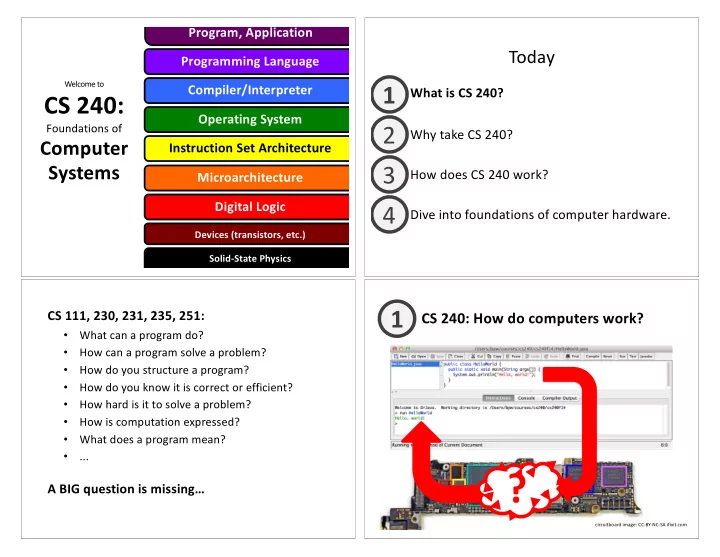
CS 111, 230, 231, 235, 251:

  • What can a program do?
  • How can a program solve a problem?
  • How do you structure a program?
  • How do you know it is correct or efficient?
  • How hard is it to solve a problem?
  • How is computation expressed?
  • What does a program mean?
  • ...

A BIG question is missing…

CS 240: How do computers work?

?

circuitboard image: CC-BY-NC-SA ifixit.com

1

slide-2
SLIDE 2

Devices (transistors, etc.) Solid-State Physics

Hardware

Digital Logic Microarchitecture Instruction Set Architecture Operating System Programming Language Compiler/Interpreter

Algorithm, Data Structure, Application

CS 111, 230, 231, 235, 251

CS 240

Software

Compiler/Interpreter

Devices (transistors, etc.) Solid-State Physics

Digital Logic Microarchitecture Instruction Set Architecture Operating System Programming Language

Algorithm, Data Structure, Application

Big Idea:

Abstraction

interface implementation Layers of

virtual machines

manage complexity.

Big Idea: Abstraction

with a few recurring subplots

Simple, general interfaces:

– Hide complexity of efficient implementation. – Make higher-level systems easy to build. – But they are not perfect.

Representation of data and programs Translation of data and programs Control flow within/across programs

0s and 1s, electricity compilers, assemblers, decoders branches, procedures, OS 1800s 1810s 1820s 1830s 1840s 1850s 1860s 1870s 1880s

slide-3
SLIDE 3

1890s 1900s 1910s 1920s 1930s 1940s 1950s 1960s 1970s ENIAC (Electronic Numerical Integrator and Computer), First Turing-complete all-electronic programmable digital computer. University of Pennsylvania, 1940s

Image: public domain

1940s 1950s 1960s 1970s 1980s 1990s 2000s 2010s 2020s

data represented as electrical signals

1940s 1950s 1960s 1970s 1980s 1990s 2000s 2010s 2020s Jean Jennings Bartik and Frances Bilas Spence with part of ENIAC. The programmers of ENIAC were six women. http://eniacprogrammers.org/, http://sites.temple.edu/topsecretrosies/

Image: public domain

program controls general-purpose hardware

1940s 1950s 1960s 1970s 1980s 1990s 2000s 2010s 2020s 1940s 1950s 1960s 1970s 1980s 1990s 2000s 2010s 2020s

Programming 1940s-style with switches and cables.

Image: public domain

physical control flow

1940s 1950s 1960s 1970s 1980s 1990s 2000s 2010s 2020s 1940s 1950s 1960s 1970s 1980s 1990s 2000s 2010s 2020s

slide-4
SLIDE 4

1930s 1940s 1950s 1960s 1970s 1980s 1990s 2000s 2010s

Image: "SSEM Manchester museum close up" by Parrot of Doom - Own work. Licensed under Creative Commons Attribution-Share Alike 3.0 via Wikimedia Commons - http://commons.wikimedia.org/wiki/File:SSEM_Manchester_museum_close_up.jpg

Manchester “Baby” SSEM (Small-Scale Experimental Machine), replica first stored-program computer -- University of Manchester (UK), 1948

programs are data machine translates instructions to control flow

1940s 1950s 1960s 1970s 1980s 1990s 2000s 2010s 2020s

http://www.pcworld.com/article/249951/if_it_aint_broke_ dont_fix_it_ancient_computers_in_use_today.html?page=2

PDP-11 "minicomputers"

http://simh.trailing-edge.com/

1930s 1940s 1950s 1960s 1970s 1980s 1990s 2000s 2010s 1940s 1950s 1960s 1970s 1980s 1990s 2000s 2010s 2020s 1930s 1940s 1950s 1960s 1970s 1980s 1990s 2000s 2010s

Images: "Ibm pc 5150" by Ruben de Rijcke - Own work. Licensed under Creative Commons Attribution-Share Alike 3.0 via Wikimedia Commons - http://commons.wikimedia.org/wiki/File:Ibm_pc_5150.jpg "IBM PC Motherboard (1981)" by German - Own work. Licensed under Creative Commons Attribution-Share Alike 3.0 via Wikimedia Commons - http://commons.wikimedia.org/wiki/File:IBM_PC_Motherboard_(1981).jpg "Macintosh-motherboard" by Shieldforyoureyes Dave Fischer - Own work. Licensed under Creative Commons Attribution-Share Alike 3.0 via Wikimedia Commons - http://commons.wikimedia.org/wiki/File:Macintosh-mot

1940s 1950s 1960s 1970s 1980s 1990s 2000s 2010s 2020s 1930s 1940s 1950s 1960s 1970s 1980s 1990s 2000s 2010s

images: CC-BY-NC-SA ifixit.com

1940s 1950s 1960s 1970s 1980s 1990s 2000s 2010s 2020s

slide-5
SLIDE 5

ENIAC iPhone 5 Year 1946 2012 Weight 30 tons 4 oz Volume 2,400 ft3 3.4 in3 Cost (USD, 2014) $6,000,000 $600 Speed few 1000 ops/sec 2,500,000,000 ops/sec Memory ~100 bytes 1,073,741,824 bytes (1 GB) Power 150,000 W <5W Input/Output Switches, lights, later punchcards Touchscreen, audio, camera, wifi, cell, … Production 1 5,000,000 sold in first 3 days 1930s 1940s 1950s 1960s 1970s 1980s 1990s 2000s 2010s

ENIAC image: public domain; iPhone image: CC-BY-NC-SA ifixit.com

1940s 1950s 1960s 1970s 1980s 1990s 2000s 2010s 2020s

Bus

Persistent Storage Network USB Display

… Input/ Output

Modern Computer Organization

1930s 1940s 1950s 1960s 1970s 1980s 1990s 2000s 2010s

Stores program code + data during execution.

Memory

Executes instructions.

Processor

1940s 1950s 1960s 1970s 1980s 1990s 2000s 2010s 2020s

Modern Computer Organization

1930s 1940s 1950s 1960s 1970s 1980s 1990s 2000s 2010s

Stores program code + data during execution.

Memory

Executes instructions.

Processor

Processor repeats:

  • 1. fetch instruction
  • 2. fetch data used by instruction
  • 3. execute instruction on data
  • 4. store result or choose next instruction

1940s 1950s 1960s 1970s 1980s 1990s 2000s 2010s 2020s

Physical implementation

  • f instructions and resources.

Hardware

Desired computation represented as instructions. Hardware/Software Interface

Software

Abstraction!

slide-6
SLIDE 6

Microarchitecture (Implementation of ISA)

ALU

Registers Memory

Instruction Fetch and Decode

Computer Computer

Instruction Set Architecture (HW/SW Interface)

memory

Instruction Logic Registers

processor

Encoded Instructions Data Instructions

  • Names, Encodings
  • Effects
  • Arguments, Results

Local storage

  • Names, Size
  • How many

Large storage

  • Addresses, Locations

Machine Instructions

23

Hardware 00000010100010101100100000010000 (adds two values and stores the result) machine code program 1930s 1940s 1950s 1960s 1970s 1980s 1990s 2000s 2010s Instruction Set Architecture specification 1940s 1950s 1960s 1970s 1980s 1990s 2000s 2010s 2020s

Assemblers and Assembly Languages

24

Hardware assembly program Assembly Language specification Assembler 1930s 1940s 1950s 1960s 1970s 1980s 1990s 2000s 2010s addl %eax, %ecx 00000010100010101100100000010000 machine code program 1940s 1950s 1960s 1970s 1980s 1990s 2000s 2010s 2020s

slide-7
SLIDE 7

Compile time Run time

Higher-Level Programming Languages

25

Hardware assembly program Assembler 1930s 1940s 1950s 1960s 1970s 1980s 1990s 2000s 2010s addl %eax, %ecx 00000010100010101100100000010000 x = x + y; machine code program high-level language program Compiler Programming Language specification 1940s 1950s 1960s 1970s 1980s 1990s 2000s 2010s 2020s

A-0: first compiler, by Grace Hopper

Early 1950s Maybe closer to assembler/linker/loader Later: B-0 à FLOW-MATIC à COBOL, late 50s

1930s 1940s 1950s 1960s 1970s 1980s 1990s 2000s 2010s 1940s 1950s 1960s 1970s 1980s 1990s 2000s 2010s 2020s

More and more layers…

  • Operating systems
  • Virtual machines
  • Hypervisors
  • Web browsers

27

1930s 1940s 1950s 1960s 1970s 1980s 1990s 2000s 2010s 1940s 1950s 1960s 1970s 1980s 1990s 2000s 2010s 2020s

CS 240 in 3 acts

Hardware implementation

From transistors to a simple computer

Hardware-software interface

From instruction set architecture to C

Abstraction for practical systems

Memory hierarchy Operating systems Higher-level languages

(4-5 weeks each)

slide-8
SLIDE 8

I just like to program. Why study the implementation?

It's fascinating, great for critical thinking. System design principles apply to software too. Sometimes system abstractions "leak." Implementation details affect your programs.

2

int ≠ integer float ≠ real

int x=…; x*x >= 0 ?

40000 * 40000 == 1600000000 50000 * 50000 == -1794967296

float a=…, b=…, c=…; (a + b) + c == a + (b + c) ?

(–2.7e23 + 2.7e23) + 1.0 == 1.0 –2.7e23 + (2.7e23 + 1.0) == 0.0

30

Ariane 5 Rocket, 1996

Exploded due to cast of 64-bit floating-point number to 16-bit signed number. Overflow.

"... a Model 787 airplane … can lose all alternating current (AC) electrical power … caused by a software counter internal to the GCUs that will overflow after 248 days of continuous power. We are issuing this AD to prevent loss of all AC electrical power, which could result in loss of control of the airplane."

  • -FAA, April 2015

Boeing 787, 2015

Reliability? Memory Performance

32

void copyji(int src[2048][2048], int dst[2048][2048]) { int i,j; for (j = 0; j < 2048; j++) for (i = 0; i < 2048; i++) dst[i][j] = src[i][j]; } void copyij(int src[2048][2048], int dst[2048][2048]) { int i,j; for (i = 0; i < 2048; i++) for (j = 0; j < 2048; j++) dst[i][j] = src[i][j]; }

several times faster due to hardware caches

Arithmetic Performance

x / 973 x / 1024

slide-9
SLIDE 9

Security Why take CS 240?

  • Learn how computers execute programs.
  • Build software tools and appreciate the value of those you use.
  • Deepen your appreciation of abstraction.
  • Learn enduring system design principles.
  • Improve your critical thinking skills.
  • Become a better programmer:

– Think rigorously about execution models. – Program carefully, defensively. – Debug and reason about programs effectively. – Identify limits and impacts of abstractions and representations. – Learn to use software development tools.

  • Foundations for:

– Compilers, security, computer architecture, operating systems, …

  • Have fun and feel accomplished!

https://cs.wellesley.edu/~cs240/

Everything is here. Please read it.

3