10/2/2017 Chapter Three Kingdoms and Empires in the Middle East 1 - - PDF document

10 2 2017
SMART_READER_LITE
LIVE PREVIEW

10/2/2017 Chapter Three Kingdoms and Empires in the Middle East 1 - - PDF document

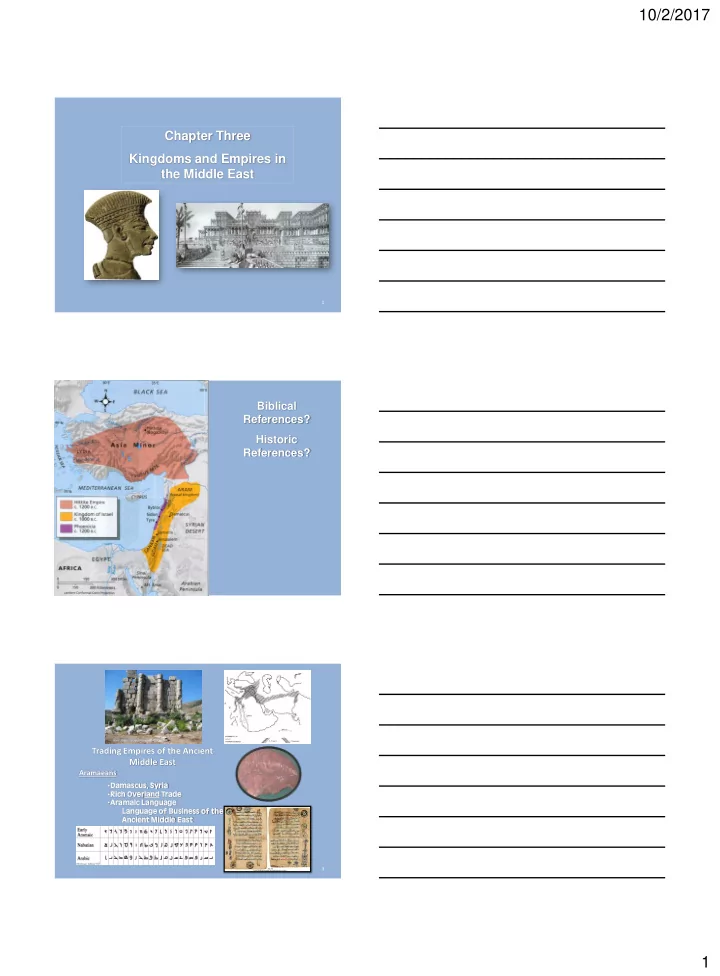
10/2/2017 Chapter Three Kingdoms and Empires in the Middle East 1 Biblical References? Historic References? Trading Empires of the Ancient Middle East Aramaeans Damascus us, Syria Rich h Overland nd Trade Aramaic Langua


slide-1
SLIDE 1

10/2/2017 1

1

Chapter Three Kingdoms and Empires in the Middle East

Biblical References? Historic References?

3

Trading Empires of the Ancient Middle East

Aramaeans

  • Damascus

us, Syria

  • Rich

h Overland nd Trade

  • Aramaic Langua

uage Langua uage e of Busines ness of the e Ancient Middle East

slide-2
SLIDE 2

10/2/2017 2

4

Phoenicians (Merchants of the Mediterranean)

  • Modern Lebanon, Israel, Jordan
  • Canaanites of the Bible
  • Rich Overseas Trade

6

slide-3
SLIDE 3

10/2/2017 3

7

Phoenicians (Merchants of the Mediterranean)

  • Modern Lebanon, Israel, Jordan
  • Canaanites of the Bible
  • Rich Overseas Trade
  • Loose confederation of City States
  • Tyre (most influential), Sidon

Byblos

  • Colonies throughout the

Mediterranean

  • Carthage – greatest colony
  • Overshadow s Tyre

8 9

slide-4
SLIDE 4

10/2/2017 4

10

Phoenicians (Merchants of the Mediterranean)

  • Modern Lebanon, Israel, Jordan
  • Canaanites of the Bible
  • Rich Overseas Trade
  • Loose confederation of City States
  • Tyre (most influential), Sidon Byblos
  • Colonies throughout the Mediterranean
  • Carthage – greatest colony
  • Overshadow s Tyre
  • Excellent sailors
  • Maritime technology
  • Exchange of goods and products (bartering)
  • Business practices
  • Alphabet (See Next Slide)

11

Evolution of the Phoenician Alphabet

12

slide-5
SLIDE 5

10/2/2017 5

13

What is going

  • n?

Note the products!

The Color Purple!

14

The Lydian's

  • Western Asia Minor
  • Modern Turkey
  • Gold Deposits
  • Midas ?
  • Develop a regional trade center
  • Sardis
  • Introduce concept of money
  • Coinage -- Stater
  • Set values for goods
  • King Croesus

15

slide-6
SLIDE 6

10/2/2017 6

16 17 18

slide-7
SLIDE 7

10/2/2017 7

19

Ancient Land of the Israelites

Land of Canaan Abraham – Yahweh – Judaism

  • Settle in the area of Canaan – “Land of Milk and Honey”
  • Share with Philistines & Phoenicians – early Canaanites
  • Migration to Egypt
  • 12 Tribes
  • Moses

20

Land of Canaan

Abraham – Yahweh – Judaism

  • Settle in the area of Canaan – “Land of Milk and Honey”
  • Share with Philistines & Phoenicians – early Canaanites
  • Migration to Egypt
  • 12 Tribes
  • Moses
  • Exodus / Return to Canaan
  • Lack of Unity - Judges
  • Fight among the Canaanites for control of area
  • Establishment of Kingdom
  • Saul – Unites Israel
  • David – Jerusalem
  • Solomon – Temple

21

The Temple at the Time of Solomon

slide-8
SLIDE 8

10/2/2017 8

22 23 24

slide-9
SLIDE 9

10/2/2017 9

25

Ancient Land of the Israelites

  • Establishment of Kingdom
  • Saul – Unites Israel
  • David – Jerusalem
  • Solomon – Temple
  • Breakup of the Kingdom
  • 10 Tribes / North = Israel
  • 2 Tribes / South = Judah (Jerusalem)

King David’s Palace

26 27

slide-10
SLIDE 10

10/2/2017 10

28

Invasion from the North

Assyrians – 722 BC

  • Sennacherib
  • Nineveh
  • Israel – Ten Tribes of the North are conquered
  • Lost Tribes of Israel ?

Chaldeans – 586 BC (Neo-Babylonians)

  • Nebuchadnezzar
  • Judah – Two tribes to the South are

conquered

  • Babylonian Captivity
  • The Jewish culture is organized

29

Babylon 586 BC Babylon Today

30

Persian Empire Begins

Cyrus II

  • Conquers Babylon

Releases the Jews to return to Judea / Israel

  • Diaspora

Torah is created

  • 1st Five Books of the Bible

Jews rebuild the Temple Lasting Legacy

  • Christianity
  • Islam
slide-11
SLIDE 11

10/2/2017 11

31 32 33

slide-12
SLIDE 12

10/2/2017 12

34 35 36

Hittites

Asia Minor

  • Modern Turkey
  • Anatolia Plateau

Well Organized Kingdom

  • Regional “Superpower”
  • Clay Tablets
  • Iron Weapons
  • Three Man Chariots

Society included elements from

  • Mesopotamia
  • Egypt
  • Less harsh legal system
slide-13
SLIDE 13

10/2/2017 13

37

The Hittite Empire

Modern Turkey Ancient Turkey

38

Hattusas The Hittite Capital City

39

Hittite Capital at Hattusas

slide-14
SLIDE 14

10/2/2017 14

40

Hittite Capital at Hattusas

41 42

The Assyrians -- Nineveh

slide-15
SLIDE 15

10/2/2017 15

43

Assyrians

Northern Mesopotamia

  • Nineveh – Capital City
  • Tigris River

Build powerful kingdom 900 BC Army – Dominant power

  • Foot Soldiers
  • Chariots
  • Cavalry

Harsh Overlords Well Organized Empire

  • Provinces – Governors – Road Networks
  • Clay Tablet Library -- 22,000 discovered!

King Sennacherib – Bible (Old Testament)

44 45

Ancient Middle East Exhibit British Museum London, England

slide-16
SLIDE 16

10/2/2017 16

46 47 48

slide-17
SLIDE 17

10/2/2017 17

49

Chaldeans

(Neo-Babylonians) Successors to the Mesopotamian Empires Last of the Mesopotamian Empires Capital City – Babylon Nebuchadnezzar

  • Hanging Gardens
  • Kingdom of Judah – 586 BC
  • Babylonian Exile

Fall to the Persians – 539 BC Cyrus II Builds huge empire to the east Moves to west capturing nations Allows Jews to return to Judea (Biblical Account!)

50 51

slide-18
SLIDE 18

10/2/2017 18

52 53 54

Persian Empire

Cyrus II

  • Defeats Chaldeans
  • Builds huge empire
  • Egypt in west to India in the east

Darius I

  • Well organized – good administrator
  • Provinces – governors – “Satraps”
  • Inspectors
  • Four Capital Cities
  • Persepolis, Susa, Babylon, Sardis
  • Royal Road
  • Dispatch riders
  • “Neither rain nor snow nor gloom of

night stays these couriers from their appointed rounds.”

slide-19
SLIDE 19

10/2/2017 19

55

Tomb of Cyrus the Great Pasargadae, Iran

Built in the shape

  • f a Ziggurat!

56

Darius I – Vainglorious Imagery

57

slide-20
SLIDE 20

10/2/2017 20

58

Persepolis Capital of the Persian Empire

59

Gate of All Lands Entry Way to the Palace

60

Entry way to the Great Hall for the Audience with the King

slide-21
SLIDE 21

10/2/2017 21

61

King’s Audience Hall 65’ in Height

62

Darius I and the Greeks

  • Persian disaster
  • 490 BC
  • 480 BC (Xerxes)

Persian Culture

  • Conquered peoples retained their own cultures
  • Tolerant rulers (Jews return to homeland)

63

Persian Religion

  • Zoroaster (Greek name)
  • Good vs. Evil
  • Final Judgment
  • Impact on Christianity ?
  • Impact on Islam ?
  • Impact on Judaism ?
  • Today, Approximately 4 million Iranians are Zoroastrians
  • Live in south-east Iran
  • Some live in India – Known as the “Parsees”
slide-22
SLIDE 22

10/2/2017 22

64

Home of the Sacred Perpetual Flame

Naqsh-I Rustam (Near Persepolis)