10/13/2019 2019 Fall Tax Update Whats New? 2019 Fall Tax Update - - PDF document

10 13 2019
SMART_READER_LITE
LIVE PREVIEW

10/13/2019 2019 Fall Tax Update Whats New? 2019 Fall Tax Update - - PDF document

10/13/2019 2019 Fall Tax Update Whats New? 2019 Fall Tax Update Whats New? Banff Small Practitioners Forum CPA Forum North October 26/27, 2019 Hugh Neilson FCPA FCA TEP Kingston Ross Pasnak LLP Video Tax News Hugh Neilson FCPA


slide-1
SLIDE 1

10/13/2019 1

Hugh Neilson FCPA FCA TEP Kingston Ross Pasnak LLP/Video Tax News

2019 Fall Tax Update – What’s New? 2019 Fall Tax Update – What’s New? Banff Small Practitioners Forum CPA Forum North

October 26/27, 2019 Hugh Neilson FCPA FCA TEP

Kingston Ross Pasnak LLP Video Tax News

Hugh Neilson FCPA FCA TEP Kingston Ross Pasnak LLP/Video Tax News

2019 Fall Tax Update – What’s New? Tax Rates

  • Personal Rates Rates
  • No changes - Pre-Election!
  • Post-Election?

Hugh Neilson FCPA FCA TEP Kingston Ross Pasnak LLP/Video Tax News

2019 Fall Tax Update – What’s New? Tax Rates

  • Federal Corporate Rates
  • No changes - Pre-Election!
  • SBD rate 9% (2019 onwards)
  • High Rate 15%
  • Post-election?
slide-2
SLIDE 2

10/13/2019 2

Hugh Neilson FCPA FCA TEP Kingston Ross Pasnak LLP/Video Tax News

2019 Fall Tax Update – What’s New? Tax Rates

  • Alberta Corporate Rates
  • Top Rate Declining
  • 12% to June 30, 2019
  • 11% July 1, 2019
  • 10%/9%/8% January 1, 2020/2021/2022
  • GRIP Integration pretty close by 2022

Hugh Neilson FCPA FCA TEP Kingston Ross Pasnak LLP/Video Tax News

2019 Fall Tax Update – What’s New? Integration

  • ABI – not much change
  • High rate ABI over-integrated in 2022?
  • SIBI – getting less terrible
  • Deferral by 2022

Hugh Neilson FCPA FCA TEP Kingston Ross Pasnak LLP/Video Tax News

2019 Fall Tax Update – What’s New? Passive Income Grind

  • Dec 31, 2019 earliest YE for most
  • Use SBD in earlier year ends?
slide-3
SLIDE 3

10/13/2019 3

Hugh Neilson FCPA FCA TEP Kingston Ross Pasnak LLP/Video Tax News

2019 Fall Tax Update – What’s New? Passive Income Grind

  • REFRESHER
  • Passive income over $50k
  • $1 income = $5 SBD limit lost
  • All gone with $150k passive income
  • Look to prior calendar year

Hugh Neilson FCPA FCA TEP Kingston Ross Pasnak LLP/Video Tax News

2019 Fall Tax Update – What’s New? Passive Income Grind

  • REFRESHER
  • Adjusted Aggregate Investment Income
  • Aka “passive income”
  • Income subject to RDTOH (AII)
  • Add most dividends received
  • Not reduced by cap losses carried over
  • Excludes “active asset” cap gains

Hugh Neilson FCPA FCA TEP Kingston Ross Pasnak LLP/Video Tax News

2019 Fall Tax Update – What’s New? Passive Income Grind

  • Substantial cash flow hit
  • Up to $70,000 in 2020
  • Pull out investment capital?
  • DO THE MATH FIRST
slide-4
SLIDE 4

10/13/2019 4

Hugh Neilson FCPA FCA TEP Kingston Ross Pasnak LLP/Video Tax News

2019 Fall Tax Update – What’s New? Passive Income Grind

  • Pull out capital? Consider
  • Up front cost (repay old deferral)
  • SBD benefit declining from $80k
  • $60k after 2020
  • How long to recover up front cost?
  • Where does the new deferral go?

Hugh Neilson FCPA FCA TEP Kingston Ross Pasnak LLP/Video Tax News

2019 Fall Tax Update – What’s New? RDTIOH Streaming

  • REFRESHER
  • First affected year Dec 31/19
  • Eligible and Non-eligible RDTOH
  • Old RDTOH “grandfathered”
  • No reason to accelerate dividends
  • New RDTOH mainly non-eligible

Hugh Neilson FCPA FCA TEP Kingston Ross Pasnak LLP/Video Tax News

2019 Fall Tax Update – What’s New? RDTIOH Streaming

  • Planning – before Dec 31/19
  • Consolidate GRIP and RDTOH?
  • Trigger GRIP and/or RDTOH?
  • Running out of time…
slide-5
SLIDE 5

10/13/2019 5

Hugh Neilson FCPA FCA TEP Kingston Ross Pasnak LLP/Video Tax News

2019 Fall Tax Update – What’s New? RDTIOH Streaming

  • Planning – after Dec 31/19
  • Move corporate investments to CDN

dividends?

  • Only generator of eligible RDTOH

Hugh Neilson FCPA FCA TEP Kingston Ross Pasnak LLP/Video Tax News

2019 Fall Tax Update – What’s New? RDTIOH Streaming

  • Planning – after Dec 31/19
  • Priority of dividends
  • Eligible dividends - recover eligible RDTOH
  • Non-Eligible div – recover non-el RDTOH
  • Back to eligible dividends when no RDTOH
  • Finally, non-eligible when GRIP runs out

Hugh Neilson FCPA FCA TEP Kingston Ross Pasnak LLP/Video Tax News

2019 Fall Tax Update – What’s New? 2019 Federal Budget

  • Pre-election to be sure
  • A shotgun, not a rifle
slide-6
SLIDE 6

10/13/2019 6

Hugh Neilson FCPA FCA TEP Kingston Ross Pasnak LLP/Video Tax News

2019 Fall Tax Update – What’s New? 2019 Federal Budget

  • What Was There – The Big Ones
  • There were no big ones!

Hugh Neilson FCPA FCA TEP Kingston Ross Pasnak LLP/Video Tax News

2019 Fall Tax Update – What’s New? 2019 Federal Budget

  • Housing Related
  • Home Buyers’ Plan
  • $35,000 limit
  • Marital breakdown

Hugh Neilson FCPA FCA TEP Kingston Ross Pasnak LLP/Video Tax News

2019 Fall Tax Update – What’s New? 2019 Federal Budget

  • Housing Related
  • First-time Home Buyer Incentive
  • 5% or 10% of home price
  • Shared equity mortgage
  • Many restrictions
  • CMHC shares the lift.
slide-7
SLIDE 7

10/13/2019 7

Hugh Neilson FCPA FCA TEP Kingston Ross Pasnak LLP/Video Tax News

2019 Fall Tax Update – What’s New? 2019 Federal Budget

  • Partial change of use
  • Canada Training Credit
  • New annuities for retirement plans
  • Employee Stock Options

Hugh Neilson FCPA FCA TEP Kingston Ross Pasnak LLP/Video Tax News

2019 Fall Tax Update – What’s New? 2019 Federal Budget

  • Medicinal Cannabis
  • Fertility expenses
  • Registered Disability Savings Plans
  • Kinship Care Providers
  • Transfers to IPPs restricted

Hugh Neilson FCPA FCA TEP Kingston Ross Pasnak LLP/Video Tax News

2019 Fall Tax Update – What’s New? 2019 Federal Budget

  • Canadian Journalism Measures
  • Credit for wages
  • Qualified donee status
  • Personal tax credit for subscriptions
  • No process yet for designating news
  • rganizations
slide-8
SLIDE 8

10/13/2019 8

Hugh Neilson FCPA FCA TEP Kingston Ross Pasnak LLP/Video Tax News

2019 Fall Tax Update – What’s New? 2019 Federal Budget

  • Farmers/Fishers
  • Exempt from Specified Corporate

Income

  • SRED
  • No more income grind for CCPCs
  • Mutual Funds – Capital Gain changes

Hugh Neilson FCPA FCA TEP Kingston Ross Pasnak LLP/Video Tax News

2019 Fall Tax Update – What’s New? 2019 Federal Budget

  • Money for CRA – compliance issues
  • Cryptocurrency and digital economy
  • Non-residents including withholdings

and reporting

  • Offshore non-compliance
  • Real estate
  • Including principal residence reporting

Hugh Neilson FCPA FCA TEP Kingston Ross Pasnak LLP/Video Tax News

2019 Fall Tax Update – What’s New? 2019 Federal Budget

  • Money for CRA – service issues
  • T1 Adjustment processing
  • Dedicated telephone service
  • Improved tracking online
  • Objection processing
  • Liaison Officer Initiative (corporations)
slide-9
SLIDE 9

10/13/2019 9

Hugh Neilson FCPA FCA TEP Kingston Ross Pasnak LLP/Video Tax News

2019 Fall Tax Update – What’s New? 2019 Federal Budget

  • Zero-emission Vehicles
  • Up to $5,000 purchase incentive

OR

  • Accelerated CCA – full writeoff
  • Watch out for passenger vehicles!

Hugh Neilson FCPA FCA TEP Kingston Ross Pasnak LLP/Video Tax News

2019 Fall Tax Update – What’s New? 2018 Fall Economic Statement

  • Accelerated Investment initiative
  • Full writeoff
  • M & P Equipment
  • Clean Energy assets

Hugh Neilson FCPA FCA TEP Kingston Ross Pasnak LLP/Video Tax News

2019 Fall Tax Update – What’s New? 2018 Fall Economic Statement

  • Accelerated Investment initiative
  • All other assets
  • Accelerated CCA
  • Half year rule
  • year and a half rule!
slide-10
SLIDE 10

10/13/2019 10

Hugh Neilson FCPA FCA TEP Kingston Ross Pasnak LLP/Video Tax News

2019 Fall Tax Update – What’s New? 2018 Fall Economic Statement

  • Accelerated Investment initiative
  • Special rules for some assets
  • Few exceptions
  • Full claim?
  • Watch marginal rates
  • Watch acquisition dates!

Hugh Neilson FCPA FCA TEP Kingston Ross Pasnak LLP/Video Tax News

2019 Fall Tax Update – What’s New? Tax on Split Income - TOSI

  • Applied for 2018
  • were we ready?
  • was CRA ready?
  • what next?

Hugh Neilson FCPA FCA TEP Kingston Ross Pasnak LLP/Video Tax News

2019 Fall Tax Update – What’s New? Tax on Split Income - TOSI

  • Related Business Updates
  • Benchmark for “business”?
  • Seems pretty low
  • Source & Specified Individual
  • Must be two people
slide-11
SLIDE 11

10/13/2019 11

Hugh Neilson FCPA FCA TEP Kingston Ross Pasnak LLP/Video Tax News

2019 Fall Tax Update – What’s New? Tax on Split Income - TOSI

  • Related Business Updates
  • Investment income
  • Not derived from financing source
  • Business of portfolio investing?
  • “For the year”
  • Watch the clock when business sold

Hugh Neilson FCPA FCA TEP Kingston Ross Pasnak LLP/Video Tax News

2019 Fall Tax Update – What’s New? Tax on Split Income - TOSI

  • Reasonable Return Update
  • Relative contributions
  • Full history
  • Initial financing?
  • Undistributed earnings
  • Not contributions to business

Hugh Neilson FCPA FCA TEP Kingston Ross Pasnak LLP/Video Tax News

2019 Fall Tax Update – What’s New? Tax on Split Income - TOSI

  • Excluded Business Update
  • Bright line
  • Any five years = permanent exception
  • Exception means no limit to income
  • The Gold Card!
slide-12
SLIDE 12

10/13/2019 12

Hugh Neilson FCPA FCA TEP Kingston Ross Pasnak LLP/Video Tax News

2019 Fall Tax Update – What’s New? Tax on Split Income - TOSI

  • Excluded Shares Update:Votes/Value
  • Votes/Value can be in multiple classes

Hugh Neilson FCPA FCA TEP Kingston Ross Pasnak LLP/Video Tax News

2019 Fall Tax Update – What’s New? Tax on Split Income - TOSI

  • Excluded Shares Update:Service
  • Gross business income
  • Investment income is not from services
  • No business = no excluded shares
  • But no related business

Hugh Neilson FCPA FCA TEP Kingston Ross Pasnak LLP/Video Tax News

2019 Fall Tax Update – What’s New? Tax on Split Income - TOSI

  • Excluded Shares Update:Service
  • CRA Website examples
  • 90% test
  • Timing can matter (prior year determines)
  • Ancillary income remains hazy
slide-13
SLIDE 13

10/13/2019 13

Hugh Neilson FCPA FCA TEP Kingston Ross Pasnak LLP/Video Tax News

2019 Fall Tax Update – What’s New? Tax on Split Income - TOSI

  • Excluded Shares Update:Prof Corp
  • Easy, right?
  • Maybe not…
  • Run-off expenses

Hugh Neilson FCPA FCA TEP Kingston Ross Pasnak LLP/Video Tax News

2019 Fall Tax Update – What’s New? Tax on Split Income - TOSI

  • Excluded Shares Update:Related Bus
  • Gross income
  • Includes taxable cap gains
  • Again, timing is everything
  • Partner carries on business of

partnership

Hugh Neilson FCPA FCA TEP Kingston Ross Pasnak LLP/Video Tax News

2019 Fall Tax Update – What’s New? Tax on Split Income - TOSI

  • Inheritances Update
  • Inherited attributes pass through
  • Multiple bequests
  • Retain records forever?
slide-14
SLIDE 14

10/13/2019 14

Hugh Neilson FCPA FCA TEP Kingston Ross Pasnak LLP/Video Tax News

2019 Fall Tax Update – What’s New? Tax on Split Income - TOSI

  • Not just dividends
  • Shareholder benefits
  • Unreasonable “salaries”?
  • Shareholder loans?

Hugh Neilson FCPA FCA TEP Kingston Ross Pasnak LLP/Video Tax News

2019 Fall Tax Update – What’s New? Shareholder Issues

  • Shareholder loans
  • Remember related parties
  • May never be statute barred

Hugh Neilson FCPA FCA TEP Kingston Ross Pasnak LLP/Video Tax News

2019 Fall Tax Update – What’s New? Shareholder Issues

  • Incentives project
  • Where did the money go?
  • Not statute barred
slide-15
SLIDE 15

10/13/2019 15

Hugh Neilson FCPA FCA TEP Kingston Ross Pasnak LLP/Video Tax News

2019 Fall Tax Update – What’s New? Shareholder Issues

  • Business or personal?
  • Trip to the space station case
  • Analogized to shareholder road trip

Hugh Neilson FCPA FCA TEP Kingston Ross Pasnak LLP/Video Tax News

2019 Fall Tax Update – What’s New? Shareholder Issues

  • Salaries and Dividends
  • Court case – marital breakup
  • Court case – business breakup
  • Court case – pausing salaries

Hugh Neilson FCPA FCA TEP Kingston Ross Pasnak LLP/Video Tax News

2019 Fall Tax Update – What’s New? Shareholder Issues

  • Owner-Manager Employment

Expenses

  • Must parallel non-owner employees
slide-16
SLIDE 16

10/13/2019 16

Hugh Neilson FCPA FCA TEP Kingston Ross Pasnak LLP/Video Tax News

2019 Fall Tax Update – What’s New? Shareholder Issues

  • Health Spending Accounts
  • CRA project?
  • Unincorporated
  • Likely no go
  • Incorporated
  • Need for T4 income?

Hugh Neilson FCPA FCA TEP Kingston Ross Pasnak LLP/Video Tax News

2019 Fall Tax Update – What’s New? Section 55 Update

  • No info in CRA Audit Manual
  • Discretionary Dividend Shares
  • CRA review done
  • No more CRA commentary
  • Want comfort? Get a ruling!

Hugh Neilson FCPA FCA TEP Kingston Ross Pasnak LLP/Video Tax News

2019 Fall Tax Update – What’s New? Corporate Issues

  • Limited Review
  • Corporate Post-Assessing Review
  • High volume
  • Vehicle expenses
  • No details on adjustments – CRA?
slide-17
SLIDE 17

10/13/2019 17

Hugh Neilson FCPA FCA TEP Kingston Ross Pasnak LLP/Video Tax News

2019 Fall Tax Update – What’s New? Corporate Issues

  • Specified Investment Business
  • Campground case
  • Taxpayer loses
  • Fact-specific

Hugh Neilson FCPA FCA TEP Kingston Ross Pasnak LLP/Video Tax News

2019 Fall Tax Update – What’s New? Corporate Issues

  • Personal Services Businesses
  • Various industries on CRA website
  • Reviews of contract truck drivers

Hugh Neilson FCPA FCA TEP Kingston Ross Pasnak LLP/Video Tax News

2019 Fall Tax Update – What’s New? Business Issues

  • Interest Deductibility
  • On account of capital
  • Specific Rule
  • CRA Folio
  • Technical and practical issues
  • Caution with shareholder loans
slide-18
SLIDE 18

10/13/2019 18

Hugh Neilson FCPA FCA TEP Kingston Ross Pasnak LLP/Video Tax News

2019 Fall Tax Update – What’s New? Business Issues

  • Cryptocurrency
  • GST/HST legislated
  • Audit project
  • Timing of income
  • Reversal of prior position?
  • CRA guidance
  • including expected records

Hugh Neilson FCPA FCA TEP Kingston Ross Pasnak LLP/Video Tax News

2019 Fall Tax Update – What’s New? Personal Tax

  • Employment Benefits
  • FCA changes the game
  • “Primary beneficiary” test
  • Economic benefits to employee taxable

Hugh Neilson FCPA FCA TEP Kingston Ross Pasnak LLP/Video Tax News

2019 Fall Tax Update – What’s New? Personal Issues

  • Allowances
  • Generally taxable
  • Travel – may be non-taxable
  • Recent court case
slide-19
SLIDE 19

10/13/2019 19

Hugh Neilson FCPA FCA TEP Kingston Ross Pasnak LLP/Video Tax News

2019 Fall Tax Update – What’s New? Personal Issues

  • Commuting
  • Personal
  • Distance not a factor
  • Recent cases

Hugh Neilson FCPA FCA TEP Kingston Ross Pasnak LLP/Video Tax News

2019 Fall Tax Update – What’s New? Personal Issues

  • Marital breakdown
  • Benefits sharing
  • “Equal or near-equal”
  • CRA said 40%+
  • FCA said 45%+
  • Finance says 40%+ with wiggle room

Hugh Neilson FCPA FCA TEP Kingston Ross Pasnak LLP/Video Tax News

2019 Fall Tax Update – What’s New? Capital Gains/Losses

  • Securities Trade Project – T5008?
  • Income-earning purpose
  • Recent loss cases
slide-20
SLIDE 20

10/13/2019 20

Hugh Neilson FCPA FCA TEP Kingston Ross Pasnak LLP/Video Tax News

2019 Fall Tax Update – What’s New? Capital Gains/Losses

  • Real Estate
  • Income or capital?
  • Principal residence?
  • Recent cases

Hugh Neilson FCPA FCA TEP Kingston Ross Pasnak LLP/Video Tax News

2019 Fall Tax Update – What’s New? GST/HST

  • New Housing Rebate
  • OOPS – rental property
  • Timing is critical
  • “Primary residence”
  • How soon?
  • Who’s on title?

Hugh Neilson FCPA FCA TEP Kingston Ross Pasnak LLP/Video Tax News

2019 Fall Tax Update – What’s New? Estates and Trusts

  • Capital gains project?
slide-21
SLIDE 21

10/13/2019 21

Hugh Neilson FCPA FCA TEP Kingston Ross Pasnak LLP/Video Tax News

2019 Fall Tax Update – What’s New? Estates and Trusts

  • Spousal Trusts
  • CAUTION – donations; life insurance
  • Spousal beneficiary dies
  • Deemed Disposition on Death
  • Valuation caution

Hugh Neilson FCPA FCA TEP Kingston Ross Pasnak LLP/Video Tax News

2019 Fall Tax Update – What’s New? Estates and Trusts

  • Trusts for Disabled beneficiaries
  • “Henson Trusts”
  • Supreme Court says:
  • Depends on all the facts

Hugh Neilson FCPA FCA TEP Kingston Ross Pasnak LLP/Video Tax News

2019 Fall Tax Update – What’s New? Aggressive Tax Roundup

  • Swap Transactions – TAXPAYER LOSS
  • SBD Multiplication – MIXED RESULTS
  • CDA Multiplication – TAXPAYER LOSS
  • Partnership Income - TAXPAYER LOSS
  • Common theme? Legistaled away
slide-22
SLIDE 22

10/13/2019 22

Hugh Neilson FCPA FCA TEP Kingston Ross Pasnak LLP/Video Tax News

2019 Fall Tax Update – What’s New? Assessments and Reassessments

  • Is anyone “Statute Barred”?
  • careless or negligent misrepresentation
  • Two edged sword
  • Bars beneficial reassessments

Hugh Neilson FCPA FCA TEP Kingston Ross Pasnak LLP/Video Tax News

2019 Fall Tax Update – What’s New? Assessments and Reassessments

  • CRA not obliged to adjust returns
  • Preserve appeal rights
  • Judicial reviews
  • 30 day deadline
  • Law flexible for extensions

Hugh Neilson FCPA FCA TEP Kingston Ross Pasnak LLP/Video Tax News

2019 Fall Tax Update – What’s New? Penalties/Taxpayer Relied

  • “The software acted alone”
  • T1135 – some good news
slide-23
SLIDE 23

10/13/2019 23

Hugh Neilson FCPA FCA TEP Kingston Ross Pasnak LLP/Video Tax News

2019 Fall Tax Update – What’s New? Registered Accounts

  • Excessive Contributions
  • TFSA honeymoon is over
  • Recent court cases split
  • Recent RRSP cases also split

Hugh Neilson FCPA FCA TEP Kingston Ross Pasnak LLP/Video Tax News

2019 Fall Tax Update – What’s New? Registered Accounts

  • Defrauded RRSP
  • Assessed as RRSP strip
  • Don’t look like an aggressive taxpayer
  • Easier said than done!

Hugh Neilson FCPA FCA TEP Kingston Ross Pasnak LLP/Video Tax News

2019 Fall Tax Update – What’s New? Registered Accpounts

  • Management fee saga
  • nearing an end?
  • Finance will recommend legislation
  • Define as “not an advantage”
  • Fingers crossed…
slide-24
SLIDE 24

10/13/2019 24

Hugh Neilson FCPA FCA TEP Kingston Ross Pasnak LLP/Video Tax News

2019 Fall Tax Update – What’s New? WCB

  • No Directors’ Coverage?
  • Potential personal liability
  • for Directors’ work in business
  • Alberta case – talk to the lawyers!

Hugh Neilson FCPA FCA TEP Kingston Ross Pasnak LLP/Video Tax News

2019 Fall Tax Update – What’s New? 2019 Tax Update – What’s New? NO BIG CHANGES THE YEAR OF 1,000 MICRO ISSUES QUESTIONS? ENJOY THE REST OF THE FORUM!

slide-25
SLIDE 25

Fall 2019 Tax Update – What’s New?

Hugh Neilson FCPA FCA TEP Kingston Ross Pasnak LLP Page 1 Video News Inc. October 26/27, 2019

Introduction When I introduced this topic in 2017 and 2018, I remarked that the past few years have seen a dizzying pace of change, even by tax standards, and that more was clearly on the way. Why is it that we are most likely to be correct when we most wish to be wrong? The past year has not seen the major changes we experienced in 2017 and 2018, but there has been an array of more minor developments. Meanwhile, changes like the new Tax on Split Income (TOSI) regime and the passive income rules move from the theoretical to the practical, revealing new challenges. Our clients (whether in traditional public practice or industry roles) look to us for guidance on tax matters in the face of rapid changes, whether those impacting broad groups of taxpayers, or narrow tax issues,

  • ften industry-specific. The purpose of this session is to highlight some of the more significant changes

impacting private businesses and their owners, and hopefully identify those areas where each of us may need to look a little closer, reassess our historical practices and keep monitoring ongoing developments. With a recent Alberta government change, and a brand-new Federal government awaiting election as I write this, and not likely sworn in yet when this will be presented, the pace of change seems unlikely to slow down Tax Rates Personal rates have remained constant since the Liberal election changes in 2015. A new Federal government may make some changes. Corporate rates have seen recent changes, with no new changes proposed. Last year, we saw the Federal small business rate reach 9%, with no new proposals (unless we count election promises, but corporate rates were not on the agenda of either of the Big Two parties). A minority could create some issues, though. The new Alberta government moved quickly to put a corporate rate reduction, from 12% to 8%, into

  • place. The small business rate will remain at 2%, however the base corporate rate declined 1%, from

12% to 11%, effective July 1, 2019 (for a phased-in rate of 11.49% for calendar 2019), and will fall a further 1% on January 1 of 2020 (10%), 2021 (9%) and 2022, where it will settle at 8% - just in time for another election in 2023! This will change integration a bit. When the NDP Government raised the rate from 10% to 12%, the dividend tax credit on eligible dividends was not increased. Once we reach 8%, however, we will be pretty close to perfect integration, absent further changes to corporate rates or dividend tax credits. Any bets on whether we will actually get there? The State of Integration The higher personal tax rates have increased the incentive to retain income in a corporation and defer personal income tax, and the deferral on small business income increased a little with the Federal

  • changes. The deferral for high rate ABI is on the rise due to the declining Alberta rate. Investment

income moves from – well, horrible to a bit less horrible is the best we can do there.

slide-26
SLIDE 26

Fall 2019 Tax Update – What’s New?

Hugh Neilson FCPA FCA TEP Kingston Ross Pasnak LLP Page 2 Video News Inc. October 26/27, 2019

Income eligible for the small business deduction benefits from a substantial deferral, but is slightly under-integrated in some provinces, and a bit over-integrated in others. Generally, the variance is less than 1%. In Alberta, under-integration is 0.65% in 2019 and 0.88% in 2019 (thanks to a small tweak to the dividend tax credit on non-eligible dividends). As has been the case for decades, if you can leave small business income behind in the company, you do it for the huge deferral. There’s little or no benefit (or cost) if you pull it all out for personal spending. High rate active business income benefits from a significant deferral, but carries a cost when ultimately withdrawn, which varies considerably between provinces (1.97% in Alberta in 2019). In most cases, we need a few years of reinvestment to make paying high rate corporate tax today preferable to taking a bonus and lending the cash back to the company. Many business owners expect a substantial return on reinvested capital, and/or have a long time horizon before they anticipate needing the cash for personal

  • spending. Assuming no further changes, however, by 2022 this income will be over-integrated (by all of

0.05%). Investment income generates limited or no deferral, with a 2.17% prepayment in Alberta in 2019. As well, when the funds are returned as dividends, there is an ultimate cost in every province, 5.55% in Alberta in 2019. As the high corporate rate declines, both the prepayment and the ultimate cost will decline, reaching a 1.33% deferral (yes, you ready that right – a DEFERRAL) in 2022, although the ultimate cost of 3.53% may deter many from pursuing that deferral. Income eligible for foreign tax credits is much more under-integrated, with greater slippage for income with a 15% credit, like US source dividends, and will remain so. It’s still not enough to pay the cost of extracting all of the investment capital, but it continues to merit consideration of portfolio rebalancing to shift foreign investment to personal accounts, and “buy Canadian” in the corporation. Dividends generate a small tax deferral in some provinces, and a prepayment in others. No ultimate tax cost, arises (outside of the potential issue of a rate change if the personal dividends are deferred). For many investors, that may soften the blow of under-integration on other investment income. Here in Alberta, we get a deferral on non-eligible dividends but a prepayment on eligible dividends. Non-eligible dividends are often received from connected corporations, avoiding Part IV tax. In Alberta, tax rates traditionally suggested always paying dividends to recover RDTOH. That’s still the case if eligible dividends can be paid, and for ineligible dividends if the recipient has income below the levels attracting 33% Federal tax (under $210,371 in 2019). Once that 33% rate kicks in, it’s preferable to defer non-eligible dividends and let the RDTOH ride, unless funds are needed for personal spending. What If We’re NOT in the Top Rate? That question is a common challenge to integration tables assuming the top rate – and with a top rate that does not apply until income tops $314,000, it seems more valid than ever. The reality is that integration depends on whether the dividend tax credit is adequate to compensate for the corporate taxes paid to generate the cash paid out as a dividend.

slide-27
SLIDE 27

Fall 2019 Tax Update – What’s New?

Hugh Neilson FCPA FCA TEP Kingston Ross Pasnak LLP Page 3 Video News Inc. October 26/27, 2019

Of course, lower personal tax rates mean lower deferrals from retaining corporate income, but the ultimate cost or benefit does not vary much at lower income levels. So those “top rate assumed” charts are still useful for many lower income taxpayers. I’ve attached integration charts for 2019 – 2023 in Alberta. Please feel free to find any errors I’ve made and let me know about those! Passive Income Grind For most corporate taxpayers, the first year-end to face the grind to SBD room for passive investment income exceeding $50,000 will be December 31, 2019, as tax years commencing after 2018 are affected. To refresh, corporations which, alone or with associated groups, earn passive income in excess of $50,000. For every dollar of passive income over $50,000, the group’s $500,000 business limit will be reduced by $5, with the entire business limit eliminated where passive income reaches or exceeds $150,000. In most cases, the passive income generated in all fiscal years ended in the preceding calendar year will determine the grind. As an example, assume that ACo (year-end April 30), BCo (year-end September 30) and CCo (year end-December 31) are associated. ACo and BCo will not be affected by these new rules for their April 30, 2019 and September 30, 2019 year-ends. CCo’s access to the SBD in its December 31, 2019 year-end will depend on the passive income of ACo for its year ended April 30, 2018, BCo for its year ended September 30, 2018 and CCo for its year ended December 31, 2018. In 2019, there may be some corporations in the associated group (such as those with December 31 year- ends) whose SBD access is reduced, and others facing no reduction. Using the SBD in the earlier year- ends may allow greater SBD claims next year. What is Passive Income So what income will erode the SBD? The starting point is aggregate investment income (AII), the income currently subject to RDTOH. This is then modified to compute Adjusted Aggregate Investment Income, including the following adjustments: · Add taxable dividends from non-connected corporations; · Add income from life insurance policies, to the extent it is not included in AII (this does not require accrual of income within a policy which would not otherwise be subject to current taxation); · Add any capital losses carried forward or back from other years; · Subtract taxable capital gains on assets primarily used in active business carried on in Canada; · Subtract taxable capital gains on shares of connected corporations which would be eligible for the capital gains exemption based on the qualifying small business corporation definition; · Subtract taxable capital gains on partnership interests if, basically, they would qualify as QSBC shares as noted above (over 10% ownership and all or substantially all assets used in active business carried on in Canada).

slide-28
SLIDE 28

Fall 2019 Tax Update – What’s New?

Hugh Neilson FCPA FCA TEP Kingston Ross Pasnak LLP Page 4 Video News Inc. October 26/27, 2019

As capital losses will offset gains only if realized in the same year, managing the timing of corporate gains and losses becomes more important under these new provisions. As well, corporations may wish to trigger gains in years where their passive income is less than $50,000 (or greater than $150,000) to reduce gains which may grind their business limit in the future. Given the exclusion of gains on certain shares, ongoing purification of active business corporations may also merit more consideration than in the past. Related Corporations What about investment income in related corporations which are not associated? In general, this will have no impact. However, the legislation includes an anti-avoidance rule. Where investment assets are transferred to a related corporation, and it is reasonable to conclude that one of the reasons for the transfer was to reduce this grind, the related corporation will be deemed associated for these purposes. CRA has indicated that, where the transfer occurred, or was planned, prior to Budget Day, it would be difficult to envision one of the purposes being avoidance of a rule which had not yet been announced (see Q9 at https://www.canada.ca/en/revenue-agency/programs/about-canada-revenue-agency- cra/federal-government-budgets/budget-2018-equality-growth-strong-middle-class/passive- investment-income/small-business-deduction-rules.html). Large Corporations CCPCs having taxable capital in excess of $10 million are already subject to a reduced business limit. Where this grind is also applicable, the greater of the two will apply. So, for example, an associated group having $100,000 of passive income (reduction of $250,000 to business limit) and $1.3 million of taxable capital (reduction of $300,000 of business limit) would retain the lower limit of $200,000 – the grinds are not added together. Cash Flow and Integration The cash flow impact of these provisions is substantial. Loss of SBD on a full $500,000 of income for a December 31, 2020 year end costs an extra $70,000 of tax, after the Alberta rate reduction. When the funds are distributed, some of that cost is recovered due to the ability to pay eligible dividends, of course, but often the personal withdrawal is a long time away. Pull the Capital Out? Is it worth extracting the investment capital to keep the SBD? Let’s consider: · If I generate $150,000 of passive income on $3 million, it will cost between $720,000 (capital gains rates) and $1.269 million (non-eligible dividend rates) of personal tax. There may also be corporate taxes if there are accrued gains on the investment assets. · The SBD is declining in value in Alberta. A full $500,000 of SBD income saved $80,000 before the new Alberta government lowered the high corporate rate. The benefit is declining to $60,000 by 2023. We’ll use $70,000 to illustrate.

slide-29
SLIDE 29

Fall 2019 Tax Update – What’s New?

Hugh Neilson FCPA FCA TEP Kingston Ross Pasnak LLP Page 5 Video News Inc. October 26/27, 2019

· It will take over 10 years to be ahead by $720,000, assuming we accessed capital gains rates at no transaction or other costs. That seems a best-case scenario. · But that deferred tax benefit is in the corporation – there will be a personal tax cost to access it. · What happens to the after tax cash? That’s $445,000 ($500,000 less SBD rate tax of 11%). It’s probably going into new passive investments. · In less than 7 years, we will have accumulated $3 million of investment capital again. Pulling out all of the cash just to avoid the loss of SBD room is not a great idea. There may be cases where it makes sense (e.g. they will need the funds for personal use in the next few years; they can benefit from an RDTOH recovery; they have access to tax-free withdrawals like shareholder loan repayments or capital dividends), but it’s not the best answer for everyone. I’ve attached some numbers for those inclined to review my work – I would not be unhappy to be proven wrong! RDTOH Streaming Introduced with the passive investment grind, the restriction on recovery of refundable taxes by paying eligible dividends has received less attention. RDTOH will be divided into two separate pools, Eligible RDTOH (which can be recovered by payment of eligible dividends, or non-eligible dividends) and Non- eligible RDTOH (which can only be recovered by payment of non-eligible dividends). The 38 1/3% recovery rate is unchanged. Eligible RDTOH Only Part IV tax paid on eligible dividends, or on dividends from a connected corporation on which that corporation recovered Eligible RDTOH (“ERDTOH”), will add to ERDTOH. Payment of eligible dividends will recover ERDTOH, but not non-eligible RDTOH (“NERDTOH”). Non-Eligible RDTOH Only non-eligible dividends will recover Non-Eligible RDTOH. Once all Non-Eligible RDTOH is recovered, eligible dividends can also recover Eligible RDTOH. The Transition So how will we get from RDTOH to Eligible and Non-eligible RDTOH? Like the grind to the SBD, the rules will first apply in the first taxation year commencing after 2018, so December 31, 2019 and later year- ends for most corporations.

slide-30
SLIDE 30

Fall 2019 Tax Update – What’s New?

Hugh Neilson FCPA FCA TEP Kingston Ross Pasnak LLP Page 6 Video News Inc. October 26/27, 2019

Any RDTOH not recovered in the prior year will be divided between the two new pools as follows, for CCPCs: (a) The RDTOH will become Eligible RDTOH to a maximum of 38 1/3% of the corporation’s General Rate Income Pool (GRIP); and (b) The remainder will become Non-eligible RDTOH. For non-CCPC’s, including corporations which have elected non-CCPC status, all RDTOH will become Eligible RDTOH. Of course, these corporations will still be required to pay out non-eligible dividends to the extent of their Low Rate Income Pool (LRIP) before paying eligible dividends. This approach ensures that any RDTOH recoverable on eligible dividends prior to the new rules coming into effect will stream into Eligible RDTOH, so there is no urgency to paying eligible dividends to recover RDTOH. Planning Issues While there is no need to accelerate dividend payments, the best results for future dividends will be attained if RDTOH in the last tax year before these rules begin is 38 1/3% of GRIP. Consider three possibilities: (a) One corporation in the group has a GRIP pool, and another has accumulated RDTOH. Consideration could be given to transactions which move the GRIP and RDTOH into the same corporation (for example, a subsidiary with GRUIP paying eligible dividends to a parent corporation with RDTOH. (b) Where RDTOH is significantly less than 38 1/3% of GRIP, consideration could be given to triggering investment income, and therefore RDTOH, in the last year before the new rules come into effect (for example, by structuring transactions to realize capital gains). Accelerating capital gains may also be beneficial in reducing future AAII which could erode SBD access. (c) Where RDTOH exceeds 38 1/3% of GRIP, consideration could be given to accelerating GRIP, perhaps by not claiming reserves, or assigning business limit to different associated corporations. Of course, strategies related to (b) and (c) above trade off greater access to RDTOH recovery by subsequent eligible dividends with immediate tax costs which might otherwise have been deferred. As well, time to implement these strategies is running out fast.

slide-31
SLIDE 31

Fall 2019 Tax Update – What’s New?

Hugh Neilson FCPA FCA TEP Kingston Ross Pasnak LLP Page 7 Video News Inc. October 26/27, 2019

Once the new rules are in place, dividend planning will also need to be revisited. Currently, eligible dividends are normally prioritized due to the reduced personal tax cost. Under the new rules, the standard planning will likely evolve to: (a) Pay eligible dividends which can recover Eligible RDTOH first; (b) Pay non-eligible dividends to recover Non-eligible RDTOH (accepting the additional personal tax, about 10.85%, as a cost of accessing the 38 1/3% dividend refund); (c) Paying eligible dividends once all RDTOH is recovered, as needed for shareholder cash flow requirements; (d) Finally, paying non-eligible dividends to the extent further cash distributions are necessary. While this feels pretty complex today, the advent of eligible dividends brought similar considerations – we have generally become used to the issues these created (prior to these new wrinkles). 2019 Federal Budget Perhaps best described as providing something for everyone, and not much for anyone, the 2019 Budget did not have the “heavy hitter” tax changes we have seen in the past few years. Rather, it had a potpourri of minor, often industry-specific, proposals for us to contend with. Housing Related Changes One theme of the budget was making acquiring one’s first home easier. The RRSP home buyers’ plan was expanded to allow a maximum withdrawal of $35,000, up from $25,000. Access to such withdrawals was expanded to parties to a marital breakdown, allowing the plan to be accessed to fund a new residence, or buy out a former spouse or common-law partner’s interest in the existing matrimonial home. The new program isn’t a tax matter, but a CMHC-managed shared-equity mortgage, the First-Time Home Buyer Incentive. Essentially, the Incentive provides a second mortgage of 5% of the home cost (10% is available for newly constructed homes). No payments are required, and no interest applies. However, CMHC gets repaid the same percentage of the home value when the Incentive must be repaid. Access can be computed at https://www.placetocallhome.ca/fthbi/eligibility-savings-calculator. Participation is limited to households with combined income of no more than $120,000 per annum (and any guarantors on the first mortgage will add their income to the household income; rental income planned from the home must also be considered). The incentive plus the mortgage cannot exceed four times household income, and must be over 80% of the property’s cost. A minimum down payment (5%

  • f the first $500,000 of lending value, plus 10% of any excess) is required, and must come from sources

such as savings, RRSP funds or gifts (not loans) from a relative. Unsecured loans or lines of credit cannot be used. Application documents with CMHC are part of the borrowing process for the mortgage.

slide-32
SLIDE 32

Fall 2019 Tax Update – What’s New?

Hugh Neilson FCPA FCA TEP Kingston Ross Pasnak LLP Page 8 Video News Inc. October 26/27, 2019

The incentive must be repaid at the earlier of the sale of the home (with advance approval from the administrator of the program) or after 25 years. Early repayment is also permitted. Where there is no arm’s length sale, formal appraisals will be required. The incentive cannot be transferred to a new property – sale of the property acquired means full repayment of the incentive. Some considerations: · The requirement for advance approval of sale, and full repayment at that time, may prove troublesome if the owner wishes to upsize their home, or move for other reasons (e.g. a new job). · The owner can renovate the property as desired – but remember that the lender shares in all increases in value, despite not sharing in costs of improvements. · There may be additional costs incurred to participate, whether up front (will lenders impose more costs?), if the property is remortgaged or on future sale. It seems clear this program is aimed at those who require the assistance to acquire that first home. As issues arise, changes to the parameters seem likely – and they need not be legislated. A full manual is

  • nline at

https://eppdscrmssa01.blob.core.windows.net/cmhcprodcontainer/sf/project/placetocallhome/pdfs/ft hbi/fthbi-operationalpolicy-manual-en.pdf. Change of Use Rules When the use of a property changes to, or from, income-earning, the property is normally deemed disposed of and reacquired for fair market value. For a property ceasing to be, or becoming, a principal residence, elections (Subsections 45(2) and 45(3)) to avoid this deemed disposition have existed for many years. The Budget extends these elections to partial, as well as full, changes of use. Although the budget documents and other notes refer to multi-unit properties (e.g. one half of a duplex; one suite in an apartment building), the actual legislation is not restricted to such properties. One has to wonder whether this will change CRA’s longstanding administrative position that ancillary income-earning use does not result in a partial or full change of use. Canada Training Credit This credit will allow a reimbursement of up to half of eligible training costs, to a notional account balance which will appear on Notices of Assessment and on the My Account portal. For each tax year, starting with 2019, $250 will be added to the pool at year end if the individual meets the following requirements: · files a tax return for the year; · is at least 25 years old and less than 65 years old at the end of the year; · is resident in Canada throughout the year; · has earnings (primarily income from employment or self-employment) of $10,000 or more in the year; and · has net income not exceeding the third tax bracket ($147,667 in 2019).

slide-33
SLIDE 33

Fall 2019 Tax Update – What’s New?

Hugh Neilson FCPA FCA TEP Kingston Ross Pasnak LLP Page 9 Video News Inc. October 26/27, 2019

There is a lifetime maximum of $5,000, so only 20 years between ages 25 and 64 will actually be eligible. No claims may be made after the year in which individual reaches age 65. The balance at the start of the year can be accessed, so claims will first be possible in 2020. Eligible training costs will be similar to those eligible for the tuition credit, and this benefit will reduce tuition eligible for credit. A new EI benefit allowing up to four weeks of benefits every four years was also promised, with a rebate for any increased premium cost to small employers. These provisions have not yet been detailed. New Annuities Advanced Life Deferred Annuities (ALDAs) are to be available to RRSPs and RRIFs. These are life annuities that commence payments at age 85. Their value will not contribute to minimum RRIF

  • withdrawals. A maximum of 25% of RRSP/RRIF funds will be able to be invested in ALDAs, with a cap of

$150,000 (to be indexed for inflation in $10,000 increments). It remains to be seen how popular these may be. They are viewed as insurance against outliving one’s money. Variable Life Annuity Payments will also become available, but these apply only to pension plans and pooled registered pension plans. These allow for payments varying with underlying investment performance and mortality experience of plan members. Employee Stock Options Access to the 50% deduction from taxable income for stock option benefits was proposed to be restricted, with some exceptions. Draft legislation indicates that options issued by CCPCs will face no

  • restriction. Parameters for non-CCPCs which are “start-up, emerging and scale-up companies” are also

to be set, hopefully quickly as the restrictions will apply to options issued on or after January 1, 2020. The restrictions will apply only to options with a value in excess of $200,000 vesting in a single year (“value” is the value of the shares on their issuance date, typically also the exercise price). However, employers to which the rules apply can elect out of the deduction for their employees. Where the employee’s deduction is denied due to such an election, or the basic provisions, the employer may deduct the benefit arising on issuance of the shares. This is an overview summary of the proposals, as it appears these rules will have little impact on those of us who provide services to owner-managers and most individuals. Only those receiving substantial benefits from non-CCPCs will be affected. Medical Expenses The Budget confirmed that only cannabis acquired from suppliers licensed to sell cannabis for medical purposes (listed at https://www.canada.ca/en/health-canada/services/drugs- medication/cannabis/industry-licensees-applicants/licensed-cultivators-processors-sellers.html) qualifies for a medical expense credit. This is a Federal licensure process, unrelated to provincial licensure to sell retail cannabis.

slide-34
SLIDE 34

Fall 2019 Tax Update – What’s New?

Hugh Neilson FCPA FCA TEP Kingston Ross Pasnak LLP Page 10 Video News Inc. October 26/27, 2019

An ongoing review of eligible fertility-related medical expenses was also announced. Expenses incurred for reasons other than medical infertility were added in a previous Budget, however issues have arisen in available claims. One recurring concern is that only expenses incurred by the individual or a related person can be claimed, so expenses incurred by a different patient (e.g. a surrogate mother) are not accepted. Registered Disability Savings Plans (RDSPs) RDSPs will be permitted to continue indefinitely after the individual ceases to be eligible for the disability tax credit. Assets in RDSPs will be given greater protection in the event of bankruptcy. Kinship Care Providers Financial assistance provided under provincial care programs aimed at placing children in the custody of close relatives, rather than foster care or other alternatives, have been “clarified” as not being income for tax or benefit purposes. This became a media focus when caregivers under a PEI kinship care program were denied certain benefits as “parents” of the children under their care. The Budget fulfills a promise made by the government at that time. Transfers to IPPs IPPs will no longer be permitted to receive assets in respect of past service for employers other than the IPP’s participating employer (or certain related employers). This is aimed at preventing an individual retiring from employment setting up a new corporation, creating an IPP and rolling a pension payout to this IPP to avoid the limits on amounts which can roll to an RRSP. Canadian Journalism Three new benefits were created for “Qualified Canadian Journalism Organizations” (QCJOs). A QCJO must be resident in Canada. If it is a corporation, the chairperson (or other presiding officer) and at least 75% of its Directors must be Canadian citizens. Partnerships and trusts may also qualify. In general, they must be owned at least 75% by Canadian citizens and/or by corporations meeting the ownership and director criteria above. A QCJO must operate in Canada, meaning that its content is edited, designed and, except in the case of digital content, published in Canada. Further, it must regularly employ two or more journalists who deal at arm’s length with the organization in the production of the content. The content itself must be primarily original news content focused on matters of general interest and reports of current events. Organizations focused on a particular topic such as industry-specific news, sports, recreation, arts, lifestyle or entertainment will not qualify. Organizations significantly engaged in content production for the government, to promote goods or services, or to promote the interests of an organization or association also will not qualify.

slide-35
SLIDE 35

Fall 2019 Tax Update – What’s New?

Hugh Neilson FCPA FCA TEP Kingston Ross Pasnak LLP Page 11 Video News Inc. October 26/27, 2019

Additional parameters are to be determined by an independent panel, and QCJOs must be designated by the Minister in a process which has not yet been created to qualify for this status. They will receive three benefits: (a) They will be entitled to a refundable labour tax credit of 25% of “qualifying labour expenditures” for “eligible newsroom employees”, to an annual maximum of $13,750 per employee (reached at compensation of $55,000). An eligible newsroom employee must work full-time (at least 26 hours per week), long-term (at least 40 consecutive weeks expected or actual) and spend at least 75% of their time producing news content. Wages from January 1, 2019 are eligible, so

  • rganizations are presumably eager to see the final parameters set, and the application process

begin. (b) Certain non-profit QCJOs will be eligible to apply for “qualified donee” status commencing in 2020, permitting them to issue receipts similar to a registered charity for donations. Further criteria apply to meet this status. (c) Individuals will be entitled to a 15% tax credit for “qualifying subscription expenses” paid for eligible digital news subscriptions. This will be capped at $500 of annual expenses (so $75 of taxes), and apply from 2020 to 2024. It appears that adults are supposed to read digital news, and not engage in fitness or artistic activities, although in fairness this credit did not exist when the Children’s Fitness and Arts credits did. As can be seen from the above, considerable uncertainty over which organizations will qualify remains. Specified Corporate Income (SCI) - Farming and Fishing Retroactive to the commencement of the SCI rules, first announced in the 2016 Federal Budget, sales of farm products and fishing catches to arm’s length corporations are exempt from the restrictions on accessing the small business deduction imposed by those provisions. No changes were included for any

  • ther type of business.

CCPCs – SRED Grind Removed CCPCs qualify for enhanced credits for scientific research and experimental development (SRED), on expenditures up to $3 million per year. Historically, this limit was reduced where prior year taxable income exceeded the small business deduction limit. This reduction has been eliminated for taxation years ended after the M<arch 19, 2019 Budget date. Access to these enhanced credits is still reduced where taxable capital exceeds $10 million. Mutual Funds In part to address “character conversion” transactions, where ordinary income is converted to capital gains, technical changes to the ability of mutual funds to access certain deductions on redemption of their units have been proposed. Who cares, mutual funds are not our clients, right?

slide-36
SLIDE 36

Fall 2019 Tax Update – What’s New?

Hugh Neilson FCPA FCA TEP Kingston Ross Pasnak LLP Page 12 Video News Inc. October 26/27, 2019

Well, at least one fund company has announced that it will incorporate many of its funds in an effort to recapture some of these tax benefits. Unitholders can file Section 85 elections with the fund company to allow a rollover. If no T2057 is filed, there will be a disposition at fair market value, triggering capital gains. So we may see a few clients this fall (or later, if other companies use this strategy as well) requesting advice on the merits of these elections. Many, however, do not receive or do not read these

  • notifications. They will doubtless be shocked when we ask about the dispositions when we discover a

T5008 form online. Hopefully, they will have cost records readily accessible! More money for CRA CRA seems to get some more money in every budget – I wonder if Budget Day for CRA is like Christmas for the kids. This year, they got the following: · $150.8 million over five years to fund more compliance initiatives, including:

  • hiring auditors, building expertise to target non-compliance associated with

cryptocurrency and the digital economy;

  • address income of non-residents, including withholdings and remittances, as well as

reporting;

  • enhance projects to deal with offshore noncompliance

A further $50 million over five years is earmarked for real estate related projects, dealing with real estate flipping, unreported dispositions, commissions being reported, appropriate GST/HST remittances and ensuring principal residence sales are being reported on tax returns. CRA also got money to improve service, including improving T1 adjustment processing times and making the dedicated telephone support line permanent. CRA also indicated they are reallocating some resources towards the following goals: · improved digital services, including more notifications and making tracking information available

  • nline (at least we will know where that adjustment request is);

· enhancing the turnaround of Objections being processed; · expanding the liaison officer initiative to 1,700 more businesses, including corporations. Zero-emission Vehicles These incentives are intended to help Canada reach goals for new light-duty vehicles being zero- emission (10% by 2025, 30% by 2030 and 100% by 2040). Several incentives were announced in the Budget. A purchase incentive of up to $5,000 for purchase or lease of a new zero-emission vehicle, for business

  • r personal use, is available. The vehicle must have a manufacturer’s suggested retail price (MSRP) of

less than $45,000 for the base model, $50,000 if it has more than six seats. Higher priced versions/trims can have an MSRP up to $55,000 (6 or less seats) or $60,000 (more than six seats). Delivery, freight and extra charges for colour and certain accessories are excluded from the price, so they will not eliminate the incentive.

slide-37
SLIDE 37

Fall 2019 Tax Update – What’s New?

Hugh Neilson FCPA FCA TEP Kingston Ross Pasnak LLP Page 13 Video News Inc. October 26/27, 2019

The full $5,000 incentive is available for eligible battery electric, hydrogen fuel cell, or longer range plug- in hybrid vehicles (battery capacity 15 kWh or more), while shorter range plug-in hybrid vehicles are eligible for a $2,500 incentive. Only new vehicles qualify. A listing of eligible vehicles can be found at https://www.tc.gc.ca/en/services/road/innovative-technologies/list-eligible-vehicles- under-izev- program.html. Leases of 48 months or more qualify for the full incentive, with reduced amounts available for shorter

  • leases. It is reduced to 75% for a minimum 36-month lease, 50% for a minimum 24- month lease, or 25%

for a minimum 12-month lease. Funding is provided on a first-come, first-serve basis and is available in addition to any other provincial incentives received. Individuals are entitled to only one incentive per year, while businesses (including NPOs and various governments) can receive up to ten. The incentive is applied at the point of sale. Where no incentive is received, accelerated CCA in the purchase year is available. This allows the full cost to be deducted in the year of purchase. There are differences in the eligibility criteria for the incentive and accelerated CCA, so some vehicles may only qualify for one of the two. Eligible zero- emission vehicles include motor vehicles that are plug-in hybrids (with a battery capacity of at least 7 kWh) or vehicles that are fully electric or fully powered by hydrogen, including light-, medium- and heavy-duty vehicles purchased by a business. The vehicle must be new (never been used or acquired for use prior). Vehicles acquired and made available for use on or after March 19, 2019, and before 2024, will qualify. For vehicles acquired in 2024 or 2025, the first-year claim will be limited to 75%, declining to 55% for 2026 and 2027, after which the normal rates will apply. Two new classes have been created, Class 54 (for most such vehicles) and Class 55 (for vehicles which would have been class 16, such as heavy freight trucks and taxis). The taxpayer can elect out and use Class 10, 10.1 or 16 as applicable. After the first year, the CCA rate will be the same – the acceleration is “use it or lose it”. Where a Class 54 vehicle is also a passenger vehicle, a maximum of $55,000 of the cost will be available for CCA (much more than the $30,000 for other passenger vehicles). This amount will be reviewed annually – which has not resulted in a lot of changes to the $30,000 limit over the years. GST on this higher amount can also be recovered. These vehicles are not each placed in a separate class. But there is a catch – unlike Class 10.1, there is a reduction in the pool when these vehicles are disposed

  • f, so recapture may arise. The proceeds are pro rated based on the original purchase price and the

$55,000 limit. For example, if a zero-emission passenger vehicle was acquired for $82,500 in April 2019, the cap of $55,000 could be deducted in the year of acquisition. Assuming it is sold in a subsequent year for actual proceeds of $45,000, the UCC pool would be reduced by $30,000 ($45,000 x 55,000/$82,500). Absent other assets in the Class 54 pool, this $30,000 would be reported as recapture.

slide-38
SLIDE 38

Fall 2019 Tax Update – What’s New?

Hugh Neilson FCPA FCA TEP Kingston Ross Pasnak LLP Page 14 Video News Inc. October 26/27, 2019

Accelerated Investment Incentive The immediate writeoff of a zero emission vehicle would probably have been more surprising had it not been preceded by the November 21, 2018 Fall Economic Statement and its Accelerated Investment Incentive. The accelerated CCA on zero emission vehicles parallels that of Manufacturing & Processing equipment (Class 53) and clean energy generation assets (Classes 43.1 and 43.2). That is, assets acquired from November 21, 2018 to December 31, 2023 will be eligible for a full deduction in the year of acquisition, assuming they are available for use. For assets acquired in 2024 or 2025, the first-year claim will be limited to 75%, declining to 55% for 2026 and 2027, after which the normal rates will apply. By that time, Class 53 is scheduled to expire, so M&P assets will be back to Class 43 (30%) and clean energy will be Class 43.1 (also 30%). Class 43.2, extended to December 31, 2024 in the 2018 Budget, will also have expired. But the Accelerated Investment Incentive does not stop there – it permits increased CCA for every depreciable asset. For those classes normally subject to the half year rule, 150% (instead of 50%) or a normal CCAS claim will be available – so the “year and a half rule” for acquisitions to December 31,

  • 2023. For 2024 through 2027, the “year and a half rule” will no longer apply, but the half year rule will

remain suspended. On January 1, 2028, we go back to the old rules. Assuming, of course, no further changes are made in the intervening years (and elections…). Some classes which have an equivalent to the half year rule (e.g. Class 13) will receive similar benefits, while classes with no half year rule (e.g. Class 14) will benefit from a 50% enhancement to first-year CCA until December 31, 2023, and a 25% enhancement from 2024 to 2027. A similar enhancement applies to the COGPE and CDE resource pools. Of course, there are limitations and restrictions, including: · acquisitions from related parties will not be eligible; · acquisitions subject to certain elections, such as Section 85, will similarly be ineligible; · CCA will still be pro rated for tax years of less than 12 months; · CCA is limited to 100% of the asset cost. While lower CCA can be claimed if desired, after the acquisition year, the normal CCA rates will still

  • apply. Some taxpayers may wish to claim reduced CCA, especially if they would pay tax at modest rates

in the asset acquisition year, but expect higher income in future years. Consider, however, a Class 10.1 passenger vehicle. CCA of $13,500 (45% of $30,000) will be available in the purchase year, with the usual 30% rate on the remaining pool each subsequent year, and a half year

  • f CCA in the disposal year, as recapture and terminal losses do not apply. If the vehicle is acquired in
  • ne year and disposed of in the next, CCA will total $15,975.

Given the importance of timing of the asset purchase (which must be on or after November 21, 2018) and availability for use, some CRA review seems likely. Retaining copies of invoices for clients may be prudent.

slide-39
SLIDE 39

Fall 2019 Tax Update – What’s New?

Hugh Neilson FCPA FCA TEP Kingston Ross Pasnak LLP Page 15 Video News Inc. October 26/27, 2019

One area where unanswered questions remain are assets under construction on November 21, 2018. Does the whole asset qualify when it becomes available for use? Is it ineligible entirely as its purchase

  • ccurred prior to that date? Or will some allocation of pre- and post- November 21, 2018 costs be

required? Tax on Split Income (TOSI) We have now filed tax returns for the first year of the expanded TOSI, but we have not yet seen how CRA will approach enforcing this tax. Many uncertainties remain in regards to the various exceptions, and it seems like questions which get answered often generate new questions. Exceptions – No Related Business For individuals age 18+, TOSI only applies if the income traces back to a “related business”, which requires a “source individual” who either works in the business, or has an ownership interest (basically, 10% of a corporation or any interest in a partnership). One question which has arisen regularly is whether certain activities are “businesses”, or simply earn income from property. CRA has stated that “In general, any commercial activity carried on by a corporation (or partnership or trust) should be considered a business” (Technical Interpretation 2018- 0743961C6), which seems to set the bar quite low. Further, note that the definition of a partnership generally requires two or more persons to be carrying on a business, so it does not appear we can have a partnership unless we also have a business. CRA has clarified that the “specified individual” receiving the income and the “source individual” involved in the business cannot be the same person (Technical Interpretation 2018-0765811C6). CRA has also noted that investment income which is financed by retained earnings from a business is not considered “derived directly or indirectly” from that business, but may be derived from a business of earning income from portfolio investments (for example in Technical Interpretation 2018-0771861E5). Note that the legislation refers to a related business “for the year”. CRA has confirmed their interpretation that, if the business has ceased before the start of the year (perhaps it has been wound up, or maybe it was sold to unrelated persons and no source individual works in the business), then the income may have been derived from that related business (e.g. retained earnings from prior years), but not “for the year”, so we may be in a waiting game for some clients. Exceptions – Reasonable Return This remains the most uncertain of all exceptions from TOSI. For individuals under age 24, this is a very restrictive exception, permitting only capital contributions as support, and typically limiting the return to the prescribed rate. For those over age 24, the exception requires all contributions to the business, and all receipts from it, to be reviewed since inception.

slide-40
SLIDE 40

Fall 2019 Tax Update – What’s New?

Hugh Neilson FCPA FCA TEP Kingston Ross Pasnak LLP Page 16 Video News Inc. October 26/27, 2019

The updated Form T1206 form used to report TOSI for 2018 tax returns states that the determination of whether an amount is a reasonable return should be made “considering the relative contributions to the related business that were made by the specified individual, and each source individual in respect of the specified individual, having regard to” the reasonable return factors. This may be helpful where contributions to a highly successful business are more or less equal, or challenging where it is clear one individual’s contributions vastly outweigh those of other parties. In one Technical Interpretation (2018-0771851E5), CRA commented on the reasonable return exception where two spouses who jointly own their home obtained a mortgage and loaned the full mortgage proceeds to their start-up, highly speculative company. Each spouse had 100 common-shares of different classes, with the active spouse having voting and the non-active spouse having non-voting shares. CRA confirmed that they would consider whether the spouses were adequately compensated for taking the risk, based on the terms and conditions of the loan. The relative risk assumed by each would also be

  • considered. They did not comment on how much consideration might be “reasonable”.

CRA repeated prior commentary that it will not generally substitute its judgment where the taxpayer has made a good-faith attempt to determine a reasonable return based on the relevant factors. Finally, CRA opined that the undistributed retained earnings in the corporation, after the loan was repaid to the spouses and the bank, would not be considered capital contributed by the spouses and, therefore, could not be considered in determining a reasonable return from the corporation. Exceptions – Excluded Business One of the broader exceptions, this presumably targets the commitment that those active in the business will not be affected. It is available to individuals age 18 or over at the end of the year. To refresh, the income recipient must be “actively engaged on a regular, continuous and substantial basis in the activities of the business” in either the current taxation year, or any five prior taxation years (these need not be sequential). The activity requirement is deemed met if the individual averages 20 hours of work per week that the business is operating. Failure to meet this average hourly requirement is not fatal, but the question of whether activity is “regular, continuous and substantial” then becomes much less certain. Meeting the five year requirement means that income derived from this business will be exempt from TOSI permanently, so this can be a very valuable exception. Most issues applicable to the related business also apply here, including the potential need to track different income sources. It is unclear how, or even whether, a corporation can stream income from specific activities to dividends paid to specific shareholders. CRA has indicated that they will accept any reasonable, supported allocation by the taxpayer, as neither corporate law nor tax law guides the sourcing of dividends. We may need to maintain schedules breaking retained earnings into their component parts.

slide-41
SLIDE 41

Fall 2019 Tax Update – What’s New?

Hugh Neilson FCPA FCA TEP Kingston Ross Pasnak LLP Page 17 Video News Inc. October 26/27, 2019

Recent CRA comments confirm how powerful this exception is. For example, in one Technical Interpretation (2018-0783741E5), CRA reviewed a situation where A, the sole shareholder of Opco had married B in 2018. B was, at one time, a full-time employee of Opco, working 40 hours per week for six years (2001 through 2006), ceasing work in 2007. Shortly after their marriage, B acquired non-voting shares of Opco. CRA confirmed that B’s previous employment by Opco resulted in her meeting the excluded business exception, so dividends paid from that business to B would never be subject to TOSI. In another Technical Interpretation (2019-0799911C6), CRA was presented with a professional corporation (PC) in which the spouse of the professional owned shares. That spouse worked as a part- time receptionist, meeting the average of 20 hours per week required under the excluded business test. Based on other employees, her services were worth $18,000 for the year. The PC paid dividends of $150,000 on the individual’s shares. CRA stated that the 20 hours per week is a bright line test – the individual met the excluded business test for the year, so no dividends from that business in that year, however large, could be subject to TOSI. Exceptions - Excluded Shares Again to refresh, this exception applies only to persons at least age 25 by the end of the year. It traces back to share ownership, requiring that all of the following criteria be met: (a) the individual owns shares directly, which account for no less than 10% of the votes, and the value, of all shares issued (the “10% votes and value test”); (b) the corporation cannot be a professional corporation (the “PC restriction”); (c) the corporation must derive less than 90% of its business income (generally for the immediately prior tax year) from the provision of services (the “services restriction”); and (d) the corporation must derive all or substantially all of its income from sources other than a related business carried on by another legal entity (the “related business restriction”). The tests must be met at the time the income is paid. CRA has confirmed that the votes and value test is met where shares of multiple classes held by the individual provide the required votes and value. CRA has indicated that both the “services restriction” and the “related business restriction” are based on gross, not net income. Services requires only business income is relevant to the service restriction, but all income is considered for the related business restriction, including taxable capital gains. CRA does not consider income from portfolio investments to be “service income”. Last year, CRA indicated that a corporation with no business income generates 0/0 of its business income from services, and this is mathematically undefined, so not “less than 90%”. On that basis, this exception would not be available. Asked to clarify this, CRA noted that a corporation with no business does not appear to carry on a related business, so a shareholder should not require this exception to avoid TOSI anyway.

slide-42
SLIDE 42

Fall 2019 Tax Update – What’s New?

Hugh Neilson FCPA FCA TEP Kingston Ross Pasnak LLP Page 18 Video News Inc. October 26/27, 2019

CRA has provided some examples of this computation on their website. They continue to believe that products ancillary to provision of services (e.g. cleaning supplies used for janitorial services; plumbing parts for plumbing services) cannot be carved out of the services, even if invoiced separately. Separate retailing to customers receiving no services would not be ancillary. It remains unclear where CRA draws the line in this regard – one example suggests that labour (service) and materials (not service) would be segregated in a deck construction and repair business, but another is clear that plumbing fixtures used in a plumbing business would be ancillary. While the PC restriction seemed the easy one, as the Income Tax Act defines a PC as a corporation that carries on the professional practice of an accountant, dentist, lawyer, medical doctor, veterinarian or chiropractor (Subsection 248(1)), issues even exist here. In a recent case (Tournier vs. H.M.Q., 2017-4483(IT)I)), the Tax Court allowed a deduction for storage costs after a lawyer’s revenue had ceased. The Court noted that such costs associated with runoff insurance would be deductible because they represented the enduring and current provision of legal services, beyond the period in which the income was received. This could be taken to mean that, as long as those runoff expenses are being incurred by a corporation, the business continues and could make the corporation a PC (and, more broadly, that this related business continues “for the year”). In Technical Interpretation 2019-0792011E5, CRA discussed the “related business restriction”, in a scenario where Holdco received dividends from Opco for many years but, in Year 1, received its last dividends as its Opco shares were sold. CRA noted that the “related business restriction” would: · prevent access to the excluded shares exception in Year 1 as dividends were received in Year 0; · prevent access to the excluded shares exception in Year 2 as dividends were received in Year 1; · no longer access to the excluded shares exception in Year 3 as no dividends were received in Year 2. In Technical Interpretation 2019-0813021E5, CRA noted that a partner carries on the business of the

  • partnership. As such, the “related business” carried on by the partnership would be a “business of the

corporation” which is a partner. Assuming the business was not a service business, and the partner corporation was not a professional corporation, the excluded shares exception could apply to the partner corporation. CRA continues to caveat many interpretations with the threat of GAAR where transactions are undertaken to artificially meet an exception. It would seem reasonable to believe selling the business would not be an artificial transaction undertaken to obtain an exception to TOSI. Exceptions – Inheritances For all individuals age 18+ at year end, the heir receiving inherited property also inherits the factors applicable to the deceased for purposes of the reasonable return exception, and will qualify for the excluded business exception if the deceased met the five year test. CRA has confirmed their interpretation that these attributes can pass through multiple owners.

slide-43
SLIDE 43

Fall 2019 Tax Update – What’s New?

Hugh Neilson FCPA FCA TEP Kingston Ross Pasnak LLP Page 19 Video News Inc. October 26/27, 2019

For example, if Mr. and Mrs. X each own shares of Opco, and Mrs. X meets the 5-year excluded business test, then passed away and left her shares to Mr. X, he would now also meet the excluded business test (applicable to all dividends, including dividends received on shares he owned prior to Mrs. X’s death). If Mr. X then bequeaths the shares to his children, Mrs. X’s excluded business exception would also pass to them (Technical Interpretation 2019-0799941C6). So, how long to we need to keep evidence supporting Mrs. X’s excluded business exception? Clearly, the many exceptions and broad provisions make TOSI an ongoing challenge, and it will likely be several years before any case law develops. Shareholder Benefits While dividends are most commonly discussed, other forms of income can also be subject to TOSI. This includes shareholder benefits under Section 15. Some practitioners have suggested an “unreasonable salary” may be a way around TOSI. Opco gets no deduction, but TOSI will not apply to a salary. Consider, however, the potential argument that this payment was not made due to the recipient’s employment, but due to their share ownership. This would be a S 15(1) benefit and, while the corporation would still get no deduction, the recipient would be subject to TOSI. If the individual is not a shareholder, the benefit would likely be taxable to the related shareholder who desired to confer the benefit, such that the recipient’s personal tax credits and marginal rates would remain inaccessible. Where a shareholder loan remains outstanding past the end of the corporate taxation year following the year in which it was advanced, it is included in income under Subsection 15(2). Here, the inclusion can be to the income of a person related to the shareholder. That income can also be subject to TOSI. Future repayment should generate a deduction, but that deduction cannot offset income subject to

  • TOSI. Further, there is a technical argument that no deduction will be available on repayment, as there

is no deduction if a previous deduction was claimed in respect of the income inclusion. Technically, the income subject to TOSI is deducted from income on the personal income tax return, so a “second deduction” for repayment may be unavailable. Shareholder Issues Overdrawn Shareholder Loans Consider the Tax Court of Canada decision in Mazzafero vs. H.M.Q. (2018-2619(IT)I). The taxpayer had received loans from a corporation controlled by her brother and his wife, which CRA had added to her

  • income. In fact, CRA reassessed taxation years beyond the ordinary reassessment period of three years

from initial assessment. The Court held that the taxpayer had made a misrepresentation by failing to report the loans as income. Her knowledge that she had borrowed $45,000 from a corporation controlled by family members over the period from 2009 to 2012, and her failure to seek advice from anyone, including the corporation’s accountant, regarding the tax implications of such a loan was sufficient neglect or carelessness to permit reassessment of each year in which funds were advanced beyond the ordinary reassessment period.

slide-44
SLIDE 44

Fall 2019 Tax Update – What’s New?

Hugh Neilson FCPA FCA TEP Kingston Ross Pasnak LLP Page 20 Video News Inc. October 26/27, 2019

The loans had not been repaid within the period permitted to avoid such an income inclusion (the end

  • f the corporation’s year following the year in which the loan was advanced). The Court noted that a

deduction may be available in a later year in which the loans were repaid, but those years were not under appeal. It is difficult to argue no misrepresentation occurred – even if the expectation was that the loans would be repaid after the personal tax return was filed, but before the deadline, an interest benefit would then apply, and should also have been reported. In the post-TOSI world, these overdrafts could also be subject to TOSI. It seems we have even more reasons to avoid such loans – income inclusions may be subject to TOSI, and CRA may have an unlimited time in which to reassess. Unreported Incentives Back in 2015, CRA sent correspondence to a number of pharmacists, inviting them to report any incentive income they had previously overlooked. In 2019, we saw the first Tax Court decision in this regard (Mikhail, 2018-1079(IT)I). The taxpayers argued that the incentives were offset by corporate costs they were used to pay, but requested T1 Adjustments to reflect the incentives as personal income, for the expressed reason that this was conservative, and would hopefully avoid a dispute with CRA. No such luck – CRA assessed them personally, but also assessed the corporation, on the basis that the incentives were corporate income appropriated by the shareholders. The Court believed that the funds were spent in the corporation, reversing the personal benefits, but did not allow offsetting deductions due to the lack of documentation. More broadly relevant, the Court allowed the reassessments outside the usual three-year ordinary reassessment period. The taxpayers knew they had received incentives, and their failure to report them was a misrepresentation attributable to carelessness or neglect. The Court commented negatively on the argument that it was the incentive payers’ responsibility to provide them with a summary of the incentives they needed to report. The Court stated that “[t]he obligation to maintain a record of those receipts for the Corporation was not the Manufacturers’ obligation. The Corporation should have taken steps to ensure that any amounts received as Rebates, regardless of form, were properly accounted for and reflected in its books and records.” Personal and Business Transactions While few of our clients will be spending $41 million on a 12-day trip to the International Space Station, the Laliberte case (2015-1475(IT)G) holds some broader lessons. In this case, the corporation paid for this trip on the argument it was done for business promotional purposes. The corporation claimed no deduction, and the individual reported 10% as a benefit in hopes of avoiding a dispute with CRA. Again, no such luck.

slide-45
SLIDE 45

Fall 2019 Tax Update – What’s New?

Hugh Neilson FCPA FCA TEP Kingston Ross Pasnak LLP Page 21 Video News Inc. October 26/27, 2019

The Court concluded the trip was undertaken primarily for personal, not business, reasons. The trip was analogized to a cross-country road trip vacation to which the owner-manager adds some stops to visit clients and other business connections. Where the primary purpose of the trip is personal, all costs would be personal except for incremental costs incurred for any incidental business added on. This trip was viewed as primarily personal for reasons including: · a 20% minority shareholder was compensated so he bore no portion of the costs; · the corporation did not evaluate other possible employees to take the trip, nor did it analyze the costs and benefits before undertaking the trip; · cancellation and accidental death insurance were acquired by a family company, not the

  • perating company;

· that family company initially paid the other costs, before charging the operating company (journal entries are more visible than other transactions…); · the owner-manager provided three reasons for the trip in a documentary video – two were personal and the third was charitable, with no business reason (how many clients post on social media?). The Court did accept there was some business benefit, allowing 10% of the costs to be removed from the employee’s income. Salaries and Dividends I believe John Fuller and Andrew Batemen were planning to discuss the Trower case (2018-927(IT)I), which involved an ex-spouse appealing the inclusion of dividends in her 2016 income. The evidence presented included a series of emails between Husband and the accountant in February, 2017 as the T5 filing deadline approached, culminating in equal amounts on T5 slips for both the husband and the ex- wife. The Court seemed less than impressed with the Husband’s claim that “dividends are always done retrospectively”, setting out the correct order of declaring first, then paying, dividends. The Court noted that it is pretty common for small business owners to make decisions, implement them and later on paper them up, so this does not feel like a blanket condemnation of year end tax planning. In this case, however, the Court noted that no dividends could have been declared from January 1 to October 2, when both Husband and Wife were directors and shareholders. Wife would have had to vote in favour of a dividend. After that, Husband, as sole director, could declare any dividends he wished, but since he was also now the sole shareholder, none would be paid to Wife. The Court also noted that, if the dividends were not known in February, 2017 they could not have been declared and paid in 2016. The Court also noted that the corporate accountant took instructions exclusively from H, filing the T5 slips reflecting equal dividends on his sole instructions. It was also noted that the taxpayer’s T5 slip was addressed to H’s address, also the address of the corporation, and appeared not to have been provided to her until October 2017. Managing conflicts of interest is pretty important to avoid insurance claims!

slide-46
SLIDE 46

Fall 2019 Tax Update – What’s New?

Hugh Neilson FCPA FCA TEP Kingston Ross Pasnak LLP Page 22 Video News Inc. October 26/27, 2019

A second case, Lunot (2018-104(IT)I) saw a former shareholder, bought out in a dispute in 2016, argue that her 2012 and 2013 dividends were overstated. One amount of $7,000 was evidenced to have been included in both a salary and a dividend, so that was reversed. The remaining withdrawals were asserted to be business expenses she incurred, which the corporation was reimbursing. A remaining shareholder testified that there were no such corporate expenses, and the payments were withdrawals/dividends. Perhaps a court case could have been avoided if the settlement had included a signoff for past transactions such as income payments, shareholder loans, etc. Finally, in Park Avenue Furniture (MFG) Corporation vs. MNR (2016-3794(CPP)), the company had reversed payroll for January to mid-October, previously recorded by their payroll service, asserting that those payments were supposed to be draws on shareholder loans. The Court did not believe that the decision to stop paying salaries had been made by the start of the year for cash flow reasons, noting that letting the source deductions continue until October was not consistent with closely-monitored cash flow. The source deductions totaled well over $125,000, and we can only assume penalties were also assessed. Owner-Manager Employment Expenses Last year, we discussed a CRA review of many owner-managers, denying claims for employment

  • expenses. This was based on an informal Tax Court decision from several years ago (Adler; 2009-

1713(IT)I) which held that the owner of the corporation would not be “required” to incur employment expenses, as there would be no negative consequences. As most employment expense deductions are available only for costs required to be incurred under the contract of employment, these were disallowed. This issue came to the attention of CPA Canada, which had some discussions with CRA. On February 15, 2018, CRA issued a release noting that “clear guidelines for taxpayers and their representatives” are

  • important. The project was ended, and all assessments were to be reversed, pending a CRA review of

their interpretations. In early October, CRA released a message to stakeholders, which CPA Canadas made available at https://www.cpacanada.ca/en/business-and-accounting-resources/taxation/corporate- tax/publications/tax-resources-for-cpas. The document discusses the general rules for employment expenses, and how these are assessed for shareholder-employees. The expenses must be incurred as part of the individual’s employment duties. Further, the employee must be required to pay the expenses, which is challenging to support where the employee also makes decisions for the employer. CRA indicated that expenses which are comparable to expenses incurred by employees (who are not shareholders or related to a shareholder) with similar duties at the same company, or at other businesses similar in size, industry and services provided, would be accepted. Of course, the other requirements of such expenses, including a signed T2200 and receipts, would also be required.

slide-47
SLIDE 47

Fall 2019 Tax Update – What’s New?

Hugh Neilson FCPA FCA TEP Kingston Ross Pasnak LLP Page 23 Video News Inc. October 26/27, 2019

Health Spending Accounts An April 18, 2019 CRA Tax Tip entitled “Warning: Buyer beware when it comes to Health Spending Accounts” discussed CRA’s observation of several businesses improperly claiming deductions under alleged HSAs. In particular, they are concerned that some insurance agents/brokers and financial planners are marketing HSAs to sole proprietors that have no arm’s length employees. The usual argument is that the HSA is a private health services plan (PHSP). In prior Technical Interpretations (such as 2003-0012351E5), CRA explained that, in a cost-plus arrangement (like an HSA), it is the employer, and not the administrator, who insures the employees. Accordingly, it is their view that a cost-plus plan for a sole proprietor does not constitute insurance unless the plan provides coverage for at least one employee as well as the sole proprietor. This is based on the reality that there has been no transfer of risk, indicating the HAS is not a plan of insurance. CRA has also issued numerous interpretations considering whether an HSA in a corporation would be a PHSP. If a proprietor does not have employees, the proprietor can still deduct PHSP premiums, provided that the plan meets all the other conditions allowing for a deduction (Section 20.01) and is not an HSA. Note that if a proprietorship has arm’s length employees, equivalent coverage must be offered to these employees for the premiums to be deductible. CRA also reminded corporations that they are eligible to participate in an HSA, even if there is only a single employee. Shareholders must also be employees, which CRA indicated requires earning T4 income, to benefit from an HSA. CRA has, in the past, challenged some PHSPs on the basis that they were conferred by virtue of share ownership, and not employment. In such a case, a full benefit would be taxable to the shareholder, and there would be no deduction to the employer. Section 55 Section 55 was already considered one of the most complex provisions in the Income Tax Act, even before the changes flowing from the 2015 Federal Budget, which broadened its scope significantly. CRA’s commentary seems to have slowed, and is likely to have halted for reasons discussed below. In Technical Interpretation 2018-0765271C6, CRA was asked what information their auditors used to address Section 55 in small and medium business audits. They advised that the Income Tax Audit Manual used by CRA employees in audits of small and medium sized businesses does not contain any information on the application of Subsection 55(2), and more specifically on the purpose test. In a November 27, 2018 Technical Interpretation (2018-0780061C6, Ton-That, Marc), CRA announced that they have finalized their study on the allocation of safe income to discretionary dividend shares. They confirmed that they stand by all positions expressed in the matter of discretionary dividend shares since November 2015. To the author, standing by a series of statements that “it depends on all of the facts and circumstances” is not exactly a revelation.

slide-48
SLIDE 48

Fall 2019 Tax Update – What’s New?

Hugh Neilson FCPA FCA TEP Kingston Ross Pasnak LLP Page 24 Video News Inc. October 26/27, 2019

CRA also stated that they will no longer provide views on this issue in Technical Interpretations or round table responses, as they are concerned that a view based on a brief summary of a hypothetical situation may be misleading. It is their position that a determination of safe income attributable to shares of a corporation can only be made after reviewing all facts and circumstances which is more appropriately addressed in a ruling request. In other words, CRA has indicated that they will not provide any general guidance on the manner in which safe income attributable to discretionary dividend shares is determined. CRA also noted that the use of discretionary dividend shares may raise additional technical issues. For example, it noted that there is uncertainty in establishing the fair market value of these shares in the context of a butterfly distribution (Subsection 55(3)(a)). Unfortunately, the moratorium on new commentary does not mitigate the many issues which the broader Section 55 provisions have created, nor does there appear to be any relieving or clarifying legislation on the horizon. CRA continues to note that they are open to issuing rulings on whether the purpose test is met, despite this being a question of fact. While the writer is tempted to suggest CRA’s recent increase to their hourly rates for issuing Advance Rulings could have influenced this change, in fairness: · it was only a 2% increase; · it was required by law to index to CPA; and · $102 per hour for the first ten hours and $158 per subsequent hour does not come close to the market rates for tax practitioners having the expertise of a typical Rulings Officer. I will content myself with suggesting that, if CRA wishes to accept subcontract tax work at those rates, many firms would likely be interested. Corporate Matters Limited Review of Corporate Tax Returns It appears this process has ended. In its place, we have the remarkably similar “Corporate Post- Assessing Review”, so the process seems to have found its name for the future. Many practitioners have commented on the volume of these requests having considerable impact on their practices. It seems unlikely the pace will slow, as CRA advises that they are finding many issues, and reassessing many returns, in the course of these reviews. The most recent, vehicle expenses, seems unlikely to be the exception. The writer would suggest that, perhaps, if CRA reported on the extent of adjustments, it would assist in supporting their use of this process. Better still, reporting on common errors found and adjusted could better educate taxpayers and their advisors, possibly reducing future errors. This seems like an excellent service to the small business community, CRA!

slide-49
SLIDE 49

Fall 2019 Tax Update – What’s New?

Hugh Neilson FCPA FCA TEP Kingston Ross Pasnak LLP Page 25 Video News Inc. October 26/27, 2019

Specified Investment Business Income A few years ago, CRA issued comments on campgrounds and storage facilities, and we soon saw a Tax Court case (0742443 B.C. Limited, 2012-2498(IT)G) where a mini-storage business was held to be a specified investment business, on the basis that its principal purpose was to derive revenue from property. A recent Tax Court case (1717398 Ontario Inc. O/A Lost Forest Park, 2017-230(IT)G) addressed a campground’s status, concluding this was also a specified investment business. The business focused on renting sites for the camping season, primarily to mobile homes and other recreational vehicles (tenants

  • ften also paid for storage on site in the off season). Short-term site rentals were rare. While there

were amenities (including a pool, playground and laundry facilities), these were used to attract seasonal

  • tenants. The Court concluded that “the services and amenities offered by the Appellant were not

sufficient to reach the “tipping point where the provision of services overcomes the provision of property”, drawing from the mini-storage case noted above. The decision also highlighted the duration

  • f the occupancy agreements (being seasonal and extended seasonal, as opposed to daily or weekly

periods) in its conclusion. The duration of stays also seems relevant to differentiating apartment buildings from hotels. the latter being generally accepted to be an active business. Personal Services Business Every year, we wonder whether a PSB project is in progress, or coming soon. CRA has added significant commentary on their website (https://www.canada.ca/en/revenue-agency/services/tax/canada- pension-plan-cpp-employment-insurance-ei-rulings/cpp-ei-explained.html) on the differentiation of employees and independent contractors in various businesses, including: · agriculture and horticulture; · barbers and hairdressers; · circuses and fairgrounds; · construction workers; · couriers; · fishers; · heavy machinery workers (owners and operators); · information technology; · police officers engaged in off-duty special services (e.g. special events; construction sites); · post-doctoral fellowships; · real estate agents; and · truck drivers. While aimed at unincorporated workers, the PSB test is whether, absent the worker’s corporation, the relationship between worker and payer would reasonably be considered one of employment, this commentary seems equally relevant to PSB determinations. A CRA Technical Interpretation (2019- 0805901M4) refers to the discussion regarding truck drivers in responding to an enquiry on the classification of driving service corporations as PSBs (an enquiry forwarded through the offices of Justin Trudeau). From the discussion, it appears CRA is reviewing some corporations in this sector.

slide-50
SLIDE 50

Fall 2019 Tax Update – What’s New?

Hugh Neilson FCPA FCA TEP Kingston Ross Pasnak LLP Page 26 Video News Inc. October 26/27, 2019

CRA also took that opportunity to note the very restricted expenses deductible from PSB income, limited to: · salaries, wages, benefits or allowances provided to the incorporated employee (note that these must be paid, not merely payable, to be deductible); · amounts paid in connection with negotiating contracts, which would have been deductible as employment expenses absent a corporation; and · legal costs incurred to collect amounts owing to the corporation. Of course, the PSB income is also ineligible for the small business deduction or the general rate reduction, and subject to a 5% additional tax, for a Federal tax rate of 33%, plus provincial taxes (8% to 12%, so a combined rate of 45% before the rate reductions announced in 2019, declining to 41% when these are fully phased in. This results in substantial under-integration. Perhaps, rather than a broad project on PSBs, we should be worried about industry-specific projects, especially for those industries CRA has clearly undertaken extensive review of the differentiation between employment and self-employment relationships. Business Income Interest Deductibility – the Basic Rules As accountants, we see interest on the income statement and it’s just another expense, so we often forget that, from an income tax perspective, it is not. The Supreme Court has held that interest on borrowed funds is generally incurred on account of capital (Gifford vs. H.M.Q., 2004 SCC 15, Docket #29416). A payment on account of capital is not deductible, except as expressly permitted (Paragraph 18(1)(b)). While we typically think of this restriction applying to things like asset purchases, it also applies to interest – so interest is not deductible unless specific criteria are met. CRA reviews a wide variety of issues related to these requirements in Folio S3-F6-C1, Interest Deductibility. Among other requirements, in order to be deductible, interest must be paid or payable on either: (i) borrowed money used for the purpose of earning income from a business or property (Subparagraph 20(1)(c)(i)); or (ii) an amount payable for property acquired for the purpose of earning income from a business

  • r property (Subparagraph 20(1)(c)(ii)).

So we need to show both an income-earning purpose, and either funds borrowed or property acquired.

slide-51
SLIDE 51

Fall 2019 Tax Update – What’s New?

Hugh Neilson FCPA FCA TEP Kingston Ross Pasnak LLP Page 27 Video News Inc. October 26/27, 2019

Complicating matters in the real world, CRA often asks us to support deductions years after the funds were borrowed, and property acquired. Consider something as simple as $100,000 advanced on a line

  • f credit and used to acquire portfolio investments. Twelve years later, we need to demonstrate that:

(a) the funds borrowed were used to acquire the investments (do we still have the LoC and investment statements?); (b) the borrowed funds now are the same funds borrowed then (possibly meaning we need all the LoC statements in between – if a portion was repaid, and new funds advanced, that new advance must also be shown to have been used to earn income); and (c) the source of income remains (possibly meaning we need all the investment statements – if investments were liquidated, we need to show that the proceeds went to a new income-earning purpose – and not a new sports car!). Consider the client who has, over many years, build up a substantial credit balance in his shareholder’s

  • loan. It has always been non-interest bearing, but we have now decided interest would be a good idea,

perhaps for tax planning. Where did that loan come from? Did the corporation borrow money from the shareholder? We often say salaries or dividends were loaned back, but cheques are seldom crossed – were there “borrowed funds” from a legal perspective? Did the corporation acquire property from the shareholder? Often it did not. With neither of those two occurrences, the interest deductibility tests are not met. Similarly, the income-earning purpose should not be taken for granted. The Courts have held this need not be the only, or even a significant, purpose, but there must be some income-earning purpose, even if the income is limited and ancillary. A direct interest-earning use is easiest to support, but indirect income-earning purposes have been accepted by the Courts, and by many CRA interpretations. Interest Deductibility – Loans to Corporations Let’s tweak our earlier example – the borrowed funds were advanced to the borrower’s corporation,

  • Opco. If Opco is paying interest, there is clearly a direct income-earning use, one which has been

accepted even if the interest our client pays to the bank exceeds the rate of interest earned from Opco. So that takes care of about 1 case in 100. CRA accepts that there is typically an indirect income-earning purpose, in that Opco will use the funds to earn income (we should be prepared to back up the claim that it did) which will hopefully see the shareholder receive dividends. We sometimes forget, however, that CRA’s interpretation is for “an interest-free loan to a wholly-owned corporation (or in cases of multiple shareholders, where shareholders make an interest-free loan in proportion to their shareholdings)”, not every possible interest-free loan. Numerous court cases have seen loans by non-shareholders, often relatives such as children, siblings, spouses and parents of the shareholders, held to have had no income-earning purpose. Similarly, a loan from one corporation owned by Mr. X to a second corporation he also owns is not going to generate income for the lender corporation, so that corporation does not have an income-earning purpose. Court cases reviewing such situations are also pretty common. Not all relate to interest – many arise when the loan goes bad, as not even a capital loss can result if there was no income-earning purpose.

slide-52
SLIDE 52

Fall 2019 Tax Update – What’s New?

Hugh Neilson FCPA FCA TEP Kingston Ross Pasnak LLP Page 28 Video News Inc. October 26/27, 2019

A 30 year old case (Helen Vine, in her capacity as Executrix of the Last Will and Testament of William J. Vine (Plaintiff) v. Her Majesty the Queen (Defendant), T-2423-85) held that such an intercorporate loan was properly considered a Subsection 15(1) benefit to the shareholder, a position CRA does not typically advance. John and Andrew indicated they were going to discuss the Black case (2016-2496(IT)G), which hinged on that income-earning purpose. But there are other recent cases for me to include! Interest Deductibility – Income Source Gone The Moras case (2018-382(IT)I) examined the deductibility of interest payments made on a line of credit that was extended to fund a business which ceased. The taxpayer operated an accounting business as a sole proprietor from 2002 until it closed in 2006. Approximately $93,000 was borrowed to finance the

  • business. From the time that the business ceased, only interest had accrued to the loan account. In 2013

and 2014, interest was expensed in the amounts 1 of $2,750 and $2,555 respectively. How many of our clients think their claims are too small for CRA to bother questioning? This case might be a wakeup call! Initially, CRA argued that the loan was not used in respect of the original business; however, at the trial they conceded that two-thirds was. The Court examined the remaining portion, which primarily consisted of travel expenses, and found that they were sufficiently tied to the business as they were previously deducted and allowed by CRA. Therefore, it was determined that the full amount of the balance related to the previous business. Generally, when an asset is disposed of after a business ceases, the proceeds offset loans to the extent that they were outstanding when the business ceased (Subsection 20.1(2)). This would mean that the interest relating to that portion of the loan is no longer deductible in the future, assuming the proceeds were not used to pay down the loan. However, the remainder is deemed to be used subsequently for the purpose of earning income from the business (Paragraph 20.1(2)(c)). In other words, interest on borrowed money remains deductible even when the source of income disappears. The Court determined that the conditions for continued deductibility were satisfied; therefore, the interest deductions were allowed. The legislation applies similarly when investments sold at a loss do not generate sufficient proceeds to repay all related borrowings. May I suggest that the moral to be drawn here is that CRA should know better than to question an accountant’s tax filings! Interest Deductibility – Return of Capital In the Van Steenis case (A-148-18), the Federal Court of Appeal reviewed whether the taxpayer could deduct interest incurred in 2013, 2014 and 2015 related to $300,000 borrowed in 2007 to purchase mutual funds. From 2007-2015, the taxpayer received $196,850 as a return of capital, although he continued to own all the units originally purchased. The majority of the return of capital was used for personal expenses.

slide-53
SLIDE 53

Fall 2019 Tax Update – What’s New?

Hugh Neilson FCPA FCA TEP Kingston Ross Pasnak LLP Page 29 Video News Inc. October 26/27, 2019

The Court stated that the requirement to trace the borrowed money to a current eligible use is relevant whether or not there has been a disposition of the original investment. That is, even though the taxpayer did not dispose of his original investment, he was still required to trace the use of the borrowed money to an income earning purpose (Paragraph 20(1)(c)). As much of the borrowed money was used for personal purposes, the deduction was not allowed. The Court also noted that this provision focuses on the current use of the borrowed funds and not on the current ownership status of the property originally acquired with it. The Court upheld the Tax Court decision that CRA’s denial of interest expense was correct. It looks like I still need that loan and investment history, I guess… Cryptocurrency/Virtual Currency Several current developments here – not including any consensus on what to call these! First, there has been some question whether virtual currency is itself a taxable supply for GST/HST purposes. Finance released draft legislation on May 17, 2019 which will add this to the definition of a “financial instrument” so it will clearly be an exempt supply…from May 18, 2019 onwards. I don’t believe CRA has

  • pined as to its pre-May 18, 2019 status.

We will likely find out, though. CRA has a cryptocurrency audit in progress, with a 13 page

  • questionnaire. That likely prompted Technical Interpretation 2018-0776661I7, addressed to a member
  • f the Small and Medium Enterprises Directorate, which discussed the taxation of bitcoin (and, by

extension, other cryptocurrency) mining. The Technical Interpretation noted that miners are typically paid in the underlying cryptocurrency for services including validation of transactions and creation of new units of the cryptocurrency. Receipt of payment in the cryptocurrency is a barter transaction, taxable when the services are provided and payment is due (typically, it is paid at that time). This may come as a surprise to those who read CRA’s Technical Interpretation 2014-0525191E5, which indicated income would be realized when the cryptocurrency received was sold. Hopefully, CRA will not seek to penalize those whose timing of reporting was consistent with this earlier interpretation – who would not have reported anything if they retained their receipts in the underlying cryptocurrency. In early March, 2019, CRA added a “Guide for cryptocurrency users and tax professionals”. Much of the page consolidates previous commentary. Some particular items of interest include:

  • Where more than one type of cryptocurrency is held in a digital wallet, each type of

cryptocurrency is considered to be a separate digital asset and must be valued separately.

  • Some examples of cryptocurrency businesses include: mining, trading, and cryptocurrency

exchanges, including ATMs.

  • Paragraphs 9 to 32 of IT-479R provide general 1 information to determine if transactions are

income or capital gains; however, it is noted that cryptocurrencies are not Canadian securities

slide-54
SLIDE 54

Fall 2019 Tax Update – What’s New?

Hugh Neilson FCPA FCA TEP Kingston Ross Pasnak LLP Page 30 Video News Inc. October 26/27, 2019

under the Income Tax Act (that is, a Subsection 39(4) election would not deem these assets to be capital in nature).

  • Buying a cryptocurrency with the intention of selling it for a profit may be treated as business

income, even if it is an isolated incident, because it could be considered an adventure or concern in the nature of trade. However, business activities normally involve some regularity or a repetitive process over time.

  • Some other common signs that a business is being carried on:
  • The activity is carried on for commercial reasons and in a commercially viable way.
  • The activities are carried on in a businesslike manner, which might include preparing a

business plan and acquiring capital assets or inventory.

  • A product or service is being promoted.
  • There is a demonstrated intention to make a profit, even if it is unlikely in the short

term.

  • If a gain was experienced on a cryptocurrency held for purposes other than resale, any gain

would be incidental to that use, so it would be considered a capital gain rather than income. CRA provided the example of bitcoins acquired to make an online purchase, with the bitcoins remaining after the purchase then converted back to Canadian funds.

  • The income tax treatment for cryptocurrency miners is different depending on whether their

mining activities are a personal activity (hobby) or a business activity. A hobby is generally undertaken for pleasure, entertainment or enjoyment, rather than for business reasons. However, hobbies pursued in sufficiently commercial and businesslike ways will be businesses.

  • Records CRA would expect a taxpayer maintain regarding digital currency activity include:
  • dates, receipts, values in Canadian funds at the time of transactions, digital wallet

records;

  • cryptocurrency addresses (including those of other parties to transactions);
  • records of related expenses such as accounting, legal and software costs; and
  • for cryptocurrency miners, CRA also noted receipts for mining hardware, documentation
  • f power costs, mining pool fees, hardware specifications, maintenance costs, hardware
  • peration time, and mining pool details and records.
  • Where a taxable property or service is exchanged for cryptocurrency, the GST/HST that applies

to the property or service is calculated based on the FMV of the currency at the time of the exchange. This seems like a useful resource for clients involved in some way in this emerging area (and accountants being asked to assist them…).

slide-55
SLIDE 55

Fall 2019 Tax Update – What’s New?

Hugh Neilson FCPA FCA TEP Kingston Ross Pasnak LLP Page 31 Video News Inc. October 26/27, 2019

Personal Tax Employment Benefits The Federal Court of Appeal ruled on a case I believe we have discussed before (Smith vs. H.M.Q., A- 161-17). Mr. Smith was a flight attendant, assessed on the basis that his employer-provided parking passes were taxable benefits. The Federal Court of Appeal agreed, but with different reasons, which may have broad impact. In the Tax Court case, the argument focused on whether the primary beneficiary of the pass was the employer or the employee. However, in this decision, the Court stated that the ultimate goal should be determining whether the employer conferred something of economic value on the employee (Paragraph 6(1)(a)). The determination of whether the employee was the primary beneficiary is useful in determining whether an economic benefit was conferred but is not the ultimate test in and of itself. Instead, the factors weighed in the primary beneficiary test may help determine that there was only incidental or no personal economic benefit, in which case it would not be a taxable benefit. The Court also noted that the fact that the good or service provided is necessary for the discharge of employment-related activities is relevant in drawing an inference about whether it is also providing a personal benefit to employees. Basically, if the benefit provided is necessary for the employee to do their job, it is less likely personal. Since having the employee’s car at work was not necessary to, or required by, the employer, the Court determined that the cost of parking was a personal decision and, therefore, a personal benefit. Also on the topic of employee benefits, a December 4, 2018 Technical Interpretation (2018-0782361C6) stated that CRA is continuing to review Folio S2-F3-C2, Benefits and Allowances Received from Employment, in respect of employee discounts. In the meantime, they will continue to administer their policy as outlined in Guide T4130. It seems unlikely that this case will speed up their review. That Folio has now been absent for two years – it would be nice if the parts not under review (i.e. the ones not twittered by elected officials) could at least be restored in the interim. Employment Expenses – Allowances While accountants find it hard to believe, some people do not like tracking individual receipts, so a lot of employers pay allowances for various costs they expect employees to incur. CRA’s payroll auditors seem quite diligent in rooting these out, and it is important to remember that most are taxable, except where specific exceptions are legislated. Technical Interpretation 2017-0682891E5 discussed the taxability of various payments to employees who were school bus drivers, related to cellular phone costs, costs of washing the bus, and electricity usage to ensure the bus would start in the morning. Unsurprisingly, they noted that an allowance would generally be taxable (Paragraphs 6(1)(a) and (b)). An allowance is usually a predetermined arbitrary amount, intended for a specific purpose, but usable as the employee chooses as receipts are not required.

slide-56
SLIDE 56

Fall 2019 Tax Update – What’s New?

Hugh Neilson FCPA FCA TEP Kingston Ross Pasnak LLP Page 32 Video News Inc. October 26/27, 2019

By contrast, a reimbursement of specific expenses would 1 be non-taxable. This would require detailed receipts provided by the employee, allowing them to be reimbursed for the exact amounts incurred. The payments to the bus drivers would be taxable allowances, as they do not fall within the legislated exceptions (Paragraphs 6(1)(b)). The most common exceptions are for travel costs, and all exceptions have specific criteria which must be met. In other words “no receipts = taxable allowance” in most cases. Travel Allowances – Court Case A recent Tax Court of Canada case, Al Saunders Contracting & Consulting Inc. (2017-4393(EI) and 2017- 4381(CPP)) reviewed whether various allowances paid to employees were subject to CPP and EI

  • premiums. The Court noted that the determination would depend on whether the allowances were

taxable for income tax purposes. Basic Rules Consistent with CRA’s comments above, the Court first noted that allowances are taxable unless a specific exception applies (Paragraph 6(1)(b)). The potentially relevant exceptions in this case were reasonable allowances for travel (Subparagraph 6(1)(b)(vii)) and for use of a motor vehicle (Subparagraph 6(1)(b)(vii.1). Any allowance for use of a motor vehicle would not be reasonable unless it is based solely on distance driven for work purposes (Subparagraph 6(1)(b)(x)). As well, if both an allowance and a reimbursement

  • f expenses is received for the same usage, the allowance is generally not reasonable (Subparagraph

6(1)(b)(xi)). It is possible to reimburse supplementary business insurance, toll and ferry charges without losing tax-free status of the allowance, provided the allowance is determined without reference to these costs. Special Work Sites The Court noted that reasonable allowances for board and lodging at a Special Work Site are non- taxable (Subsection 6(6)). However, this exception requires completion and submission of Form TD4, Declaration of Exemption – Employment at a Special Work Site by the employer and employee. It did not appear that these forms were completed, so the Court indicated that this exception was not

  • available. It is unclear why the Court considered Form TD4 essential for this exception, as neither the

form nor the legislation requires its completion, nor is it filed with CRA. CRA has acknowledged that, while the form is useful in documenting that all requirements for such claims have been met, it is not required. The Court went on to note that, in any case, the evidence presented was not sufficiently detailed or specific to demonstrate that the other requirements for this exception were met. This may be the reason why the Court did not further examine any requirements for filing TD4 forms.

slide-57
SLIDE 57

Fall 2019 Tax Update – What’s New?

Hugh Neilson FCPA FCA TEP Kingston Ross Pasnak LLP Page 33 Video News Inc. October 26/27, 2019

Subsistence Allowances Based on the taxpayer’s testimony, the Court concluded that these amounts were paid for employees working on the road to cover meals and hotels. The taxpayer’s policy was to pay these allowances where the employee travelled more than 160 kilometres away from their base. They were travel allowances. But were they reasonable? The Court calculated the effective daily allowances to range from $30 to $93. This was less than allowances paid to federal government employees in the same years, which indicated that the allowances were reasonable (National Joint Council rates). Therefore, they were not taxable. The fact that employees had discretion on the spending of these funds was not relevant – the recipient of an allowance has discretion on how it is spent by definition. Trailer Allowances Some employees received trailer allowances as well as subsistence allowances. The Court accepted the taxpayer’s testimony that the employees would stay in their trailers rather than in hotels. These were, therefore, travel allowances. However, the amounts paid, $150 per day, were not reasonable. CRA had determined that campsites with sewer services could be rented for $60 per day, and the taxpayer provided no evidence of why a higher amount would be reasonable. The excess allowances were held to be taxable. Truck allowances The taxpayer paid both fixed monthly allowances and per kilometre rates in respect of the same travel. As a result, both amounts were properly assessed as taxable. Travel Incentive A Tax Court of Canada case, McEachern vs. H.M.Q. (2017-2932(IT)I) addressed whether a travel incentive/allowance paid in respect of an employee’s travel from his home in New Brunswick to a PUP in Edmonton was a taxable amount. From the PUP, the employer provided a charter flight to get employees to Yellowknife and a remote worksite (mine). The employee worked on a rotating schedule: two weeks-on (mine site) and two weeks-off (home). CRA did not consider any taxable benefit arose from costs of travel between the PUP and the mine. The costs of travel to a remote work location are not taxable benefits (Subparagraph 6(6)(b)(ii)). These costs were not included as a taxable benefit on the taxpayer’s T4 slip. The travel incentive under dispute, calculated as a percentage of salary, was offered to offset employees’ costs of travel to the PUP, which the employees paid personally. The employer did not issue a TD4 (Declaration of Exemption – Employment at a Special Worksite) because it took the position that the allowance was a taxable amount since it was 1 not tied to actual travel costs incurred. The Court held that the exception for travel to and from a remote location did not apply because the PUP, Edmonton, was not at a remote location. Therefore, the Court considered whether the travel was to a special work site instead (Subparagraph 6(6)(b)(i)), which could also make the amount non-taxable.

slide-58
SLIDE 58

Fall 2019 Tax Update – What’s New?

Hugh Neilson FCPA FCA TEP Kingston Ross Pasnak LLP Page 34 Video News Inc. October 26/27, 2019

The Court found that the PUP was not a worksite at all and, therefore, could not be a special worksite. It was also noted that the travel from the employee’s home to the PUP was personal in nature since it was his choice to reside in another province. Based on the above, the allowance was found to be taxable. Employment Expenses – Commuting It seems like we see a lot of cases reminding us that the costs of commuting to work are personal, and not deductible. One recent example is the MacDonald case (2017-4706(IT)I), in which the Tax Court reviewed claims by an individual who lived in Ottawa and was employed in Regina. Travel between the two cities was held to be personal. The Court observed that the fact that the employee might choose to “squeeze in” work (in this case on some Mondays or Fridays) at his home in Ottawa did not, without more, constitute the home being an employment location. This could be surprising news for many

  • wner-managers who have a workspace in their homes.

Marital Breakdown We have seen a recent flurry of activity involving the ability of parents who share custody of children to claim benefits including the Canada Child Benefit and GST/HST credits. The benefits are paid to the primary custodial parent. When each parent resides with each child on an equal, or near-equal, basis, however, the benefits are split – each parent is entitled to half of the benefits they would receive if they were the primary custodial parent. The Act has not defined “near-equal” and it has commonly been interpreted to be the same test as the Federal Child Support Guidelines applies to determine shared custody - Capital Gains and Losses Securities Trades Project? Recently, CRA has begun sending correspondence enquiring about individuals who have reported no capital dispositions, but who have received T5008 forms reporting securities dispositions. This does not appear to be part of the now-familiar matching program – the letters are typically related to the 2016 and/or 2017 tax years. It seems like a lot of investors do not understand that the results of securities sales (especially mutual funds) are not reflected on their T3 and T5 slips. The writer finds many are shocked to learn that maintaining cost records is their responsibility, not that of the investment dealer (or their tax preparer). Income-Earning Purpose Above, the need for an income-earning purpose is discussed in the context of interest deductibility. The same applies for realizing a capital gain on a loss on funds loaned to another person. This often arises in the context of a business investment loss, as was the situation in a recent Tax Court case, Depatie (2018- 351(IT)I).

slide-59
SLIDE 59

Fall 2019 Tax Update – What’s New?

Hugh Neilson FCPA FCA TEP Kingston Ross Pasnak LLP Page 35 Video News Inc. October 26/27, 2019

The taxpayer, her sister, and her mother had a verbal agreement that the corporation’s restaurant business was a partnership in which she, her sister, and her mother would share income equally. They each had an equal vote in the business operations. However, only the mother owned shares in the corporation. The three individuals jointly acquired a building which was rented to the corporation. Each of them advanced significant funds to the corporation, used to finance the business. No interest was charged, although they intended to charge interest when the business became profitable. The taxpayer also worked part-time in the business in some years, receiving modest salaries. The Court accepted the taxpayer’s, and her mother’s, testimony that the business profits would be shared equally. Due to the climate of trust within the family, it was understandable that legal documentation was not put into place. Had the business succeeded, the taxpayer could have received income by way of interest on her advances, higher rents on the building, or higher salaries for her work. The advances were made to earn income, so the ABIL was allowed. Contrasting with this decision, the Tax Court of Canada denied an ABIL in the case of Nabil Warda Inc. (2018-35(IT)I). Here, the corporate taxpayer was denied any tax relief for losses on non-interest bearing loans to a sister corporation because the lender had no income-earning purpose for advancing the

  • loans. Ideally, CRA will recognize that the principal of the corporation, a CPA, is clearly the exception

which proves the rule that our tax filings are always correct… Real Estate Sales CRA has been reviewing the tax treatment of real estate sales fairly often. Some recent court cases in this regard include: · Bygrave (2016-2201(IT)I), where CRA had reassessed the taxpayer to treat the sale of a Toronto condominium as income, rather than the capital gains he reported, and assessed penalties for gross negligence. The condo was a pre-sale, and was sold shortly after its completion, with the taxpayer never moving in. This was the result of his father’s unexpected death during the construction period, requiring him to look after his mother. That rendered the fairly small condominium unsuitable as a residence, and he had instead bought out his brother’s interest in a townhouse they jointly owned. · Les Developpements Iberville Ltee (2018 QCCA 1886), a Quebec case in which the taxpayer had acquired a parcel of land which totaled about 30 million square feet. The taxpayer only wanted 10 million square feet for its project, but did not want to lose the purchase opportunity. A capital gain was reported on sale of the excess 20 million square feet. The Court held that the excess portion was always intended to be re-sold, and agreed with Revenu Quebec that the gains were ordinary income, not capital gains.

slide-60
SLIDE 60

Fall 2019 Tax Update – What’s New?

Hugh Neilson FCPA FCA TEP Kingston Ross Pasnak LLP Page 36 Video News Inc. October 26/27, 2019

· Wall (2014-4354(IT)G), where the taxpayer sold four real estate properties over five years, with gains totaling over $2.2 million. The Court noted that:

  • the properties were speculative (in Vancouver, and run-down properties that he

demolished and rebuilt);

  • the properties were held for an average of about a year and a half (under construction

for most of that period);

  • similar activities were conducted for his corporation, father and girlfriend, and

generated vastly more income than his activities as a realtor;

  • his explanations for deciding to sell them when he intended to reside in them were

neither credible nor plausible;

  • based on his reported income, he could not afford to live in the properties in any case.

The Court’s discussion of evidence of ordinarily inhabiting the property suggested bills for cable

  • r internet access would be more persuasive than insurance and gas, as the latter would be

incurred for a vacant property. It did not help that the real estate listings described the houses as new, and included a budget for appliances. Neither did the failure to report a sale of vacant land, which clearly could not be a principal residence. The combined income tax, GST (proceeds about $5.4 million) and gross negligence penalties would have been substantial. GST/HST New Housing Rebate (NHR)/Residential Rental Rebate (RRR) OK, it’s not income tax, but a big part of CRA’s real estate activities includes reviewing NHR claims. One issue which has arisen in more than one court case has been the taxpayer who claims the NHR on a property acquired as a rental property. The RRR should have been claimed, and is typically identical in its particulars. With a two-year window for application, often the purchaser is too late to apply for this rebate by the time the NHR has been denied. One recent Tax Court case (Poirier, 2016-4517(GST)G) suggests a possible out. The Court noted that, in some cases, CRA is required to reduce assessments of net tax by rebate amounts which are not

  • therwise payable because they were not claimed within the statutory period (Excise Tax Act Subsection

296(2.1)). The Court noted that this provision requires CRA to consider whether the RRR would have been available when assessing the denied NHR. If the RRR would be available, and has not been applied for at the time the NHR is disallowed, it should reduce the required repayment of the NHR. This might be obtained by objecting to, or appealing, the assessment which denied the NHR. The Court noted that this relief would not be available if an application for the RRR was filed before CRA assessed the taxpayer to require the NHR be repaid. As such, once the error is identified, it would be necessary to wait for the assessment denying the NHR before applying for the RRR. A proactive RRR application could result in both rebates being unavailable.

slide-61
SLIDE 61

Fall 2019 Tax Update – What’s New?

Hugh Neilson FCPA FCA TEP Kingston Ross Pasnak LLP Page 37 Video News Inc. October 26/27, 2019

Many other cases address taxpayers not meeting the requirement of using, or at least intending to use, the property as their primary place of residence. In one recent Tax Court case (Lounsbury, 2018- 895(GST)), the Court noted that the rebate does not require the property to become the primary place

  • f residence immediately upon completion. However, the Court held that it must be intended to be so

used within a reasonable period. In that case, based on the timing of substantial completion, and the taxpayer’s expected retirement dates (when they planned to stop renting their apartment in the city and reside full-time in the property in question), the property would not become their primary place of residence for over six years after substantial completion. The Court held that this was too long a delay, so the rebate was denied. The legislation does not specify any timeframe (whether specific or “within a reasonable period”). Another problematic issue, highlighted in two Federal Court of Appeal cases (Ngai, A-181-17 and Cheema, A-447-16) is that all property owners must intend to use the property as their primary place of

  • residence. This can be satisfied where a related person intends to occupy the property (for example, a

child). However, in these cases, an individual not related to the occupant (an aunt and uncle in the Ngai case, and a friend in the Cheema case) were on title as mortgage guarantors. They had no beneficial interest in the property, but their presence as owners was sufficient to deny the NHR. It seems to the writer like fixing this inequity was an opportunity missed in the focus on housing in the 2019 Federal budget. Estates and Trusts For most practitioners, Estate and Trust filings are an infrequent aspect of their practice. However, especially as one’s client base ages, they are also an unavoidable part of practice. After some significant changes to estate taxation a few years back, it seems like new issues arise regularly in this area. Capital Gains Project? Recently, practitioners began to notice a trend of enquiries from CRA’s Aggressive Tax Planning section directed to individuals reporting capital gains allocated from a trust. Considerable details, particularly regarding any funds received from the trust, are requested by CRA. Some of these enquiries relate to transactions already outside the ordinary reassessment period, so CRA seems to be looking for egregious situations. It is important to remember that income of the trust must be paid, or payable, to the beneficiary – that individual must be entitled to the money. Spousal Trusts Many of our clients include a trust for a surviving spouse in their wills. Properly structured, such a trust defers the deemed disposition of assets from the individual’s death to the surviving spouse’s death. This requires all income of the trust be payable to the surviving spouse throughout his or her lifetime, and that no one else be able to encroach on the capital of the trust during that surviving spouse’s lifetime. Alter ego and joint spousal and partner trusts, which can also receive assets on a rollover basis, are similarly restricted.

slide-62
SLIDE 62

Fall 2019 Tax Update – What’s New?

Hugh Neilson FCPA FCA TEP Kingston Ross Pasnak LLP Page 38 Video News Inc. October 26/27, 2019

CRA has noted that these restrictions are strict. The ability to direct trust funds to a charity during the spouse’s lifetime was considered sufficient to invalidate its status (Technical Interpretation 2018- 0768841C6). Similarly, a requirement that the trust pay insurance premiums on a policy on the surviving spouse was considered encroaching on the capital for someone else’s benefit (2018-0768901C6), invalidating the trust’s status. What happens when the surviving spouse passes away? At that time, the trust’s assets are deemed to be disposed of at fair market value. In a recent Tax Court case (Estate of Harry Levatte; 2017-3368(IT)G), this was overlooked in the trust return for the year of death, after which no further returns were filed on the basis the assets had been distributed to the children of the deceased. That return, filed in 2007, was reassessed by CRA to reflect the deemed dispositions in 2016. The Court held that the failure to report the deemed dispositions was a misrepresentation attributable to carelessness or neglect, such that CRA was not barred from reassessing the return. The Court also noted that the accountant “was at least careless or negligent” in not having reviewed the will sufficiently to identify the spousal trust. The court went on to note that an accountant preparing a return for an estate would be expected to know the implications of a spousal trust, including the deemed disposition on death of the surviving spouse. The statute barred period also did not apply in the Lewin case (2016-482(IT)G), which John and Andrew planned to discuss. In that case, the misrepresentation attributable to carelessness or neglect was an inadequately supported valuation of a private corporation owned by the deceased, and deemed disposed of on his death. Trusts for Disabled Beneficiaries Often known as Henson Trusts, discretionary trusts for disabled beneficiaries have become fairly

  • common. The argument is that the discretion means neither trust income nor capital should be

considered in assessing the disabled beneficiary’s eligibility for various benefits. A recent Supreme Court of Canada case (S.A. vs. Metro Vancouver Housing Corp., Docket #37551) upheld this result for a disabled individual (SA) who had been denied rent assistance on the basis that the assets of a trust under her father’s will were considered to be assets in which she had a beneficial interest. SA had refused to provide information on the trust’s assets to the program administrator (MVHC) in conjunction with her annual application for rent assistance. Consistent with a “Henson trust”, the trust terms appointed SA and her sister as trustees, required two trustees at all times, and provided the trustees with discretion to pay as much of the income or capital as they “decide is necessary or advisable” for SA’s maintenance or benefit. The terms also provided that any remaining assets at the time of SA’s death be distributed in accordance with her will, or intestacy law if her will did not provide direction. Finally, in the event of her sister’s inability or unwillingness to serve as trustee, SA could appoint a replacement trustee.

slide-63
SLIDE 63

Fall 2019 Tax Update – What’s New?

Hugh Neilson FCPA FCA TEP Kingston Ross Pasnak LLP Page 39 Video News Inc. October 26/27, 2019

The Court held that the term “assets” as used in the program documentation did not include the discretionary trust interest, which was more akin to “a mere hope” of future distributions. It was reasonable for MVHC to require details of the trust structure, and SA had previously provided that legal

  • documentation. As SA’s interest in the trust was not an asset, MVHC could not require disclosure of

details of the trust assets as a condition of her rental assistance. MVHC was required to provide rental assistance on the basis of SA’s assets other than the trust interest and compensate her for assistance denied to date. The Court noted that this does not mean that the interest of a disabled person in a “Henson trust” could never be treated as an asset. This would depend on the rules and regulations governing the relevant program. Further, a dissent by two of the nine judges indicated that there was no contractual

  • bligation requiring MVHC to consider SA’s application for rental assistance, and therefore MVHC could

not be required to provide rental assistance. While the ruling of the majority is binding, requiring MVHC to provide rental assistance in this case, both the comments of the majority and the dissenting

  • pinion indicate that each program’s terms must be examined to determine whether such a trust

interest would properly be considered an asset of the individual. Aggressive Tax Planning It seems like cases dealing with aggressive tax planning pop up every year. What strategies have the courts addressed in the last year or so? Glad you asked! Swap Transaction The Tax Court case of Louie vs. H.M.Q. (2016-2068(IT)G) addressed a taxpayer using swap transactions between her TFSA, RRSP and non-registered account to aggressively transfer value to her TFSA (prior to such transactions becoming part of the “advantage tax” rules). 71 individual transactions undertaken from May 15 to October 17, 2009 were at issue. The taxpayer’s investment manager allowed swaps to be valued at any price between the lowest and highest trading price on the date of the transaction. For shares swapped in to the TFSA, the taxpayer used the lowest value for the day, while shares swapped

  • ut used the highest value. The transactions always occurred shortly before the close of trading, on days

where the trading price was volatile. The same shares were swapped in and out within a 24-hour period. The Court agreed that the enhancement of TFSA value from these swaps was subject to the advantage tax (100%), but that ordinary investment returns in future years, after the swaps ceased, was not similarly subject to the advantage tax. Small Business Deduction (SBD) Multiplication Two cases where complex structures were used to access the SBD in multiple corporations hit the Tax Court this year. Both strategies were eliminated by the 2016 changes to the SBD rules, but CRA had to rely on Subsection 256(2.1) in these cases. That provision deems corporations to be associated where tax benefits are reasonably considered to be a main reason for their separate existence.

slide-64
SLIDE 64

Fall 2019 Tax Update – What’s New?

Hugh Neilson FCPA FCA TEP Kingston Ross Pasnak LLP Page 40 Video News Inc. October 26/27, 2019

In one case (Jencal, 2016-3757(IT)G), the Court did not accept the non-tax reasons put forward, including estate planning (the principal of the corporation could not explain the estate plan), reducing risk of ownership passing beyond the family (the Court felt that this risk was unchanged by the holding companies created), improved governance (the Court found that, if anything, the new structure created additional governance complexity) and the ability to invest independent of the other shareholders (the main corporation did not distribute significant amounts, so the holding companies were not accumulating investments). By contrast, at least two occasions where the tax benefits had been discussed were evidenced to the Court. In the second case (Prairielane Holdings Ltd. et al, 2015-3513(IT)G), the evidence indicated that the

  • wnership group had been unaware of the SBD benefits of the stacked partnership they had adopted.

The company behind the restructuring had taxable capital in excess of $15 million based on its partnership interest, and expected no SBD (a technical glitch allowed it access for the one year under review), and the smaller partner’s evidence showed he was not aware of the tax issue at all. The evidence also pointed to other, non-tax reasons driving the decision. Capital Dividend Multiplication John and Andrew were planning to discuss Gladwin Realty Corporation (2016-1733(IT)G). Suffice it to say that the Tax Court felt a complex strategy to get 100% of a capital gain out as a tax-free capital dividend was an abuse of the legislative provisions, so the General Anti-avoidance Rule applied. Partnership Income Allocations We often discuss the many, very directed, provisions which address income splitting by individuals, using corporations and trusts. Partnerships tend to get less attention. A recent Tax Court case (Aquilini et al. vs. H.M.Q., 2015-129(IT)G) highlights the power CRA has to address income allocations among partners. The taxpayers’ structure was complex, involving several partnerships and family trusts. The main partnership (AIGLP) held, among other assets, a 50% interest in the Vancouver Canucks. However, at its core, the issue was direction of income away from the business principals to family trusts for their lineal

  • descendants. A complex income allocation formula between numerous related partners effectively

provided that the first $1 million of net income would be allocated to various individual family members (the mother and her three sons) and partnerships controlled by the family. The remainder would be allocated to four family trusts, one for each individual. Further, losses could only be allocated to the

  • sons. This provision was purportedly included to protect the mother’s capital.

The Court analyzed the income allocation in the context of two deeming provisions which permit CRA to reallocate the partnership income for tax purposes. The first provision (Subsection 103(1.1)) allows CRA to deem income in the partners’ hands in amounts which are reasonable under the circumstances. This provision applies where two or more non-arm’s length partners agree to share income or loss in a way that is not reasonable having regard to capital invested and work performed for the partnership, or other factors as may be relevant. The Court stated that this provision does not require a purpose of reducing or deferring taxes and is intended to prevent income splitting between related parties.

slide-65
SLIDE 65

Fall 2019 Tax Update – What’s New?

Hugh Neilson FCPA FCA TEP Kingston Ross Pasnak LLP Page 41 Video News Inc. October 26/27, 2019

The Court determined that only factors pertaining to business considerations were relevant. Protection

  • f an older partner’s capital, for example, would not lead an arm’s length business partner to agree to

greater risk of losses, and reduced income allocations. The Court also rejected arguments that the three brothers performed some of their work for the partnership on behalf of entities such as their family trusts (in their capacity as trustees) justified higher income allocations to those entities. From a capital investment perspective, the mother would receive 35% of the first $1 million with only an 8.8% contribution. The sons would each receive 17.3% despite a 23.7% contribution. All income over $1 million (approximately $48 million in 2017) would be allocated to the trusts despite a capital contribution of less than 0.001%. This imbalance was increased by the fact that, despite receiving less from a capital contribution perspective, the sons also contributed significantly more work than their

  • mother. In addition, they also shouldered the risk of loss.

Given the large discrepancy between income allocation and inputs, the Court determined that the distributions were unreasonable. Further, it opined that CRA’s method for determining income allocations was reasonable in light of the absence of any alternatives put forward by the taxpayers. CRA had used each partner’s proportional share of capital contributed prior to income allocations. Although the appeals were dismissed on this basis, the Court also considered whether a deemed allocation under the other provision (Subsection 103(1)) would apply. This provision applies regardless

  • f whether the partners act at arm’s length. It requires only that the principal reason for the agreement

is reasonably considered to be the reduction or postponement of tax. The Court determined that tax was the primary motivating factor since it was demonstrated that the family went back to their advisors to seek a method to reduce taxes at the trust level as soon as the need arose. This was complemented by the fact that the trust agreements allowed for a third party to be appointed beneficiary which appeared to contradict the stated intent of passing the growth to lineal

  • descendants. The Court determined that the conditions of this provision were satisfied such that CRA

could deem a reasonable allocation of income to the partners under this provision as well. Some practitioners believe the comparatively small number of anti-avoidance provisions applicable to partnerships leads to an ability to use partnerships as an income-splitting tool. This case demonstrates the power CRA has to challenge partnership income allocations, even before the TOSI rules were expanded in 2018. The case also suggests the use of a partnership as an estate planning/estate freeze vehicle is challenging, at best. Assessments and Reassessments We see many cases recently where CRA is able to reassess taxpayers past the ordinary reassessment period (generally three years from initial assessment for our clients, CCPCs, personal trusts and individuals). However, there is another side to a return becoming statute-barred, in that reassessments to the benefit of the taxpayer also cannot be made.

slide-66
SLIDE 66

Fall 2019 Tax Update – What’s New?

Hugh Neilson FCPA FCA TEP Kingston Ross Pasnak LLP Page 42 Video News Inc. October 26/27, 2019

In the 6075240 Canada Inc. case (T-387-16), the Federal Court reviewed CRA’s refusal to reassess two tax years of a corporation which had failed to file tax returns, with CRA eventually issuing arbitrary

  • assessments. More than three years later, the corporation filed returns for these years reflecting lower
  • income. The Court held that CRA could not reassess the taxpayer, as the three-year ordinary

reassessment period had expired. John and Andrew planned on discussing the Revera Long Term Care case (T-88-18), where the taxpayer argued that their overstated income was a misrepresentation attributable to their own carelessness and neglect, such that the ordinary reassessment period did not apply. The Federal Court held that nothing prevented CRA issuing a reassessment to the taxpayer’s benefit in such cases, however the decision remained one where CRA has discretion. A third Federal Court case (9027-4218 Quebec Inc. et al; T-219-18) serves as a reminder that even an adjustment requested within the ordinary reassessment period is not required to be accepted by CRA. CRA has an obligation to assess a return with all due dispatch, but is not required to process adjustment

  • requests. In this case, the Court found CRA’s decision not to reassess was reasonable, based on their

analysis of the underlying tax issue. With no reassessment, the taxpayer had no objection r appeal rights to challenge the correctness of CRA’s analysis. To the writer, all of these cases reinforce a simple maxim – once the taxpayer has been assessed, or reassessed, a Notice of Objection should be filed within the relevant time limit (normally 90 days, but no later than April 30 of the following year for individuals – so April 30, 2020 for the 2018 tax year) to protect the taxpayer’s appeal rights. While Objections can be accepted up to a year after this deadline expires, acceptance is not guaranteed, and can require going to court just to have the right to continue the dispute. In at least one of the cases above, the taxpayer also missed the deadline to file a judicial review application – 30 days after the date a decision is communicated to the taxpayer (typically by CRA). While the Court can accept late applications for judicial review, missing the deadline creates additional risks and potentially greater costs. Penalties and Taxpayer Relief Tax Software In the Way case (2017-3629(IT)I), the taxpayer’s argument that he should not be liable for errors in pension splitting he had claimed because he relied on his tax software. Either the software developer or CRA, who certified the software, should be liable. The Tax Court noted that such liability claims were not in its purview, and suggested provincial small claims court. Due Diligence – Investment Income The Polubiec case (2016-3298(IT)G) addressed the penalty for missing income. The taxpayer argued he had relied on his information slips, and therefore overlooked investment income for several prior years should not count against him. In concluding that the taxpayer had not exercised due diligence, upholding the penalty, the Court noted that the taxpayer had no system for ensuring all reporting slips had been received, to ensure all income was reported. Especially with several past years of missing

slide-67
SLIDE 67

Fall 2019 Tax Update – What’s New?

Hugh Neilson FCPA FCA TEP Kingston Ross Pasnak LLP Page 43 Video News Inc. October 26/27, 2019

income, the Court indicated that a reasonable person would have taken steps to ensure there were no missing slips. One has to wonder what proportion of Canadian taxpayers would be “reasonable persons” based on the standard expressed above. However, this is another case reminding us that the taxpayer cannot rely on third parties, but has an obligation to ensure all of their income is identified and reported. T1135 The Moore case (2018-2659(IT)I) brought a much happier result for the taxpayer, who was absolved of his T1135 penalty on the basis he had exercised due diligence. He had stock options in his employer’s US parent corporation, which reached a cost of $100,000 in 2015. He did not realize his obligation to file a T1135 until 2016, and filed for both years at that time. The Court’s sympathy appeared entirely on the taxpayer. The Court noted that the 2015 version of the tax return indicated “See specified foreign property in the Guide for more information” in respect of the question which referred to Form T1135. Turning to the 2015 Guide, the Court noted there was no heading for “specified foreign property” (SFP) in the table of contents. The information on specified foreign property was located under the heading of “Foreign Income”, which the Court noted as odd, given the T1135 filing requirement is not contingent on income from the property. Further, the information provided was limited to several items that were not SFP. Under a subheading “Shares of a non-resident corporation”, commentary was limited to directing those holding 10% or more of a non- resident corporation to Form T1134. The Court indicated that a “tax professional will recognize this sub- sub-heading” but did not think most reasonable Canadian taxpayers would find the information on foreign property. The Court further suggested that the taxpayer’s voluntary correction of this error was the type of compliance effort CRA might want to encourage, even where the taxpayer was not aware of the Voluntary Disclosure Program and that it “cannot imagine” why CRA would prefer the appeal to fail, and have the taxpayer subsequently “go back to CRA’s Fairness Review program armed with my comments”. The Court also mused on the low probability CRA would ever have discovered the absence of a T1135 for 2015 had the taxpayer simply filed the 2016 form and ignored his 2015 error. Also related to the T1135, a Technical Interpretation (2017-0708511C6) confirmed CRA’s prior position that the Voluntary Disclosure Program does not permit CRA to waive penalty or interest beyond the 10- year period (the limit for waiver under taxpayer relief in Subsection 220(3.1)). In addition, it is CRA’s policy to automatically apply a late filing penalty of $2,500 (Subsection 162(7)) if all the conditions are met (see above for the Tax Court’s thoughts on that policy…). However, CRA noted that the $2,500 penalty is generally limited to the normal reassessment period. That period is extended by three years if the T1135 was missed and an amount from the specified foreign property was not included in the taxpayer’s return (Paragraph 152(4)(b.2)). Also, CRA may assess beyond the normal reassessment period if there has been a misrepresentation attributable to neglect, carelessness, wilful default or fraud (Paragraph 152(4)(a)). Thus, although the penalty is automatic, it will not generally be assessed outside the normal reassessment period unless there has been a misrepresentation attributable to neglect, carelessness, wilful default or fraud.

slide-68
SLIDE 68

Fall 2019 Tax Update – What’s New?

Hugh Neilson FCPA FCA TEP Kingston Ross Pasnak LLP Page 44 Video News Inc. October 26/27, 2019

Registered Accounts TFSA Over-contributions Apparently, the honeymoon is over. CRA is assessing that 1% per month penalty tax on excess TFSA contributions, and is less inclined to waive the tax. In Technical Interpretation 2017-0732391E5, CRA notes that, if they do agree to waive the 1% tax, the individual must withdraw sufficient funds from the TFSA to eliminate the excess contribution, and withdraw (and pay tax on) any associated income or capital gains (Paragraph 12(1)(z.5) and Section 207.061). The writer has also seen indications that, when CRA assesses for current excess contributions, their process includes reviewing the history, and assessing (possibly automatically/computer-generated) penalty tax for any prior excess contributions, for periods when they were largely waiving this tax. The Federal Court reviewed one situation (Gekas, T-1530-18) where CRA had refused to waive this tax. The individual had previously withdrawn funds from one TFSA and contributed them to another, resulting in an excess contribution until the amount was added to contribution room in the following

  • year. In a later year, a series of errors at his financial institution resulted in the taxpayer again over-
  • contributing. In reviewing CRA’s refusal to waive the tax, the Court noted that:

· CRA’s assertion that the prior waiver indicated the taxpayer was a “repeat over-contributor” was inappropriate – the prior waiver indicated that this was not a blameworthy over-

  • contribution. While good for this taxpayer, will this translate to a reduced willingness to waive

the tax in the future? · CRA did not fully assess the extent to which the excess contributions arose due to mistakes made by others. This was not a full win – CRA was only told to review the situation again, and they may conclude that the errors of the financial institution mean the taxpayer should seek restitution from them, not that the tax should be waived. So what were those errors? The taxpayer directed his financial institution to transfer $10,000 into his TFSA when he had $10,045 in contribution room. When the taxpayer enquired on the transfer ten days later, the clerk did not see the

  • riginal transfer, so a second $10,000 transfer was made. Later in the year the taxpayer requested that

his TFSA account be split into two accounts. However, the financial institution erroneously deposited another $10,000, rather than transferring funds out from the existing account. In a second case (Jiang, T-1530-18), the taxpayer did not fare so well. Excess contributions while a non- resident attracted two 1% per month taxes (one for excess contributions and a second for contributions made while non-resident) over several years. The taxpayer had not updated her mailing address so letters for the various years went to her old Canadian residence. The Court noted that it was not CRA’s fault the taxpayer did not update her address, and that following their internal policy manual which states that poor advice from a financial institution does not automatically result in the tax being waived was reasonable. Overall, monitoring TFSA room and contributions is clearly important to avoid excess contributions, and the related penalty tax.

slide-69
SLIDE 69

Fall 2019 Tax Update – What’s New?

Hugh Neilson FCPA FCA TEP Kingston Ross Pasnak LLP Page 45 Video News Inc. October 26/27, 2019

RRSP – Over-contributions We know that obtaining a waiver for the 1% tax on excess RRSP contributions has been challenging for many years, and the Courts have generally supported CRA. However, in one recent Tax Court case (Roy, 2017-2709(IT)I), CRA had already waived the tax. The taxpayer’s investments had become virtually worthless, making withdrawal of $21,349 of excess contributions subject to the 1% per month tax impossible. So why was the taxpayer in court? CRA also treated these excess contributions as no longer being available for future deduction, as if they had been withdrawn and offset with the undeducted

  • contributions. The Court held that no provision in the Act provided for such a reduction, and the Court

found it a “curious argument” by CRA given the lack of any administrative support. The Court also noted that CRA “must know that the Court does not make decisions on the basis of fairness”, dismissing CRA’s view that it was not fair to allow the taxpayer to avoid the penalty tax but still get to deduct the RRSP contributions in the future. Funny…I don’t see CRA reducing these penalty taxes to the actual return on excess contributions, much less the tax which would have arisen had they been earned outside a registered plan. That seems even more consistent with a principal of fairness. Lest we become too confident, the Connolly case (A-400-17) serves as a reminder of the challenge in getting this penalty tax waived. Here, the Federal Court of Appeal agreed that CRA’s refusal to waive penalty tax, plus late filing penalties for several years of T1-OVPs and interest charges, all totaling over $70,000 on over-contributions of $45,000, was reasonable. The taxpayer had not filed tax returns for many years (apparently his accountant advised he did not have to; it looks like he was a typical employee who would have all taxes covered by source deductions), so he did not know his contribution limit, which was significantly reduced due to a pension plan at his employment. The Court held that failure to determine one’s contribution limit was not a “reasonable error”, nor were reasonable steps taken to withdraw the excess amounts when brought to his attention. CRA’s internal guidelines indicate that “reasonable steps” require the taxpayer to withdraw the excess within two months of CRA correspondence identifying it. Notably, the Federal Court referred to the excess contribution rules as a “hidden trap”, and questioned whether more might be done to prevent excess contributions being made, such as requiring RRSP issuers obtain the taxpayer’s signature that they are aware that significant costs can arise where contributions exceed the contribution limit before accepting an RRSP contribution. We can probably imagine how supportive the banks, and other RRSP issuers, would be if such additional administration were proposed.

slide-70
SLIDE 70

Fall 2019 Tax Update – What’s New?

Hugh Neilson FCPA FCA TEP Kingston Ross Pasnak LLP Page 46 Video News Inc. October 26/27, 2019

For those interested, or suffering from insomnia, the timeline here, over sixteen years, was as follows: · The contributions were made in 2003 and 2004. · His returns for 1997 – 2004 were filed in early 2005. The Notices of Assessment mentioned the tax on excess contributions in theory, but no further CRA action was taken. · His 2005 through 2008 returns were filed later (the exact timing was not stated in the case). · CRA’s first letter regarding T1-OVPs was sent on February 9, 2007. His accountant filed T1-OVPs and a T3012 form on February 12, 2008. CRA had no record of receiving these. · On October 20, 2008, CRA again sent correspondence requesting the forms within 30 days, this time noting they would consider making arbitrary assessments. · Arbitrary assessments were issued on January 5, 2009. · On January 21, 2009 the accountant filed T1-OVPs for 2003 through 2007, and T3012 forms for 2003 and 2004. · The funds were withdrawn on February 26, 2010, and included on the taxpayer’s 2010 return, with an offsetting deduction claimed. The deduction was denied. · The taxpayer objected, eventually finding his way to Tax Court. The decision, unreported (2012- 3282(IT)I), was that he was too late for 2003 but, as his 2004 return had been reassessed in 2008, he was within the period allowed for that year. That decision was rendered on April 5, 2013, and suggested he consider a taxpayer relief request. · That request was filed on December 19, 2013. · T1-OVPs for 2008, 2009 and 2010 were requested by correspondence dated September 29,

  • 2014. CRA issued arbitrary assessments on June 19, 2015. The taxpayer filed T1-OVPs in

August, and the 2010 assessment was adjusted pursuant to an Objection. · The CRA denied relief on November 30, 2016, leading to a Judicial Review in the Federal Court (decision released November 7, 2017), and to this appeal, on which the decision was released

  • n May 24, 2019.

RRSP – Fraud Losses CRA has been reviewing RRSP stripping transactions, typically involving an RRSP investment which goes bad, with funds circling back to the annuitant. Unfortunately, in the Tax Court case of Stewart (2010- 3525(IT)G), a taxpayer defrauded by an investment promoter looked a lot like a participant in an RRSP strip, and CRA assessed him for the full value of the lost RRSP funds. Originally, a 10-acre parcel of land was acquired by the promoters for $5,000. A mortgage was registered against it in the amount of $1.8 million, followed by two other mortgages which brought the total to $6.9 million, sold as RRSP investments. The Court accepted the taxpayers’ assertion that the funds were stolen and that they had lost access to them, finding that no money was received by the taxpayers outside of the RRSP and that the taxpayers were acting at arm’s length from the promoter and the corporations involved in the sale of the investment in mortgage interests. The taxpayers had simply chosen to participate for investment

  • purposes. Although the investments disappeared, the Court found that, at the time of investment,

consideration with an equivalent FMV was received in return. They had essentially made a loan to a company that was still holding their cash. It was only at a later point that the funds disappeared.
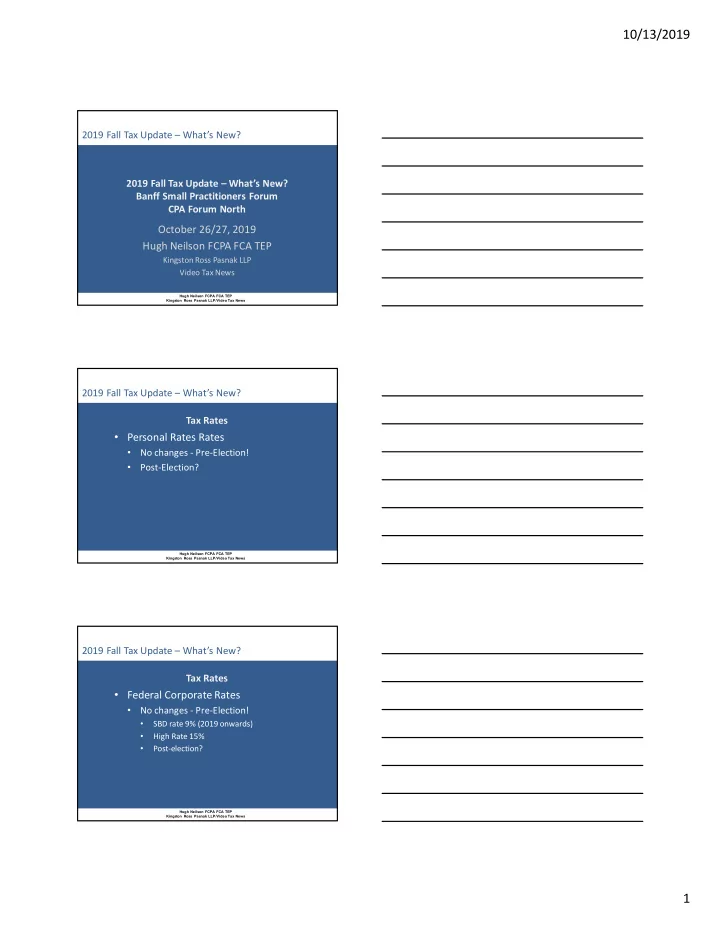
slide-71
SLIDE 71

Fall 2019 Tax Update – What’s New?

Hugh Neilson FCPA FCA TEP Kingston Ross Pasnak LLP Page 47 Video News Inc. October 26/27, 2019

The Court also determined that, since the original series of loans were secured with an interest in land, the undivided interests in the mortgages purchased by the taxpayers and other investors would also be secured with an interest in land. Therefore, it met the definition of a mortgage. As this criterion was met, and as the taxpayers were acting at arm’s length with the vendors, it was not found to be a non- qualified investment. Any mortgage secured by real property situated in Canada (or an interest therein), where the mortgagor is neither the annuitant nor a non-arm’s length person, is a qualified investment for an RRSP or RRIF (Regulation 4900(4)). Investment Management Fees For many years now, fees related to funds held within registered accounts like RRSPs and TFSAs have been non-deductible. It remains commonplace, however, for the annuitant of these plans to pay related fees personally to avoid erosion of the tax-advantaged investment capital. Several years ago, CRA determined that the “advantage tax”, aimed at abusive strategies involving registered accounts, technically applies to such fees. The advantage tax is assessed at a rate of 100%, so this is a significant

  • issue. Recognizing that, CRA initially announced that this change in policy would be effective only for

fees related to periods after 2017. [2016-0670801C6] Subsequently, CRA determined the issue merited more time, and announced the new policy will apply no sooner than January 1, 2019, to provide time to consider submissions by stakeholders, followed by Technical Interpretation 2018-0779261E5, released in early October, 2018, where CRA advised that this position will be deferred indefinitely, pending a review by the Department of Finance. On October 8, 2019, a Finance letter to a CRA official was released, indicating that Finance would recommend that the legislation “be amended to clarify that the payment by a controlling individual (as defined in subsection 207.01(1)) of investment management fees that pertain to a registered plan does not constitute an advantage for the plan”, effective for 2018 and subsequent taxation years. Hopefully, this will make its way into a future tax Bill, however given that neither CRA nor Finance appears to believe the advantage tax should apply, this issue is hopefully now settled. Dedicated Telephone Service (DTS) A January 4, 2019 update to the CRA website set out a new, expanded DTS for income tax preparers. Previously available only to small CPA firms in Manitoba, Ontario, Quebec and New Brunswick, the program was expanded across Canada and is open to firms of up to 50 partners who prepare at least ten Canadian income tax returns for clients during a filing season. The service is no longer restricted to CPAs. The DTS provides technical tax assistance to tax preparers. It does not deal with client-specific situations, and its officers have no access to specific taxpayer information. Firms can apply to participate using CRA Form RC562, which can be submitted by email. Terms and conditions are set out on the form and include the following: · Participants receive a unique Telephone Access Code, which must be kept confidential. · CRA responses are limited to previous interpretative positions taken by CRA and will not deal with specific situations. · There may be times when the DTS is unavailable due to limited staffing, unforeseen delays, or malfunctions.

slide-72
SLIDE 72

Fall 2019 Tax Update – What’s New?

Hugh Neilson FCPA FCA TEP Kingston Ross Pasnak LLP Page 48 Video News Inc. October 26/27, 2019

The form also noted that this remains a pilot project, however the 2019 Federal Budget later announced funding to make this a permanent service. WCB – Directors’ Insurance While not a tax case, many accountants advise on WCB matters, or even prepare filings in conjunction with T4 slips. A June 5, 2019 LawNow article by Jessica Steingard discussed a March 18, 2019 Alberta Court of Appeal case (Hall et al. vs. Stewart, 2019 ABCA 98) in which the Court held that a director could be held personally liable for an accident that caused injury to an employee of another corporation. The director was involved in both the management and direct installation of a staircase that collapsed in a new home build. WCB covered the damages to the injured workers and then sued the director to recover the costs. Similar to most provinces, WCB is required in Alberta in respect of business conducted in certain

  • environments. If participating in such workers’ insurance, the injured party does not generally have the

ability to sue its employer or other covered workers. However, this limited ability to sue does not prevent claims against directors whose work performed is part of the business of the corporation, unless

  • ptional director workers’ compensation insurance was purchased. It did not matter whether the

director’s negligence occurred in respect of directorship duties or other involvement in the business. Since the director was clearly involved in the portion of the business in which the accident occurred, and since no optional director’s workers’ compensation insurance was purchased, the Court found that he could be held personally liable if it was demonstrated that he had acted negligently. As workers’ compensation is governed provincially, the law may differ from province to province. For example, a CanLII Connects article (Can a Corporate Director face a Personal Injury Suit for a Workplace Accident? Alberta Court of Appeal Says Yes!, Frank Portman) noted that “Ontario has a similar scheme, although most officers and directors in the construction industry are subject to mandatory coverage”. It would seem prudent for a director who is involved in an applicable business, especially if they are directly involved in operations, to obtain professional advice (seems like a lawyer, not an accountant, would be the right professional) to determine exposure and alternatives for risk mitigation. Conclusion The reader may be surprised that the writer grappled with numerous other possible inclusions from the past year or so (perhaps not as many as for 2018, but more than prior years). Thank you to John Fuller, Andrew Bateman and their colleagues at Felesky Flynn for carving out some of the current cases I discarded (or included, but will not speak to). It felt like 2019 lacked the big changes we have seen in recent years, but they appear to have been replaced with an array of minor items. The pace of change has certainly not slowed in recent years, and staying current is a challenge for all of us. Hopefully, the above highlights will be useful to participants in keeping their knowledge current!

slide-73
SLIDE 73

SIBI (4) To $500K (3) No SBD (2) Eligible Non-Eligible Eligible Non-Eligible 10% W/H 15% W/H Income in Corporation 1,000.00 1,000.00 1,000.00 1,000.00 1,000.00 1,000.00 1,000.00 1,000.00 1,000.00 Foreign Tax (100.00) (150.00) Corporate Tax (110.00) (265.04) (501.71) (383.33) (383.33) (445.04) (445.04) (401.71) (351.71) Dividend Refund

  • 306.67

383.33 383.33

  • 227.36

187.70 Available for Dividend 890.00 734.96 804.96 1,000.00 1,000.00 554.96 554.96 725.65 685.99 Personal Tax (highest rate) (376.47) (234.64) (340.50) (317.10) (423.00) (175.98) (234.75) (306.95) (290.18) Net After Tax Cash 513.53 500.32 464.46 682.90 577.00 378.98 320.21 418.70 395.82 Income Earned Directly 1,000.00 1,000.00 1,000.00 1,000.00 1,000.00 1,000.00 1,000.00 1,000.00 1,000.00 Personal Tax (highest rate) (480.00) (480.00) (480.00) (317.10) (423.00) (480.00) (480.00) (480.00) (480.00) Net After Tax Cash 520.00 520.00 520.00 682.90 577.00 520.00 520.00 520.00 520.00 Deferral 370.00 214.96 (21.71) (66.23) 39.67 34.96 34.96 (21.71) (21.71) Deferral as a percentage 37.00% 21.50%

  • 2.17%
  • 6.62%

3.97% 3.50% 3.50%

  • 2.17%
  • 2.17%

Savings (Cost) (6.47) (19.68) (55.54)

  • (141.02)

(199.79) (101.30) (124.18) Savings (Cost) as a percentage

  • 0.65%
  • 1.97%
  • 5.55%

0.00% 0.00%

  • 14.10%
  • 19.98%
  • 10.13%
  • 12.42%

(1) All tax rates incorporate all announced rate changes to August 31, 2019, and assume a December 31 corporate year end and top personal rates (unless otherwise noted). All rates assume a full fiscal year. (2) The after tax corporate income is paid as a mix of eligible and ineligible dividends, so the personal tax rate is a blend of those two rates. The GRIP addition is 72% (general rate factor per Subsection 89(1)). (3) Note that corporations with taxable capital in excess of $10 million or Adjusted Aggregate Investment Income in excess of $50,000 have their access to reduced corporate tax rates reduced or eliminated. (4) Note that eligible to recover RDTOH would generally be paid as this results in a net tax recovery, while non-eligible dividends would not. (5) Note that, in making salary/dividend decisions, other costs of salaries must also be considered (eg. CPP premiums). These are not incorporated above. normal active income, non-eligible dividends would likely be distributed. Unless CRA permits a late designation, the result may be PSB rates on the corporate income and non-eligible dividend rates to the shareholder. Rates 2019 Personal: Ordinary Income 48.00% Dividends - Non-eligible 42.30% Dividends - Eligible 31.71% Corporate: General 26.50% M & P 26.50% ABI to Fed SBD 11.00% Investment 50.17% Personal Service Business 44.50% GRIP Percentage 72.00% Foreign Investment Income (6) Personal Services Business income is included in the GRIP computation, so eligible dividends can be paid. However, if the company believed that the income was Integration in Alberta - Top Rate Personal Tax December 31, 2019 Active Business Income Dividends (5) Personal Service Business Income (6)

slide-74
SLIDE 74

SIBI (4) To $500K (3) No SBD (2) Eligible Non-Eligible Eligible Non-Eligible 10% W/H 15% W/H Income in Corporation 1,000.00 1,000.00 1,000.00 1,000.00 1,000.00 1,000.00 1,000.00 1,000.00 1,000.00 Foreign Tax (100.00) (150.00) Corporate Tax (110.00) (250.00) (486.67) (383.33) (383.33) (430.00) (430.00) (386.67) (336.67) Dividend Refund

  • 306.67

383.33 383.33

  • 227.36

187.70 Available for Dividend 890.00 750.00 820.00 1,000.00 1,000.00 570.00 570.00 740.69 701.03 Personal Tax (highest rate) (376.47) (241.00) (346.86) (317.10) (423.00) (180.75) (241.11) (313.31) (296.54) Net After Tax Cash 513.53 509.00 473.14 682.90 577.00 389.25 328.89 427.38 404.50 Income Earned Directly 1,000.00 1,000.00 1,000.00 1,000.00 1,000.00 1,000.00 1,000.00 1,000.00 1,000.00 Personal Tax (highest rate) (480.00) (480.00) (480.00) (317.10) (423.00) (480.00) (480.00) (480.00) (480.00) Net After Tax Cash 520.00 520.00 520.00 682.90 577.00 520.00 520.00 520.00 520.00 Deferral 370.00 230.00 (6.67) (66.23) 39.67 50.00 50.00 (6.67) (6.67) Deferral as a percentage 37.00% 23.00%

  • 0.67%
  • 6.62%

3.97% 5.00% 5.00%

  • 0.67%
  • 0.67%

Savings (Cost) (6.47) (11.00) (46.86)

  • (130.75)

(191.11) (92.62) (115.50) Savings (Cost) as a percentage

  • 0.65%
  • 1.10%
  • 4.69%

0.00% 0.00%

  • 13.07%
  • 19.11%
  • 9.26%
  • 11.55%

(1) All tax rates incorporate all announced rate changes to August 31, 2019, and assume a December 31 corporate year end and top personal rates (unless otherwise noted). All rates assume a full fiscal year. (2) The after tax corporate income is paid as a mix of eligible and ineligible dividends, so the personal tax rate is a blend of those two rates. The GRIP addition is 72% (general rate factor per Subsection 89(1)). (3) Note that corporations with taxable capital in excess of $10 million or Adjusted Aggregate Investment Income in excess of $50,000 have their access to reduced corporate tax rates reduced or eliminated. (4) Note that eligible to recover RDTOH would generally be paid as this results in a net tax recovery, while non-eligible dividends would not. (5) Note that, in making salary/dividend decisions, other costs of salaries must also be considered (eg. CPP premiums). These are not incorporated above. normal active income, non-eligible dividends would likely be distributed. Unless CRA permits a late designation, the result may be PSB rates on the corporate income and non-eligible dividend rates to the shareholder. Rates 2020 Personal: Ordinary Income 48.00% Dividends - Non-eligible 42.30% Dividends - Eligible 31.71% Corporate: General 25.00% M & P 25.00% ABI to Fed SBD 11.00% Investment 48.67% Personal Service Business 43.00% (6) Personal Services Business income is included in the GRIP computation, so eligible dividends can be paid. However, if the company believed that the income was Integration in Alberta - Top Rate Personal Tax December 31, 2020 Personal Service Business Income (6) Foreign Investment Income Active Business Income Dividends (5)

slide-75
SLIDE 75

SIBI (4) To $500K (3) No SBD (2) Eligible Non-Eligible Eligible Non-Eligible 10% W/H 15% W/H Income in Corporation 1,000.00 1,000.00 1,000.00 1,000.00 1,000.00 1,000.00 1,000.00 1,000.00 1,000.00 Foreign Tax (100.00) (150.00) Corporate Tax (110.00) (240.00) (476.67) (383.33) (383.33) (420.00) (420.00) (376.67) (326.67) Dividend Refund

  • 306.67

383.33 383.33

  • 227.36

187.70 Available for Dividend 890.00 760.00 830.00 1,000.00 1,000.00 580.00 580.00 750.69 711.03 Personal Tax (highest rate) (376.47) (245.23) (351.09) (317.10) (423.00) (183.92) (245.34) (317.54) (300.77) Net After Tax Cash 513.53 514.77 478.91 682.90 577.00 396.08 334.66 433.15 410.27 Income Earned Directly 1,000.00 1,000.00 1,000.00 1,000.00 1,000.00 1,000.00 1,000.00 1,000.00 1,000.00 Personal Tax (highest rate) (480.00) (480.00) (480.00) (317.10) (423.00) (480.00) (480.00) (480.00) (480.00) Net After Tax Cash 520.00 520.00 520.00 682.90 577.00 520.00 520.00 520.00 520.00 Deferral 370.00 240.00 3.33 (66.23) 39.67 60.00 60.00 3.33 3.33 Deferral as a percentage 37.00% 24.00% 0.33%

  • 6.62%

3.97% 6.00% 6.00% 0.33% 0.33% Savings (Cost) (6.47) (5.23) (41.09)

  • (123.92)

(185.34) (86.85) (109.73) Savings (Cost) as a percentage

  • 0.65%
  • 0.52%
  • 4.11%

0.00% 0.00%

  • 12.39%
  • 18.53%
  • 8.69%
  • 10.97%

(1) All tax rates incorporate all announced rate changes to August 31, 2019, and assume a December 31 corporate year end and top personal rates (unless otherwise noted). All rates assume a full fiscal year. (2) The after tax corporate income is paid as a mix of eligible and ineligible dividends, so the personal tax rate is a blend of those two rates. The GRIP addition is 72% (general rate factor per Subsection 89(1)). (3) Note that corporations with taxable capital in excess of $10 million or Adjusted Aggregate Investment Income in excess of $50,000 have their access to reduced corporate tax rates reduced or eliminated. (4) Note that eligible to recover RDTOH would generally be paid as this results in a net tax recovery, while non-eligible dividends would not. (5) Note that, in making salary/dividend decisions, other costs of salaries must also be considered (eg. CPP premiums). These are not incorporated above. normal active income, non-eligible dividends would likely be distributed. Unless CRA permits a late designation, the result may be PSB rates on the corporate income and non-eligible dividend rates to the shareholder. Rates 2021 Personal: Ordinary Income 48.00% Dividends - Non-eligible 42.30% Dividends - Eligible 31.71% Corporate: General 24.00% M & P 24.00% ABI to Fed SBD 11.00% Investment 47.67% Personal Service Business 42.00% GRIP Percentage 72.00% (6) Personal Services Business income is included in the GRIP computation, so eligible dividends can be paid. However, if the company believed that the income was Integration in Alberta - Top Rate Personal Tax December 31, 2021 Personal Service Business Income (6) Foreign Investment Income Active Business Income Dividends (5)

slide-76
SLIDE 76

SIBI (4) To $500K (3) No SBD (2) Eligible Non-Eligible Eligible Non-Eligible 10% W/H 15% W/H Income in Corporation 1,000.00 1,000.00 1,000.00 1,000.00 1,000.00 1,000.00 1,000.00 1,000.00 1,000.00 Foreign Tax (100.00) (150.00) Corporate Tax (110.00) (230.00) (466.67) (383.33) (383.33) (410.00) (410.00) (366.67) (316.67) Dividend Refund

  • 306.67

383.33 383.33

  • 227.36

187.70 Available for Dividend 890.00 770.00 840.00 1,000.00 1,000.00 590.00 590.00 760.69 721.03 Personal Tax (highest rate) (376.47) (249.46) (355.32) (317.10) (423.00) (187.09) (249.57) (321.77) (305.00) Net After Tax Cash 513.53 520.54 484.68 682.90 577.00 402.91 340.43 438.92 416.04 Income Earned Directly 1,000.00 1,000.00 1,000.00 1,000.00 1,000.00 1,000.00 1,000.00 1,000.00 1,000.00 Personal Tax (highest rate) (480.00) (480.00) (480.00) (317.10) (423.00) (480.00) (480.00) (480.00) (480.00) Net After Tax Cash 520.00 520.00 520.00 682.90 577.00 520.00 520.00 520.00 520.00 Deferral 370.00 250.00 13.33 (66.23) 39.67 70.00 70.00 13.33 13.33 Deferral as a percentage 37.00% 25.00% 1.33%

  • 6.62%

3.97% 7.00% 7.00% 1.33% 1.33% Savings (Cost) (6.47) 0.54 (35.32)

  • (117.09)

(179.57) (81.08) (103.96) Savings (Cost) as a percentage

  • 0.65%

0.05%

  • 3.53%

0.00% 0.00%

  • 11.71%
  • 17.96%
  • 8.11%
  • 10.40%

(1) All tax rates incorporate all announced rate changes to August 31, 2019, and assume a December 31 corporate year end and top personal rates (unless otherwise noted). All rates assume a full fiscal year. (2) The after tax corporate income is paid as a mix of eligible and ineligible dividends, so the personal tax rate is a blend of those two rates. The GRIP addition is 72% (general rate factor per Subsection 89(1)). (3) Note that corporations with taxable capital in excess of $10 million or Adjusted Aggregate Investment Income in excess of $50,000 have their access to reduced corporate tax rates reduced or eliminated. (4) Note that eligible to recover RDTOH would generally be paid as this results in a net tax recovery, while non-eligible dividends would not. (5) Note that, in making salary/dividend decisions, other costs of salaries must also be considered (eg. CPP premiums). These are not incorporated above. normal active income, non-eligible dividends would likely be distributed. Unless CRA permits a late designation, the result may be PSB rates on the corporate income and non-eligible dividend rates to the shareholder. Rates 2022 Personal: Ordinary Income 48.00% Dividends - Non-eligible 42.30% Dividends - Eligible 31.71% Corporate: General 23.00% M & P 23.00% ABI to Fed SBD 11.00% Investment 46.67% Personal Service Business 41.00% GRIP Percentage 72.00% (6) Personal Services Business income is included in the GRIP computation, so eligible dividends can be paid. However, if the company believed that the income was Integration in Alberta - Top Rate Personal Tax December 31, 2022 Personal Service Business Income (6) Foreign Investment Income Active Business Income Dividends (5)

slide-77
SLIDE 77

Non-Eligible Eligible Tax-Free

Dividends Dividends CDA/SHL 5% Rate of Return

Capital 20,000.00 20,000.00 20,000.00 Personal Tax on Withdrawal, Note 1 (8,460.00) (6,342.00)

  • Available to Invest

11,540.00 13,658.00 20,000.00 Return 577.00 682.90 1,000.00 Personal Tax, Note 2 (276.96) (327.79) (480.00) After Tax Cash Personal 300.04 355.11 520.00 After Tax Cash Corporate 386.28 386.28 386.28 Corporate (Dis)Advantage 86.24 31.17 (133.72) 4% Rate of Return Capital 25,000.00 25,000.00 25,000.00 Tax on Withdrawal, Note 1 (10,575.00) (7,927.50)

  • Available to Invest

14,425.00 17,072.50 25,000.00 Return 577.00 682.90 1,000.00 Personal Tax, Note 2 (276.96) (327.79) (480.00) After Tax Cash Personal 300.04 355.11 520.00 After Tax Cash Corporate 386.28 386.28 386.28 Corporate (Dis)Advantage 86.24 31.17 (133.72) Personal Tax Rates

On investment income 48.00% 48.00% 48.00%

On withdrawal

42.30% 31.71% 0.00%

Assumptions:

  • 1. The tax consequences of withdrawal of the investments are assumed to be limited to personal tax at the highest tax bracket,

with no further costs (e.g. loss of benefits). It is assumed no corporate taxes (for example, on gains on the investments) will arise.

  • 2. The funds are assumed to be invested by the individual to earn the same rate of return, as ordinary income, and attract tax at

the top personal tax rate. Summary of Results: The Corporate (Dis)Advantage represents the difference between the after tax cash on $1,000 of passive investment income earned corporately, after the corporate and personal taxes set out in Appendix C, and the after-tax cash retained retained personally as calculated above. A positive number indicates that, despite the added tax costs of passive corporate income, the after-tax cash retained is superior to the results if funds are drawn out and invested personally, under these assumptions set out above. A negative number indicates withdrawal of the funds, and personal investment, would generate superior results over retaining the funds in the corporation. PASSIVE INVESTMENT GRIND – WITHDRAW INVESTMENT CAPITAL? SHORT-TERM This analysis assesses the short-term tax implications of distributing assets generating passive investment income which will erode access to the small business deduction.

slide-78
SLIDE 78

Total capital withdrawal 3,000,000 Tax Savings for claiming SBD on $500K 70,000 Personal tax (non-eligible dividend) 1,269,000 Years to recover 18.13 Personal tax (capital gains) 720,000 Years to recover 10.29 Annual cash flow (after claiming SBD) 445,000 Years until $3 million of surplus assets accumulated 6.74 Assumptions:

  • 1. The corporation has $3 million of capital surplus which earns 5% return ($150,000), fully eroding the SBD

in the subsequent year. This is assumed fully withdrawn to preserve SBD access for as long as possible.

  • 2. It is assumed no other costs associated with the withdrawal will be incurred. This includes realization of gains on

disposition and transaction costs, including costs to permit extraction of investment capital at capital gains rates.

  • 3. A 5% rate of return is assumed. When $1 million of surplus assets accumulate, passive income of $50,000

results, and the SBD will begin to erode with further accumulations. At $3 million of surplus assets, $150,000

  • f passive income will eliminate the small business deduction limit of $500,000.
  • 4. Personal taxes are estimated at the highest 2019 rates. Corporate tax rates for a full fiscal year ending December

31, 2020 are assumed. Rate changes announced up to June 30, 2019 have been included.

  • 5. The impact of any return on reinvested capital in years subsequent to the withdrawal is ignored.
  • 6. Reduced access to the SBD from reinvestment of new capital is ignored in determining the "Years to recover"

the personal tax paid. Corporate Tax Rates SBD Rate 11.00% General Rate 25.00% Investment Rate 48.67% Personal Tax Rates Dividends - Non-Eligible 42.30% Dividends - Eligible 31.71% Regular income 48.00% PASSIVE INVESTMENT GRIND – WITHDRAW INVESTMENT CAPITAL? LONG-TERM This analysis assesses the long-term tax implications of distributing assets generating passive investment income which will erode access to the small business deduction.