1.Thermal Imaging and Compaction LI02 LI03 160,0C 160 150 140 - - PowerPoint PPT Presentation

1 thermal imaging and compaction li02 li03 160 0 c 160
SMART_READER_LITE
LIVE PREVIEW

1.Thermal Imaging and Compaction LI02 LI03 160,0C 160 150 140 - - PowerPoint PPT Presentation

1.Thermal Imaging and Compaction LI02 LI03 160,0C 160 150 140 130 120 115,0C The Thermal Scanner can measure and quantify thermal segregation of asphalt Asphalt into the Paver Hopper Asphalt behind the Paver Thermal Scanner on the


slide-1
SLIDE 1

1.Thermal Imaging and Compaction

115,0°C 160,0°C 120 130 140 150 160 LI02 LI03
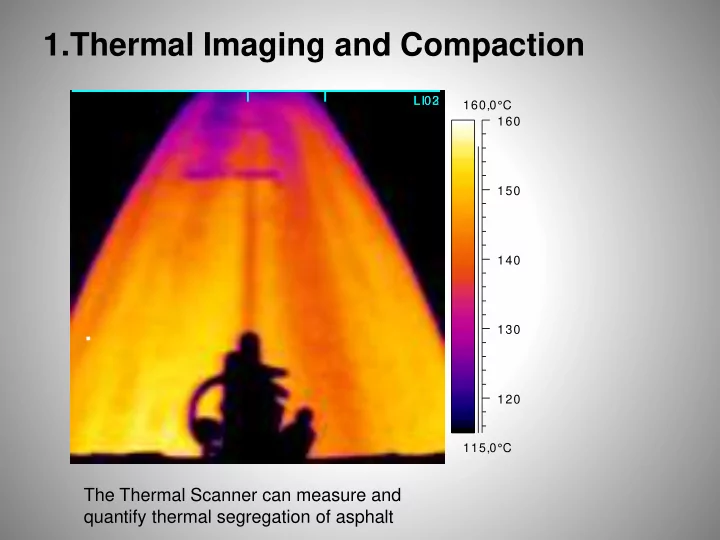
The Thermal Scanner can measure and quantify thermal segregation of asphalt

slide-2
SLIDE 2

Asphalt into the Paver Hopper Asphalt behind the Paver

slide-3
SLIDE 3

Thermal Scanner on the Paver

slide-4
SLIDE 4
  • 2. Why use Thermal Imaging?
  • Thermal segregation can make it impossible to compact the

materials to the required density.

  • This poorly compacted material is quite often the deciding factor for

the life of the pavement

  • Thermal scanning is used to identify the areas of thermal

segregation.

  • The Thermal Scanner is used as a tool to identify the factors

causing the segregation.

  • The area of uncompactable material behind the paver Is called the “

Risk Area”.

  • The main problem area was quickly identified as the transport
  • vehicles. The insulated half pipe truck was identified as the best

transport vehicle

slide-5
SLIDE 5

Poor Thermal uniformity

Here the effect of thermal segregation can be seen for different parts of the process. Measured as a percentage of the area behind the paver that is below what is the minimum compaction temperature. 9% of the area is uncompactable (of which 6,3 % is because of the trucks).

slide-6
SLIDE 6

Transport effect on Thermal uniformity Insulated half pipe truck – Uninsulated Aluminium truck

Here the difference can be seen between an insulated half pipe truck body and a standard uninsulated Aluminium body. The insulted halfpipe has an area of 0,4% that is below the minimum compaction

  • temperature. The aluminium body has an area of 28% that is below minimum

compaction temperature ( blue areas)

slide-7
SLIDE 7

Very good Thermal uniformity

Here the whole process has been optimised to reduce thermal Segregation resulting in a very small area of material below minimum compaction temperature. The area has been reduced to approximately 0,1%

slide-8
SLIDE 8

ABb ABS

E20 Södertälje 1998 - 2013

slide-9
SLIDE 9

Thermal imaging in use

Scandinavia:

  • Substantial bonuses were paid if the half pipe truck was used.
  • Within 5 years the only trucks delivering asphalt were the half pipe

trucks

  • The risk area was defined as a percentage of the paved area that

was below the minimum compaction temperature.

  • Bonuses were paid to reduce the risk area to almost zero.
slide-10
SLIDE 10

Very good Thermal Uniformity

Uniform temperature of the mat behind the paver. This is the ideal situation when using a Material transfer vehicle with remixing capability.

slide-11
SLIDE 11
  • 3. Business Case for using Thermal Scanners

Contractor:

  • Proof of quality with final inspection
  • Lower risk (better tendering price)
  • Lower Guarantee costs
  • Competitive advantage with tendering for contracts
  • Possibility for bonus (if customer understands the benefits)
  • With performance contracts he will have lower future maintenance

costs.

slide-12
SLIDE 12
  • 4. Summary
  • The Thermal Scanner has given us the possibility to see

the production and paving process in a completely different light.

  • It has enabled us to see weaknesses in the process that have huge

effects on the life of the pavement.

  • The main benefits come when the Client sees the benefits

and is willing to pay for the improvements that can be made.