
SLIDE 1
2020-08-24
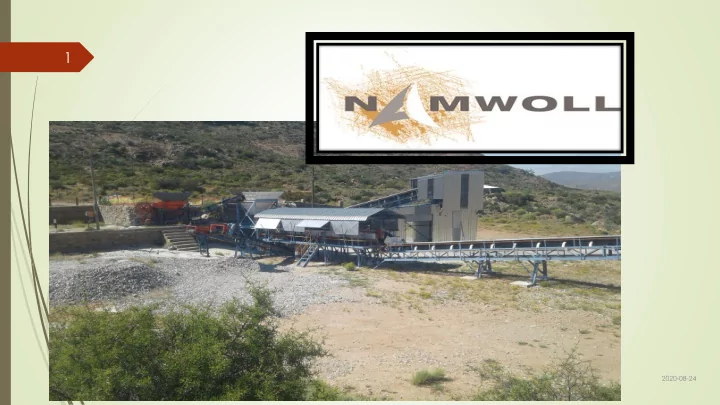
1 2020-08-24 Group structure of NAMWOLL 2 INCUBEX MINERALS LTD - - PowerPoint PPT Presentation
1 2020-08-24 Group structure of NAMWOLL 2 INCUBEX MINERALS LTD 100% 100% NamWoll Namaqua Processing Manufacturi Wollastonite Plant ng (Pty) Ltd (Pty) Ltd 100% Rainbow House Properties 108 (Pty)Ltd Mining Right The Namwoll Team
2020-08-24
INCUBEX MINERALS LTD
Namaqua Wollastonite (Pty) Ltd NamWoll Manufacturi ng (Pty) Ltd Mining Right Rainbow Properties 108 (Pty)Ltd
100% 100% 100%
Processing Plant House
Namwoll during 2013 and has since re-established the Processing Operation (Siyaghopa Trading 147 (PTY) Ltd) and the Magata Mine (Namaqua Wollastonite (PTY) Ltd).
mine in South Africa.
million tonnes.
2020-08-24
2020-08-24
2547 Wilgenhoutfontein No.426 - a portion of the remainder 138.2 SNC30/5/1/2/2/537MR 23-Jun-10 22-Jun-40 Wollastonite Namaqua Wollastonite (Pty) Ltd REF # FARM PORTION SIZE (ha) MINING RIGHT COMMENCE- MENT DATE EXPIRY DATE MINERALS HELD BY
Short Term Objectives: Make production more efficient and cut down on costs; Marketing drive to increase the current Sales to 150 tonnes a month; Finalise Feasibility Study on expansion. Long Term Objectives: Expand plant to produce at least 1000 tonnes a month which will lower our unit cost; Take over the entire South African Market; Export product to Europe.
2020-08-24
2020-08-24
Mine Pit Crushing and Screening Plant Truck Loading Bin Wollastonite Processing Plant
(CaSiOɜ) that may contain small amounts of iron, magnesium, and manganese substituting for calcium.
fluids as in skarns or contact metamorphic rocks. Associated minerals include garnets, vesuvianite, diopside, tremolite, epidote, plagioclase feldspar, pyroxene and calcite. Some of the properties that make wollastonite so useful are its high brightness and whiteness, low moisture and oil absorption, low volatility and enhancement of flexural and compaction strengh.
for calcium ends with diopside and hedenbergite respectively it is structurally very different, with a third SiO4 tetrahedron in the linked chain (as opposed to two in the pyroxenes).
2020-08-24
2020-08-24
Wollastonite in nature. Fine Crystals.
Wollastonite in nature. Cluster of crystals with carnet and dioptase inclusions. Wollastonite cluster. Wollastonite cluster. Wollastonite needles under a microscope. Wollastonite end product.
1. GENERAL
2. IDENTIFICATION
2020-08-24
2020-08-24
this is due to its fluxing properties, freedom from volatile constituents, whiteness, and acicular particle shape. In some industries, it is used in different percentages of impurities, such as its use as a fabricator of mineral wool insulation or as an ornamental building material.
cracking and glaze defects.
steel.
and suspending agent.
temperatures and improves flexural and tensile strength.
15%; friction products, 10% to 15%; and miscellaneous, 10% to 15%. Ceramic applications probably account for 30% to 40% of wollastonite sales worldwide, followed by polymers (plastics and rubber) with 30% to 35% of sales, and paint with 10% to 15% of sales. The remaining sales were for construction, friction products, and metallurgical applications.
2020-08-24
Application Field Specific Application Wollastonite Function
Ceramic Industry Various ceramics, glass and moulds
Metallurgical Industry Protection slag for heat insulation material and cast steel
Building Materials Industry Calcium silicon plate, cement fibrolite plate, fire insulation board
Rubber and Plastics Industry Styrene butadiene rubber
Coating and Paint Industry Anticorrosive paint, thermal insulation coating, construction paint
1.
2020-08-24
CHEMICAL ANALYSIS % Calcium CaO 46.5 – 47.5 Magnesium MgO 0.16 – 0.3 Silica SiO2 48 – 49.5 Sodium Na2O Trace Potassium K2O3 0.08 – 0.88 Phosphorus P2O5 0.01 – 0.05 Titanium TiO2 0.03 – 0.04 Iron Fe2O3 0.5 – 0.55 Aluminium Al2O3 0.8 – 0.9 L.O.I 2.6 – 2.7 PHYSICAL PROPERTIES % pH 9.8 - 10 Moisture (110 dec C at 24 hrs) 0.5 PHYSICAL PROPERTIES % Oil Absorption 23-25g/100g Refractive Index 1.63 Hardness moh 4.5 – 5.0 Whiteness SABS 137 Dry 80 – 85 Specific gravity 2.8 – 2.9 Melting Point 1540c Appearance White Shape Acicular PARTICULAR SIZE DISTRIBUTION MICRON Retained on cumulative 250 micron 0.00 150 micron 0.09% 75 micron 10 – 12% 45 micron 22 – 25%
2.
2020-08-24
CHEMICAL ANALYSIS % Calcium CaO 46.5 – 47.5 Magnesium MgO 0.16 – 0.3 Silica SiO2 48 – 49.5 Sodium Na2O Trace Potassium K2O3 0.08 – 0.88 Phosphorus P2O5 0.01 – 0.05 Titanium TiO2 0.03 – 0.04 Iron Fe2O3 0.5 – 0.55 Aluminium Al2O3 0.8 – 0.9 L.O.I 2.6 – 2.7 PHYSICAL PROPERTIES % pH 9.8 - 10 Moisture (110 dec C at 24 hrs) 0.5 Oil Absorption 14-15g/100g PHYSICAL PROPERTIES % Refractive Index 1.63 Hardness moh 4.5 – 5.0 Whiteness SABS 137 Dry 80 – 85 Specific gravity 2.8 – 2.9 Melting Point 1540c Appearance White Shape Acicular PARTICULAR SIZE DISTRIBUTION MICRON Retained on cumulative 250 micron 0.05% 150 micron 6-8% 100 micron 15-17% 75 micron 39-44% 45 micron 72-74%
3.
2020-08-24
CHEMICAL ANALYSIS % Calcium CaO 44 - 45.5 Magnesium MgO 0.2 – 0.4 Silica SiO2 49 - 51 Sodium Na2O Trace Potassium K2O3 0.11 – 0.13 Phosphorus P2O5 0.01 – 0.05 Titanium TiO2 0.03 – 0.04 Iron Fe2O3 0.4 – 0.5 Aluminium Al2O3 1.18 – 1.2 L.O.I 3.5 – 3.7 PHYSICAL PROPERTIES % pH 9.8 - 10 Moisture (110 dec C at 24 hrs) 0.5 Refractive Index 1.63 PHYSICAL PROPERTIES % Hardness moh 3.5 – 4.00 Whiteness SABS 137 Dry 80 – 85 Specific gravity 2.8 – 2.9 Melting Point 1540c Appearance Wollastonite/Garnet/Calcite Shape Acicular/round mixed PARTICULAR SIZE DISTRIBUTION MICRON 2000 micron Trace 1600 micron 4.4% 1000 micron 30.90% 710 micron 44.60% 500 micron 60.10% 425 micron 66.60% 250 micron 83.80% 150 micron 92.60%
2020-08-24
Type of Fibre Diameter [pm] Specific Gravity [g/cm²] Tensile Strength [Mpa] Elastic Modulus [Gpa] Ultimate Elongation [%]
Metallic Steel Glass E Glass AR Glass 5 – 1000
8 - 20 7.85
2.70 200 – 2600
1500 - 3700 195 – 210
80 0.5 – 5
2.5 – 3.6 Synthetic Acrylic (Pan) Aramid (e.g Kevlar) Carbon (low modulus) Carbon (hight modulus) Nylon (polyamide) Polyester (e.g. PET) Polyethylene (PE) Polyethylene (HHPE) Polypropylene (PP) Polyvinyl acetate (PVA) 5 – 7 10 – 12 7 – 18 7 – 18 20 – 25 10 – 8 25 – 1000
3 - 8 1.18 1.4 – 1.5 1.6 – 1.7 1.7 – 1.9 1.16 1.34 – 1.39 0.96 0.97 0.90 – 0.91 1.2 – 2.5 200 -1000 2000 – 3500 800 – 1100 1500 – 4000 965 280 – 1200 80 – 600 1000 – 4000 310 – 760 800 - 3600 14.6 – 19.6 62 – 130 38 – 43 200 – 800 5.17 10 – 18 5.0 80 – 150 3.5 – 4.9 20 - 80 7.5 – 50 20 – 4.6 2.1 -2.5 1.3 – 1.8 20 10 – 50 12 – 100 29 – 4.1 6 – 15 4 - 12 Natural – Organic Cellulose (wood) Coconut Bamboo Jute 15 – 125 100 – 400 50 – 400 100 - 200 1.50 1.12 – 1.15 1.50 1.02 – 1.04 300 – 2000 120 – 200 200 – 440 250 – 350 10 – 50 19 – 25 33 – 40 25 – 32 20 10 – 25
Natural – Inorganic Asbestos Wollastonite 0.02 – 25 25 – 40 2.55 2.87 – 3.09 200 – 1800 2700 4100 164 303 - 530 2 – 3
2020-08-24
The overall global production of wollastonite has been around 1.4 million tonnes in recent years Global production of the mineral had increased from 1,098.3 tonnes in 2013 to 1,421.5 tonnes in 2017, representing a CAGR of 6.7% China had been the largest producer of the mineral in 2017, accounting for 77.4% of the global production, followed by India (10.8%), Mexico (6.2%) and United
States (3.5%)
Smaller producers such as Chile, Kenya, Namibia, South Africa, Sudan, Tajikistan, Turkey, and Uzbekistan had a combined total production of about 6,000.0 tonnes in
2017.
World reserves of wollastonite exceeded 100.0 million tonnes in 2018, however many deposits have not been surveyed, precluding accurate reserves estimates Large deposits of wollastonite were found in China, Finland, India, Mexico and the United States while smaller yet significant deposits were found in Canada, Chile,
Kenya, Namibia, South Africa, Spain, Sudan, Tajikistan, Turkey and Uzbekistan
Since wollastonite is not widely covered by official or government publications, overall consumption information is not available on a country-by-country basis However, information regarding export data from U.S and Indian publications on the mineral can help determine markets which have a demand for the mineral Companies from the United States exported wollastonite to countries such as Argentina, Belgium, Brazil, China, Colombia, the Dominican Republic, Germany, Hong
Kong, India, Italy, the Netherlands, Portugal, and the United Kingdom
In 2017-18, India exported to countries such as Belgium, Japan, Germany, France and UK, wherein Belgium and Japan accounted for the majority, 54.0% and 23.0%
respectively, of the overall exports.
2020-08-24
Challenges: New equipment needed; DMR requirements; Lack of a proper marketing study; Conclude formal resource statement; Expand plant to produce export volumes.
2020-08-24
Solutions: Training programmes – in process; Marketing drive to increase sales. Work with the DMR to overcome issues – in process; Fund raise initiatives for short term and long term objectives.
2020-08-24