
SLIDE 1
SURVEY ON SOCIOECONOMIC IN ANGKAOL VILLAGE AND BLUE SWIMMING CRAB MARKET IN KEP PROVINCE, CAMBODIA
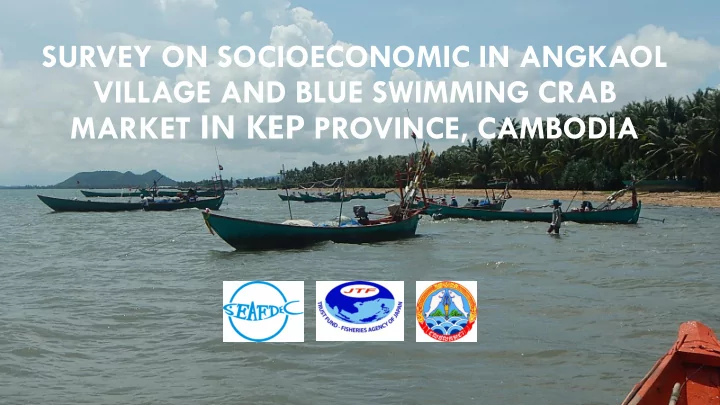
VILLAGE AND BLUE SWIMMING CRAB MARKET IN KEP PROVINCE, CAMBODIA - - PowerPoint PPT Presentation
SURVEY ON SOCIOECONOMIC IN ANGKAOL VILLAGE AND BLUE SWIMMING CRAB MARKET IN KEP PROVINCE, CAMBODIA OBJECTIVE To collect baseline data on socio - economic To collect data on Blue Swimming Crab Market in Kep province To explain the
SURVEY ON SOCIOECONOMIC IN ANGKAOL VILLAGE AND BLUE SWIMMING CRAB MARKET IN KEP PROVINCE, CAMBODIA
OBJECTIVE
➢ To collect baseline data on socio-economic ➢ To collect data on Blue Swimming Crab Market in Kep province ➢ To explain the fisheries management in Kep Province
DATA COLLECTING
➢ The data collecting were conducted in July 2018 ➢ From the total number of fishers in the Village, 60 fishers (11.7% female and 88.3% male) were engaged as respondents for the survey ➢ 15 respondents were interview for marketing survey in three landing sites are Angkaol (3 persons), Okraza (2 persons), and Thmey Market (10 persons).
GENERAL INFORMATION OF RESPONDENTS
3school (18%), and Bachelor(1.7%)
Results :Asset and Household goods to facilitate their livelihood
Household Asset and goods % Have % None
100
100
16.7 83.3
100
45.0 55.0
100.0
100
100
100
46.7 53.3
83.3 16.7
85.0 15.0
100.0
100.0
100.0
100.0
RESULTS :ROLES OF WOMEN AND MEN
20 40 60 80 100 120 Preparing fishing gear and fishing Post-harvest production Marketing/Selling Blue Swimming Crab Men Women 20 40 60 80 100 120 Men Women Both Domestic roles Productive roles
RESULTS :FISHING
Type of fishing gear
fishing gear Fishing Season (month)
day per month Fishing hours a day
per fishing trip Average Cost
(Riels) Crab Gill net (15%) 240-2,500 meters All year round 15-25 8-10 1-2 111,222 (28 USD) Crab Trap (85%) 250-2,000 Traps All year round 10-27 6-14 1-2 110,049 (27.5 USD)
netters, and 6 squid jiggers
Crab Trap Crab Gill net
RESULTS :PROBLEMS IN FISHING
loss fishing gear and net missing by trawler 9% raining, storm cannot fish 73% small amount of fishing 2% someone stole fishing gear 16%
RESULTS :SUGGESTION FOR FISHERIES MANAGEMENT
25 3.3 1.7 31.7 3.3 1.7 26.7 6.7 5 5 10 15 20 25 30 35 No suggestion eliminate illegal fishing gear eliminate long trap fishing gear need patrolling at night Save habitat Areas set up protection Blue Swimming areas want to have crab bank again zoning small and large scale zoning Trap, gill net and trawler
RESULTS :BLUE SWIMMING CRAB MARKET IN KEP PROVINCE
Consumers
22.7 18.2 9.1 50.0 Wholesale market Processing company Restaurant Others (retail seller, guest, villager, tourist) Lok and VN 9% Kampong Trach and Lok market 9% Lok, Drek Tanam Vill 8%
Kep market 50%Phnom Penh 8% Okrasa market 8% Along the beach in Kep province 8%
RESULTS :BLUE SWIMMING CRAB MARKET IN KEP PROVINCE (CONT.)
Blue Swimming Crab Market
RESULTS :BLUE SWIMMING CRAB MARKET IN KEP PROVINCE (CONT.)
➢ 7-8 crabs/kg price 40,000-50,000 Riels (10.0-12.5 USD) ➢ 10-15 crabs/kg price 25,000-40,000 Riels (6.25-10.0 USD) ➢ 15-17 crabs/kg price 15,000-25,000 Riels (3.75-6.25 USD) ➢ Other crab small size 20-30 kg (30-40 crab/kg) price 6,000-7,000 Riels (1.5-1.75 USD) Price of Crab from Fisher
CONCLUSIONS
washing machine, refrigerator, fan mobile phone and motorbike.
women focus on household chore while men work for fishing activities.
fisher use Crab trap and Gill net.
especially tourist at Kep Market with is the biggest seafood market at Kep province
livelihood of villagers at Kep Province
perception is no problem on its product
TAKANO Keiko1, MATSUISHI Takashi Fritz2
1 Graduate School of Global Food Resources, Hokkaido University 2 Global Institution for Collaborative Research and Education, Faculty of Fisheries Sciences, Hokkaido UniversityFisheries Management in Kep province
FISHERIES MANAGEMENT OF BLUE SWIMMING CRAB IN KEP
❑ Find the problems and weak points of fisheries management in Kep ❑ Clarify more effective management part for the future
Back groundBlue-swimming crab (BSC) Portunus pelagicus
❑ Main marine product in Kep ❑ Valuable species ❑ Data poor for fisheries management The assessment tool which can suit for data poor countries is needed How to assess fisheries management in data poor situation?
14Aims of study
➢ Back ground ➢ Materials and Method
➢ Results ➢ Discussion ➢ Conclusion
FISHERY MANAGEMENT ASSESSMENT TOOL (FISHMAT)
FishMAT includes mainly two components
will be assessed by
Fishery Management Assessment Tool for developing country ❑ Assesses fisheries management qualitatively
Management measures for fisheries system
8 categories for fisheries activities Each category has 10 to 15 detail factors (total 87 factors)
1
MCSA code
It is based MCS system for realizing national fishery strategies and capacity building for resource management
2
Materials and Methods (Terashima et al., 2016)FishMAT
(FAO, 1994) (Makino, 2013) ❑ To Manage Fisheries system, 8 categories of Management measures for developing countries were developed
MANAGEMENT MEASURES FOR FISHERIES SYSTEM
8 categories of Management measures
Recruitment Fishing Process Transport Consume
① Basic information of current situation ② Ecosystem enhancement ③ Input-control (effort management) ④ Output-control (harvests management) ⑤ Business improvement ⑥ Post-harvest treatment ⑦ Human and organizational capacity ⑧ Assessment and analysis capacity
Fisheries activities have many steps
Fisheries system
(Makino, 2013; Terashima et al., 2016) Materials and Methods 17Components of FishMAT 1
EXAMPLE OF FACTORS IN CATEGORY 4
Factors
Have 10 to 15 detail factors (total 87 factors) > classified as M,C,S, or A
Weight
Lowest (1) to highest important (3) according to importance of factors
18 Materials and Methods Factors Weight MCSA2
M2
C2
S1
C1
S6.Restrictions on upper-limit of catch amount per each fisher 2
C2
S1
C1
S 10.Regulation or support system on local fishers or fishery cooperative for fish catch recordings2
M 11.Public awareness or fishers' training program regarding above factors1
A 12.Periodical communications between fishers and government regarding above factors1
A Score18
④ Output-control (harvest management)
MCSA CODE
19 Materials and MethodsImprovement from MCS to MCSA
For fisheries strategy or improving management ability of fishery, FAO developed a system
M Monitoring Monitoring of fishing effort characteristic and resource yields C Control Control to regulatory conditions with resource exploitation S Surveillance It required to maintain compliance on fishing activities A Management Activities Management Activities in a participatory approach and jointly undertaken by local fishers and administrative institutions
For developing countries, Management Activities (A) is important
FAO (1994) Terashima et al. (2016)Components of FishMAT 2
SURVEY PLACE IN KEP
① ② ③ ① Ou Krasar ② Thmey (Kep crab market) ③ Angkaol
Survey period
27 November – 2 December, 2018 12 February – 13 February, 2019 10 June – 15 June, 2019 26 August- 29 August, 2019
Total 18 days
❑ Three major landing places of BSC
20 Materials and Methods Face to face interview
❑ Using questionnaires with staff of SEAFDEC* and FiA**
Questionnaires
❑ Designed based on the contents of FishMAT
DATA COLLECTION
10 Boat
6 Labor fishers
(not family member)
16 Middle
traders
2 Officers from
Kep FiAC***
4 Officers
from FiA
Kep FiAC***=Kep Fisheries Administration Cantonment 21 Materials and Methods SEAFDEC*=Southeast Asian Fisheries Develop Center FiA**=Fisheries Administration4 Enumerators
Total 42 interviewees from 6 kind of occupation
➢ Back ground ➢ Materials and Method
➢ Results ➢ Discussion ➢ Conclusion
SUMMARY OF INTERVIEW (1)
Categories Remarks
① Basic information
▪ Lack of statistical data was conspicuous
② Maintenance ecosystem
▪ Several activities for ecosystem enhancement collaborating with NGOs or governmental sectors ▪ Community of fishery (CFis) member fisher had better knowledge and management than other fishers
③ Input-control
▪ Regulation for fishing gear but few actual restrictions due to the lack of surveillance activity
④ Output-control
▪ Insufficient surveillance and periodical communication between fishers and government
Results 23 SUMMARY OF INTERVIEW (2)
Categories Remarks
⑤ Business improvement
▪ The only micro-finance schemes for local fishers from the private bank, NGOs or crab bank observed
⑥ Post-harvest treatment
▪ No standard and surveillance for sanitary
⑦ Human/organizational capacity
▪ NGOs collaborated with CFis to educate local fishers and support fisheries management activities
⑧ Assessment capacity
▪ Research institute for inland fishery and aquaculture more developed than marine fishery
Results 24 RESULT OF FISHMAT
Categories/MCSA code M C S A Total ① Basic information of current situation
8/1553% ② Maintenance Rehabilitation of the Ecosystem
9/1560% ③ Input-Control
9/2536% ④ Output-Control
3/1817% ⑤ Business improvement
2/1513% ⑥ Post-harvest treatment / processing
2/1513% ⑦ Human and organizational capacity
11/1573% ⑧ Assessment and analysis capacity
10/1471% Total
25/3964%
14/2850%
1/234%
14/4233%
54/13241%
M:Monitoring C:Control S:Surveillance A:Management Activities 0~25% 26~50% 51~75% 76~100%
25 Results ➢ Back ground ➢ Materials and Method
➢ Results ➢ Discussion ➢ Conclusion
26 ❑ THE COMMON THING FOR THESE CATEGORIES IS THAT SEVERAL EXTERNAL SUPPORTS CONCENTRATED ON THEM
COMMON THING BETWEEN CATEGORY ①,②,⑦, AND ⑧
Discussions 27Scored more than 50 %
ABOUT CATEGORIES GOT SCORES LESS THAN HALF
This made possible to understand which management part should be focused on the next
Discussions 28Scored less than 50 %
➢ Back ground ➢ Materials and Method
➢ Results ➢ Discussion ➢ Conclusion
FOR SUPPORTING WEAK POINTS,
④ OUTPUT-CONTROL ⑤ BUSINESS IMPROVEMENT ⑥ POST-HARVEST TREATMENT/PROCESSING ▪ SURVEILLANCE
Conclusions 30❑ Educating Community of Fishery (CFis), and making opportunities for communications between CFi, Kep FiAC, and FiA
For the management issues and sustainable use of BSC Stand further improvement;
FOR SUPPORTING WEAK POINTS,
IF SITUATION WILL BE IMPROVED
Before After
31 ConclusionsIF SITUATION WILL BE IMPROVED
IF SITUATION WILL BE IMPROVED
Categories/MCSA code M C S A Total ① Basic information of current situation
8/1553% ② Maintenance Rehabilitation of the Ecosystem
11/1573% ③ Input-Control
14/2556% ④ Output-Control
6/1833% ⑤ Business improvement
9/1560% ⑥ Post-harvest treatment / processing
5/1533% ⑦ Human and organizational capacity
13/1586% ⑧ Assessment and analysis capacity
10/1471% Total
27/3964%
14/2850%
8/2335%
27/4264%
76/13257%
0~25% 26~50% 51~75% 76~100%
Conclusions 32M:Monitoring C:Control S:Surveillance A:Management Activities
IF SITUATION WILL BE IMPROVED
THANK YOU