1 Water markets Regulation of water rights Use it or lose - - PDF document

1
SMART_READER_LITE
LIVE PREVIEW

1 Water markets Regulation of water rights Use it or lose - - PDF document

Water Markets: Opportunities and Reforms Growing freshwater scarcity and increased demand Need for more effective water management and allocation. Australia` s Murray Darling Basin and the Southwestern US Focus on the US, although


slide-1
SLIDE 1

1

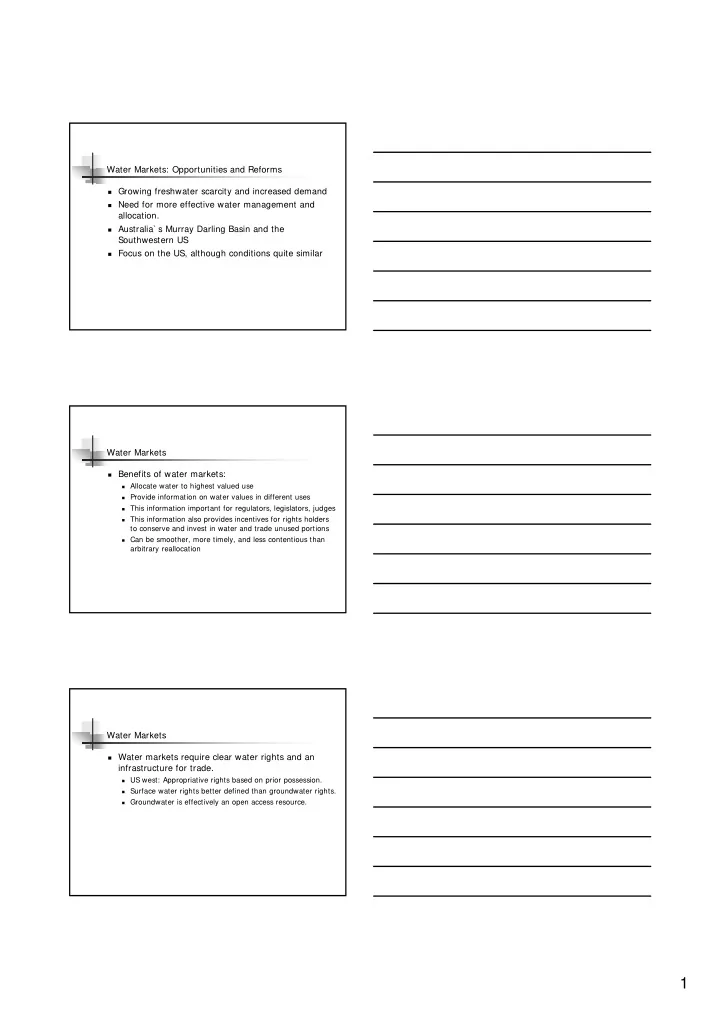
Water Markets: Opportunities and Reforms

Growing freshwater scarcity and increased demand Need for more effective water management and

allocation.

Australia` s Murray Darling Basin and the

Southwestern US

Focus on the US, although conditions quite similar

Water Markets

Benefits of water markets:

Allocate water to highest valued use Provide information on water values in different uses This information important for regulators, legislators, judges This information also provides incentives for rights holders

to conserve and invest in water and trade unused portions

Can be smoother, more timely, and less contentious than

arbitrary reallocation

Water Markets

Water markets require clear water rights and an

infrastructure for trade.

US west: Appropriative rights based on prior possession. Surface water rights better defined than groundwater rights. Groundwater is effectively an open access resource.
slide-2
SLIDE 2

2

Water markets

Regulation of water rights

Use it or lose it—incentives for low-valued uses Problem of status of conserved or salvaged water Return flows Interconnected users-Changes in time, nature, and place of

diversion

Water substitution Groundwater Transaction costs Review process. Legitimate and hold up. Public Interest and environmental flows Federal and state law, Endangered Species Act, Water trading

for flow maintenance.

Water Markets

Nature and benefits of trades

Prices reveal differences in marginal values

Differences in trade across the states—supply,

demand, and institutional-regulatory setting

Patterns of trading Contract type used Still limited, perhaps 2% of water consumed.

Water Transfer Prices ($/ML) by Sector 1987-2008

Agriculture- to-Urban Leases Agriculture- to- Agriculture Leases Agriculture- to-Urban Sales Agriculture-to- Agriculture Sales Mean price ($)

$440

$65 $5,672 $3,239 Median price ($)

$70

$16 $3,745 $1,872 Number of observations

228

237 1,127 216
slide-3
SLIDE 3

3

Water Transactions by Type and State 1987-2008 Total Transactions Number of Sales Number of One- year Leases Number of Multi- year leases Arizona 230 158 45 16 California 637 100 311 77 Colorado 2,144 1,804 98 43 Idaho 147 31 110 3 Montana 46 3 14 26 New Mexico 143 73 49 14 Nevada 187 145 4 4 Oregon 118 21 56 26 Texas 314 89 141 67 Utah 84 60 15 8 Washington 56 23 23 9 Wyoming 62 6 41 5 Total 4,168 2,513 907 298
slide-4
SLIDE 4

4

Water Markets

Benefits: Reallocation Price differentials Tucson example Imperial Irrigation District/San Diego

Water Markets

Reform

Specify water rights: surface and groundwater Local settlement agreements Adjudication Registry of water rights and amounts Coordination across agencies Clarify position of rights holders within water supply
  • rganizations—Irrigation Districts
Clear regulatory process—limits on protests, standing Clarify meaning of reasonable use, no injury, no harm Commitment to use water markets and rights
slide-5
SLIDE 5

5

Water Markets

Conclusion

Water markets for information Water markets for incentives Water markets for wise use Water markets for reallocation Water markets for informed policy Water markets for less contentious water management