EECS 373 Homework #2 Design of Microprocessor-Based Systems Where - - PDF document

eecs 373
SMART_READER_LITE
LIVE PREVIEW

EECS 373 Homework #2 Design of Microprocessor-Based Systems Where - - PDF document

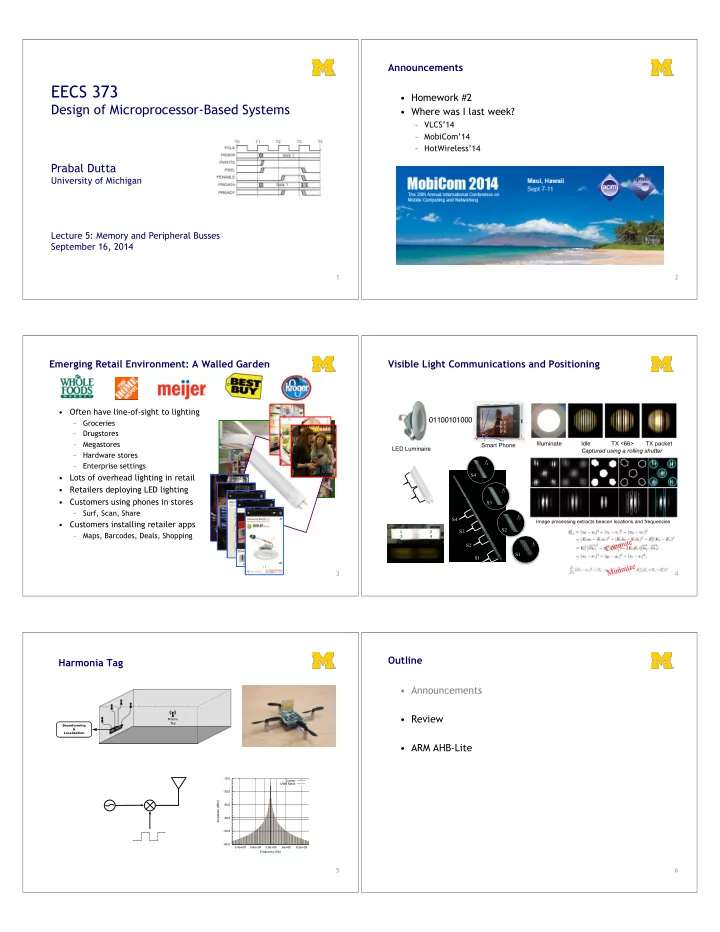
Announcements EECS 373 Homework #2 Design of Microprocessor-Based Systems Where was I last week? VLCS14 MobiCom14 HotWireless14 Prabal Dutta University of Michigan Lecture 5: Memory and Peripheral Busses September


slide-1
SLIDE 1

1

EECS 373

Design of Microprocessor-Based Systems

Prabal Dutta

University of Michigan Lecture 5: Memory and Peripheral Busses September 16, 2014

2

Announcements

  • Homework #2
  • Where was I last week?

– VLCS’14 – MobiCom’14 – HotWireless’14

Emerging Retail Environment: A Walled Garden

  • Often have line-of-sight to lighting

– Groceries – Drugstores – Megastores – Hardware stores – Enterprise settings

  • Lots of overhead lighting in retail
  • Retailers deploying LED lighting
  • Customers using phones in stores

– Surf, Scan, Share

  • Customers installing retailer apps

– Maps, Barcodes, Deals, Shopping

3

Visible Light Communications and Positioning

S1 S2 S3 S4 S1 f1 S2 f2 S3 f3 S4 f4

01100101000

Image processing extracts beacon locations and frequencies

!" ! #" # $" $ %&'#

  • %&'$
  • %&'!
  • %&'$
  • ( (

%&'!

  • ( (

%&'#

  • ( (

%&)*) +))))))), !"

Smart Phone

C

  • m

p u t e M i n i m i z e

LED Luminaire Illuminate Idle TX <66> TX packet Captured using a rolling shutter

4

  • 60.0
  • 50.0
  • 40.0
  • 30.0
  • 20.0
  • 10.0

5.4e+09 5.6e+09 5.8e+09 6e+09 6.2e+09 Amplitude (dBm) Frequency (Hz) Carrier UWB Mask

Harmonia Tag

5

     

6

Outline

  • Announcements
  • Review
  • ARM AHB-Lite
slide-2
SLIDE 2

What happens after a power-on-reset (POR)?

  • On the ARM Cortex-M3
  • SP and PC are loaded from

the code (.text) segment

  • Initial stack pointer

– LOC: 0x00000000 – POR: SP ! mem(0x00000000)

  • Interrupt vector table

– Initial base: 0x00000004 – Vector table is relocatable – Entries: 32-bit values – Each entry is an address – Entry #1: reset vector

  • LOC: 0x0000004
  • POR: PC ! mem(0x00000004)
  • Execution begins

7

!.equ !STACK_TOP,!0x20000800! !.text! !.syntax !unified! !.thumb! !.global !_start! !.type !start,!%function! ! _start:! !.word !STACK_TOP,!start! start:! !movs!r0,!#10! !...!

System Memory Map

9 !#define!!SYSREG_SOFT_RST_CR!!0xE0042030! ! !uint32_t!*reg!=!(uint32_t!*)(SYSREG_SOFT_RST_CR);! ! !main!()!{! !!!*reg!|=!0x00004000;!//!Reset!GPIO!hardware! !!!*reg!&=!~(0x00004000);! !}! ! !

Accessing memory locations from C

  • Memory has an address and value
  • Can equate a pointer to desired address
  • Can set/get de-referenced value to change memory

10

Some useful C keywords

  • const

– Makes variable value or pointer parameter unmodifiable – const foo = 32;

  • register

– Tells compiler to locate variables in a CPU register if possible – register int x;

  • static

– Preserve variable value after its scope ends – Does not go on the stack – static int x;

  • volatile

– Opposite of const – Can be changed in the background – volatile int I;

11

#include!<stdio.h>! #include!<inttypes.h>! ! #define!REG_FOO!0x40000140! ! main!()!{! !!uint32_t!*reg!=!(uint32_t!*)(REG_FOO);! !!*reg!+=!3;! ! !!printf(0x%x\n,!*reg);!//!Prints!out!new!value! }!

What happens when this instruction executes?

12

*reg += 3 is turned into a ld, add, str sequence

  • Load instruction

– A bus read operation commences – The CPU drives the address reg onto the address bus – The CPU indicated a read operation is in process (e.g. R/W#) – Some handshaking occurs – The target drives the contents of reg onto the data lines – The contents of reg is loaded into a CPU register (e.g. r0)

  • Add instruction

– An immediate add (e.g. add r0, #3) adds three to this value

  • Store instruction

– A bus write operation commences – The CPU drives the address reg onto the address bus – The CPU indicated a write operation is in process (e.g. R/W#) – Some handshaking occurs – The CPU drives the contents of r0 onto the data lines – The target stores the data value into address reg

slide-3
SLIDE 3

Modern embedded systems have multiple busses

13 Atmel SAM3U Historical 373 focus Expanded 373 focus 14

Why have so many busses?

  • Many designs considerations

– Master vs Slave – Internal vs External – Bridged vs Flat – Memory vs Peripheral – Synchronous vs Asynchronous – High-speed vs low-speed – Serial vs Parallel – Single master vs multi master – Single layer vs multi layer – Multiplexed A/D vs demultiplexed A/D

  • Discussion: what are some of the tradeoffs?

15

APB

  • IDLE

– Default APB state

  • SETUP

– When transfer required – PSELx is asserted – Only one cycle

  • ACCESS

– PENABLE is asserted – Addr, write, select, and write data remain stable – Stay if PREADY = L – Goto IDLE if PREADY = H and no more data – Goto SETUP is PREADY = H and more data pending

Setup phase begins with this rising edge Setup Phase Access Phase 16

APB signal definitions

  • PCLK: the bus clock source (rising-edge triggered)
  • PRESETn: the bus (and typically system) reset signal (active low)
  • PADDR: the APB address bus (can be up to 32-bits wide)
  • PSELx: the select line for each slave device
  • PENABLE: indicates the 2nd and subsequent cycles of an APB xfer
  • PWRITE: indicates transfer direction (Write=H, Read=L)
  • PWDATA: the write data bus (can be up to 32-bits wide)
  • PREADY: used to extend a transfer
  • PRDATA: the read data bus (can be up to 32-bits wide)
  • PSLVERR: indicates a transfer error (OKAY=L, ERROR=H)

Let’s say we want a device that provides data from a switch on a read to any address it is assigned. (so returns a 0 or 1)

17

Mr. Switch

! ! PWRITE ! ! ! PENABLE ! ! PSEL ! ! PADDR[7:0] ! ! PCLK !

!

!

PREADY PRDATA[32:0]

Device provides data from switch A if address 0x00001000 is read from. B if address 0x00001004 is read from

18

Mr. Switch Mrs. Switch

! ! PWRITE ! ! ! PENABLE ! ! PSEL ! ! PADDR[7:0] ! ! PCLK !

!

!

PREADY PRDATA[32:0]

slide-4
SLIDE 4

All reads read from register, all writes write…

19

PWDATA[31:0] ! ! ! PWRITE ! ! ! ! PENABLE ! ! ! PSEL ! ! ! ! PADDR[7:0] ! ! ! PCLK ! ! ! PREADY !

!

!

328bit!Reg ! ! D[31:0]!!!!!!!!!!!!!!!!!!! ! ! !!!!!!!!!!!!!!!!!!Q[31:0]! EN! !! !!!!C!!!!!!!!!!!!!!!! !

We are assuming APB only gets lowest 8 bits of address here…

PREADY PRDATA[32:0]

20

Outline

  • Announcements
  • Review
  • ARM AHB-Lite

Advanced Microcontroller Bus Architecture (AMBA)

  • Advanced High-performance Bus (AHB)
  • Advanced Peripheral Bus (APB)

AHB

  • High performance
  • Pipelined operation
  • Burst transfers
  • Multiple bus masters
  • Split transactions

APB

  • Low power
  • Latched address/control
  • Simple interface
  • Suitable of many

peripherals

21 22

Actel SmartFusion system/bus architecture

23

AHB-Lite supports single bus master and provides high-bandwidth operation

  • Burst transfers
  • Single clock-edge
  • peration
  • Non-tri-state

implementation

  • Configurable bus width

24

AHB-Lite bus master/slave interface

  • Global signals

– HCLK – HRESETn

  • Master out/slave in

– HADDR (address) – HWDATA (write data) – Control

  • HWRITE
  • HSIZE
  • HBURST
  • HPROT
  • HTRANS
  • HMASTLOCK
  • Slave out/master in

– HRDATA (read data) – HREADY – HRESP

slide-5
SLIDE 5

25

AHB-Lite signal definitions

  • Global signals

– HCLK: the bus clock source (rising-edge triggered) – HRESETn: the bus (and system) reset signal (active low)

  • Master out/slave in

– HADDR[31:0]: the 32-bit system address bus – HWDATA[31:0]: the system write data bus – Control

  • HWRITE: indicates transfer direction (Write=1, Read=0)
  • HSIZE[2:0]: indicates size of transfer (byte, halfword, or word)
  • HBURST[2:0]: indicates single or burst transfer (1, 4, 8, 16 beats)
  • HPROT[3:0]: provides protection information (e.g. I or D; user or handler)
  • HTRANS: indicates current transfer type (e.g. idle, busy, nonseq, seq)
  • HMASTLOCK: indicates a locked (atomic) transfer sequence
  • Slave out/master in

– HRDATA[31:0]: the slave read data bus – HREADY: indicates previous transfer is complete – HRESP: the transfer response (OKAY=0, ERROR=1) 26

Key to timing diagram conventions

  • Timing diagrams

– Clock – Stable values – Transitions – High-impedance

  • Signal conventions

– Lower case n denote active low (e.g. RESETn) – Prefix H denotes AHB – Prefix P denotes APB

27

Basic read and write transfers with no wait states

Pipelined Address & Data Transfer

28

Read transfer with two wait states

Two wait states added by slave by asserting HREADY low Valid data produced 29

Write transfer with one wait state

One wait state added by slave by asserting HREADY low Valid data held stable 30

Wait states extend the address phase of next transfer

One wait state added by slave by asserting HREADY low Address stage of the next transfer is also extended

slide-6
SLIDE 6

31

Transfers can be of four types (HTRANS[1:0])

  • IDLE (b00)

– No data transfer is required – Slave must OKAY w/o waiting – Slave must ignore IDLE

  • BUSY (b01)

– Insert idle cycles in a burst – Burst will continue afterward – Address/control reflects next transfer in burst – Slave must OKAY w/o waiting – Slave must ignore BUSY

  • NONSEQ (b10)

– Indicates single transfer or first transfer of a burst – Address/control unrelated to prior transfers

  • SEQ (b11)

– Remaining transfers in a burst – Addr = prior addr + transfer size

32

A four beat burst with master busy and slave wait

One wait state added by slave by asserting HREADY low Master busy indicated by HTRANS[1:0] 33

Controlling the size (width) of a transfer

  • HSIZE[2:0] encodes the size
  • The cannot exceed the data bus

width (e.g. 32-bits)

  • HSIZE + HBURST is determines

wrapping boundary for wrapping bursts

  • HSIZE must remain constant

throughout a burst transfer

34

Controlling the burst beats (length) of a transfer

  • Burst of 1, 4, 8, 16, and undef
  • HBURST[2:0] encodes the type
  • Incremental burst
  • Wrapping bursts

– 4 beats x 4-byte words wrapping – Wraps at 16 byte boundary – E.g. 0x34, 0x38, 0x3c, 0x30,…

  • Bursts must not cross 1KB

address boundaries

35

A four beat wrapping burst (WRAP4)

36

A four beat incrementing burst (INCR4)

slide-7
SLIDE 7

37

An eight beat wrapping burst (WRAP8)

38

An eight beat incrementing burst (INCR8) using half-word transfers

39

An undefined length incrementing burst (INCR)

40

Multi-master AHB-Lite requires a multi-layer interconnect

  • AHB-Lite is single-master
  • Multi-master operation

– Must isolate masters – Each master assigned to layer – Interconnect arbitrates slave accesses

  • Full crossbar switch often

unneeded

– Slaves 1, 2, 3 are shared – Slaves 4, 5 are local to Master 1

41

Questions? Comments? Discussion?