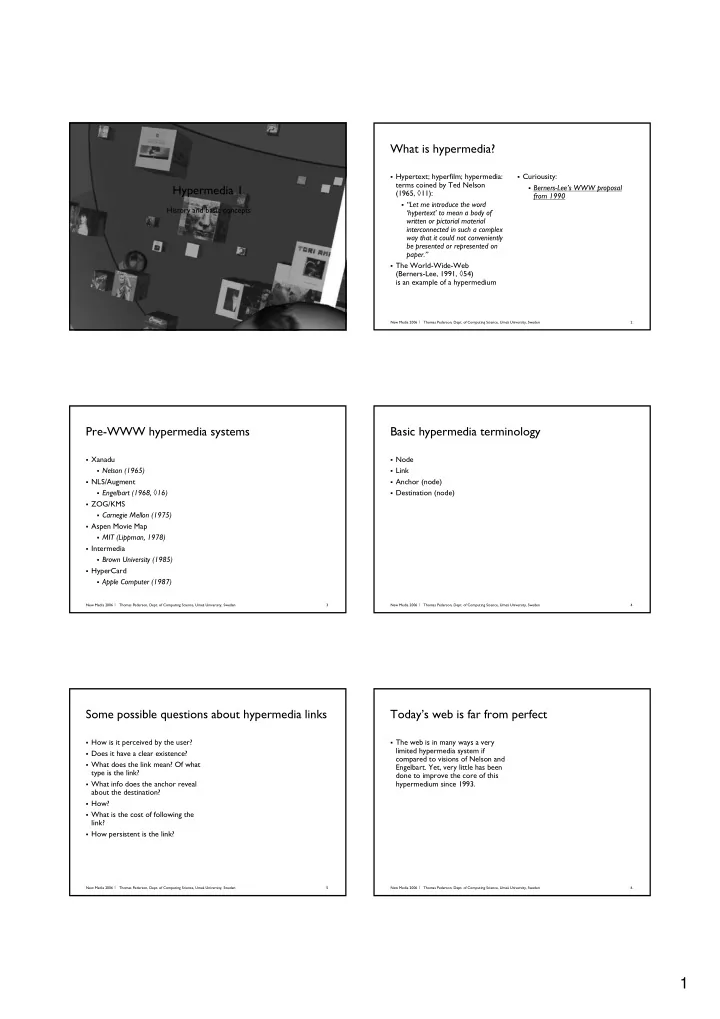
1 Todays web is far from perfect Typed links and nodes The web is - - PDF document

1
SMART_READER_LITE
LIVE PREVIEW

1 Todays web is far from perfect Typed links and nodes The web is - - PDF document

What is hypermedia? Hypertext; hyperfilm; hypermedia: Curiousity: terms coined by Ted Nelson Hypermedia 1 Berners-Lees WWW proposal (1965, 11): from 1990 Let me introduce the word History and basic concepts


slide-1
SLIDE 1

1

New Media 2006 | Thomas Pederson, Dept. of Computing Science, Umeå University, Sweden

Hypermedia 1

History and basic concepts

New Media 2006 | Thomas Pederson, Dept. of Computing Science, Umeå University, Sweden 2

What is hypermedia?

Hypertext; hyperfilm; hypermedia:

terms coined by Ted Nelson (1965, ◊11):

“Let me introduce the word

‘hypertext’ to mean a body of written or pictorial material interconnected in such a complex way that it could not conveniently be presented or represented on paper.”

The World-Wide-Web

(Berners-Lee, 1991, ◊54) is an example of a hypermedium

Curiousity: Berners-Lee’s WWW proposal

from 1990

New Media 2006 | Thomas Pederson, Dept. of Computing Science, Umeå University, Sweden 3

Pre-WWW hypermedia systems

Xanadu Nelson (1965) NLS/Augment Engelbart (1968, ◊16) ZOG/KMS Carnegie Mellon (1975) Aspen Movie Map MIT (Lippman, 1978) Intermedia Brown University (1985) HyperCard Apple Computer (1987)

New Media 2006 | Thomas Pederson, Dept. of Computing Science, Umeå University, Sweden 4

Basic hypermedia terminology

Node Link Anchor (node) Destination (node)

New Media 2006 | Thomas Pederson, Dept. of Computing Science, Umeå University, Sweden 5

Some possible questions about hypermedia links

How is it perceived by the user? Does it have a clear existence? What does the link mean? Of what

type is the link?

What info does the anchor reveal

about the destination?

How? What is the cost of following the

link?

How persistent is the link?

New Media 2006 | Thomas Pederson, Dept. of Computing Science, Umeå University, Sweden 6

Today’s web is far from perfect

The web is in many ways a very

limited hypermedia system if compared to visions of Nelson and

  • Engelbart. Yet, very little has been

done to improve the core of this hypermedium since 1993.

slide-2
SLIDE 2

2

New Media 2006 | Thomas Pederson, Dept. of Computing Science, Umeå University, Sweden 7

Today’s web is far from perfect

The web is in many ways a very

limited hypermedia system if compared to visions of Nelson and

  • Engelbart. Yet, very little has been

done to improve the core of this hypermedium since 1993.

Bieber et al. (1997) suggest the

following enhancements:

Typed links and nodes Link attributes and structure-

based query

Connecting occurrences:

transclusions, warm links and hot links

Annotations and public or private

links

Computed, personalized links External link databases and link

update mechanisms

Local and global overviews Trails and guided tours Backtracking and History-based

Navigation

New Media 2006 | Thomas Pederson, Dept. of Computing Science, Umeå University, Sweden 8

Typed links and nodes

Helps authors organize

information more effectively

Provides context to readers Link type examples: “explanantion” “further details” “contrasting argument” A typed link conveys the

relationship between the link’s destination and the link’s anchor

Similarly, node types categorize

node content

Example: gIBIS (Conklin &

Begeman, 1989) uses typed nodes and links

New Media 2006 | Thomas Pederson, Dept. of Computing Science, Umeå University, Sweden 9

Link attributes and structure-based query

Link attributes (“labels”) can add

even more semantic info to links

Makes it possible to make the

links context-sensitive

Readers should also be allowed to

define labels

By supporting more advanced link

attributes, structure-based queries can be asked (compare with today’s free-text based queries)

The web can become more like a

database

New Media 2006 | Thomas Pederson, Dept. of Computing Science, Umeå University, Sweden 10

Connecting occurrences: transclusions, warm links and hot links

Transclusion – a mechanism for

having the exact same object (node content) exist in multiple places

Note 1: not copies, more like

“shortcuts”

Eliminates the problem of manual

updating of node object copies when the original changes

Note 2: we are talking about

parts of nodes, not whole nodes

Warm links – node content

becomes updated on user request

Hot links – node content becomes

automatically updated when the node is about to be displayed

New Media 2006 | Thomas Pederson, Dept. of Computing Science, Umeå University, Sweden 11

Annotations and public or private links

Annotation provides means to

comment on node content

Very common in non-WWW

hypermedia systems, why not in the WWW?

What about going further, allowing

readers to modify the node content itself?

Need for access permission

control like in ordinary file systems

NSCA Mosaic 2.6 supports

personal, workgroup, and public annotations

New Media 2006 | Thomas Pederson, Dept. of Computing Science, Umeå University, Sweden 12

Computed, personalized links

The reader should be allowed to

specify rules for automatic link generation

Example: a sales agent in an

insurance company could specify to the hypermedia system that names of customers would automatically be linked to every insurance policy ever held by that customer

slide-3
SLIDE 3

3

New Media 2006 | Thomas Pederson, Dept. of Computing Science, Umeå University, Sweden 13

External link databases and link update mechanisms

Enables users without write-access

to nodes to create links nevertheless

The links are not hardcoded into

the node but are stored externally

New Media 2006 | Thomas Pederson, Dept. of Computing Science, Umeå University, Sweden 14

Local and global overviews

Global overview diagrams provide

an overall picture and can also provide anchors for local overview diagrams

Local overview diagrams provide a

fine-grained picture of the local neighborhood of a node

Both serve as navigational aids

New Media 2006 | Thomas Pederson, Dept. of Computing Science, Umeå University, Sweden 15

Trails and guided tours

The concept of trails or paths are

taken from Vannevar Bush (1945)

Trails connect a chain of links

through information spaces, providing context for viewing and understanding a series of documents (nodes).

Authors can prepare multiple

“recommended” trails tuned to different readers

New Media 2006 | Thomas Pederson, Dept. of Computing Science, Umeå University, Sweden 16

Backtracking and History-based Navigation

Helps managing detours Reduces cognitive overhead Many different kinds of

backtracking has been proposed in the literature

Common browsers use the

“stack” metaphor

New Media 2006 | Thomas Pederson, Dept. of Computing Science, Umeå University, Sweden 17

Video clips illustrating hypermedia

Douglas Engelbart’s NLS/Augment

demo from 1968.

demo video Pederson’s 3D navigation vision

from 1997.

Video clip

New Media 2006 | Thomas Pederson, Dept. of Computing Science, Umeå University, Sweden

New Media

End of hypermedia I – history and basic concepts