1 08 Augmenting Human Intellect 08 Augmenting Human Intellect - - PDF document

1
SMART_READER_LITE
LIVE PREVIEW

1 08 Augmenting Human Intellect 08 Augmenting Human Intellect - - PDF document

Lecture overview 02: Vannevar Bush Hypermedia 2 08, 16: Douglas Engelbart; Douglas Engelbart & William English Exploratory and Constructive Hypertext 11, 21, 30: Ted Nelson 54: Tim Berners-Lee


slide-1
SLIDE 1

1

New Media 2006 | Thomas Pederson, Dept. of Computing Science, Umeå University, Sweden

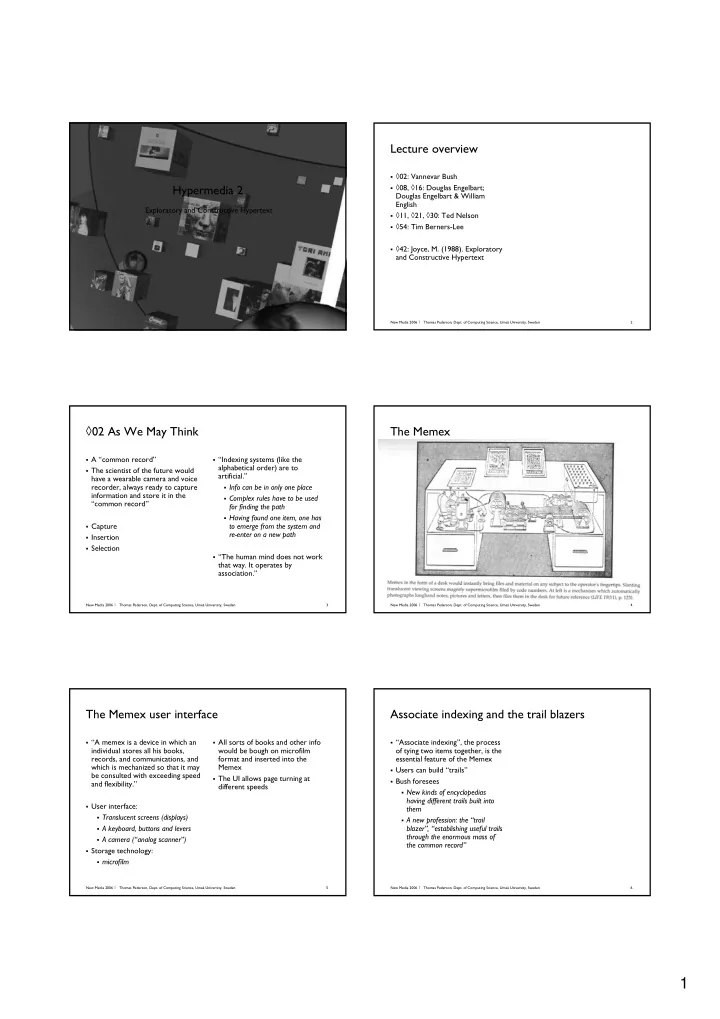
Hypermedia 2

Exploratory and Constructive Hypertext

New Media 2006 | Thomas Pederson, Dept. of Computing Science, Umeå University, Sweden 2

Lecture overview

◊02: Vannevar Bush ◊08, ◊16: Douglas Engelbart;

Douglas Engelbart & William English

◊11, ◊21, ◊30: Ted Nelson ◊54: Tim Berners-Lee ◊42: Joyce, M. (1988). Exploratory

and Constructive Hypertext

New Media 2006 | Thomas Pederson, Dept. of Computing Science, Umeå University, Sweden 3

◊02 As We May Think

A “common record” The scientist of the future would

have a wearable camera and voice recorder, always ready to capture information and store it in the “common record”

Capture Insertion Selection “Indexing systems (like the

alphabetical order) are to artificial.”

Info can be in only one place Complex rules have to be used

for finding the path

Having found one item, one has

to emerge from the system and re-enter on a new path

“The human mind does not work

that way. It operates by association.”

New Media 2006 | Thomas Pederson, Dept. of Computing Science, Umeå University, Sweden 4

The Memex

New Media 2006 | Thomas Pederson, Dept. of Computing Science, Umeå University, Sweden 5

The Memex user interface

All sorts of books and other info

would be bough on microfilm format and inserted into the Memex

The UI allows page turning at

different speeds

“A memex is a device in which an

individual stores all his books, records, and communications, and which is mechanized so that it may be consulted with exceeding speed and flexibility.”

User interface: Translucent screens (displays) A keyboard, buttons and levers A camera (“analog scanner”) Storage technology: microfilm

New Media 2006 | Thomas Pederson, Dept. of Computing Science, Umeå University, Sweden 6

Associate indexing and the trail blazers

“Associate indexing”, the process

  • f tying two items together, is the

essential feature of the Memex

Users can build “trails” Bush foresees New kinds of encyclopedias

having different trails built into them

A new profession: the “trail

blazer”, “establishing useful trails through the enormous mass of the common record”

slide-2
SLIDE 2

2

New Media 2006 | Thomas Pederson, Dept. of Computing Science, Umeå University, Sweden 7

◊08 Augmenting Human Intellect

Engelbarts “framework” The H-LAM/T System

H – human L – language A – artifacts M – methodology T – training New Media 2006 | Thomas Pederson, Dept. of Computing Science, Umeå University, Sweden 8

◊08 Augmenting Human Intellect

Essentially all humans are

augmented

E.g. a typewriter makes the

process of writing faster

De-augmentation is also possible E.g. the idea of writing with a

brick pen (p97)

New Media 2006 | Thomas Pederson, Dept. of Computing Science, Umeå University, Sweden 9

◊08 Augmenting Human Intellect

About the Memex: “The Memex allows a human

user to do more conveniently (less energy, more quickly) what he could have done with relatively

  • rdinary photographic equipment

and filing systems, but he would have had to spend so much time in the lower-level processes of manipulation that his mental time constants of memory and patience would have rendered the system unusable in the detailed and intimate sense which Bush illustrates.”

One important feature of

augmentation technology is its ability to speed up, and otherwise simplify, the structuring of symbols

New Media 2006 | Thomas Pederson, Dept. of Computing Science, Umeå University, Sweden 10

◊08 Augmenting Human Intellect

“If my mental processes were

more powerful, I could dispense with the cards, and hold all of the card-sized concept structures in my memory, where also would be held the categorization linkages that evolved as I worked (with my feet up on the artifacts and my eyes closed). As it is, and as it probably always will be […] I want to work in problem areas where the number and interrelationship complexity of the individual factors involved are too much for me to hold and manipulate within my mind.”

Augmentation technology like the

Memex would encourage

New methods of work by the user New ways of collaboration

E.g. the way info is copied and

distributed to other individuals Each node is a concept Engelbart mainly studied

hypermedia based on nodes of smaller size than the typical web pages of today

He started out with a set of

physical notecards

New Media 2006 | Thomas Pederson, Dept. of Computing Science, Umeå University, Sweden 11

◊08 Augmenting Human Intellect

In the paper he demonstrates how

various types of hyperlinks could facilitate comprehension of complex arguments and statements

Hiearchical structures embedded In-node expansion of target nodes

New Media 2006 | Thomas Pederson, Dept. of Computing Science, Umeå University, Sweden 12

◊16 Augmenting Human Intellect System setup (1968)

1 central computer 64KB RAM 4.5 MB swapping drum 96 MB file-storage disk 12 client workstations 875-line highres CRT monitor Keyboard Five-key handset (optional) Mouse High-level languages and

associated compilers

slide-3
SLIDE 3

3

New Media 2006 | Thomas Pederson, Dept. of Computing Science, Umeå University, Sweden 13

◊16 Augmenting Human Intellect Objective and Engelbart’s vision

Engelbart’s vision is carried

forward today by the bootstrap alliance

www.bootstrap.org Having as a general aim to boost

“Collective IQ”

To develop principles and

techniques for designing an “augmentation system”

Technology Changes in conceptualizing,

visualizing, and organizing working material

Changes in procedures and

methods for working individually and cooperatively

The research group was also the

subject group in the experiment

Demo video clip of the system on

the course book CD

New Media 2006 | Thomas Pederson, Dept. of Computing Science, Umeå University, Sweden 14

◊11 Ted Nelson and ELF

Desiderata: The system should sustain changes and re-

arrangements of its contents,

permit dynamic outlining, not be complicated. “If a writer is really to be helped

by an automated system, it ought to do more than retype and transpose: it should stand by him during early periods of muddled confusion, when his ideas are scraps, fragments, phrases, and contradictory overall designs.”

Proposal: A file system for personal filing, and manuscript assembly

New Media 2006 | Thomas Pederson, Dept. of Computing Science, Umeå University, Sweden 15

◊11 Ted Nelson and ELF/PRIDE

Definition of hypertext “Let me introduce the word

‘hypertext’ to mean a body of written or pictorial material interconnected in such a complex way that it could not conveniently be presented or represented on paper.”

ELF (Evolutionary List File) is a

machine that is able to carry out basic operations on

Entries Lists Links Sequences PRIDE UI towards ELF providing UNDO

and history functions

New Media 2006 | Thomas Pederson, Dept. of Computing Science, Umeå University, Sweden 16

◊21 Ted Nelson: Computer Lib / Dream Machines (1974)

Self-published book Two books back to back Computer Lib: challenging what

the computers are here for

Dream Machines: new media-

focused with a twofold vision:

Computerized media experiences

need to be designed with users (the audience) in mind, i.e. founding ideas for the area of HCI

These new media experiences should

be published in an open publishing network (Xanadu) based on ELF/PRIDE

New Media 2006 | Thomas Pederson, Dept. of Computing Science, Umeå University, Sweden 17

◊30 Ted Nelson: Proposal for Xanadu (1981)

Other important points Eternal revision – there is no final

word

User privacy Like Engelbart, Nelson envisions

hypermedia on a higher granularity than the document level

It is relatively small text

fragments that are nodes in the medium

Features: Links Alternative parallell versions Historical backtrack Hierarchical relationships

A node can be part of another node

etc.

New Media 2006 | Thomas Pederson, Dept. of Computing Science, Umeå University, Sweden 18

◊54: Tim Berners-Lee and the WWW

Important concepts of the

WWW:

URI /URL HTTP HTML Originally developed by Berners-

Lee to facilitate collaboration at CERN

Key features: Same user interface no matter

what kind of server (http, ftp, gopher, etc.)

Open for multimedia extension Free browser (NCSA Mosaic)

slide-4
SLIDE 4

4

New Media 2006 | Thomas Pederson, Dept. of Computing Science, Umeå University, Sweden 19

◊42 Joyce, M. (1988). Exploratory and Constructive Hypertext

Constructive hypertexts are those

in the process of creation by the user/author

Exploratory hypertexts are former

constructive hypertexts, now being experienced by a user/reader who is not an author

  • f the work

Both have their uses

New Media 2006 | Thomas Pederson, Dept. of Computing Science, Umeå University, Sweden 20

Exploratory hypertexts

Should encourage the audience to

to control the transformations of a body of information to meet its need and interests

Including creating, changing and

recovering particular encounters with the body of knowledge (e.g. trails, paths, webs, notebooks)

Should facilitate understanding of

the material by making it easy to test and view alternative

  • rganizations of the medium

New Media 2006 | Thomas Pederson, Dept. of Computing Science, Umeå University, Sweden 21

Constructive hypertext

Authors have to not only be able

to switch between alternative views, but also to transform the views themselves

Constructive hypertext is a tool

for

inventing, discovering, viewing,

and testing multiple alternative

  • rganizational structures

comparing such structures of

thought with more traditional

  • nes (e.g. printed media)

Should support the use of

hypertext as an invention or analytic tool

Outline processors Personal Information Managers

(PIMs)

Has to facilitate user action To create, change, recover

information

Also here, trails, paths, webs,

notebooks should be possible to maintain, but they are all versions of what they are becoming

New Media 2006 | Thomas Pederson, Dept. of Computing Science, Umeå University, Sweden 22

The road towards a constructive version of the WWW

In order for the web to become a

contructive hypertext it should enable users to

Annotate Create links Share links Technical problems e.g. how to support transclusion

(Ted Nelson), i.e. to include parts

  • f a web page as part of another

Legal problems People have already started law

suits against contextual misuse of material they have authored

New Media 2006 | Thomas Pederson, Dept. of Computing Science, Umeå University, Sweden

New Media

End of hypermedia 2: Exploratory and constructive hypertext