1 Multiple Access protocols Multiple Access protocols single - - PDF document

1
SMART_READER_LITE
LIVE PREVIEW

1 Multiple Access protocols Multiple Access protocols single - - PDF document

Medium Access Links and Protocols Three types of links: point-to-point (single wire, e.g. PPP, SLIP) broadcast (shared wire or medium; e.g, Ethernet, Wavelan, etc.) Physical Layer switched (e.g., telephone systems, switched


slide-1
SLIDE 1

1

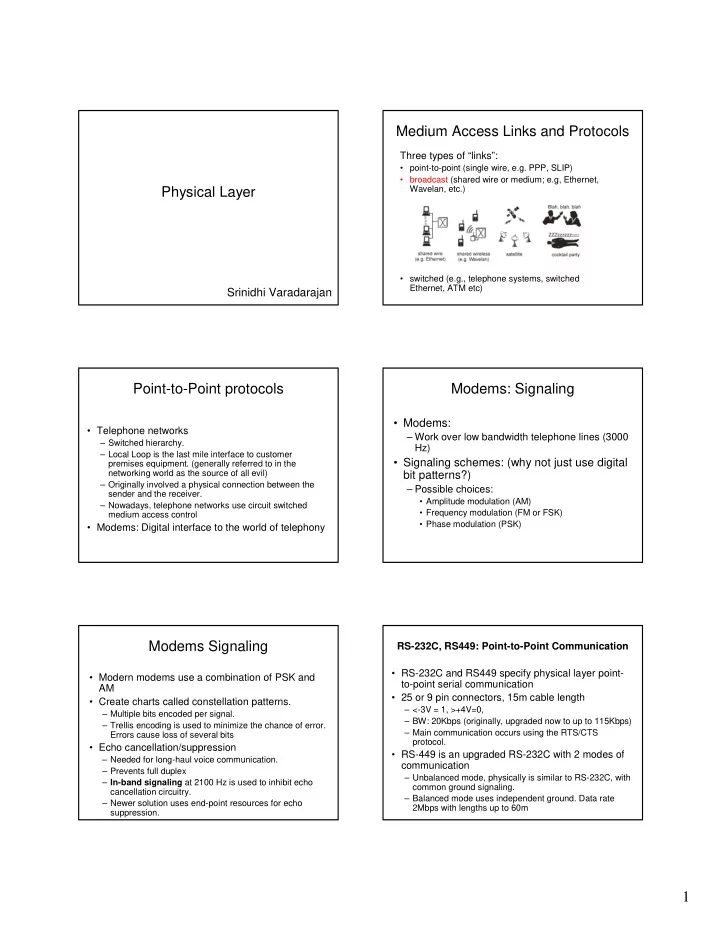
Physical Layer

Srinidhi Varadarajan

Medium Access Links and Protocols

Three types of “links”:

  • point-to-point (single wire, e.g. PPP, SLIP)
  • broadcast (shared wire or medium; e.g, Ethernet,

Wavelan, etc.)

  • switched (e.g., telephone systems, switched

Ethernet, ATM etc)

Point-to-Point protocols

  • Telephone networks

– Switched hierarchy. – Local Loop is the last mile interface to customer premises equipment. (generally referred to in the networking world as the source of all evil) – Originally involved a physical connection between the sender and the receiver. – Nowadays, telephone networks use circuit switched medium access control

  • Modems: Digital interface to the world of telephony

Modems: Signaling

  • Modems:

– Work over low bandwidth telephone lines (3000 Hz)

  • Signaling schemes: (why not just use digital

bit patterns?)

– Possible choices:

  • Amplitude modulation (AM)
  • Frequency modulation (FM or FSK)
  • Phase modulation (PSK)

Modems Signaling

  • Modern modems use a combination of PSK and

AM

  • Create charts called constellation patterns.

– Multiple bits encoded per signal. – Trellis encoding is used to minimize the chance of error. Errors cause loss of several bits

  • Echo cancellation/suppression

– Needed for long-haul voice communication. – Prevents full duplex – In-band signaling at 2100 Hz is used to inhibit echo cancellation circuitry. – Newer solution uses end-point resources for echo suppression.

RS-232C, RS449: Point-to-Point Communication

  • RS-232C and RS449 specify physical layer point-

to-point serial communication

  • 25 or 9 pin connectors, 15m cable length

– <-3V = 1, >+4V=0, – BW: 20Kbps (originally, upgraded now to up to 115Kbps) – Main communication occurs using the RTS/CTS protocol.

  • RS-449 is an upgraded RS-232C with 2 modes of

communication

– Unbalanced mode, physically is similar to RS-232C, with common ground signaling. – Balanced mode uses independent ground. Data rate 2Mbps with lengths up to 60m

slide-2
SLIDE 2

2

Multiple Access protocols

  • single shared communication channel
  • two or more simultaneous transmissions by nodes:

interference

– only one node can send successfully at a time

  • multiple access protocol:

– distributed algorithm that determines how stations share channel, i.e., determine when station can transmit – communication about channel sharing must use channel itself! – what to look for in multiple access protocols:

  • synchronous or asynchronous
  • information needed about other stations
  • robustness (e.g., to channel errors)
  • performance

Multiple Access protocols

  • claim: humans use multiple access protocols

all the time

  • class can "guess" multiple access protocols

– multiaccess protocol 1: – multiaccess protocol 2: – multiaccess protocol 3: – multiaccess protocol 4:

MAC Protocols: a taxonomy

Three broad classes:

  • Channel Partitioning

– divide channel into smaller “pieces” (time slots, frequency) – allocate piece to node for exclusive use

  • Random Access

– allow collisions – “recover” from collisions

  • “Taking turns”

– tightly coordinate shared access to avoid collisions

Goal: ef f icient , f air, simple, decent ralized

Channel Partitioning MAC protocols: TDMA

TDMA: time division multiple access

  • access to channel in "rounds"
  • each station gets fixed length slot (length = pkt trans

time) in each round

  • unused slots go idle
  • example: 6-station LAN, 1,3,4 have pkt, slots 2,5,6

idle

Channel Partitioning MAC protocols: FDMA

FDMA: frequency division multiple access

  • channel spectrum divided into frequency bands
  • each station assigned fixed frequency band
  • unused transmission time in frequency bands go idle
  • example: 6-station LAN, 1,3,4 have pkt, frequency bands

2,5,6 idle

f r equency bands t i m e

Channel Partitioning (CDMA)

CDMA (Code Division Multiple Access)

  • unique “code” assigned to each user; ie, code set

partitioning

  • used mostly in wireless broadcast channels (cellular,

satellite,etc)

  • all users share same frequency, but each user has own

“chipping” sequence (ie, code) to encode data

  • encoded signal = (original data) X (chipping sequence)
  • decoding: inner-product of encoded signal and chipping

sequence

  • allows multiple users to “coexist” and transmit

simultaneously with minimal interference (if codes are “orthogonal”)

slide-3
SLIDE 3

3

CDMA Encode/Decode

CDMA: two-sender interference

Random Access protocols

  • When node has packet to send

– transmit at full channel data rate R. – no a priori coordination among nodes

  • two or more transmitting nodes -> “collision”,
  • random access MAC protocol specifies:

– how to detect collisions – how to recover from collisions (e.g., via delayed retransmissions)

  • Examples of random access MAC protocols:

– slotted ALOHA – ALOHA – CSMA and CSMA/CD

Slotted Aloha

  • time is divided into equal size slots (= pkt trans.

time)

  • node with new arriving pkt: transmit at beginning
  • f next slot
  • if collision: retransmit pkt in future slots with

probability p, until successful.

Success (S), Collision (C), Empty (E) slots

Slotted Aloha efficiency

Q: what is max fraction slots successful?

A: Suppose N stations have packets to send – each transmits in slot with probability p – prob. successful transmission S is:

by single node: S= p (1-p)(N-1) by any of N nodes S = Prob (only one transmits) = N p (1-p)(N-1)

… choosing optimum p as n -> infty ...

= 1/e = .37 as N -> infty

At best : channel use f or usef ul t r ansmissions 37%

  • f t ime!

Pure (unslotted) ALOHA

  • unslotted Aloha: simpler, no synchronization
  • pkt needs transmission:

– send without awaiting for beginning of slot

  • collision probability increases:

– pkt sent at t0 collide with other pkts sent in [t0-1, t0+1]

slide-4
SLIDE 4

4

Pure Aloha (cont.)

P(success by given node) = P(node transmits) . P(no other node transmits in [p0-1,p0] . P(no other node transmits in [p0,p0+1] = p . (1-p) . (1-p) P(success by any of N nodes) = N p . (1-p) . (1-p) … choosing optimum p as n -> infty ... = 1/(2e) = .18

S = t hr oughput = “goodput ” (success r at e) G = of f er ed load = Np

0.5 1.0 1.5 2.0 0.1 0.2 0.3 0.4

P ur e Aloha Slot t ed Aloha

pr ot ocol const r ains ef f ect ive channel t hr oughput !

CSMA: Carrier Sense Multiple Access

CSMA: listen before transmit:

  • If channel sensed idle: transmit entire pkt
  • If channel sensed busy, defer transmission

– Persistent CSMA: retry immediately with probability p when channel becomes idle (may cause instability) – Non-persistent CSMA: retry after random interval

  • human analogy: don’t interrupt others!

CSMA collisions

collisions can occur:

propagat ion delay means t wo nodes may not year hear each ot her’s t ransmission

collision:

ent ire packet t ransmission t ime wast ed

spat ial layout of nodes along et her net

not e:

role of dist ance and propagat ion delay in det ermining collision prob.

CSMA/CD (Collision Detection)

CSMA/CD: carrier sensing, deferral as in CSMA

– collisions detected within short time – colliding transmissions aborted, reducing channel wastage – persistent or non-persistent retransmission

  • collision detection:

– easy in wired LANs: measure signal strengths, compare transmitted, received signals – difficult in wireless LANs: receiver shut off while transmitting

  • human analogy: the polite conversationalist

CSMA/CD collision detection “Taking Turns” MAC protocols

channel partitioning MAC protocols: – share channel efficiently at high load – inefficient at low load: delay in channel access, 1/N bandwidth allocated even if only 1 active node! Random access MAC protocols – efficient at low load: single node can fully utilize channel – high load: collision overhead “taking turns” protocols look for best of both worlds!

slide-5
SLIDE 5

5

“Taking Turns” MAC protocols

Polling:

  • master node “invites”

slave nodes to transmit in turn

  • Request to Send,

Clear to Send msgs

  • concerns:

– polling overhead – latency – single point of failure (master)

Token passing:

  • control token passed from
  • ne node to next sequentially.
  • token message
  • concerns:

– token overhead – latency – single point of failure (token)

Reservation-based protocols

Distributed Polling:

  • time divided into slots
  • begins with N short reservation slots

– reservation slot time equal to channel end-end propagation delay – station with message to send posts reservation – reservation seen by all stations

  • after reservation slots, message transmissions ordered by known

priority