1 Predictor for a Single Branch Branch History Table of 1-bit - - PDF document

1
SMART_READER_LITE
LIVE PREVIEW

1 Predictor for a Single Branch Branch History Table of 1-bit - - PDF document

Reducing Branch Penalty Branch penalty in dynamically scheduled processors: wasted cycles due to pipeline flushing on mis- predicted branches Lecture 9: Branch Prediction I Reduce branch penalty: 1. Prediction analysis, 1-bit predictor,


slide-1
SLIDE 1

1

1

Lecture 9: Branch Prediction I

Prediction analysis, 1-bit predictor, 2-bit predictor, branch history table, branch target buffer

2

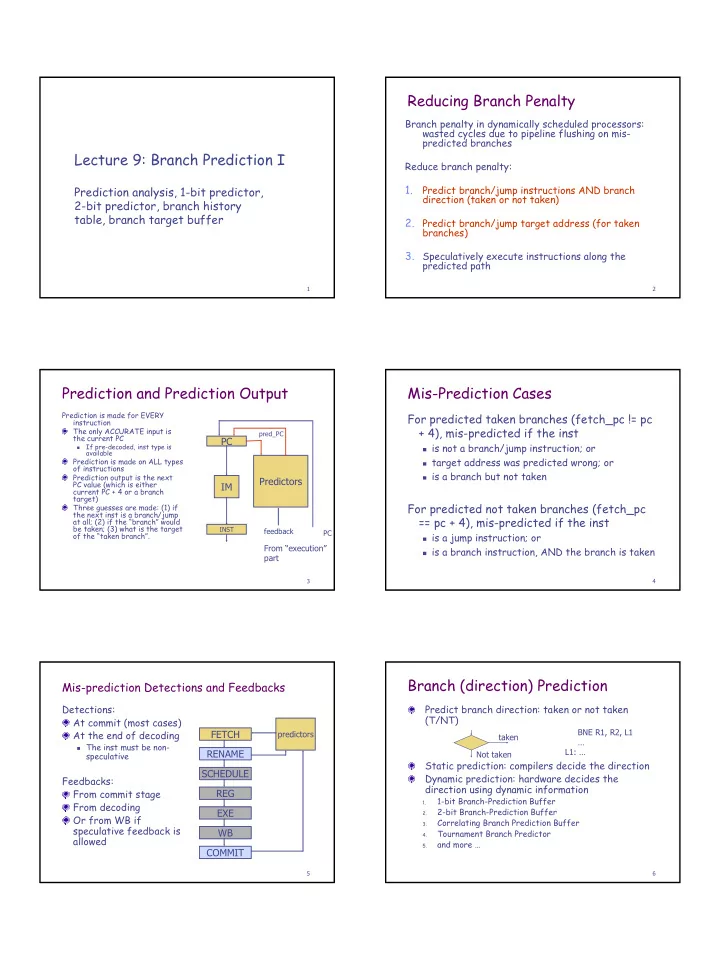
Reducing Branch Penalty

Branch penalty in dynamically scheduled processors: wasted cycles due to pipeline flushing on mis- predicted branches Reduce branch penalty:

1.

Predict branch/jump instructions AND branch direction (taken or not taken)

2.

Predict branch/jump target address (for taken branches)

3.

Speculatively execute instructions along the predicted path

3

Prediction and Prediction Output

Prediction is made for EVERY instruction The only ACCURATE input is the current PC

  • If pre-decoded, inst type is

available

Prediction is made on ALL types

  • f instructions

Prediction output is the next PC value (which is either current PC + 4 or a branch target) Three guesses are made: (1) if the next inst is a branch/jump at all; (2) if the “branch” would be taken; (3) what is the target

  • f the “taken branch”.

IM PC

INST

Predictors

feedback PC

From “execution” part

pred_PC

4

Mis-Prediction Cases

For predicted taken branches (fetch_pc != pc + 4), mis-predicted if the inst

is not a branch/jump instruction; or target address was predicted wrong; or is a branch but not taken

For predicted not taken branches (fetch_pc == pc + 4), mis-predicted if the inst

is a jump instruction; or is a branch instruction, AND the branch is taken 5

Mis-prediction Detections and Feedbacks

Detections: At commit (most cases) At the end of decoding

The inst must be non-

speculative

Feedbacks: From commit stage From decoding Or from WB if speculative feedback is allowed FETCH RENAME REG SCHEDULE COMMIT WB EXE

predictors

6

Branch (direction) Prediction

Predict branch direction: taken or not taken (T/NT) Static prediction: compilers decide the direction Dynamic prediction: hardware decides the direction using dynamic information

1.

1-bit Branch-Prediction Buffer

2.

2-bit Branch-Prediction Buffer

3.

Correlating Branch Prediction Buffer

4.

Tournament Branch Predictor

5.

and more … Not taken taken BNE R1, R2, L1 … L1: …

slide-2
SLIDE 2

2

7

Predictor for a Single Branch

state

  • 2. Predict

Output T/NT

  • 1. Access
  • 3. Feedback T/NT

T Predict Taken Predict Taken

1

T NT

General Form 1-bit prediction

NT

PC Feedback

8

Branch History Table of 1-bit Predictor

BHT also Called Branch Prediction Buffer in textbook Can use only one 1-bit predictor, but accuracy is low BHT: use a table of simple predictors, indexed by bits from PC Similar to direct mapped cache More entries, more cost, but less conflicts, higher accuracy BHT can contain complex predictors

Prediction Prediction

K-bit

Branch address

2k

9

1-bit BHT Weakness

Example: in a loop, 1-bit BHT will cause 2 mispredictions Consider a loop of 9 iterations before exit:

for (…){ for (i=0; i<9; i++) a[i] = a[i] * 2.0; }

End of loop case, when it exits instead of looping

as before

First time through loop on next time through

code, when it predicts exit instead of looping

Only 80% accuracy even if loop 90% of the time 10

Solution: 2-bit scheme where change prediction only if get misprediction twice: (Figure 3.7, p. 249) Blue: stop, not taken Gray: go, taken Adds hysteresis to decision making process

2-bit Saturating Counter

T T NT Predict Taken Predict Not Taken Predict Taken Predict Not Taken

11 10 01 00

T NT T NT NT

11

Correlating Branches

Code example showing the potential

If (d==0) d=1; If (d==1) …

Assemble code

BNEZ R1, L1 DADDIU R1,R0,#1 L1: DADDIU R3,R1,#-1 BNEZ R3, L2 L2: …

Observation: if BNEZ1 is not taken, then BNEZ2 is taken

12

Correlating Branch Predictor

Idea: taken/not taken of recently executed branches is related to behavior of next branch (as well as the history of that branch behavior)

Then behavior of

recent branches selects between, say, 2 predictions of next branch, updating just that prediction

(1,1) predictor: 1-bit

global, 1-bit local

Branch address (4 bits) 1-bits per branch local predictors Prediction Prediction 1-bit global branch history (0 = not taken)

slide-3
SLIDE 3

3

13

Correlating Branch Predictor

General form: (m, n) predictor

m bits for global

history, n bits for local history

Records correlation

between m+1 branches

Simple implementation:

global history can be store in a shift register

Example: (2,2)

predictor, 2-bit global, 2-bit local

Branch address (4 bits) 2-bits per branch local predictors Prediction Prediction 2-bit global branch history (01 = not taken then taken)

14

0% 1% 5% 6% 6% 11% 4% 6% 5% 1% 0% 2% 4% 6% 8% 10% 12% 14% 16% 18% 20% nasa7 matrix300 tomcatv doducd spice fpppp gcc espresso eqntott li Frequency of Mispredictions 4,096 entries: 2-bits per entry Unlimited entries: 2-bits/entry 1,024 entries (2,2)

Accuracy of Different Schemes

(Figure 3.15, p. 206)

4096 Entries 2-bit BHT Unlimited Entries 2-bit BHT 1024 Entries (2,2) BHT

Frequency of Mispredictions

15

Branch Target Buffer

Branch Target Buffer (BTB): Address of branch index to get prediction AND branch address (if taken)

Note: must check for branch match now, since can’t use wrong

branch address

Example: BTB combined with BHT

Branch PC Predicted PC =? PC of instruction FETCH Extra prediction state bits Yes: instruction is branch and use predicted PC as next PC No: branch not predicted, proceed normally (Next PC = PC+4)

16

Estimate Branch Penalty

EX: BHT correct rate is 95%, BTB hit rate is 95% Average miss penalty is 6 cycles How much is the branch penalty?