Branch Prediction Tackles problem of stalls from control - - PDF document

branch prediction
SMART_READER_LITE
LIVE PREVIEW

Branch Prediction Tackles problem of stalls from control - - PDF document

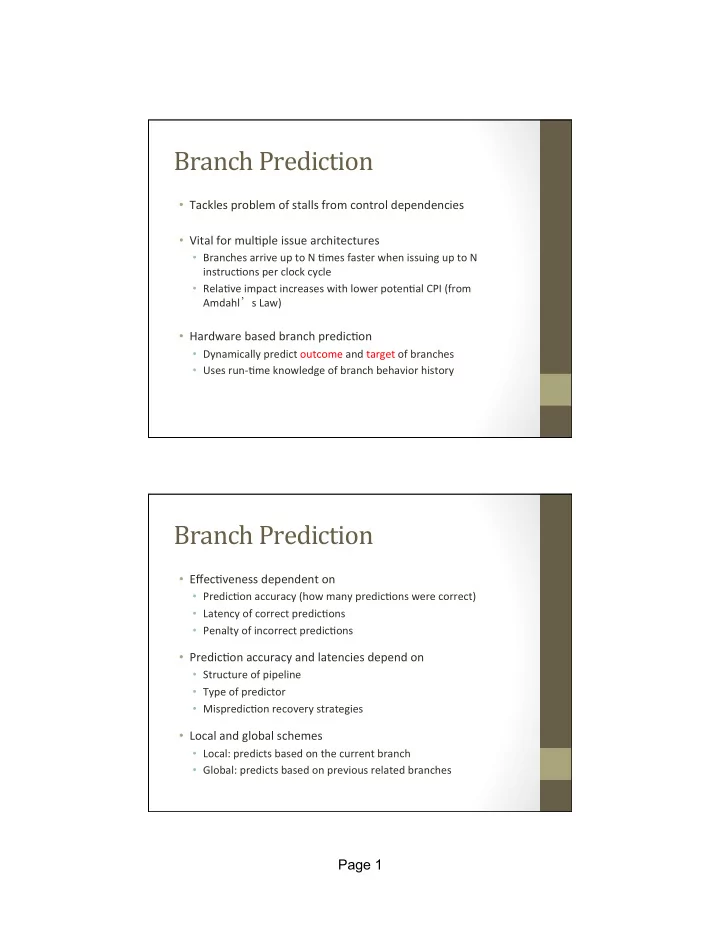
Branch Prediction Tackles problem of stalls from control dependencies Vital for mul5ple issue architectures Branches arrive up to N 5mes faster when


slide-1
SLIDE 1

Page 1

Branch ¡Prediction ¡

  • Tackles ¡problem ¡of ¡stalls ¡from ¡control ¡dependencies ¡
  • Vital ¡for ¡mul5ple ¡issue ¡architectures ¡
  • Branches ¡arrive ¡up ¡to ¡N ¡5mes ¡faster ¡when ¡issuing ¡up ¡to ¡N ¡

instruc5ons ¡per ¡clock ¡cycle ¡

  • Rela5ve ¡impact ¡increases ¡with ¡lower ¡poten5al ¡CPI ¡(from ¡

Amdahl’s ¡Law) ¡

  • Hardware ¡based ¡branch ¡predic5on ¡
  • Dynamically ¡predict ¡outcome ¡and ¡target ¡of ¡branches ¡ ¡
  • Uses ¡run-­‑5me ¡knowledge ¡of ¡branch ¡behavior ¡history ¡

Branch ¡Prediction ¡

  • Effec5veness ¡dependent ¡on ¡
  • Predic5on ¡accuracy ¡(how ¡many ¡predic5ons ¡were ¡correct) ¡
  • Latency ¡of ¡correct ¡predic5ons ¡
  • Penalty ¡of ¡incorrect ¡predic5ons ¡
  • Predic5on ¡accuracy ¡and ¡latencies ¡depend ¡on ¡
  • Structure ¡of ¡pipeline ¡
  • Type ¡of ¡predictor ¡
  • Mispredic5on ¡recovery ¡strategies ¡
  • Local ¡and ¡global ¡schemes ¡
  • Local: ¡predicts ¡based ¡on ¡the ¡current ¡branch ¡
  • Global: ¡predicts ¡based ¡on ¡previous ¡related ¡branches ¡
slide-2
SLIDE 2

Page 2

Branch ¡History ¡Table ¡(BHT) ¡

  • Memory ¡indexed ¡by ¡lower ¡por5on ¡of ¡

address ¡of ¡branch ¡instruc5ons ¡(a ¡local ¡ scheme) ¡

  • A ¡single ¡bit ¡indicates ¡direc5on ¡
  • Previously: ¡1=taken, ¡0=not ¡taken ¡
  • Previous ¡direc5on ¡is ¡current ¡predic5on ¡
  • On ¡a ¡branch, ¡record ¡the ¡correct ¡
  • utcome ¡of ¡the ¡branch ¡
  • Mul5ple ¡branches ¡may ¡map ¡to ¡the ¡

same ¡table ¡entry ¡

1 1 1 1 1 1 1 Address

Taken

BHT

Two-­‑Bit ¡Prediction ¡

  • Previous ¡scheme ¡-­‑ ¡one-­‑bit ¡predic5on ¡
  • Consider ¡a ¡loop: ¡even ¡with ¡all ¡branches ¡taken, ¡there ¡will ¡be ¡two ¡

mispredic5ons ¡(one ¡at ¡the ¡beginning ¡and ¡one ¡when ¡exi5ng ¡the ¡ loop) ¡

  • Extend ¡to ¡two-­‑bit ¡scheme ¡
  • A ¡predic5on ¡must ¡be ¡inaccurate ¡twice ¡before ¡it’s ¡changed ¡
slide-3
SLIDE 3

Page 3

Two-­‑Bit ¡Prediction ¡

Predict Taken Predict Taken Predict Not Taken Predict Not Taken

Not Taken Taken Not Taken Taken Not Taken Taken Taken Not Taken

State is recorded as two bits in the BHT

Two-­‑Bit ¡Saturating ¡Counters ¡

  • Two-­‑bit ¡scheme ¡may ¡be ¡implemented ¡as ¡a ¡satura5ng ¡counter ¡
  • MSB ¡indicates ¡branch ¡predic5on ¡
  • Increment ¡on ¡a ¡taken ¡branch ¡
  • Decrement ¡on ¡a ¡not-­‑taken ¡branch ¡
  • Specialized ¡case ¡of ¡n-­‑bit ¡satura5ng ¡counter ¡
  • Values ¡0 ¡to ¡2n-­‑1, ¡ ¡
  • Don’t ¡increment/decrement ¡past ¡maximum/minimum ¡value ¡
  • Predict ¡taken ¡when ¡counter ¡> ¡one ¡half ¡maximum ¡value ¡
  • Two-­‑bit ¡scheme ¡works ¡nearly ¡as ¡well ¡as ¡larger ¡number ¡of ¡bits ¡

State Description 00 No taken branches, initial 01 One taken branch 10 Two taken branches 11 Three taken branches

slide-4
SLIDE 4

Page 4

BHT ¡Implementation ¡

  • A ¡small ¡cache ¡accessed ¡during ¡IF ¡
  • Counter ¡(two ¡bits) ¡aZached ¡to ¡each ¡cache ¡line ¡
  • If ¡branch ¡predicted ¡taken, ¡fetch ¡begins ¡from ¡target ¡as ¡soon ¡as ¡

target ¡PC ¡known ¡

  • In ¡DLX, ¡the ¡branch ¡outcome ¡and ¡target ¡are ¡known ¡at ¡same ¡

5me ¡-­‑ ¡no ¡advantage ¡for ¡such ¡a ¡simple ¡pipeline ¡

Two-­‑Bit ¡Prediction ¡Accuracy ¡

Prediction accuracy for SPEC’89. Accuracy approaches that of an infinite table size.

slide-5
SLIDE 5

Page 5

BHT ¡Performance ¡

  • “Bimodal ¡predic5on” works ¡well ¡-­‑ ¡branches ¡fall ¡into ¡one ¡of ¡

two ¡camps: ¡taken ¡or ¡not ¡taken ¡

  • Accuracy ¡isn’t ¡enough ¡-­‑ ¡frequency ¡also ¡important ¡
  • More ¡frequent ¡branches, ¡the ¡beZer ¡accuracy ¡required ¡
  • Integer ¡codes ¡(e.g., ¡gcc, ¡eqntoZ, ¡espresso) ¡may ¡have ¡very ¡

frequent ¡branches ¡

  • With ¡more ¡ILP, ¡accuracy ¡(with ¡frequency) ¡becomes ¡vitally ¡
  • important. ¡

Improving ¡on ¡BHT ¡

  • Even ¡with ¡infinite ¡table ¡size ¡-­‑ ¡accuracy ¡is ¡not ¡much ¡improved ¡
  • ver ¡4096 ¡entries ¡ ¡
  • Conflicts ¡in ¡the ¡table ¡isn’t ¡the ¡problem ¡
  • Increasing ¡bits ¡per ¡entry ¡also ¡does ¡not ¡help. ¡
  • Problem: ¡BHT ¡uses ¡only ¡recent ¡local ¡history ¡of ¡a ¡branch ¡to ¡

predict ¡future ¡(not ¡pa<ern ¡based) ¡

  • Solu5on: ¡Look ¡at ¡global ¡history ¡of ¡other ¡branches ¡in ¡making ¡a ¡

predic@on ¡about ¡the ¡current ¡one. ¡

slide-6
SLIDE 6

Page 6

Correlating ¡Branches ¡

  • Branch ¡history ¡can ¡lead ¡to ¡beZer ¡decisions ¡

if (aa==2) SUBUI R3,R1,2 aa=0; BNEZ R3,L1 B1 ¡ if (bb==2) ADD R1,R0,R0 bb=0; L1: SUBUI R3,R2,2 if (aa!=bb) { ... } BNEZ R3,L2 B2 ¡ ADD R2,R0,R0 L2: SUBU R3,R1,R2 BEQZ R3,L3 B3 ¡ If ¡B1 ¡and ¡B2 ¡both ¡taken, ¡then ¡B3 ¡is ¡probably ¡not ¡taken ¡(110) ¡ If ¡B1 ¡and ¡B2 ¡both ¡not ¡taken, ¡then ¡B3 ¡is ¡taken ¡(001) ¡

Correlating ¡Branches ¡

if (d == 0) BNEZ R1,L1 B1 ¡ d=1; ADDI R1,R0,1 if (d == 1) { ... } L1: SUBUI R3,R1,1 BNEZ R3,L2 B2 ¡ ... L2: ...

¡ d ¡ ¡d==0? ¡B1 ¡ ¡d ¡before ¡B2 ¡d==1? ¡B2 ¡ 0 ¡ ¡Yes ¡Not ¡taken ¡1 ¡ ¡Yes ¡Not ¡taken ¡ 1 ¡ ¡No ¡Taken ¡ ¡1 ¡ ¡Yes ¡Not ¡taken ¡ 2 ¡ ¡No ¡Taken ¡ ¡2 ¡ ¡No ¡Taken ¡ ¡ If ¡B1 ¡is ¡not ¡taken, ¡then ¡B2 ¡is ¡not ¡taken ¡(00). ¡

slide-7
SLIDE 7

Page 7

One-­‑Bit ¡Predictor ¡

¡ ¡B1 ¡B1 ¡New ¡B1 ¡ ¡B2 ¡B2 ¡New ¡B2 ¡ d ¡ ¡predict ¡actual ¡predict ¡ ¡predict ¡ac7on ¡predict ¡ 2 ¡ ¡NT ¡ ¡ ¡ ¡NT ¡ ¡ ¡ 0 ¡ ¡ ¡ ¡ ¡ ¡ ¡ ¡ ¡ 2 ¡ ¡ ¡ ¡ ¡ ¡ ¡ ¡ ¡ 0 ¡ ¡ ¡ ¡ ¡ ¡ ¡ ¡ ¡ ¡ d ¡alternates ¡between ¡2 ¡and ¡0 ¡ Predictors ¡for ¡B1 ¡and ¡B2 ¡are ¡ini5alized ¡to ¡not ¡taken ¡(NT) ¡ ¡ What ¡happens ¡with ¡the ¡branch ¡predic5ons??? ¡ ¡

One-­‑Bit ¡Predictor ¡

¡ ¡B1 ¡B1 ¡New ¡B1 ¡ ¡B2 ¡B2 ¡New ¡B2 ¡ d ¡ ¡predict ¡actual ¡predict ¡ ¡predict ¡ac7on ¡predict ¡ 2 ¡ ¡NT ¡T ¡T ¡ ¡NT ¡T ¡T ¡ 0 ¡ ¡T ¡NT ¡NT ¡ ¡T ¡NT ¡NT ¡ 2 ¡ ¡NT ¡T ¡T ¡ ¡NT ¡T ¡T ¡ 0 ¡ ¡T ¡NT ¡NT ¡ ¡T ¡NT ¡NT ¡ ¡ d ¡alternates ¡between ¡2 ¡and ¡0 ¡ Predictors ¡for ¡B1 ¡and ¡B2 ¡are ¡ini5alized ¡to ¡not ¡taken ¡(NT) ¡ ¡ What ¡happens ¡with ¡the ¡branch ¡predic5ons??? ¡ All ¡branches ¡are ¡mispredicted! ¡

slide-8
SLIDE 8

Page 8

Prediction ¡with ¡Correlation ¡

  • With ¡1-­‑bit ¡of ¡correla5on, ¡each ¡branch ¡predictor ¡has ¡a ¡

predic5on ¡for: ¡

  • previous ¡branch ¡taken ¡
  • previous ¡branch ¡not ¡taken ¡

bit 1

Not Taken (00) Taken (01) Not Taken (10) Taken (11) Not Taken (0) Taken (1) Correlating branch

  • utcome

Branch prediction based on history

This could be an N-bit predictor, selected by M-bit correlation

1-­‑Bit ¡Pred., ¡1-­‑Branch ¡Correlation ¡

¡ ¡B1 ¡B1 ¡New ¡B1 ¡ ¡B2 ¡B2 ¡New ¡B2 ¡ d ¡ ¡predict ¡actual ¡predict ¡ ¡predict ¡ac7on ¡predict ¡ 2 ¡ ¡ ¡ ¡ ¡ ¡ ¡ ¡ ¡ 0 ¡ ¡ ¡ ¡ ¡ ¡ ¡ ¡ ¡ 2 ¡ ¡ ¡ ¡ ¡ ¡ ¡ ¡ ¡ 0 ¡ ¡ ¡ ¡ ¡ ¡ ¡ ¡ ¡ ¡ d ¡alternates ¡between ¡2 ¡and ¡0 ¡ Predictors ¡for ¡B1 ¡and ¡B2 ¡are ¡ini5alized ¡to ¡not ¡taken ¡(NT/NT) ¡ ¡ ¡T/NT ¡ ¡ ¡ ¡ What ¡happens ¡with ¡the ¡branch ¡predic5ons??? ¡ ¡

If last branch is taken, use this prediction If last branch is not taken, use this prediction

slide-9
SLIDE 9

Page 9

1-­‑Bit ¡Pred., ¡1-­‑Branch ¡Correlation ¡

¡ ¡B1 ¡B1 ¡New ¡B1 ¡ ¡B2 ¡B2 ¡New ¡B2 ¡ d ¡ ¡predict ¡actual ¡predict ¡ ¡predict ¡ac7on ¡predict ¡ 2 ¡ ¡NT/NT ¡T ¡T/NT ¡ ¡NT/NT ¡T ¡NT/T ¡ 0 ¡ ¡T/NT ¡NT ¡T/NT ¡ ¡NT/T ¡NT ¡NT/T ¡ 2 ¡ ¡T/NT ¡T ¡T/NT ¡ ¡NT/T ¡T ¡NT/T ¡ 0 ¡ ¡T/NT ¡NT ¡T/NT ¡ ¡NT/T ¡NT ¡NT/T ¡ ¡ d ¡alternates ¡between ¡2 ¡and ¡0 ¡ Predictors ¡for ¡B1 ¡and ¡B2 ¡are ¡ini5alized ¡to ¡not ¡taken ¡(NT/NT) ¡ ¡ What ¡happens ¡with ¡the ¡branch ¡predic5ons??? ¡ Nota5on: ¡predic@on ¡if ¡last ¡branch ¡not ¡taken/predic@on ¡if ¡last ¡branch ¡taken ¡ Only ¡the ¡first ¡itera@on ¡is ¡mispredicted! ¡

Prediction ¡with ¡Correlation ¡

  • (m,n) ¡predictor ¡
  • m ¡bits ¡of ¡correla5on ¡
  • n-­‑bit ¡predictor ¡for ¡branch ¡
  • last ¡m ¡branches ¡(2m) ¡each ¡with ¡an ¡n-­‑bit ¡predictor ¡
  • Implementa5on: ¡Global ¡history ¡with ¡selected ¡address ¡bits ¡(so ¡

called ¡“gselect”) ¡

  • m-­‑bit ¡shig ¡register ¡holds ¡outcome ¡of ¡last ¡m ¡branches ¡
  • BHT ¡indexed ¡by ¡m:low(PC) ¡
  • BHT ¡can ¡also ¡be ¡indexed ¡just ¡by ¡m ¡(global ¡history ¡predic5on) ¡

¡

slide-10
SLIDE 10

Page 10

(2,2) ¡Implementation ¡

Address 1 0 2-bit prediction global history shift register Address 1 0 implemented as a small narrow memory indexed by concatentation

  • f branch PC and history

2-bit prediction

Trade-­‑off ¡in ¡(m,n) ¡Predictor ¡

  • m ¡bits ¡used ¡to ¡select ¡predictor ¡entry ¡
  • m ¡= ¡a ¡+ ¡b ¡bits ¡
  • a ¡is ¡number ¡of ¡address ¡bits ¡
  • b ¡is ¡number ¡of ¡history ¡bits ¡
  • We ¡want ¡enough ¡address ¡bits ¡that ¡each ¡branch ¡is ¡reasonably ¡

well ¡iden5fied, ¡along ¡with ¡an ¡increasing ¡number ¡of ¡history ¡

  • bits. ¡
  • Bimodal ¡is ¡b=0, ¡a=m ¡
  • Global ¡history ¡is ¡b=m, ¡a=0 ¡
slide-11
SLIDE 11

Page 11

Local ¡Branch ¡Prediction ¡

  • Consider ¡the ¡loop ¡

for (i=1; i<=4; i++) {...}

  • Loop ¡branch ¡executes ¡with ¡paZern ¡(1110)n ¡
  • If ¡we ¡know ¡how ¡the ¡branch ¡has ¡behaved ¡previously, ¡we ¡can ¡

predict ¡it. ¡

  • Local ¡predictors ¡use ¡the ¡past ¡history ¡of ¡a ¡par@cular ¡branch ¡

(unlike ¡the ¡previous ¡scheme ¡-­‑ ¡a ¡global ¡predictor) ¡

Local ¡Branch ¡Prediction ¡

  • A ¡two-­‑level ¡history ¡table ¡
  • Table ¡1: ¡history ¡of ¡recent ¡branches ¡indexed ¡by ¡the ¡low ¡

address ¡bits ¡of ¡branch ¡instruc5on ¡PC ¡

  • Table ¡2: ¡two-­‑bit ¡branch ¡predictors ¡indexed ¡by ¡the ¡history ¡from ¡

table ¡1 ¡

Address 2-bit Prediction History Counters Pattern

slide-12
SLIDE 12

Page 12

Local ¡Branch ¡Prediction ¡

  • Assume ¡some ¡branch ¡executed ¡repeatedly. ¡
  • With ¡3 ¡bits ¡of ¡history ¡and ¡23 ¡counters, ¡the ¡predictor ¡can ¡

always ¡predict ¡the ¡branch. ¡

  • Each ¡execu5on ¡has ¡unique ¡history ¡(to ¡index ¡into ¡predic5on ¡

table) ¡

Shig ¡in ¡1 ¡on ¡a ¡taken ¡branch ¡to ¡the ¡history ¡ History ¡ ¡ ¡History ¡ 000 ¡-­‑ ¡itera5on ¡0 ¡ ¡ ¡100 ¡ 001 ¡-­‑ ¡itera5on ¡1 ¡ ¡ ¡101 ¡ 010 ¡ ¡ ¡ ¡110 ¡-­‑ ¡itera5on ¡4 ¡ ¡ 011 ¡-­‑ ¡itera5on ¡2 ¡ ¡ ¡111 ¡-­‑ ¡itera5on ¡3 ¡ ¡

Contention ¡in ¡Local ¡Predictors ¡

Local ¡predictors ¡can ¡suffer ¡from ¡conten5on ¡ (1) ¡History ¡may ¡be ¡a ¡mix ¡of ¡histories ¡from ¡different ¡ ¡ ¡ ¡ ¡ ¡ ¡branches ¡that ¡map ¡to ¡the ¡same ¡history ¡entry ¡ (2) ¡Conflicts ¡on ¡similar ¡history ¡paZerns ¡

  • E.g., ¡(0110)n ¡and ¡(1110)n ¡map ¡to ¡same ¡entry ¡when ¡branch ¡

history ¡entry ¡says ¡“110”. ¡ ¡ ¡

slide-13
SLIDE 13

Page 13

Local ¡Branch ¡Prediction ¡Accuracy ¡

For small tables, it’s worse than bimodal For larger tables, up to half as many mispredictions as the bimodal scheme

Local ¡vs. ¡Global ¡Accuracy ¡

Global with counter table indexed by history (not PC) Effectively identifies branches Captures more information about the branch history and begins to identify branches

slide-14
SLIDE 14

Page 14

Local ¡vs. ¡Global ¡Select ¡

Earlier scheme as described Uses the best combination of history and address bits to form index Global and bimodal are essentially gselect with different a,b

Local ¡vs. ¡Gselect ¡

  • Gselect ¡beZer ¡for ¡< ¡1KB ¡tables ¡
  • Local ¡beZer ¡for ¡> ¡1KB ¡tables ¡(but ¡gselect ¡is ¡close) ¡
  • gselect ¡-­‑ ¡storage ¡space ¡for ¡global ¡history ¡is ¡small ¡
  • gselect ¡-­‑ ¡a ¡single ¡array ¡access ¡ ¡
  • local ¡-­‑ ¡two ¡array ¡accesses ¡
  • Thus, ¡gselect ¡poten5ally ¡faster ¡
slide-15
SLIDE 15

Page 15

Global ¡with ¡Index ¡Sharing ¡

  • So ¡called ¡“gshare” predictor ¡
  • Similar ¡to ¡“gselect” predictor, ¡except ¡the ¡branch ¡address ¡

and ¡global ¡history ¡are ¡combined ¡by ¡doing ¡an ¡XOR ¡ ¡

Address History

XOR

2-bit prediction n-bits m-bits n-bits

Global ¡History ¡w/Index ¡Sharing ¡

  • Hash ¡on ¡the ¡address ¡+ ¡global ¡history ¡
  • BeZer ¡able ¡to ¡iden5fy ¡branches ¡

Branch ¡Global ¡ ¡ ¡ ¡ ¡ Address ¡History ¡ ¡gselect ¡ ¡gshare ¡ 00000000 ¡00000001 ¡00000001 ¡00000001 ¡ 00000000 ¡00000000 ¡00000000 ¡00000000 ¡ 11111111 ¡00000000 ¡11110000 ¡11111111 ¡ 11111111 ¡10000000 ¡11110000 ¡01111111 ¡ ¡

  • Gselect ¡lost ¡the ¡history ¡in ¡the ¡upper ¡four ¡bits ¡
slide-16
SLIDE 16

Page 16

Gshare ¡vs ¡Gselect ¡ Tournament ¡Branch ¡Predictors1 ¡

  • Combine ¡previous ¡schemes ¡into ¡a ¡scheme ¡that ¡has ¡advantages ¡
  • f ¡both ¡
  • Select ¡among ¡predictors ¡P1 ¡and ¡P2 ¡
  • A ¡separate ¡counter ¡array ¡picks ¡among ¡P1 ¡and ¡P2 ¡-­‑ ¡i.e., ¡which ¡

predic5on ¡to ¡use. ¡

  • 2-­‑bit ¡satura5ng ¡counter ¡-­‑ ¡counters ¡keep ¡track ¡of ¡which ¡

predictor ¡is ¡more ¡accurate ¡

1also known as “combining predictors”

slide-17
SLIDE 17

Page 17

Keeping ¡Track ¡of ¡Predictor ¡ Accuracy ¡

  • 2-­‑bit ¡counter ¡incremented/decremented ¡

P1-­‑correct ¡P2-­‑correct ¡P1-­‑correct ¡-­‑ ¡P2-­‑correct ¡Ac7on ¡ ¡ ¡ ¡ ¡ ¡ ¡ ¡ ¡ ¡0 ¡ ¡ ¡ ¡ ¡ ¡ ¡ ¡ ¡ ¡0 ¡ ¡ ¡ ¡ ¡ ¡ ¡ ¡ ¡ ¡ ¡ ¡0-­‑0 ¡= ¡0 ¡ ¡None ¡ ¡ ¡ ¡ ¡ ¡ ¡ ¡ ¡ ¡0 ¡ ¡ ¡ ¡ ¡ ¡ ¡ ¡ ¡ ¡1 ¡ ¡ ¡ ¡ ¡ ¡ ¡ ¡ ¡ ¡ ¡ ¡0-­‑1 ¡= ¡-­‑1 ¡ ¡Decrement ¡ ¡ ¡ ¡ ¡ ¡1 ¡ ¡ ¡ ¡ ¡ ¡ ¡ ¡ ¡ ¡0 ¡ ¡ ¡ ¡ ¡ ¡ ¡ ¡ ¡ ¡ ¡ ¡1-­‑0 ¡= ¡1 ¡ ¡Increment ¡ ¡ ¡ ¡ ¡ ¡1 ¡ ¡ ¡ ¡ ¡ ¡ ¡ ¡ ¡ ¡1 ¡ ¡ ¡ ¡ ¡ ¡ ¡ ¡ ¡ ¡ ¡ ¡1-­‑1 ¡= ¡0 ¡ ¡None ¡ ¡ Counter ¡value ¡Use ¡predictor ¡ ¡00 ¡ ¡ ¡ ¡ ¡ ¡ ¡ ¡ ¡P2 ¡ ¡01 ¡ ¡ ¡ ¡ ¡ ¡ ¡ ¡ ¡P2 ¡ ¡10 ¡ ¡ ¡ ¡ ¡ ¡ ¡ ¡ ¡P1 ¡ ¡11 ¡ ¡ ¡ ¡ ¡ ¡ ¡ ¡ ¡P1 ¡ Selects which predictor table to use for the prediction

Tournament ¡Predictor ¡ Implementation ¡

Address 2-bit prediction P1 P2 Predictor selection Selects P2

slide-18
SLIDE 18

Page 18

Bimodal/gshare ¡Tournament ¡ Predictor ¡

  • Branches ¡tend ¡to ¡show ¡either ¡local ¡or ¡global ¡history ¡
  • Bimodal ¡-­‑ ¡use ¡when ¡local ¡history ¡is ¡beneficial ¡
  • Gshare ¡-­‑ ¡use ¡when ¡global ¡history ¡is ¡beneficial ¡
  • Adapts ¡to ¡the ¡par5cular ¡branch ¡by ¡way ¡of ¡the ¡predictor ¡

selec5on ¡mechanism ¡

Tournament ¡Predictor ¡ Performance ¡

Tournament predictor always better than either predictor alone

slide-19
SLIDE 19

Page 19

Which ¡Contributes ¡the ¡Most? ¡

Usually bimodal used more, but gshare helps and the predictor is chosen on a per branch basis

Branch ¡Target ¡Buffer ¡(BTB) ¡

  • In ¡DLX, ¡we ¡need ¡the ¡fetch ¡address ¡at ¡end ¡of ¡IF ¡
  • Need ¡to ¡know: ¡Undecoded ¡instruc5on ¡is ¡a ¡branch ¡and ¡what ¡

the ¡next ¡PC ¡should ¡be. ¡

  • Buffer ¡to ¡hold ¡next ¡predicted ¡branch ¡target ¡address ¡-­‑ ¡

“branch ¡target ¡buffer” ¡

  • Essen5ally, ¡with ¡the ¡branch ¡direc5on ¡predic5on, ¡we ¡can ¡also ¡

buffer ¡the ¡predicted ¡target ¡address. ¡

slide-20
SLIDE 20

Page 20

Branch ¡Target ¡Buffer ¡

  • Need ¡to ¡know ¡whether ¡the ¡fetched ¡instruc5on ¡is ¡predicted ¡as ¡

a ¡taken ¡branch. ¡

  • Unlike ¡BHT, ¡we ¡must ¡tag ¡all ¡entries ¡to ¡ensure ¡the ¡entry ¡

corresponds ¡to ¡an ¡actual ¡branch. ¡ ¡ ¡

  • We ¡don’t ¡even ¡know ¡if ¡the ¡instruc5on ¡is ¡a ¡branch ¡since ¡it’s ¡not ¡

decoded! ¡

  • Store ¡only ¡predicted ¡taken ¡branches ¡in ¡BTB ¡
  • May ¡require ¡two ¡tables: ¡One ¡for ¡predicted ¡branch ¡targets ¡and ¡
  • ne ¡for ¡the ¡branch ¡predictor. ¡

BTB ¡Implementation ¡

Match

...

Address tag Predicted PC Prediction state bits Address Predicted PC

Prediction bits may be in the prediction buffer instead Implemented as an associative memory - may be fully associative, direct mapped, or set

  • associative. Tags must match!
slide-21
SLIDE 21

Page 21

Send PO to memory and BTB In BTB? Send predicted PC Taken? Enter branch IO and next PC into BTB Taken branch? Mispredicted branch, flush pipeline, delete BTB entry Normal Execution Prediction correct

IF ID EX Handling instructions with a branch target buffer

Branch ¡Prediction ¡Summary ¡

  • Local ¡-­‑ ¡history ¡of ¡a ¡single ¡branch ¡(paZern) ¡
  • Global ¡-­‑ ¡correla5ng ¡branches ¡
  • Combined ¡-­‑ ¡some ¡branches ¡beZer ¡predicted ¡with ¡global ¡than ¡

local ¡and ¡vice ¡versa. ¡Combined ¡can ¡select ¡among ¡both. ¡