1 Functional group classifications Chapter 2 - Alkanes - - PDF document

1
SMART_READER_LITE
LIVE PREVIEW

1 Functional group classifications Chapter 2 - Alkanes - - PDF document

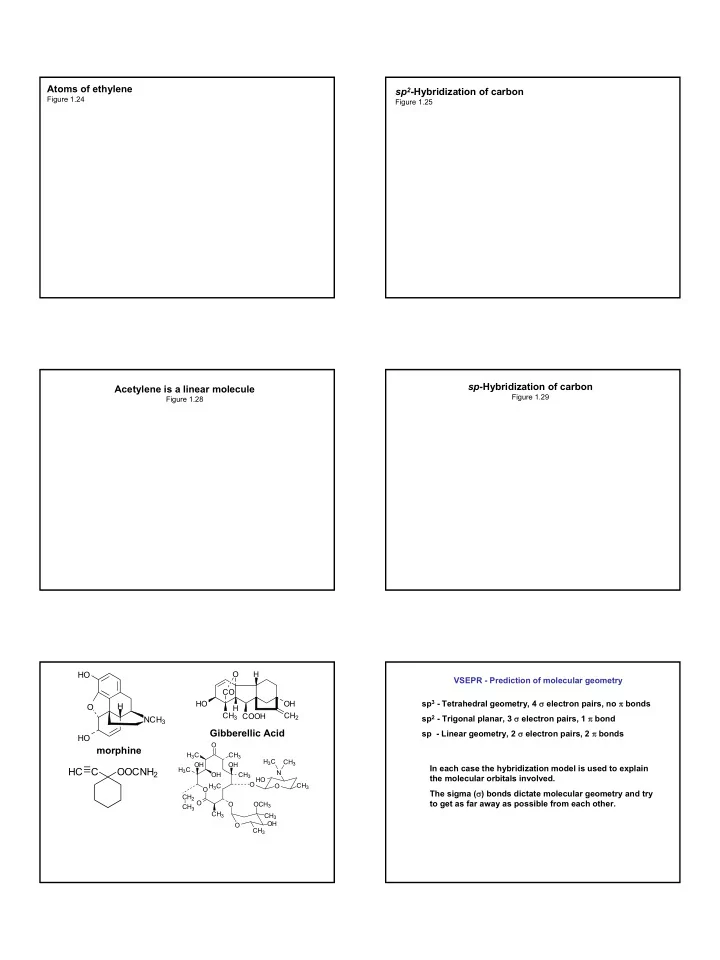
Atoms of ethylene sp 2 -Hybridization of carbon Figure 1.24 Figure 1.25 sp -Hybridization of carbon Acetylene is a linear molecule Figure 1.29 Figure 1.28 HO O H VSEPR - Prediction of molecular geometry CO sp 3 - Tetrahedral geometry, 4


slide-1
SLIDE 1

1

Atoms of ethylene

Figure 1.24

sp2-Hybridization of carbon

Figure 1.25

Acetylene is a linear molecule

Figure 1.28

sp-Hybridization of carbon

Figure 1.29

H NCH3 HO O HO HO CH3 H COOH OH H O CO CH2

morphine Gibberellic Acid C HC OOCNH2

O CH3 OH CH3 OCH3 O O CH3 H3C OH OH H3C CH2 CH3 O CH3 H3C OH CH3 O O O HO CH3 N CH3 H3C

VSEPR - Prediction of molecular geometry sp3 - Tetrahedral geometry, 4 σ electron pairs, no π bonds sp2 - Trigonal planar, 3 σ electron pairs, 1 π bond sp - Linear geometry, 2 σ electron pairs, 2 π bonds In each case the hybridization model is used to explain the molecular orbitals involved. The sigma (σ) bonds dictate molecular geometry and try to get as far away as possible from each other.

slide-2
SLIDE 2

2

Chapter 2 - Alkanes

Classification of hydrocarbons: aliphatic or aromatic Aliphatic (“fat”) Aromatic (“smell”) Alkanes, alkenes, alkynes Arenes - benzenes, polyaromatics Classifications are old but still useful for organizing families of compounds

Functional group classifications

Simple Alkanes

Methane (CH4) Ethane (C2H6) Propane (C3H6) Structural Isomers C5H12 Neopentane C4H10 isobutane C5H12 n-pentane C5H12 isopentane C4H10 n-butane Careful with drawing chains!

CH3CHCH2CH3 CH3 CH3CHCH2CH3 CH3 CH3CH2CHCH3 CH3 CH3CH2CHCH3 CH3 CH2CH2CH3 CH3 CH3

All the same compound Table 2.2 – need to know names up to C12

slide-3
SLIDE 3

3

IUPAC Rules and how to apply them

Hexane (IUPAC); n-hexane (common) Longest chain - hexane substituent - methyl position on chain - 2 2-methylhexane not 5-methylhexane 3,4-dimethylheptane

Rules:

  • Find the longest continuous carbon chain
  • Identify substituent groups attached to the chain
  • Number the chain so as to keep numbers small
  • Write the name in the following format:

Numerical location - [substituent(s)][parent alkane] e.g. 2,3-dimethylheptane Alkyl Substituents Replace -ane ending with -yl H C H C C C H C C C C C

Primary (1o) Secondary (2o) Tetriary (3o)

CH3CH2CH2- CH3CH CH3 CH3 C CH3 H3C

Propyl group isopropyl group t-Butyl group 1-methylethyl 1,1-dimethylethyl