1 11/6/2019 Examples of Policies and Procedures Designation of a - - PDF document

1
SMART_READER_LITE
LIVE PREVIEW

1 11/6/2019 Examples of Policies and Procedures Designation of a - - PDF document

11/6/2019 Technology Accommodation Options for the Disabled Population in the Correctional Environment 1 1 Where Did We Start? 2 2 Agency Perspective Policies and Procedures Training Efforts Audits of Disability Operations


slide-1
SLIDE 1

11/6/2019 1

1

Technology Accommodation Options for the Disabled Population in the Correctional Environment

2

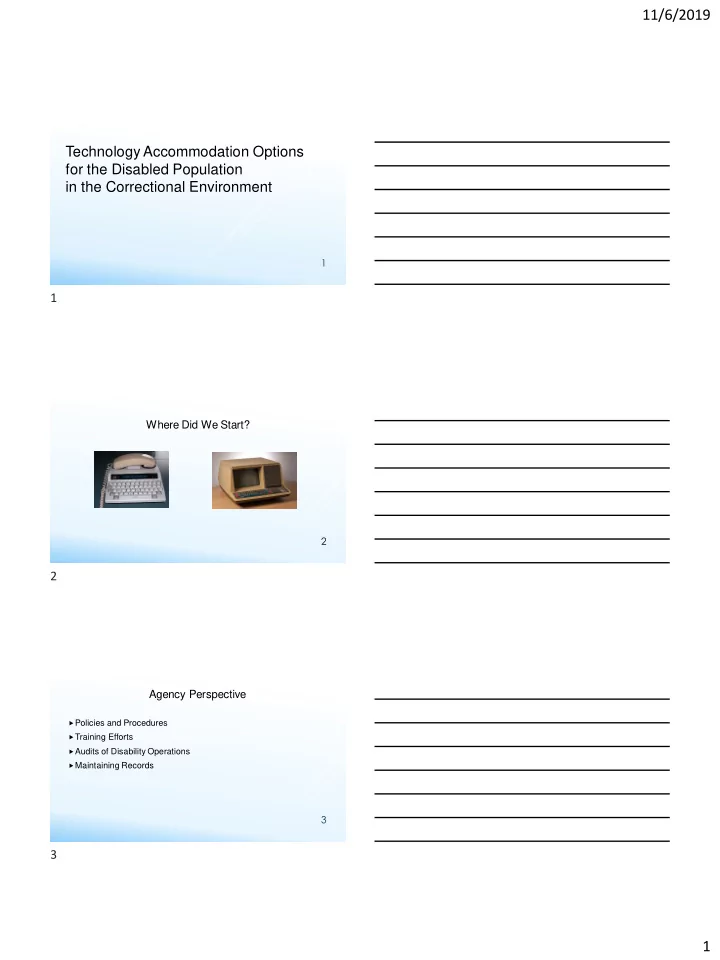
Where Did We Start?

3

Agency Perspective

Policies and Procedures Training Efforts Audits of Disability Operations Maintaining Records

1 2 3

slide-2
SLIDE 2

11/6/2019 2

4

Examples of Policies and Procedures

 Designation of a Statewide ADA Coordinator and facility ADA Coordinators  Specify the responsibilities, authority and training requirements  Agency/staff requirements and offender rights under the ADA  Facility staff must ensure that an individual with a disability will not be

excluded from participation in, or be denied the benefits of, the services, programs, or activities of the facility, or be subjected to discrimination

 Reasonable accommodations must be made for offenders with disabilities,

consistent with and as required by the Americans with Disabilities Act of 1990, as Amended (42 U.S.C. §12101 et seq.) and the Virginians with Disabilities Act (COV §51.5-1 et seq.)

5

Examples of Policies and Procedures Part 2

 Agency/staff requirements and offender rights under the ADA  Such accommodations will allow for participation in services, programs,

and activities that may include but not be limited to:

 Provision of medical and mental health care, medication, auxiliary aids

and services, and protection from weather related injury

 Removal of barriers to physical plant access or transfer to a facility that

meets the offender’s needs

 Modification to procedure and/or facility practice, unless the facility can

demonstrate that making the modification would fundamentally alter the nature of the service, program or activity

6

Examples of Policies and Procedures Part 3

 Offenders with disabilities must be provided education, durable medical

equipment, supplies and facilities, and the support necessary to perform self-care and personal hygiene in a reasonably private environment.

 Appropriately trained individuals should be assigned to assist offenders who

cannot otherwise perform major life activities. Offender helpers should be limited to providing assistance in such matters as ambulation and should not provide personal care such as bathing.

 Staff and contract staff are responsible to communicate information,

announcements, procedures, and other directions to offenders with communication disabilities in a manner that will maximize the offender’s ability to comprehend and understand the information.

4 5 6
slide-3
SLIDE 3

11/6/2019 3

7

Examples of Policies and Procedures Part 4

 How Offenders should make requests for accommodations  Offenders may request a reasonable accommodation for their disability by submitting a Reasonable Accommodation Request  Disability Determination Process  The facility ADA Coordinator will review the Requestand, in consultation with appropriate staff, make a determination on the Request.  Reasonable Accommodation Requests will be acted upon in writing within ten business days, or a shorter time if necessary, by either granting the request, denying it, requesting further investigation, or granting it with modification. A specific reason must be stated if the request is denied or modified.

8

Examples of Policies and Procedures Part 5

 Accommodation Denials  Any offender who believes, they were discriminated against because of their disability, or decides to appeal their Accommodation Requests may do so utilizing the Offender Grievance Procedure. Grievances of this type must be initially reviewed by the facility ADA Coordinator, who should consult with the Facility Unit Head and, ultimately, the DOC ADA Coordinator  Housing for Offenders with Disabilities  Durable Medical Equipment, Disability Aids, and Prostheses  Offender Programs and Services  Medical, mental health, housing, telephone, tablets, education, recreation, visitation, count procedures, and restraints

9

Training Efforts

 All staff, contract staff, interns, and volunteers who regularly interact with

  • ffenders will receive instruction related to the provisions of accommodations for
  • ffenders with disabilities and the requirements of this operating procedure

 Staff and contract staff complete annual on-line training  Upon arrival and during formal orientation, all offenders, to include those

  • ffenders who are transferred immediately to the infirmary or restrictive housing

upon intake, will be informed of their right to non-discrimination on the basis of a disability and the process for requesting a reasonable accommodation as outlined in this operating procedure

 Each offender, upon arrival will be provided a copy, Notice of Rights for Offenders

with Disabilities, which includes the DOC ADA Coordinator’s contact information.

 The facility Orientation Manual, Packet, and/or other written orientation materials

must include the facility ADA Coordinator’s name and contact information.

7 8 9

slide-4
SLIDE 4

11/6/2019 4

10

Audits of Disability Operations

 Quarterly site visits  ADA Survey  Initial review of access to the prison’s programs, activities and services  Compile list of all offenders with disabilities in the population and what

accommodations or auxiliary aids are provided

 Action Plan

 How access issues will be addressed and the timeframes for implementation and

modifications

11

Maintaining Records

 Accommodation Requests  Approved or denied accommodation requests  All Accommodation Requests with respect to medical care will be placed

in the offender’s Health Record with a copy forwarded to the offender and a copy maintained by the facility ADA Coordinator.

 Accommodation Requests not specifically involving medical care will be

maintained by the institutional ADA Coordinator with a copy forwarded to the offender.

 Program Access and modifications

12

Medical Perspective 10 11 12

slide-5
SLIDE 5

11/6/2019 5

13

Definitions

ADL’s Assistive Technology Prosthesis

14

ADL - Activities of Daily Living

ADL

 The ability to perform actions

that involve the management

  • f basic bodily functions.

Examples are eating, bathing, dressing, and toileting Bathing

15

Assistive Technology

 Assistive, adaptive and

rehabilitative devices for

  • ffenders with disabilities

Electric Wheelchair

13 14 15

slide-6
SLIDE 6

11/6/2019 6

16

Prosthesis

An artificial body part, such as a leg, a heart or an implant

17

Verification of Offender Medical Information

Intake process

 Self Reported from Offender  Documentation from Offender’s

Medical Record

 Documentation from

Consultative Services

 Physical Examination

18

Correct Accommodation for the Disability

16 17 18

slide-7
SLIDE 7

11/6/2019 7

19

Examples of Assistive Technology

20

Electronic Message Board

21

Video Phone

19 20 21

slide-8
SLIDE 8

11/6/2019 8

22

Education

23

Example Operating Procedure for Education

 Screening for ABE Eligibility and Notification  The educational staff at all reception facilities will screen all

  • ffenders for ABE eligibility.

 Offenders who can provide documented verification of the

following will not be tested for ABE eligibility in reception or parole violator units: (see Operating Procedure 601.4, Educational Testing)

 Verified high school diploma from an accredited institution  Verified HSE

24

Example Operating Procedure for Education Part 2

 The Principal will provide written notification to each offender of

their ABE eligibility status. The educational staff will also notify casework management staff of each offender's status.

 ABE Exemptions - Offenders may be exempt from ABE ONLY if

they meet the requirements below:

 They have a verified high school diploma or HSE.  ABE eligible offenders on work release, pre-release, or assigned

to the Corrections Construction Unit are exempted from ABE for the duration of that assignment

22 23 24

slide-9
SLIDE 9

11/6/2019 9

25

Example Operating Procedure for Education Part 3

 ABE eligible offenders may be exempted by the Assistant

Superintendent for Education Operations on the recommendation

  • f the Principal when any of the following are true:

 There are mental health problems based on the recommendation of

the staff psychologist, or other qualified professionals

 There are medical problems based on the recommendation of the

physician, or other qualified professionals

 There are learning difficulty problems based on the

recommendation of the Principal

 If a student shows no measurable progress over a 12-month period

  • f continuous enrollment the Principal may exempt the student.

26

Example Operating Procedure for Education Part 4

 If a student does not make significant progress over an 18-month

period of continuous enrollment the student should be exempted. At the discretion of the Principal, the student may be allowed to remain in class as long as there is no waiting list.

 If an individual has reached the age of eligibility for full Social

Security benefits

 These exemptions shall not impact the offender negatively in terms of good

time awards nor shall these exemptions impact the offender's ability to participate in other programs unless it can be demonstrated that attainment

  • f functional literacy is a legitimate prerequisite to participation in the other

programs.

27

Take Away….

 The ADA refers to the legal aspects of disabilities not the medical or educational

aspect.

 “Record of” means that the person has a history of, or has been misclassified as

having, a mental or physical impairment that substantially limits one or more major life activities, even though the person does not currently have a disability.

 “Regarded as” means that the person either…  Has an impairment that does not substantially limit a major life activity.  Has an impairment that substantially limits a major life activity only as a result of the attitudes of others towards them.  Does not have any impairment, but is treated by an entity as having an impairment.

25 26 27

slide-10
SLIDE 10

11/6/2019 10

28

Take Away Part 2….

 “Qualified inmates or detainees with disabilities should have access to available programs

and activities, whether they are mandatory or voluntary. Such activities may include educational, vocational, work release or religious programs as well as opportunities for visitation.” ADA National Network (adata.org)

29

DOCUMENTATION IS … KEY

30

Scenario 1

 A student with a documented sensori-neural hearing loss has a verified

  • GED. The student would like to participate in a computer literacy program

at the institution. After submitting a request, the student was denied the

  • pportunity to participate in a vocational program because he had obtained

a GED and vocational programs are not mandatory.

 Should the student be allowed to participate in a vocational program?  Should the student receive accommodations if they are allowed to participate

in the voluntary vocational program?

 If the student is allowed to enroll in class, when should he be enrolled

(immediately or after accommodations have been determined)?

28 29 30

slide-11
SLIDE 11

11/6/2019 11

31

Scenario 2

 A student with a documented disability requests an exemption from educational

  • programs. Upon further review, the student has a verified GED documented in

CORIS.

 Does the student qualify for an exemption from educational programs?

32

Technology Accommodations

33

More Tech

This Photo by Unknown Author is licensed under CC BY-NC-ND

31 32 33

slide-12
SLIDE 12

11/6/2019 12

34 35

Demonstration

36

Take Away

 Consult with other agencies to establish a lending system

…borrow then buy!

 Contact VDBVI, VDDHH, DARS and other state agencies that

provided services for people with disabilities.

 Ask questions  Consult with your colleagues!!!!!!!  No man is an island!

34 35 36

slide-13
SLIDE 13

11/6/2019 13

37 38

Challenges

 Staff turnover  Financial Implications  Security Concerns  Resistance to New T

echnology

 Infrastructure  Device Maintenance  Contract Medical Staff  Documentation

39

37 38 39

slide-14
SLIDE 14

11/6/2019 14

40

Contact Information

  • Barry Marano – Barry.Marano@vadoc.virginia.gov
  • r (804) 763-9960
  • Rose Durbin – Rose.Durbin@vadoc.virginia.gov
  • r (540) 395-1220
  • Felecia Bowles – Felecia.Bowles@vadoc.virginia.gov
  • r (804) 887-8102
  • Rashida Butcher – Rashida.Butcher@vadoc.virginia.gov
  • r (804) 887-8059

40