Low carbon electricity and energy De Dev San v Sanyal yal EVP, - - PDF document
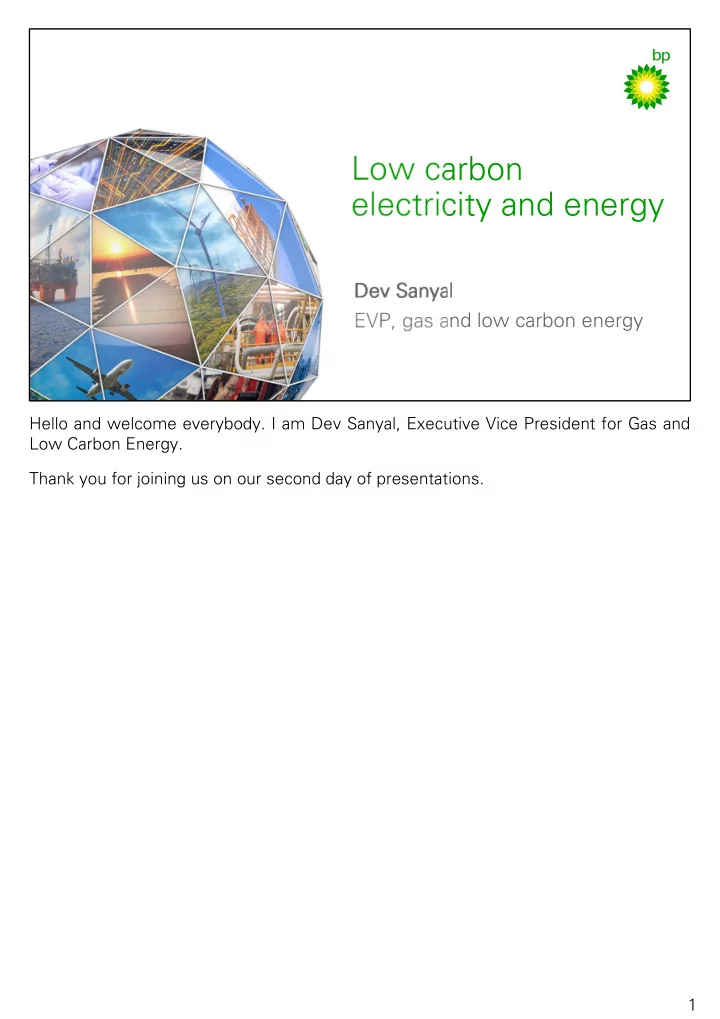
Low carbon electricity and energy De Dev San v Sanyal yal EVP, gas and low carbon energy Hello and welcome everybody. I am Dev Sanyal, Executive Vice President for Gas and Low Carbon Energy. Thank you for joining us on our second day of
2
Low carbon electricity and energy | bp week: September 2020 2
Cautionary statement
Forward-looking statements - cautionary statement
In order to utilize the ‘safe harbor’ provisions of the United States Private Securities Litigation Reform Act of 1995 (the ‘PSLRA’) and the general doctrine of cautionary statements, bp is providing the following cautionary statement: The discussion in this results announcement contains certain forecasts, projections and forward-looking statements - that is, statements related to future, not past events and circumstances - with respect to the financial condition, results of operations and businesses of bp and certain of the plans and objectives of bp with respect to these items. These statements may generally, but not always, be identified by the use of words such as ‘will’, ‘expects’, ‘is expected to’, ‘aims’, ‘should’, ‘may’, ‘objective’, ‘is likely to’, ‘intends’, ‘believes’, ‘anticipates’, ‘plans’, ‘we see’, ‘focus on’ or similar expressions. In particular, the following, among other statements, are all forward looking in nature: bp’s new strategy to focus on low-carbon electricity and energy, including statements regarding its aims to become a leading, global player in low carbon electricity and energy, provide integrated energy offers, generate stable returns and enhance base unlevered project returns from renewables businesses to at least 8% to 10%, develop around 20GW
- f net renewable generating capacity by 2025 and 50GW by 2030, deliver 350TW hours of traded electricity by 2025 and 500TW hours by 2030, grow its LNG portfolio to 25Mtpa by 2025 and to more than 30Mtpa by 2030,
maintain focus on safety and operational reliability, double bioenergy production to 50Kbd by 2025 and to more than 100Kbd by 2030, market 20% of the world’s biojet fuel by 2030, increase hydrogen business to 10% share in core markets, deliver 15% reduction in the carbon intensity of its marketed products by 2030, build partnerships with countries, cities and industries in decarbonisation efforts and to amplify value through digital and innovation; plans and expectations regarding the Bunge joint venture, including statements with respect to its aims to export 1.2TW hours of power generated by biofuels in 2020, generate returns of around 15% or higher from bioenergy businesses and quadruple the business by 2030, expectations regarding bp’s announced new offshore wind partnership with Equinor, including statements regarding aims to jointly develop up to 4.4GW across four offshore wind projects in the US, participate in future developments in the US and to grow participation internationally in the future including beyond 2030; plans and expectation to drive value through integrated downstream gas, including statements regarding the LNG project pipeline, projects in the port of Acu and Guangdong Dapeng, integration of renewables, gas, bioenergy and hydrogen and the significant role of renewables in bp’s business; plans and expectations regarding Lightsource bp’s strategy to transform Lightsource bp from being a leading European solar developer to being a global force in solar, including statements with respect to the timing of Project Bighorn; and expectations regarding shifts in energy markets, including the acceleration of electrification, growth of renewables and new opportunities for differentiated customer offers. By their nature, forward-looking statements involve risk and uncertainty because they relate to events and depend on circumstances that will or may occur in the future and are outside the control of bp. Actual results may differ materially from those expressed in such statements, depending on a variety of factors, including: the extent and duration of the impact of current market conditions including the significant drop in the oil price, the impact of COVID-19, overall global economic and business conditions impacting our business and demand for our products as well as the specific factors identified in the discussions accompanying such forward-looking statements; changes in consumer preferences and societal expectations; the pace of development and adoption of alternative energy solutions; the receipt of relevant third party and/or regulatory approvals; the timing and level of maintenance and/or turnaround activity; the timing and volume of refinery additions and outages; the timing of bringing new fields onstream; the timing, quantum and nature of certain acquisitions and divestments; future levels of industry product supply, demand and pricing, including supply growth in North America; OPEC quota restrictions; PSA and TSC effects; operational and safety problems; potential lapses in product quality; economic and financial market conditions generally or in various countries and regions; political stability and economic growth in relevant areas of the world; changes in laws and governmental regulations; regulatory or legal actions including the types of enforcement action pursued and the nature of remedies sought or imposed; the actions of prosecutors, regulatory authorities and courts; delays in the processes for resolving claims; amounts ultimately payable and timing of payments relating to the Gulf of Mexico oil spill; exchange rate fluctuations; development and use of new technology; recruitment and retention of a skilled workforce; the success or
- therwise of partnering; the actions of competitors, trading partners, contractors, subcontractors, creditors, rating agencies and others; our access to future credit resources; business disruption and crisis management; the
impact on our reputation of ethical misconduct and non-compliance with regulatory obligations; trading losses; major uninsured losses; decisions by Rosneft’s management and board of directors; the actions of contractors; natural disasters and adverse weather conditions; changes in public expectations and other changes to business conditions; wars and acts of terrorism; cyber-attacks or sabotage; and other factors discussed elsewhere in this report, and under “Risk factors” in bp Annual Report and Form 20-F 2019 as filed with the US Securities and Exchange Commission.
Septembe September 2020 r 2020
Yesterday, you heard about bp’s 2020 Energy Outlook and our new sustainability frame, along with our plans to reinvent bp. Today, we are looking more closely at our three by three strategy. Carol and William will talk about our plans for integrating energy systems and partnering with countries, cities and industries, while Emma will discuss convenience and mobility – one of our three focus areas. Before that, I will talk about our low carbon electricity and energy businesses, and how they support the delivery of bp’s ambition. I know there are a number of questions about our low carbon businesses. I will address four of these during my presentation today: ‐ Why BP? ‐ What is our renewables pipeline? ‐ What are our expected returns? ‐ And finally, can we execute? Before we look at the opportunity ahead of us and why I am excited about this, I would like to make a point on safety. Safety is our core value and is integral to how we see the development of our
- businesses. Over the past few years, we have seen a marked improvement in the
safety performance of all of our new renewable businesses. Central to this has been 3
A sustainability frame linking our purpose and
Low carbon electricity and energy Conv
- nvenience
enience and mobility and mobility Resilient and focused hydrocarbons
Driving digital and innovation Partnering with countries, cities and industries Integrating energy systems
- Low carbon electricity
- Integrated gas
- Bio-energy
- Hydrogen and CCUS
- Advancing g
vancing grow
- wth
th mark markets
- Redef
defining ining c convenien nvenience ce
- Next-gen m
xt-gen mobi
- bility
lity
- Continued rigour in safety
and operations
- Driving emissions down
- Focused upstream and
refining portfolio
Our strategy – an IEC delivering solutions for customers
- ur Operating Management System which has built off decades of
- perating experience in our traditional businesses. However, as ever,
there is always more to do. And we will do so. 3
We outlined our core beliefs on the 4th of August. For low carbon energy, these translate into the following: Firstly, electrification is accelerating. Driven by falling costs, renewables are likely to provide the vast majority of this growth. Wind and solar are already the most competitive new builds in most energy markets. This includes fossil-fuel markets. The global average costs for PV solar have decreased by 90% and onshore wind by 60% over the past decade. We see these trends continuing, with further cost reductions of 30 to 40% over the next decade. And with falling costs comes real growth. Renewables have become the fastest growing source of energy and we see this continuing over the next decade and beyond. We are leaning in and plan to build material renewables businesses, with an ambition to have developed 50 gigawatts by 2030. Secondly, with the growth of renewables there is no longer one dominant source of
- energy. We see a world in which there is convergence of different forms of energy.
This creates the opportunity to combine multiple sources of energy and provide firm energy. As a company with interests in multiple sources of energy, we are uniquely positioned to do so. For example, gas with renewables, solar with biopower, etc. Thirdly, we see opportunities for differentiated customer offers. This includes mobility and digital solutions. We see a growing customer demand for clean, affordable energy 4
Low carbon electricity and energy | bp week: September 2020 4
Our beliefs on the energy transition
The world will electrify, with renewables a clear winner
- Customers. will redefine
mobility and convenience, driven by electrification, digital and fleets Oil and gas challenged; but will remain part
- f the energy mix
for decades Energy systems will become increasingly multi-technology, integrated and local Customers – countries, cities, industries and corporates – will demand bespoke energy solutions Driving digital and innovation
Customers Customers – countries, cities, industries and corporates – will demand bespoke energy solutions
- ns
Energy syste Energy systems s will become increasingly multi-technology, integrated and local The world will electrify, with renewables renewables a clear winner
across both OECD and non-OECD markets. For instance, in 2019, almost 20 gigawatts of renewable corporate PPAs were signed globally. An almost four-fold increase since 2015. This is now an increasingly global trend, driven by price and choice. Governments are also setting increasingly ambitious targets for
- renewable. For example, the UK has set a target of 40 gigawatts of
- ffshore
wind by 2030. In the United States, New York and Massachusetts are targeting 70% and 100% renewable capacity by 2030 and 2045 respectively. This is the reason we believe in becoming a company that provides integrated, low carbon energy solutions for our customers – bringing together different forms of energy to give the world what it wants, clean, affordable and firm energy. An Integrated Energy Company. 4
Let me now turn to the first question of Why BP? And answer this through a few lenses. First, we have global reach. We are present in over 70 countries and this enables access to new markets. For instance, in just two years since joining forces with bp, Lightsource bp has more than doubled its global footprint. Second, as Gordon will discuss, our projects organisation is ranked top quartile by IPA industry project benchmarks in four out of five input metrics. Project execution is key as we build-out our new projects. This includes our recent announcement of an agreement to form a strategic partnership in offshore wind energy with Equinor in the United States. One example is the re-powering of Flat Ridge 1 wind energy asset. This complex project was completed with no safety incidents, ahead of schedule and under budget. This was due to leveraging processes and experience learned from our projects
- rganisation.
Third, our long-established Operating Management System enables a focus on
- perating excellence. This has driven availability above 95% in our wind and bioenergy
- businesses. Availability is core to profitability and we believe our performance
benchmarks strongly. Fourth, we are also one of the world’s top energy traders. We trade 250 terawatt hours
- f electricity across the United States, Europe and Brazil. This gives us access to
differentiated expertise, risk management and the ability to trade in merchant markets. Our trading business is already creating power offtake and risk management options 5
Low carbon electricity and energy | bp week: September 2020 5
Why bp?
Multi-energy Multi-energy soluti solution
- ns
s Global reach Global reach Partnerships Partnerships Trading Trading Proje Projects ts Operations Operations
Low carbon electricity and energy | bp week: September 2020 5
for our own renewables businesses, and for third parties. Carol will discuss this in more detail. Fifth, we have a history of creating mutually beneficial partnerships. We want to do more. We are building new and deeper relationships with governments, cities and corporate customers. At a scale that is difficult for others to replicate. For example, in India, our presence built through our gas position enhanced the ability of Lightsource bp’s joint venture, Eversource, to compete and win the mandate to manage the Green Growth Equity
- Fund. This fund aims to grow to $1bn backed by the Indian
government, the UK government, private equity as well as other
- investors. Its purpose is to grow sustainable energy infrastructure in
the world’s fastest growing energy market. Finally, we are present across the energy value chain. We have the ability to bring together multiple energy solutions for our customers in
- ne place. As an example, as part of our recent deal with Amazon, we
will supply renewable power from solar and wind to their data centres. William will talk more about this later today. I hope this helps describe why we believe we have a clear role to play. These strengths are core to our strategy and make us different from pure renewable players as well of utilities. The combination of these strengths give us conviction that we can be a leading low carbon electricity and energy business. 5
We are not starting from scratch. Today we have a strong set of established businesses which provide a solid and growing foundation for the future. Let me run through them: ‐ Lightsource BP, one of Europe’s leading solar developers. In 18 months since joining with bp, their development pipeline grew by more than 500% from 1.6 gigawatts to 9.8 gigawatts. Since then, it has increased further to around 16 gigawatts. ‐ In the beginning of 2018, Lightsource bp was present in 5 countries. Since then it has entered Australia, Brazil, Egypt, Greece, Italy, Spain, Portugal, Trinidad &
- Tobago. In the United States, its activities have grown from zero to 20 states in
just 2 years. ‐ BP wind energy is a business we have built over a decade. We now operate a 1.7 gigawatt gross portfolio, across 9 of our 10 wind assets in the United States. We have high-graded our portfolio by focussing on high-margin regions and have divested 800 megawatts. Since the middle of the decade, we have increased EBITDA per megawatt hour by 60%. An example of value over volume. ‐ BP Bunge is one of the world’s largest bioenergy companies. We have combined scale with innovative technology. Our Smart Log system, which is a digital logistics management system has delivered a 25% increase in efficiency across 32 million tonnes of industrial capacity. Last year, BP Biofuels’ industrial availability was 97%. ‐ Integrated with BP Bunge is its biopower business, generated at its industrial
- sites. Last year, BP Biofuels exported around 70% of its production to the grid.
6
Low carbon electricity and energy | bp week: September 2020 6
Building from a solid and growing foundation
biopower biofuels
- ffshore wind
solar
- nshore wind
US biogas
This year we expect bp Bunge to export 1.2 terawatt hours. ‐ In Biogas, we are the largest Renewable Natural Gas supplier to the heavy duty transport sector in the United States, through our joint venture with Aria Energy, which supplies around 120 million gallons of diesel equivalent in this fast growing market. ‐ And finally, last week, we announced our intent to form a strategic partnership in offshore wind energy with Equinor which is focused in the United States, one of the world’s fastest growing offshore wind markets. We plan to grow our participation in offshore wind energy internationally. We are also building new businesses that offer the potential for distinctive growth beyond 2030 such as Green and Blue Hydrogen. A business that builds off our renewables and gas businesses. Let me show you a short video of what we have today. 6
As I hope that shows you, we are already in action. Our foundations give us conviction that we can become a leading, global player in low carbon electricity and energy. What does that look like? As Giulia laid out on the 4th of August, our aims are as follows: Firstly, in low carbon energy, we intend to build material renewable energy businesses by developing 20 gigawatts by 2025 and 50 gigawatts by the end of the decade. By leveraging our trading and customer facing capabilities, we aim to deliver 350 terrawatt hours of traded electricity by 2025 and 500 terrawatt hours by 2030. Secondly, we aim to grow our integrated gas position building on our equity gas resources, with our LNG portfolio and our marketing capability. We aim to grow our LNG portfolio to 25 million tonnes per annum by 2025, and to more than 30 million tonnes per annum by 2030. Thirdly, we aim to grow our bioenergy businesses and deliver low carbon solutions for customers in aviation, marine and heavy-duty transportation. We plan to scale our BP Bunge joint venture and grow our biogas and biojet businesses. We intend doubling our bioenergy production in the next five years and to further double it in the following five years to the end of the decade And fourthly, in Hydrogen and CCUS we aim to create a distinctive position, with a 7
Low carbon electricity and energy | bp week: September 2020 7
- 50
50GW developed renewables1
- Positio
sition across generation and customers
- 500
500TWh traded2
- 10
10% hydrogen share in core markets
- Net Zero Teesside
- 25
25Mtpa customer sales
- >30
>30Mtpa LNG portfolio
- >10
>100Kbd produced and integrated across value chain
- 20
20% biojet market share
- Co
Cost a st advantaged vantaged platforms across Brazil
Low c Low carbon bon electricity electricity Hydrogen Hydrogen and CCUS and CCUS Integrat Integrated gas ed gas Bioenergy Bioenergy
Integrated low carbon portfolio
(1) Developed to FID (2) Traded electricity may include electricity sourced from the grid
bp 2030 aims – low carbon electricity and energy
10% share of hydrogen in core markets. Finally, low carbon electricity and energy plays a key role in meeting
- ur Aim 3. Our solutions are expected to contribute to the 15%
reduction in the carbon intensity of our marketed products we are aiming to achieve by 2030. 7
Let me now talk about each in turn – starting with the biggest area – that of low carbon electricity. It is important to put our growth aspirations in context as I know many have said it seems aggressive. In reality, this is a massively expanding market. Renewables have the potential to grow threefold and to account for 45% of global power capacity by 2030. In that scenario, from 1400 gigawatts today, the world would see an additional 3200 gigawatts of new solar, wind and biopower by 2030. Even in Spencer’s Business as Usual scenario, this number is 2070 gigawatts. In essence - this is a story of economic growth, powered by access to electricity. And the scale of this potential marketplace growth gives us confidence in our low carbon electricity ambition. 8
Low carbon electricity and energy | bp week: September 2020 8
High-growth markets create opportunities
1453
Source: bp energy outlook rapid transition scenario
CAGR1
Solar Wind Biopower
4655
(1) Compound annual growth rate
2020 2030
Low carbon electricity and energy | bp week: September 2020 8
Global renewable capacity GW
So having established that there is a growing market place – do we have a development pipeline? By the end of last year, we had developed around 2.5 gigawatts net, across our
- businesses. We see further growth in each of our wind, solar and biopower
businesses. Our agreement with Equinor to form a strategic partnership will give us a new and growing platform for growth in renewable electricity, with offshore wind energy. These businesses have a robust pipeline of projects spread across 13 different
- countries. Around 20 gigawatts gross of identified projects.
We see a combination of organic growth and infill acquisitions of very early stage development pipelines. These will be from developers that do not have the capability to finance or develop the assets. We will enhance this pipeline through integration with our other businesses. This might be a city or a corporate trying to access renewable power solutions. William will speak about this later. Let me now share some detail regarding the development pipeline. Starting with solar where it is possible to move from concept to construction in just 18 months to 2 years. This sector is characterised by fast cycle times which will allow us to grow our pipeline rapidly in the next 5 years. Projects in our solar pipeline include: Bighorn Solar, supplying 300 megawatts to the Evraz steel company in Colorado, the 9
Low carbon electricity and energy | bp week: September 2020 9
Solar 83% Wind 15% Biopower 2% 9 7 2 2 0. 0.2 US Europe Latin America Asia Africa/ME
Renewable growth underpinned by a robust pipeline
Early stage options1 Low carbon electricity Development pipeline1 By region By technology Development pipeline1 GW
(1) Development pipeline and early stage options shown as gross GW
single largest customer solar project in the United States. The 260 megawatt Impact solar project in Texas, where bp is offtaking 100% of the generation. Lightsource bp are building one of Spain’s first subsidy-free projects in
- Zaragoza. This is a 250 megawatt project. And this project uses new
bifacial technology. In 2019, Lightsource bp acquired a 2 gigawatt pipeline from Enerlife in
- Brazil. And it has already converted a part of this pipeline, by winning a
200 megawatt tender in the north eastern state of Ceara. In Australia, Lightsource bp have a 500 megawatt integrated solar project, one of the largest bifacial projects in the country. In India, the Green Growth Equity fund which Lightsource bp’s joint venture, Eversource, manages and in which we have approved a direct investment and shareholding, has invested in Ayana Renewables. They are currently constructing 500 megawatts of solar. Beyond solar, our pipeline also includes offshore wind energy, including our recent agreement to form a strategic partnership with Equinor in the United States, with an initial 4.4 gigawatts of gross generating capacity. We also intend to grow further internationally. Finally, in addition to our identified projects we are also currently evaluating a further 21 gigawatts of early stage options. This includes a number of onshore wind opportunities that we are pursuing building off our US position. In summary - we believe we have a high-quality development pipeline in attractive markets. We also have a number of growth options. This gives us confidence to underpin the aim of developing 20 gigawatts by 2025 and 50 gigawatts by the end of the decade. And all of this will be executed within our disciplined financial framework. We will not compromise returns to deliver those aims as some have questioned - we will not pursue a volume over value strategy. We have learned that lesson. 9
Let me spend a few minutes describing last week’s announcement. This is a great example of how strategic partnerships can allow us to grow in our business. We are investing in the fastest growing energy segment, where a six-fold global growth is forecast, to 200 gigawatts by 2030. This growth is driven by abundant resources, supportive regulation and significant improvements in costs, technology and performance. Similar to our onshore wind and solar businesses, we anticipate these strong technology and performance improvement trends will continue. Driven by more efficient turbines, improved operating performance, and the application of digital technology. Equinor are an excellent partner, and a proven leader in offshore wind energy. They have a demonstrated track record in safety. They have deep experience in development and in operations. They are also leaders in next generation offshore wind
- technology. We believe we can leverage their capabilities with our own US and global
- ffshore projects and power markets expertise. We share a cultural and strategic fit.
The partnership plans to jointly develop up to 4.4 gigawatts across two leases divided into four offshore wind projects in the US; Empire Wind One and Two and Beacon One and Two. These projects will, when complete, supply into the growing US East Coast electricity
- markets. As I have already mentioned, key states on the East Coast have either set or
are considering ambitious renewable targets. Beyond these initial four projects, the partnership will plan to participate in future developments in the United States. It also has the potential to grow globally in the future. 10
Low carbon electricity and energy | bp week: September 2020 10
Low carbon electricity
US East Coast projects
- Further US opportunities
- Global potential
- ffshore wind
partnership growing renewable business
- pportunity
From 30GW 30GW to 200GW 200GW by 2030
New strategic partnership in offshore wind1
Synergies from scale, execution and integration
70% 70% fall in LCOE2 in past 10 years
(1) Subject to customary regulatory and other approval the transaction is expected to close in early 2021 (2) Levelised cost of energy (3) Gross GW
3
This marks an exciting new chapter for us. An entry into a new business with a world-class partner. This investment is expected to deliver returns in line with our investment process outlined by Murray on the 4th of August. I will return to this. 10
Dev: Dev: A few moments next on Solar. Lightsource bp is what I call an execution powerhouse. This is a good example of our ability to develop our pipeline at pace. Let me introduce you now to two colleagues from Lightsource bp. They have a tremendous track record of delivering innovative, fast paced renewable project developments. Kareen Boutonnat is a co-founder of Lightsource bp and was their group COO prior to recently being appointed CEO for Europe and Asia. Before joining Lightsource she was in Silicon Valley growing tech start-ups. Emily Buckley is Lightsource bp’s strategy manager. Last year, she was featured on the Forbes ‘30 under 30’ list. Kareen: Kareen: Thank you, Dev, and hello everyone. I will describe what it takes to win as a global solar
- developer. Emily will then describe how this comes to life.
Our partnership with bp started in January 2018 and has demonstrated the power of bringing together complementary capabilities. Lightsource is a focussed solar developer and bp has the global reach, operational expertise, trading capability, and financial strength to accelerate our growth. Together, we want to transform from a leading European developer to a global force in solar. In the 2.5 years of our partnership with bp, we’ve more than doubled our presence globally from 5 countries to 13. As you have heard from Dev, we have grown our pipeline from: 1.6 gigawatts in 2018 to 16 gigawatts today. 11
Low carbon electricity and energy | bp week: September 2020 11
Lightsource bp – a global platform with global impact
Low carbon electricity
Cairo Sydney Mumbai Port of Spain Sao Paulo Philadelphia San Francisco Madrid Athens Bath London Cork Milan Lisbon
Delivering fast cycle times Innovative financing driving enhanced returns Rapid application of leading technologies Originating high growth pipelines Attracting global talent
Low carbon electricity and energy | bp week: September 2020 11
Our business model is all about execution, execution, execution. And the 5 key ingredients are targeted origination, decisions at speed, financing, cutting-edge tech, and talent. Let me give you a bit more context. Our experience of 10 years in solar development and our global reach allow us to assess opportunities and make decisions quickly. This ability to move fast, gives us an advantage and our investment committee runs weekly to review at least 3 potential deals. A great example of our speed was a recent solar auction in Brazil where the time between our decision to participate and us winning was just two short weeks. We are a solar business with financing at our core, and we have constantly innovated with financing models, raising project debt at rapid levels, enabling us to scale. Cutting-edge tech also plays a key role in optimising our projects. We are an early adopter of new technology and here are some examples: We started migrating all our plant designs to bifacial technology in 2020 after successful pilots in 2018, driving enhanced energy yields. We were the first in the UK to deploy reactive power technology, providing energy services from our solar plants at night. We are exploring green hydrogen opportunities in tandem with bp in Australia. Finally, but most importantly, all this is made possible by our people. We have always been investors in people. We have built a diverse and agile team representing 32 nationalities. They are dedicated to the success of our business. Our culture is open and enabling, anyone with an idea can pitch to the Investment Committee. This inspires out of the box thinking, and talent retention. I hope I have given you some good insight into why Lightsource bp is very well positioned to capitalise on the huge global opportunity for 11
- solar. I’ll hand over now to Emily to talk about a specific project.
Emily: Emily: Thank you Kareen. Here is a real example of how Lightsource bp executes: Project Bighorn, Solar Powered steel in Colorado. Bighorn is a 300 megawatt solar facility which will soon provide power through the local utility to steel producer EVRAZ at their plant in Pueblo, Colorado. The economics of solar energy and its budget certainty is helping the steel mill retain its 1000 local workers, remain in Pueblo and expand their operations. Project Bighorn is complex, involving a $250 million investment from Lightsource bp and our partners, over 700,000 bifacial panels and the creation of over 300 local construction jobs. We won the power contract for Bighorn in a competitive auction due to our strong track record of moving quickly and executing effectively. We reached financial close less than a year after winning the bid. The project is now entering construction and due to come online in 2021. Project Bighorn is just one example of what Lightsource bp and solar have to offer. I’m personally really proud to work for a business that is not only driving decarbonisation but also empowering local economic growth at the same time. 11
Thank you Emily and Kareen. Next to returns. We should acknowledge that while the quantum of return matters – so too does the quality. Let me address quality first. Today, the renewables market is dominated by Power Purchase Agreements, or PPAs. Normally PPAs have offtake contracts lasting for more than 20 years. In the past, the PPAs were mostly with governments and utilities. We are now seeing a growing trend for corporate PPAs. PPAs provide a key source of stable, largely derisked cashflows and returns. The stability of PPAs currently underpins access to third party sources of finance and allows us to efficiently build scale. You have heard how this works from our Lightsource bp colleagues. Over time, we see this evolving with increased merchant exposure. This plays to our strengths and we will embrace this evolution, just as we have in natural gas where markets have also evolved from long-term contracts. As one of the largest power trader in the United States along with a growing portfolio globally we see value in this merchant exposure for bp. Through our trading business we have the ability to market the uncontracted merchant exposure or become the power offtaker. We have the expertise, track record and the capacity to manage and optimise volatility and risk. This is a competitive advantage and a source of differentiation versus pure play companies. Today our renewables businesses provide stable returns. And as the market evolves, 12
Low carbon electricity and energy | bp week: September 2020 12
Low carbon electricity
Renewables generate stable returns
25 30 years
Indicative renewable project revenue profile
Stable PPA revenues Merchant pricing stabilised through integration
Governments Corporates
Low carbon electricity and energy | bp week: September 2020 12
as an Integrated Energy Company, we are positioned to capture growing returns. 12
And having addressed quality, let me now address quantum. We are confident that we can enhance base unlevered project returns of 5 to 6 % to at least 8 to 10%. We are already seeing a track record of delivering these returns. For example, in Lightsource bp we are seeing project returns towards the higher end of this range. There are three sources of value. Firstly, the deployment of our operational and projects expertise to build and operate high performing assets. As I previously explained, our Top Quartile project execution is enabling us to build new assets. Our Operating Management System and the sharing
- f our operating capabilities is enabling us to ensure they are safe, reliable and
efficiently managed. For instance, OMS has helped us improve our availability by around 2% in our onshore wind business. Secondly, it is also driven by the integration of multi-energy customer offers, trading and digital, which we as an IEC can achieve. This is about providing customers with clean, firm and affordable energy through the combination of gas and renewables, for example. Integration is also about trading, where we can be the offtaker for renewable projects. As markets evolve we are well positioned to manage and optimise merchant price risk. Carol will speak about this later. As David will explain later, we are digitising bp. An example of a digital technology that is creating benefits in our renewables business is Onyx Insights, a company within bp
- launchpad. They have developed advanced predictive maintenance solutions that we
13
Low carbon electricity and energy | bp week: September 2020 13
Low carbon electricity
Stable returns with IEC differentiation
Internal rate of return
Expected returns Unlevered project returns Structured financing Farmdown
- ptions
Integration Operational & project expertise
deploy into our US wind business. This provides us access to on-time reliability, enabling fault detection 12 to 18 months before failure. This reduces down-time and maintenance costs. We believe this integration can achieve up to 2% additional returns. Thirdly, it is also driven by the use of efficient structured financing, including access to low cost sources of funds. This frees equity capital to invest in further growth. These three sources of value underpin our confidence in achieving 8 to 10% returns which are stable and competitive. We have optionality to achieve further returns uplift. This is based upon a decision as to whether we farm down our interest in the project or retain the asset within our portfolio. We may choose to do this at or after financial close. We have a choice whether we drive further growth or return cash to
- bp. We aim to have developed 50 gigawatts to financial close, but the
amount we own and operate may vary. We will manage our growth within a disciplined financial framework. As I said earlier - the investment returns are driven by our focus on value. 13
As I said at the start, we believe that there will be a convergence of energy sources. This is why we are not participating in renewables for renewables sake. We are growing that business so we can combine it with gas, bioenergy and hydrogen, to give customers what they want. By integrating them, we believe that we can access different customers and drive value. Turning first to gas. Whilst the world is short on firm, renewable power, it has abundant natural gas. Gas has an important role to play in the energy transition. By partnering with renewables it provides cleaner, firm and affordable energy. Gas in the form of hydrogen can also be a decarbonised fuel. Because of this, natural gas will continue to play a central role in our business. It also remains a resilient source of operating cash that will fuel our transition. Firstly, we have positions in equity gas with approximately 120 trillion cubic feet, net discovered resources. I will talk more about these resource positions tomorrow with Gordon. Secondly, we have significant origination and trading capabilities – in both piped gas and LNG. We are the largest natural gas marketer in North America and we currently have an International LNG portfolio of 15 million tonnes per annum. Carol will describe these in her session later. Thirdly, we see value in integrating our equity and LNG positions with downstream
- markets. Our Integrated Gas and Power business seeks to extend presence along and
14
Low carbon electricity and energy | bp week: September 2020 14
Resource portfolio Midstream
- ptimisation
Downstream customer access
- Balance
- Resilience
- Merchant LNG
- Equity LNG
- Trading
- Infrastructure access
- Downstream markets
- Commercial and industrial offers
Integrated gas
Driving value through integrated downstream gas
Low carbon electricity and energy | bp week: September 2020 14
across value chains building access to customers. This represents a pivot from our traditional strategy where the business has been resource led. This is where I want to focus on today. Extending our presence to customers will increase the resilience of our portfolio and will enable us to capture incremental margins. We have seen margin uplifts ranging from $0.2 to $2.5/mmbtu depending on the market. We will capture downstream customers through accessing infrastructure, extending our presence into high-growth markets and from growing Commercial and Industrial offers. I would now like to introduce you to Federica Berra. She heads our integrated gas and power business globally. She recently joined us from ExxonMobil and I am delighted to have her in my leadership team. 14
Thank you, Dev. It is really energizing for me to be joining bp at this time and I am excited to play a part in the transition of bp from an IOC to an Integrated Energy Company. I would like to give you two examples of where we have accessed infrastructure to enable downstream market participation. Both are examples of value chain integration, through LNG, and moving further downstream in the gas value chain into new domestic markets. Firstly, with our partners we are developing the largest gas to power project in Latin America at the Port of Acu. The 3 gigawatts of installed capacity is expected to provide energy for up to 14 million households. We are also developing an LNG regas terminal there, with capacity of 7.5 million tonnes per annum. The supply will come from within our LNG trading portfolio. This gives us great and probably unique flexibility to dispatch at short notice to the grid. 1.3 gigawatts of the power capacity is expected to be online in mid-2021. Within the Port of Acu, we have the ability to develop an additional two power plants, which can be combined with renewable power. This will create further demand for LNG. Strategically, this project also underpins the Port’s ability to create a domestic gas and power hub - capable of receiving LNG and future offshore gas resources. We see potential beyond the first Gas Natural Acu project. Another example is Guangdong Dapeng LNG. We were the first International Company 15
Low carbon electricity and energy | bp week: September 2020 15
Guangdong Dapeng LNG Gas Natural Açu
Integrated gas
Delivering integrated gas solutions to customers
Low carbon electricity and energy | bp week: September 2020 15
in China to build a presence in regas infrastructure through this terminal. Since 2006, the Guandong terminal has been expanded including
- ptimisations to allow processing of more than 8 million tonnes per
annum of LNG in 2020. Through this facility we are leveraging our access to equity LNG from North West Shelf and our trading portfolio. We have recently announced two gas sales agreements with ENN and Foran Energy, to deliver 0.6 million tonnes per annum starting from
- 2021. This makes us the first foreign energy company to sell regasified
LNG and directly supply gas to customers in China. We will take our learnings from Guangdong Dapeng LNG to expand our energy value chain in China. This includes participating in new regas infrastructure and creating a marketing business in other premium energy markets. These two examples illustrate how we are able to build attractive and integrated customer offers. We intend to continue to grow and expand these offers in other high-growth markets in the future. Back to you, Dev. 15
Thank you Fede for your leadership and the focus that you are bringing to this space. I will now turn to another growing business, Bioenergy. We see bioenergy playing a significant role in providing low and zero carbon solutions for liquids ground fuels. Over time, it also provides solutions for hard to decarbonise sectors, such as aviation, marine and heavy goods vehicles. In 2030, our Rapid Transition Scenario sees growth of around an additional 2 million barrels a day of road transport biofuels demand. This is getting towards double current demand of 2.6 million barrels a day. The share of biofuels in the total liquid road transportation fuels segment grows from 6% today to 11% by 2030. There is no single pathway to meet this demand. It will require a range of technologies across a range of feedstocks. We already have an established Biofuels business, through our BP Bunge joint venture in Brazil. We also have biogas in North America and refinery co-processing across our portfolio. We see these businesses generating returns of around 15% or higher. It competes well within our disciplined financial framework. Our intent is to quadruple this area by the end of this decade. Our focus will be on differentiating and growing options across four businesses: Biofuels and biopower where through BP Bunge we will look for the potential to scale up the businesses further in a market that is fast consolidating. 16
Low carbon electricity and energy | bp week: September 2020 16 (1) bp bunge gross ethanol equivalent production capacity and gross biopower export; (2) Largest biogas supplier to the transportation sector; (3) Municipal solid waste; (4) Hydrogenated vegetable oil; (5) bp net (6) Includes bp’s 2019 net equity ethanol equivalent production for sugarcane ethanol & biopower production and bp’s 2019 refining bio co-processing production
Bioenergy
Four bioenergy businesses drive growth
Bioenergy production5
50 kb/d by 2025
1/3 1/3 1/3
100 kb/d by 2030
MSW3 to biojet and biofuel
- Production 40 kb/d1
- Biopower 1.2 TWh1
- Largest US biogas supplier2
Biogas Biojet
- Supply at 11 airports in 4 countries
- Fulcrum MSW3 to biojet partnership
- 6 kb/d5
- 5 refineries
HVO4 & refinery co-processing
Low carbon electricity and energy | bp week: September 2020 16
Current capacity Biofuel and biopower HVO4 & refinery co-processing Biogas 22 kb/d6 Expected growth contributions
Biofuels & biopower
In biogas, we intend to build on our current US position. We are exploring options with Emma’s business to expand into new markets in heavy duty transport. In biojet, we are one of the leading marketers of sustainable aviation fuel with supply at 11 airports in four countries. We see opportunities in leveraging technologies, such as Fischer Tropsch to convert Municipal Solid Waste to Biojet. We intend marketing 20% of the world’s biojet by 2030. And finally, in refinery co-processing, we are focussing on capital-lite sustainable feedstocks to produce biodiesel and biojet. We currently process 6,000 barrels a day across 5 refineries. Gordon will speak about this tomorrow. 16
Turning to Hydrogen. We see hydrogen having a key role to play in the decarbonisation of power, industry and transport. Hydrogen complements our existing businesses and capabilities. Green Hydrogen is an adjacency to the growth of renewables. And blue hydrogen is enabled by the scale-up
- f Carbon Capture Use and Storage, or CCUS.
The growth of this market will depend upon supportive policy, technology growth and customer choice. We will also build new partnerships in this space, for example Net Zero Teesside. And we are investing in new technologies, such as C-capture, Solidia and Carbon Free. Our aim is to build positions in both green and blue hydrogen in the US, UK, Europe, China as well as Australia. To achieve this, we are accessing the following new segments: Industry, including the decarbonisation of our own refineries. We have a partnership with GET H2 in Lingen and are also participating in a project to support the decarbonisation of the Port of Rotterdam. In the power sector, we see potential to decarbonise gas through CCUS. In future, this can provide a clean dispatchable energy to firm renewables. Net Zero Teesside offers the potential to establish a clean energy industrial cluster – a first in the world - and includes opportunities to integrate hydrogen with power, 17
Low carbon electricity and energy | bp week: September 2020 17
- 10% of clean hydrogen
market1 by 2030
- Power
- Industry
- Transport
Clean hydrogen and CCUS
Building momentum in clean hydrogen
We are accessing Guided by
- 0.6m tonnes hydrogen
used in our operations
- Technology
- Partnerships
Using our
(1) In core markets Low carbon electricity and energy | bp week: September 2020 17
industry and transport. And finally, in the transport sector we plan to participate in hydrogen refuelling, targeting the heavy-duty truck segment. Hydrogen could achieve nearly 20% of final energy consumption by
- 2050. It represents the next phase of low carbon energy growth.
By building on our low carbon businesses as well as on our existing capabilities, we plan to capture a 10% share of hydrogen in core markets by 2030. Now, I would like to share a short video about the Net Zero Teesside project that we operate on behalf our partners. 17
Now, let me turn to the fourth question - are we capable of executing on our strategy? We believe we have developed a track record in our low carbon businesses. However, we have more to do. We will deliver our strategy by focussing on Industrialisation, Innovation, and
- Integration. Let me explain what I mean by this.
Industrialisation, where we will deploy our top quartile project engineering, supply chain and execution capabilities across our businesses to build scale. You heard yesterday from Kerry about Louise Jacobsen Plutt, who has 20 years experience in Engineering roles. Louise now sits on my leadership team and runs our Hydrogen and CCUS business globally. She brings her expertise in improving reliability and driving efficiency to this new business. We drive innovation and digitisation in our businesses. For instance, our data scientists analyse the 600 million data points a day generated from our onshore wind portfolio to unlock opportunities for improving operating
- efficiency. We are now implementing this across the rest of our portfolio.
And finally, a consistent theme - integration. This is about capturing value by
- ptimising across and along energy value chains.
As an example, in the United States our trading organisation has created offtake agreements for Lightsource bp. This has enabled access to new sources of funding and to bring solar projects to financial close. 18
Low carbon electricity and energy | bp week: September 2020 18
Building scale Optimising value chains Leveraging technology
Executing within a disciplined financial framework
Low carbon electricity and energy | bp week: September 2020 18
In summary, we have demonstrated an ability to build and grow new businesses, like the ones I have described today. This is something that our partners recognise, and the reason why they want to work with us. We will build on this as we grow our portfolio and every growth
- pportunity will be evaluated against our ability to industrialise,
innovate and integrate. This is why we are confident that we will be able to deliver the returns I have described within our disciplined financial framework. 18
Very quickly, this slide summarises where we aim to be in 2025 en route to our 2030 aims. We intend to grow our renewables portfolio to 20 gigawatts by 2025 and to 50 gigawatts by 2030. In traded electricity, we plan to grow to 350 terrawatt hours and by the end of the decade, we intend to double our portfolio compared to 2019. In LNG, we aim to grow our portfolio by 60% by 2025 and more than double it by 2030 compared to 2019. And finally, in bioenergy, we plan to more than double the portfolio by 2025, and quadruple it by 2030 compared to 2019. 19
Low carbon electricity and energy | bp week: September 2020 19
Low carbon electricity and energy – disciplined growth
(1) Developed to FID (2) Traded electricity may include electricity sourced from the grid (3) Includes bp’s 2019 net equity ethanol equivalent production for sugarcane ethanol & biopower production and bp’s 2019 refining bio co-processing production
Developed renewables1 (GW)
50 2.5 20
Traded electricity2 (TWh)
500 250 350
LNG portfolio (Mtpa)
30 14.9 25
Bioenergy3 (Kbd)
>100 221 50
To conclude I would like to reiterate four key messages. Firstly, this is the fastest growing energy segment, and we want to be a leader. Secondly, we are not starting from scratch. We have a growing portfolio of businesses and a robust pipeline of future projects. Thirdly, we have confidence in our ability to deliver 8 to 10% stable returns, underpinning and enhancing value through our capabilities as an IEC. And finally, we have projects, operations and trading capabilities that we will deploy from our existing businesses to help us execute our strategy. I am energised by the number of people, both in bp and externally, who are excited about our purpose and want to be a part of our future. We are attracting talent, a high-quality cadre of people who want to be a part of the
- solution. You have heard from some of these people today.
People are at the heart of everything we do, and they are helping us build leading businesses that are making a difference to the world. Our people’s energy and ingenuity will drive us forward. Thank you very much for listening and I will now hand you over to my colleague Carol. 20
Low carbon electricity and energy | bp week: September 2020 20
Low carbon electricity and energy
High growth markets create opportunities Strong pipeline of identified projects Confidence in 8 – 10% stable returns Skills and capabilities to execute
Low carbon electricity and energy | bp week: September 2020 20