1 5 6 Motivation: Module Dependencies Dependency Analysis Local - - PDF document

1
SMART_READER_LITE
LIVE PREVIEW

1 5 6 Motivation: Module Dependencies Dependency Analysis Local - - PDF document

2 2 Outline Motivation Dependency and Guideline Analysis for TTCN-3 Dependency Analysis Steffen Herbold, Philip Makedonski, Guideline Analysis Jens Grabowski, Kathrin Becker, Stefan Kirchner, Benjamin Zeiss Tools


slide-1
SLIDE 1

1

Dependency and Guideline Analysis for TTCN-3

Steffen Herbold, Philip Makedonski, Jens Grabowski, Kathrin Becker, Stefan Kirchner, Benjamin Zeiss Georg-August-Universität Göttingen, Germany

2

Outline

  • Motivation
  • Dependency Analysis
  • Guideline Analysis
  • Tools
  • Summary & Outlook

2 3

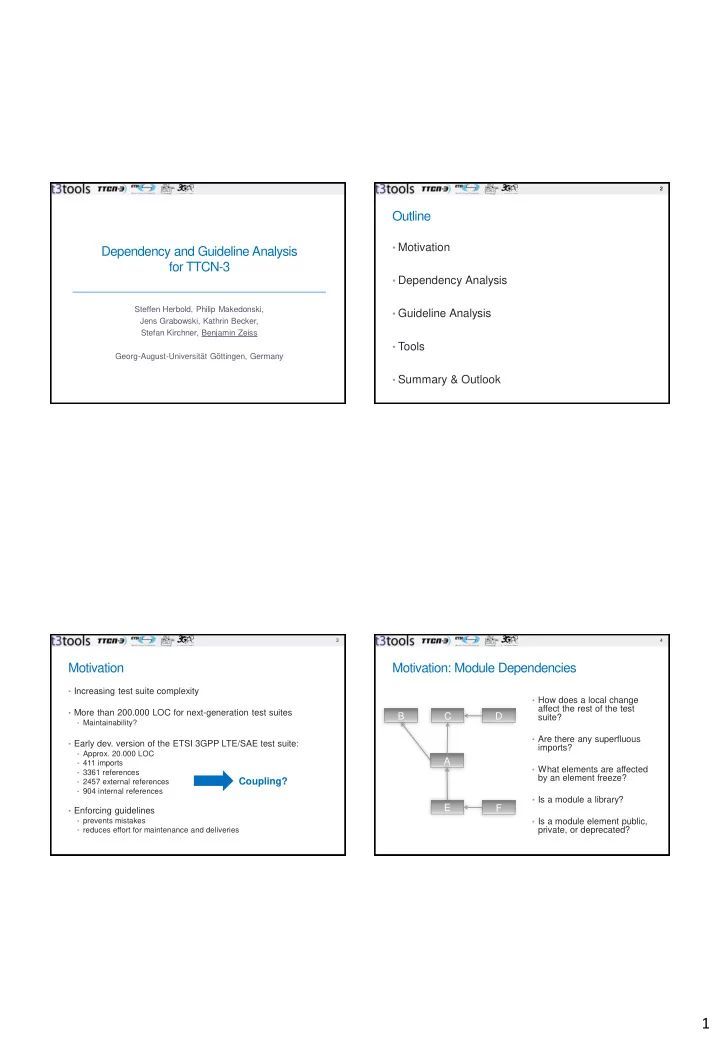
Motivation

  • Increasing test suite complexity
  • More than 200.000 LOC for next-generation test suites
  • Maintainability?
  • Early dev. version of the ETSI 3GPP LTE/SAE test suite:
  • Approx. 20.000 LOC
  • 411 imports
  • 3361 references
  • 2457 external references
  • 904 internal references
  • Enforcing guidelines
  • prevents mistakes
  • reduces effort for maintenance and deliveries

Coupling?

4

Motivation: Module Dependencies

B C D A

  • How does a local change

affect the rest of the test suite?

  • Are there any superfluous

imports?

  • What elements are affected

by an element freeze?

  • Is a module a library?
  • Is a module element public,

private, or deprecated?

E F

slide-2
SLIDE 2

2

5

Motivation: Module Dependencies

e1 e2 Testcase 1 Testcase 2 Testcase 3 e3 e4 e5 A B

Internal references External references Import

6

Dependency Analysis

e1 e2 Testcase 1 Testcase 2 Testcase 3 e3 e4 e5 A B

  • Local change:

7

Dependency Analysis

e1 e2 Testcase 1 Testcase 2 Testcase 3 e3 e4 e5 A B

  • Local change:
  • Addition of new external dependencies, higher coupling

e6 e7 C

8

Dependency Analysis

e1 e2 Testcase 1 Testcase 2 Testcase 3 e3 e4 e5 A B

  • Local change:
  • Addition of new internal dependencies, stronger cohesion

e6 e7 C

slide-3
SLIDE 3

3

9

Dependency Analysis

e1 e2 Testcase 1 Testcase 2 Testcase 3 e3 e4 e5 A B

  • Local change:
  • Removal of dependencies, less coupling, superfluous imports

e6 e7 C

10

Dependency Analysis

e1 e2 Testcase 1 Testcase 2 Testcase 3 e3 e4 e5 A B

  • Element freeze:
  • Testcase 3 is frozen, all dependencies must not be changed anymore

11

Dependency Analysis

e1 e2 Testcase 1 Testcase 2 Testcase 3 e3 e4 e5 A B

  • Primitive library:
  • No further imports, only incoming dependencies, no test cases
  • Non-primitive library:
  • No test cases, mostly incoming dependencies

12

Dependency Analysis

e1 e2 Testcase 1 Testcase 2 Testcase 3 … e3 e4 e5 Function 1 … A B

  • Public / private / deprecated elements:

public private / deprecated

slide-4
SLIDE 4

4

13

Guideline Analysis

  • Guidelines are a constructive QA measure to prevent

mistakes or quality problems.

  • Guideline analysis is an analytical QA measure to

continuously enforce guidelines during the development.

  • Examples:
  • Naming conventions
  • Test data structuring
  • Style conventions
  • Modularization rules

14

Guideline Analysis: Naming Conventions

  • Examples:
  • Test case numbering:
  • TC_COR_0009_47_ND
  • Non-Default altstep prefix:
  • a_receiveSetup()
  • Default altstep prefixes:
  • d_receiveSetup()
  • Implications:
  • Better understandability

15

Guideline Analysis: Test Data Structuring

  • Examples:
  • Grouping of related definitions
  • Alphabetic ordering of types within groups
  • Order and placement of local definitions
  • Implications:
  • Improved locality  Better understandability,

Better maintainability

16

Guideline Analysis: Style Conventions

  • Examples:
  • Formatting style
  • Nesting of alt-statements
  • Depth of stacked template modifications
  • Implications:
  • Better understandability
  • Better maintainability
  • Better reusability
slide-5
SLIDE 5

5

17

Guideline Analysis: Modularization Rules

  • Examples:
  • Modules names imply their content
  • TypesAndValues, Templates, …
  • Standard-Imports must exist
  • LibCommonDefs, …
  • Other modularization concepts exist!
  • Implications:
  • Better locality  Better understandability
  • Bundling of elements that belong together

18

Dependency / Guideline Relationships

  • Dependencies promote quality attributes:
  • Bad quality affects dependent modules
  • High Fan-In  Big Impact on Quality
  • Determination of modules with high risk
  • Guidelines may involve dependencies:
  • No unused imports
  • Standard imports must exist
  • Over-specific runs on clause

19

Tools

  • T3Q
  • Static guideline checking
  • T3D
  • HTML Documentation Generator (Javadoc-like)
  • T3Pendency
  • Test-Suite Dependency Analysis
  • Open-Source
  • Eclipse Public License (EPL)
  • Based on the TRex infrastructure
  • TTCN-3 v4.1.1 support
  • Cross-platform
  • Command-line tools, scheduled execution possible

20

T3Q – TTCN-3 Guideline Checker

  • Fine-grained XML configuration with project profiles
  • Approx. 30 guideline checks implemented
  • Naming conventions
  • Log format must match a regular expression
  • No unused definitions on module level
  • Templates module must contain only template definitions
  • No unused imports
  • No "all" keyword in port type definitions
  • No label or goto statements
  • Code formatting
  • Basic size metrics (LOC, No. of test cases,…)
slide-6
SLIDE 6

6

21

T3D – TTCN-3 Documentation Generator

  • XML representation of module definition dependencies
  • Generation of different switchable views using XSLT:
  • Main view
  • TTCN-3 listings with cross-links
  • Testcase view
  • Dependencies between test cases and module parameters
  • Import view
  • Import relationships
  • Documentation as HTML
  • Customizable look & feel

22

T3D – Main View

23

T3D – Import View

24

T3D – Module Parameter View

slide-7
SLIDE 7

7

25

T3Pendency – TTCN-3 Dependency Analyzer

  • Calculation of dependency metrics:
  • Number of Imports / Number of superfluous Imports
  • Number of modules that reference a given module (Fan-In)
  • Number of modules referenced by a given module (Fan-Out)
  • Number of internal / external references
  • Can be determined at the level of:
  • Modules
  • Module definitions
  • Public / private suggestions
  • Graphviz visualization

26

T3Pendency – TTCN-3 Dependency Analyzer

27

T3Pendency – TTCN-3 Dependency Analyzer

28

Summary & Outlook

  • Summary:
  • Dependency analysis
  • Guideline analysis
  • Relationships between Dependencies and Guidelines
  • T3Q, T3D, T3Pendency tools
  • Outlook:
  • Freely available, open-source (EPL)
  • Download at http://t3tools.informatik.uni-goettingen.de
  • TRex for Refactoring and Metrics, IDE:
  • http://www.trex.informatik.uni-goettingen.de
  • More guideline checks, more features, but …
  • No commercial support  community-driven tool maintenance!
slide-8
SLIDE 8

8

29

Contact

  • Websites:
  • http://www.trex.informatik.uni-goettingen.de
  • http://t3tools.informatik.uni-goettingen.de
  • E-Mail:
  • t3tools@informatik.uni-goettingen.de
  • Acknowledgments:
  • ETSI CTI, STF 160