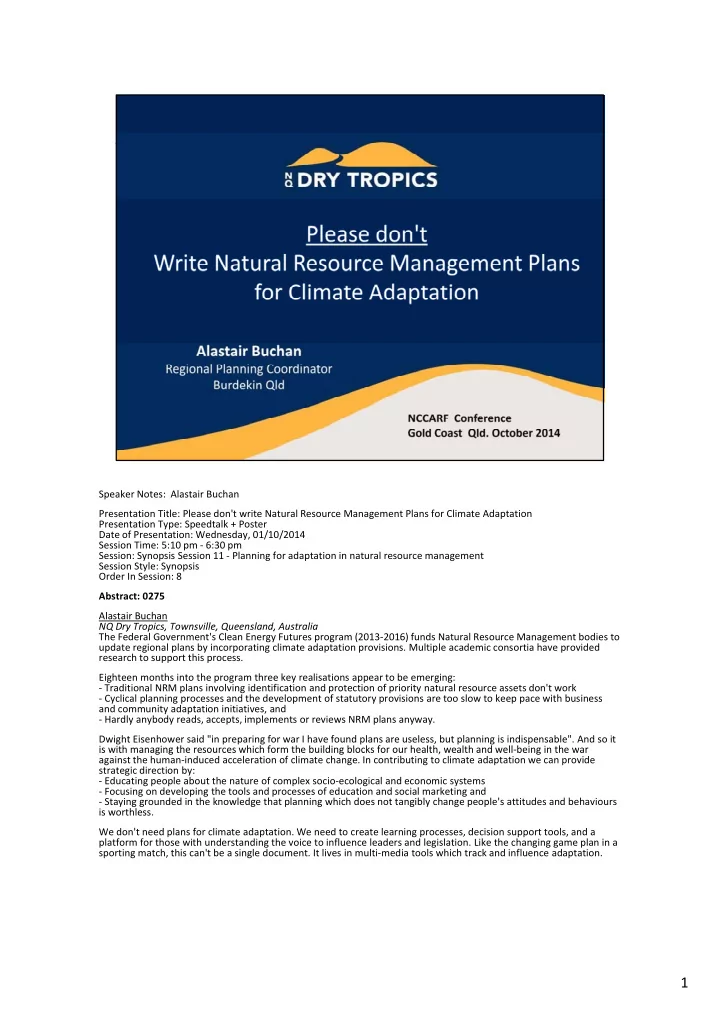
1 Good evening all: Today I will share insights from regional NRM - - PDF document

1
SMART_READER_LITE
LIVE PREVIEW

1 Good evening all: Today I will share insights from regional NRM - - PDF document

Speaker Notes: Alastair Buchan Presentation Title: Please don't write Natural Resource Management Plans for Climate Adaptation Presentation Type: Speedtalk + Poster Date of Presentation: Wednesday, 01/10/2014 Session Time: 5:10 pm 6:30 pm


slide-1
SLIDE 1 Speaker Notes: Alastair Buchan Presentation Title: Please don't write Natural Resource Management Plans for Climate Adaptation Presentation Type: Speedtalk + Poster Date of Presentation: Wednesday, 01/10/2014 Session Time: 5:10 pm ‐ 6:30 pm Session: Synopsis Session 11 ‐ Planning for adaptation in natural resource management Session Style: Synopsis Order In Session: 8 Abstract: 0275 Alastair Buchan NQ Dry Tropics, Townsville, Queensland, Australia Q y p , , Q , The Federal Government's Clean Energy Futures program (2013‐2016) funds Natural Resource Management bodies to update regional plans by incorporating climate adaptation provisions. Multiple academic consortia have provided research to support this process. Eighteen months into the program three key realisations appear to be emerging: ‐ Traditional NRM plans involving identification and protection of priority natural resource assets don't work ‐ Cyclical planning processes and the development of statutory provisions are too slow to keep pace with business and community adaptation initiatives, and ‐ Hardly anybody reads, accepts, implements or reviews NRM plans anyway. Dwight Eisenhower said "in preparing for war I have found plans are useless, but planning is indispensable". And so it is with managing the resources which form the building blocks for our health, wealth and well‐being in the war is with managing the resources which form the building blocks for our health, wealth and well being in the war against the human‐induced acceleration of climate change. In contributing to climate adaptation we can provide strategic direction by: ‐ Educating people about the nature of complex socio‐ecological and economic systems ‐ Focusing on developing the tools and processes of education and social marketing and ‐ Staying grounded in the knowledge that planning which does not tangibly change people's attitudes and behaviours is worthless. We don't need plans for climate adaptation. We need to create learning processes, decision support tools, and a platform for those with understanding the voice to influence leaders and legislation. Like the changing game plan in a sporting match, this can't be a single document. It lives in multi‐media tools which track and influence adaptation.

1

slide-2
SLIDE 2

Good evening all: Today I will share insights from regional NRM climate adaptation planning in Queensland Queensland. In 2013 the Federal Labour Government funded 56 NRM bodies (13 in Qld) to update Regional Natural Resource plans for Climate Change. With a history of good climate mitigation ideas but some perverse program delivery outcomes it was not surprising our brief included specific criteria for resource protection. We were encouraged think about complex socio‐economics, resilient eco‐systems and diversity

  • f community interests. The following is a summary of guidance on planning for climate

adaptation drawn from the Clean Energy. Futures program’s 3 principles: Collaborate to access the best available information, and then logically, comprehensibly and transparently guide adaptation actions.

2

slide-3
SLIDE 3 So what have we learned in eighteen months? I have come to three key realisations: Firstly : Traditional NRM plans which identify and seek to protect priority natural resource assets, don't work. This is because systems rather than mechanistic thinking is needed: So there is little point in bolting a climate adaptation chapter with generic feel good targets on to this sort of plan. Secondly: Cyclical planning processes (Plan, Implement, Review, Improve) and statutory plan reforms, occur over 1 or 2 political cycles meaning 4‐8 years. This is simply too slow to keep pace with business and community adaptation interests and initiatives, and Thirdly: Hardly anybody seriously reads, markets, implements or reviews NRM planning documents anyway (Once the money has gone we move on). So the central question remains: How should we manage our natural resources in the midst of what we know should be a war against extremely rapid climate change? Dwight Eisenhower gave us a good clue. He said "in preparing for war I have found plans are useless, but planning is indispensable". This means our plans need to encourage people to keep planning, researching and sharing knowledge. Community adaptation is achieved through ‘learning by planning’ and not by following a prescriptive plan. We don't need NRM plans for climate adaptation. We need to: C t l i t l t h l l th i d t ti j Create learning tools to help people on their own adaptation journey These tools must be easily identifiable and fun to use We must use media with which people are already comfortably engaged

3

slide-4
SLIDE 4

Like the changing game plan in a sporting match, Resources adaptation plans can't be written into a document. Our plan should be to fuel the initiatives that live in multi‐media tools. These can then be used to influence climate adaptation. Those confident of their understanding of climate issues will create their own voice to influence social leaders business and legislation voice to influence social leaders, business and legislation. The outcome may be unexpected, but at least it will be genuine and as logical, comprehensive and transparent as any glossy book on a shelf. Thank You: Please come and have a chat at the poster. 4

slide-5
SLIDE 5

Please don't write Natural Resource Management Plans for Climate Adaptation

Alastair Buchan

Regional Planning Coordinator Burdekin Dry Tropics Region Qld Ph: 0448 250235 alastair.buchan@nqdrytropics.com.au

Clean Energy Futures Program Principles for Climate Adaptation summarised

  • Collaborate to access the best available

information, and then

  • Logically, comprehensibly and transparently
  • guide adaptation actions.

The Brief The Learning The Suggestion The Outcome

Think:

  • Complex socio-economics
  • Resilient eco-systems
  • Diversity of community interests

www . cranckycurlue . com - NQCC

Those confident of their understanding of climate issues will create their own voice to influence social leaders, business and legislation. The outcome may be unexpected, but at least it will be genuine and as logical, comprehensive and transparent as any glossy book on a shelf Create learning tools to help people on their

  • wn adaptation journey

Design and adopt learning tools that are easily identifiable and fun to use Use media with which people are already comfortably engaged Like the changing game plan in a sporting match, Resources Adaptation Plans can't easily be written into a document Traditional NRM plans don't work because they apply mechanistic not systems thinking Cyclical planning (PIRI) and law reforms, cannot keep pace with business and community adaptation interests and initiatives Hardly anybody reads, markets, implements or reviews NRM planning documents (once the money’s gone we move on) There’s little point adding generic climate adaptatio n targets to a mechanistic plan

Implementing good ideas may result in unforseen bad outcomes (Pink Batts)

Focus on changing attitudes and behaviours rather than biophysical targets

Beware perverse effects

http://1.bp.blogspot.com/- l4Tufs5FgzE/TtQGNYp3KaI/AAAAAAAAANs/HYAd_x7HkRI/s1600/SportsCoachingPE.jpg