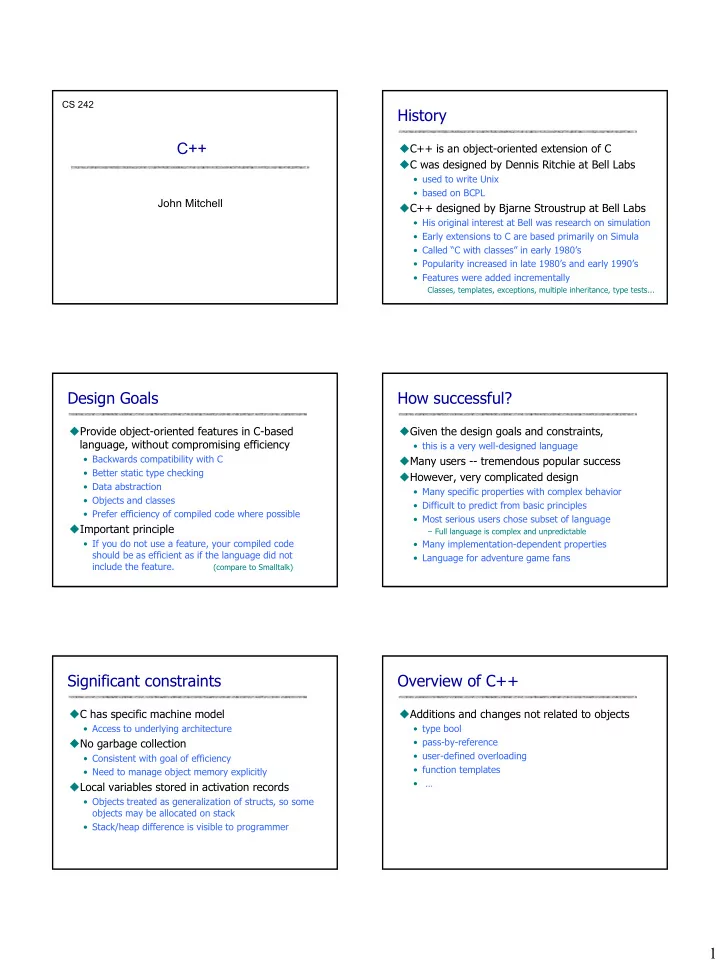

SLIDE 1
1 C++
John Mitchell
CS 242
History
C++ is an object-oriented extension of C C was designed by Dennis Ritchie at Bell Labs
- used to write Unix
- based on BCPL
C++ designed by Bjarne Stroustrup at Bell Labs
- His original interest at Bell was research on simulation
- Early extensions to C are based primarily on Simula
- Called “C with classes” in early 1980’s
- Popularity increased in late 1980’s and early 1990’s
- Features were added incrementally
Classes, templates, exceptions, multiple inheritance, type tests...
Design Goals
Provide object-oriented features in C-based language, without compromising efficiency
- Backwards compatibility with C
- Better static type checking
- Data abstraction
- Objects and classes
- Prefer efficiency of compiled code where possible
Important principle
- If you do not use a feature, your compiled code
should be as efficient as if the language did not include the feature. (compare to Smalltalk)
How successful?
Given the design goals and constraints,
- this is a very well-designed language
Many users -- tremendous popular success However, very complicated design
- Many specific properties with complex behavior
- Difficult to predict from basic principles
- Most serious users chose subset of language
– Full language is complex and unpredictable
- Many implementation-dependent properties
- Language for adventure game fans
Significant constraints
C has specific machine model
- Access to underlying architecture
No garbage collection
- Consistent with goal of efficiency
- Need to manage object memory explicitly
Local variables stored in activation records
- Objects treated as generalization of structs, so some
- bjects may be allocated on stack
- Stack/heap difference is visible to programmer
Overview of C++
Additions and changes not related to objects
- type bool
- pass-by-reference
- user-defined overloading
- function templates
- …