
1
FS Consistency, Block Allocation, and WAFL FS Consistency, Block Allocation, and WAFL Summary of Issues for File Systems Summary of Issues for File Systems
- 1. Buffering disk data for access from the processor.
block I/O (DMA) must use aligned, physically resident buffers block update is a read-modify-write
- 2. Creating/representing/destroying independent files.
disk block allocation, file block map structures directories and symbolic naming
- 3. Masking the high seek/rotational latency of disk access.
smart block allocation on disk block caching, read-ahead (prefetching), and write-behind
- 4. Reliability and the handling of updates.
Rotational Media Rotational Media
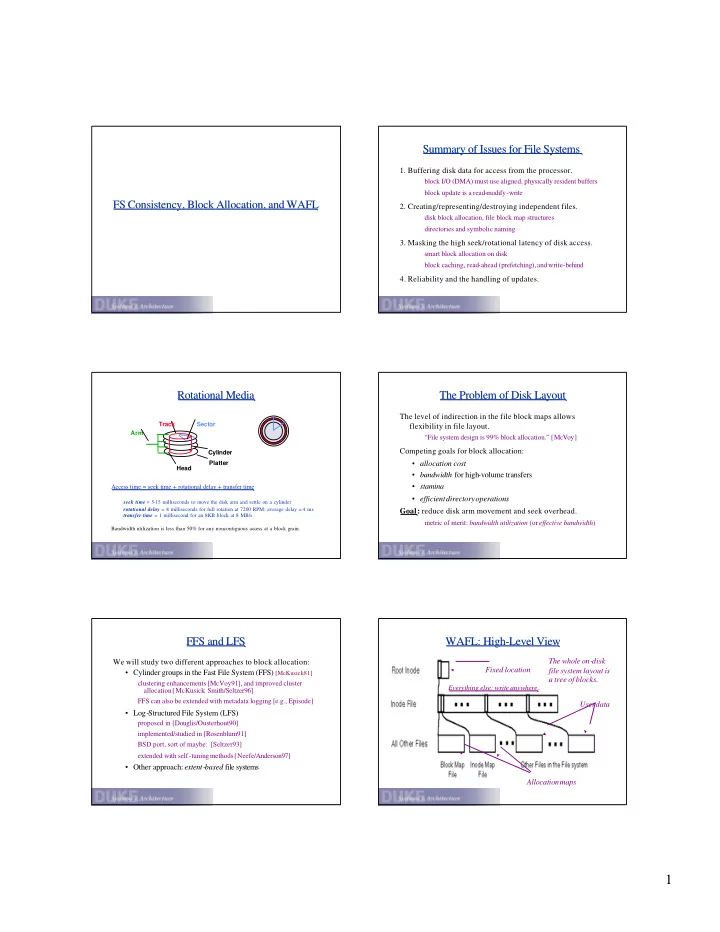
Sector Track Cylinder Head Platter Arm Access time = seek time + rotational delay + transfer time
seek time = 5-15 milliseconds to move the disk arm and settle on a cylinder rotational delay = 8 milliseconds for full rotation at 7200 RPM: average delay = 4 ms transfer time = 1 millisecond for an 8KB block at 8 MB/s Bandwidth utilization is less than 50% for any noncontiguous acc ess at a block grain.
The Problem of Disk Layout The Problem of Disk Layout
The level of indirection in the file block maps allows flexibility in file layout.
“File system design is 99% block allocation.” [McVoy]
Competing goals for block allocation:
- allocation cost
- bandwidth for high-volume transfers
- stamina
- efficient directory operations
Goal: reduce disk arm movement and seek overhead.
metric of merit: bandwidth utilization (or effective bandwidth)
FFS and LFS FFS and LFS
We will study two different approaches to block allocation:
- Cylinder groups in the Fast File System (FFS) [McKusick81]
clustering enhancements [McVoy91], and improved cluster allocation [McKusick: Smith/Seltzer96] FFS can also be extended with metadata logging [e.g., Episode]
- Log-Structured File System (LFS)
proposed in [Douglis/Ousterhout90] implemented/studied in [Rosenblum91] BSD port, sort of maybe: [Seltzer93] extended with self-tuning methods [Neefe/Anderson97]
- Other approach: extent-based file systems
WAFL: High WAFL: High-Level View Level View
Allocation maps Fixed location The whole on-disk file system layout is a tree of blocks.
Everything else: write anywhere.
User data