Structural Programming Course Content and Data Structures - - PDF document

structural programming course content and data structures
SMART_READER_LITE
LIVE PREVIEW

Structural Programming Course Content and Data Structures - - PDF document

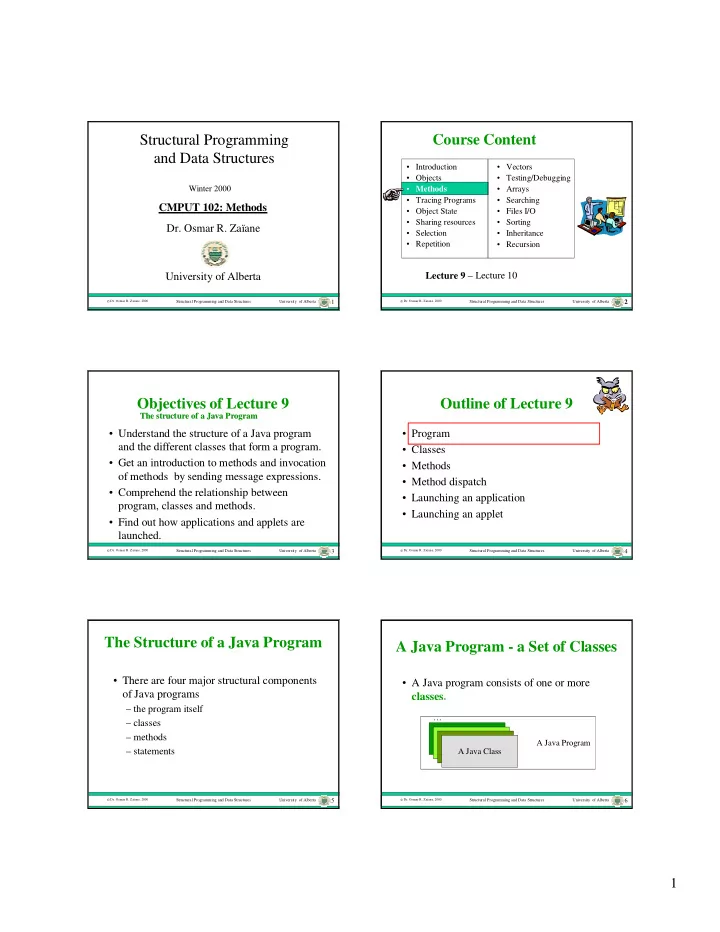
Structural Programming Course Content and Data Structures Introduction Vectors Objects Testing/Debugging Winter 2000 Methods Arrays Tracing Programs Searching CMPUT 102: Methods Object State Files


slide-1
SLIDE 1

1

Structural Programming and Data Structures University of Alberta

 Dr. Osmar R. Zaïane, 2000

1

Structural Programming and Data Structures

  • Dr. Osmar R. Zaïane

University of Alberta

Winter 2000

CMPUT 102: Methods

Structural Programming and Data Structures University of Alberta

 Dr. Osmar R. Zaïane, 2000

2

  • Vectors
  • Testing/Debugging
  • Arrays
  • Searching
  • Files I/O
  • Sorting
  • Inheritance
  • Recursion

2

Course Content

  • Introduction
  • Objects
  • Methods
  • Tracing Programs
  • Object State
  • Sharing resources
  • Selection
  • Repetition

Lecture 9 – Lecture 10

Structural Programming and Data Structures University of Alberta

 Dr. Osmar R. Zaïane, 2000

3

Objectives of Lecture 9

  • Understand the structure of a Java program

and the different classes that form a program.

  • Get an introduction to methods and invocation
  • f methods by sending message expressions.
  • Comprehend the relationship between

program, classes and methods.

  • Find out how applications and applets are

launched.

The structure of a Java Program The structure of a Java Program

Structural Programming and Data Structures University of Alberta

 Dr. Osmar R. Zaïane, 2000

4

Outline of Lecture 9

  • Program
  • Classes
  • Methods
  • Method dispatch
  • Launching an application
  • Launching an applet

Structural Programming and Data Structures University of Alberta

 Dr. Osmar R. Zaïane, 2000

5

The Structure of a Java Program

  • There are four major structural components
  • f Java programs

– the program itself – classes – methods – statements

Structural Programming and Data Structures University of Alberta

 Dr. Osmar R. Zaïane, 2000

6

A Java Program - a Set of Classes

  • A Java program consists of one or more

classes.

One Java Class A Java Program One Java Class One Java Class A Java Class …

slide-2
SLIDE 2

2

Structural Programming and Data Structures University of Alberta

 Dr. Osmar R. Zaïane, 2000

7

Outline of Lecture 9

  • Program
  • Classes
  • Methods
  • Method dispatch
  • Launching an application
  • Launching an applet

Structural Programming and Data Structures University of Alberta

 Dr. Osmar R. Zaïane, 2000

8

Syntax for a Java Class

public class Adventure {

/* An instance of this class is an arithmetic adventure game where an adventurer navigates rooms that contain treasure chests that are opened by correctly answering arithmetic problems. */

}

class end delimiter class name class start delimiter class comment

body of the class goes here

start comment delimiter end comment delimiter visibility modifier class keyword

Structural Programming and Data Structures University of Alberta

 Dr. Osmar R. Zaïane, 2000

9

Outline of Lecture 9

  • Program
  • Classes
  • Methods
  • Method dispatch
  • Launching an application
  • Launching an applet

Structural Programming and Data Structures University of Alberta

 Dr. Osmar R. Zaïane, 2000

10

A Java Class - a Set of Methods

  • The body of each Java class includes a set
  • f methods.
  • A method is some code that performs a

single task.

One Java Class A Java Class One Java Class One Java Class A Java Method …

Structural Programming and Data Structures University of Alberta

 Dr. Osmar R. Zaïane, 2000

11

Two Kinds of Methods

  • There are two kinds of methods in Java.
  • An instance method implements a message

that is sent to an instance of the class.

  • A static method implements a task that is

independent of any particular object.

  • In either case, some code is run and

(optionally) a result is returned.

Structural Programming and Data Structures University of Alberta

 Dr. Osmar R. Zaïane, 2000

12

Syntax for a Java Method

public static void main(String args[]) { /* Starting point for a program. */ } method end delimiter static keyword method comment visibility modifier return type method name

body of the method goes here

method start delimiter parameter list

slide-3
SLIDE 3

3

Structural Programming and Data Structures University of Alberta

 Dr. Osmar R. Zaïane, 2000

13

A Java Method - Statements

  • The body of a method includes a sequence
  • f statements.

A Java Method A Java Statement A Java Statement A Java Statement A Java Statement …

Structural Programming and Data Structures University of Alberta

 Dr. Osmar R. Zaïane, 2000

14

Java Statements

  • There are many kinds of Java statements.
  • Each statement ends with a semi-colon.
  • We have already seen four kinds of

statements:

– variable declaration – import – message expression – assignment statement

Structural Programming and Data Structures University of Alberta

 Dr. Osmar R. Zaïane, 2000

15

Outline of Lecture 9

  • Program
  • Classes
  • Methods
  • Method dispatch
  • Launching an application
  • Launching an applet

Structural Programming and Data Structures University of Alberta

 Dr. Osmar R. Zaïane, 2000

16

Method Dispatch

  • The association of messages to instance

methods is called method dispatch.

  • The class of the receiver object must

contain an instance method with the same name as the message name.

  • The class of each parameter in the

parameter list of the method must match the class of each corresponding argument in the argument list of the message.

Structural Programming and Data Structures University of Alberta

 Dr. Osmar R. Zaïane, 2000

17

Method Dispatch Example 1

“Hello”.toUpperCase();

String Class

public String toUpperCase() { /*

“HELLO” class of receiver is String empty argument list message name is toUpperCase empty parameter list

Structural Programming and Data Structures University of Alberta

 Dr. Osmar R. Zaïane, 2000

18

Method Dispatch Example 2

System.out.print("Hello");

PrintStream Class

public void print(String aString) /*

class of receiver is PrintStream

  • ne argument class String

message name is print

  • ne parameter class String
slide-4
SLIDE 4

4

Structural Programming and Data Structures University of Alberta

 Dr. Osmar R. Zaïane, 2000

19

Kinds of Java Programs

  • Recall there are three kinds of programs:

– Applications – Applets – Libraries

  • The structure of all three kinds of programs

are the same.

  • However, each kind of program is launched

differently.

  • Libraries are never launched, they are just

called by other programs.

Structural Programming and Data Structures University of Alberta

 Dr. Osmar R. Zaïane, 2000

20

Outline of Lecture 9

  • Program
  • Classes
  • Methods
  • Method dispatch
  • Launching an application
  • Launching an applet

Structural Programming and Data Structures University of Alberta

 Dr. Osmar R. Zaïane, 2000

21

Java Applications - launching

  • In a Java application, one class is marked as

the special “starting” class.

  • When the Java application is launched by

the interpreter, it invokes a static method called “main” in the start class.

One Java Class A Java Program One Java Class One Java Class Program Start Class Java Interpreter main()

Structural Programming and Data Structures University of Alberta

 Dr. Osmar R. Zaïane, 2000

22

Java Applications - main Protocol

  • The start class must contain a static method

for main with protocol:

public static void main(String args[])

Structural Programming and Data Structures University of Alberta

 Dr. Osmar R. Zaïane, 2000

23

Outline of Lecture 9

  • Program
  • Classes
  • Methods
  • Method dispatch
  • Launching an application
  • Launching an applet

Structural Programming and Data Structures University of Alberta

 Dr. Osmar R. Zaïane, 2000

24

Java Applets - launching

  • When the web browser reads a document

that tells it to load an applet, it creates an instance of your applet subclass and sends it the instance message init().

A Java Applet Other Java Classes Web Browser init() anApplet Other Java Classes Other Java Classes Applet Subclass

slide-5
SLIDE 5

5

Structural Programming and Data Structures University of Alberta

 Dr. Osmar R. Zaïane, 2000

25

Java Applets - init

  • The init() message creates all of the

graphical objects in the applet, like buttons and fields and puts them into your applet

  • bject.
  • If you do not want to put any graphical
  • bjects in your applet, you do not need to

implement an init() method in your applet subclass.

Structural Programming and Data Structures University of Alberta

 Dr. Osmar R. Zaïane, 2000

26

Java Applets - paint

  • Whenever your applet must be displayed, the

paint message is sent to your applet.

  • For example, the paint message is sent after

your applet is first initialized and any time the screen must be refreshed.

  • The protocol for the paint message is:

public void paint(Graphics aGraphics);

  • The paint method in your applet subclass must

display any objects that you did not put in your applet with the init() method.

Structural Programming and Data Structures University of Alberta

 Dr. Osmar R. Zaïane, 2000

27

Objectives of Lecture 10

  • Attempt to implement our first class by

writing a collection of methods.

Implementing Classes Implementing Classes -

  • Methods

Methods

Structural Programming and Data Structures University of Alberta

 Dr. Osmar R. Zaïane, 2000

28

Outline of Lecture 10

  • Restructuring the start class
  • Self reference - this
  • The return statement
  • Adventure Version 2

Structural Programming and Data Structures University of Alberta

 Dr. Osmar R. Zaïane, 2000

29

The Start Class

  • We have already implemented a class in
  • ur simple Java programs:

public class Adventure { /* Version 1 This program is an arithmetic adventure... */ . . .

  • However, we have not used this class for

anything except to hold the static main() method that starts our program and contains all the code.

Structural Programming and Data Structures University of Alberta

 Dr. Osmar R. Zaïane, 2000

30

The Program Object - Adventure

  • Instead, we can restructure the code by

creating multiple objects and methods.

  • In the static main() method, we create an

Adventure object and send it the play() message.

  • The play() message is implemented by an

instance method in the Adventure class.

slide-6
SLIDE 6

6

Structural Programming and Data Structures University of Alberta

 Dr. Osmar R. Zaïane, 2000

31

Multiple Objects and Messages

  • The problem is decomposed so that the play()

method creates other objects and sends messages to them.

  • This is a prototype for all application

programs since they can all be structured the same way.

Structural Programming and Data Structures University of Alberta

 Dr. Osmar R. Zaïane, 2000

32

main()

The new main() Method

  • Create an instance of the start class, Adventure.
  • Send it the play() message to play the game.
  • ther
  • bjects
  • t

h e r m e s s a g e s Adventure game main() new 1 2 play 4 3

Structural Programming and Data Structures University of Alberta

 Dr. Osmar R. Zaïane, 2000

33

Program - Adventure 2.1

import java.util.*; public class Adventure { /* Version 2 This program is an arithmetic adventure game ... */ /* Constructors */ public Adventure () { /* Initialize an Adventure by creating the appropriate

  • bjects.

*/ }

Structural Programming and Data Structures University of Alberta

 Dr. Osmar R. Zaïane, 2000

34

Program - Adventure 2.2

/* Main program */ public static void main(String args[]) { Adventure game; game = new Adventure(); game.play(); }

Structural Programming and Data Structures University of Alberta

 Dr. Osmar R. Zaïane, 2000

35

Outline of Lecture 10

  • Restructuring the start class
  • Self reference - this
  • The return statement
  • Adventure Version 2

Structural Programming and Data Structures University of Alberta

 Dr. Osmar R. Zaïane, 2000

36

Self- Referencing

  • Inside of a method, we often need to send a

message to the receiver of the current message.

  • That is, we need an object reference to the current
  • bject.

game farewell greeting play enterRoom 1 4 3 2

slide-7
SLIDE 7

7

Structural Programming and Data Structures University of Alberta

 Dr. Osmar R. Zaïane, 2000

37

The Java Variable called this

  • In a natural language, self referencing is

done using the word me or I.

  • In Java, the word this is used for self

reference.

  • If the variable this appears in a method, it

refers to the the receiver object of that method.

Structural Programming and Data Structures University of Alberta

 Dr. Osmar R. Zaïane, 2000

38

Program - Adventure 2.3

/* Private Instance Methods */ private void play() { /* Play the Adventure game. */ String name; Integer tokens; name = this.greeting(); tokens = this.enterRoom(name); this.farewell(name, tokens); }

Structural Programming and Data Structures University of Alberta

 Dr. Osmar R. Zaïane, 2000

39

Program - Adventure 2.4

private void farewell(String userName, Integer tokenCount) { /* Say farewell to the user with the given name and report the given count of tokens earned. */ System.out.print("Congratulations "); System.out.print(userName); System.out.print(" you have left the game with "); System.out.print(tokenCount); System.out.println(" tokens."); }

Structural Programming and Data Structures University of Alberta

 Dr. Osmar R. Zaïane, 2000

40

Outline of Lecture 10

  • Restructuring the start class
  • Self reference - this
  • The return statement
  • Adventure Version 2

Structural Programming and Data Structures University of Alberta

 Dr. Osmar R. Zaïane, 2000

41

The Return Statement

  • A return statement is used in a method to

return the result object or value.

  • The syntax of the return statement is:

<return statement> ::= return <reference>

  • The class of the object or value reference that

is returned must match the return type specified in the method signature.

Structural Programming and Data Structures University of Alberta

 Dr. Osmar R. Zaïane, 2000

42

Outline of Lecture 10

  • Restructuring the start class
  • Self reference - this
  • The return statement
  • Adventure Version 2
slide-8
SLIDE 8

8

Structural Programming and Data Structures University of Alberta

 Dr. Osmar R. Zaïane, 2000

43

Program - Adventure 2.5

private String greeting() { /* Greet the user and answer a String that represents the player’s name. */ String playerName; System.out.println("Welcome to the Arithmetic Adventure game."); System.out.print("The date is "); System.out.println(new Date()); System.out.println(); System.out.print("What is your name?"); playerName = Keyboard.in.readString();

Structural Programming and Data Structures University of Alberta

 Dr. Osmar R. Zaïane, 2000

44

Program - Adventure 2.6

System.out.print("Well "); System.out.print(playerName); System.out.println(", after a day of hiking you spot a silver cube."); System.out.println("The cube appears to be about 5 meters on each side."); System.out.println("You find a green door, open it and enter."); System.out.println("The door closes behind you with a soft whir and disappears."); System.out.println("There is a feel of mathematical magic in the air."); Keyboard.in.pause(); return playerName; }

Structural Programming and Data Structures University of Alberta

 Dr. Osmar R. Zaïane, 2000

45

Program - Adventure 2.7

private Integer enterRoom(String theName) { /* The user with the given name has entered the first room. After the adventure is done, return the number of tokens obtained during the game. */ Integer myTokens; System.out.print("How many tokens would you like, "); System.out.print(theName); System.out.print("?"); myTokens = Keyboard.in.readInteger(); return myTokens; }

Structural Programming and Data Structures University of Alberta

 Dr. Osmar R. Zaïane, 2000

46

Adventure 2 Output

Structural Programming and Data Structures University of Alberta

 Dr. Osmar R. Zaïane, 2000

47

The Big Picture

Adventure Our class game play() farewell() enterRoom() greeting()

Structural Programming and Data Structures University of Alberta

 Dr. Osmar R. Zaïane, 2000

48

What happens in play()?

Adventure Our class game play()

farewell() enterRoom() greeting()

name tokens g r e e t i n g 1 e n t e r R

  • m

2 f a r e w e l l 3

slide-9
SLIDE 9

9

Structural Programming and Data Structures University of Alberta

 Dr. Osmar R. Zaïane, 2000

49

Adventure game play()

farewell() enterRoom()

name tokens

What happens between play() and greeting()?

String Integer Fred greeting() playerName greeting

Structural Programming and Data Structures University of Alberta

 Dr. Osmar R. Zaïane, 2000

50

Adventure game play()

farewell() greeting()

name tokens

What happens between play() and enterRoom()?

String Integer Fred enterRoom( ) myTokens 30 theName enterRoom(name)

Structural Programming and Data Structures University of Alberta

 Dr. Osmar R. Zaïane, 2000

51

Adventure game play()

greeting() enterRoom()

name tokens

What happens between play() and farewell()?

String Integer Fred farewell( ) 30 farewell(name,tokens) userName tokenCount