1 Self-Organization Pattern A particular, organized arrangement of - - PDF document

1
SMART_READER_LITE
LIVE PREVIEW

1 Self-Organization Pattern A particular, organized arrangement of - - PDF document

Last time Cellular automata One-dimensional Wolframs classification Langtons lambda parameter Two-dimensional Conways Game of Life Pattern formation in slime molds Dictyostelium discoideum Modeling of


slide-1
SLIDE 1

1

11/11 - 05 1 Emergent Systems, Jonny Pettersson, UmU

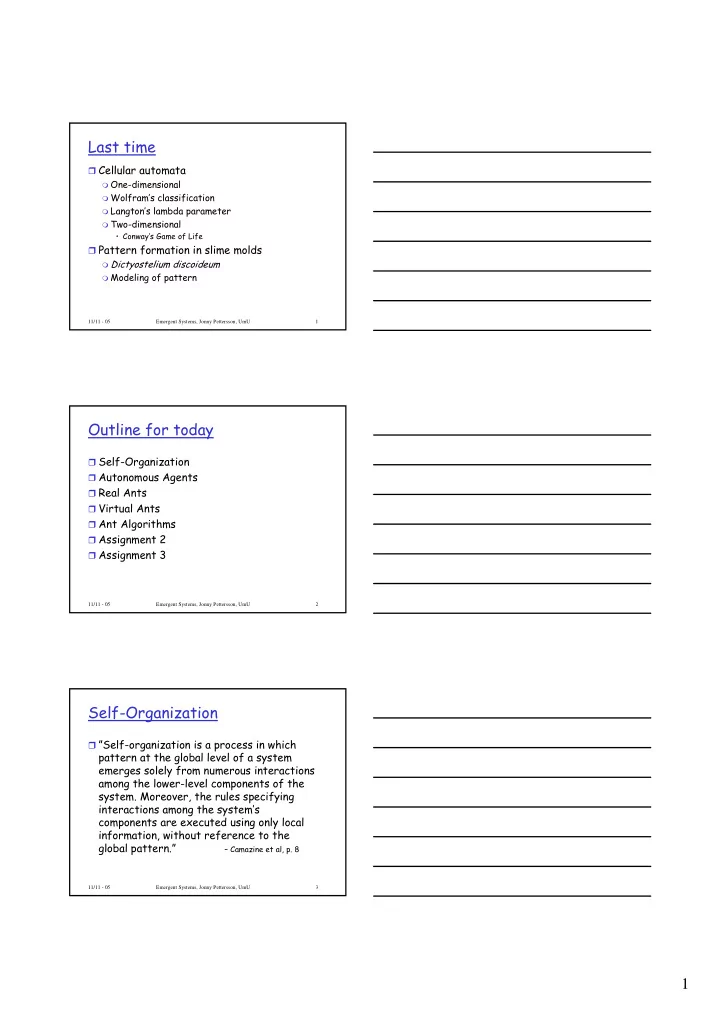
Last time

Cellular automata

One-dimensional Wolfram’s classification Langton’s lambda parameter Two-dimensional

  • Conway’s Game of Life

Pattern formation in slime molds

Dictyostelium discoideum Modeling of pattern

11/11 - 05 2 Emergent Systems, Jonny Pettersson, UmU

Outline for today

Self-Organization Autonomous Agents Real Ants Virtual Ants Ant Algorithms Assignment 2 Assignment 3

11/11 - 05 3 Emergent Systems, Jonny Pettersson, UmU

Self-Organization

”Self-organization is a process in which

pattern at the global level of a system emerges solely from numerous interactions among the lower-level components of the

  • system. Moreover, the rules specifying

interactions among the system’s components are executed using only local information, without reference to the global pattern.” – Camazine et al, p. 8

slide-2
SLIDE 2

2

11/11 - 05 4 Emergent Systems, Jonny Pettersson, UmU

Self-Organization

Pattern

A particular, organized arrangement of objects

in space or time Interactions

Based on local information only - no global

information

Physical laws Genetically controlled properties of the

components

11/11 - 05 5 Emergent Systems, Jonny Pettersson, UmU

Self-Organization - Ingredients

Positive feedback

Activity amplification

Negative feedback

Activity balancing

Amplification of random fluctuations Multiple interactions

11/11 - 05 6 Emergent Systems, Jonny Pettersson, UmU

Self-Organization - Information

Signals

Stimuli shaped by natural selection specifically

to convey information Cues

Stimuli that convey information only

incidentally Gathered from one’s neighbors

Stimuli-response, simple behavioral rules of

thumb Gathered from work in progress

Stigmergy Random fluctuation and chance heterogeneities

slide-3
SLIDE 3

3

11/11 - 05 7 Emergent Systems, Jonny Pettersson, UmU

Self-Organization - Characteristics

Dynamic systems Exhibit emergent properties

Attractors Multistability Bifurcations Parameter tuning Environmental factors

Adaptive systems Different patterns may result from the

same mechanism

Simple rules, complex patterns

11/11 - 05 8 Emergent Systems, Jonny Pettersson, UmU

Self-Organization – Alternatives

Central leader

Need effective communication and cognitive

abilities Blueprints

Most be stored

Recipes

Hinders flexibility

Templates

Must be available

11/11 - 05 9 Emergent Systems, Jonny Pettersson, UmU

Stigmergy

A recursive control system Effective for coordination in space and

time

A sequence of qualitatively different

stimulus-response behaviors

Two types:

Qualitative stigmergy Quantitative stigmergy

slide-4
SLIDE 4

4

11/11 - 05 10 Emergent Systems, Jonny Pettersson, UmU

Stigmergy - Advantages

Permits simpler agents Decrease direct communication between

agents

Incremental improvement Flexible, since when environment changes,

agents respond appropriately

11/11 - 05 11 Emergent Systems, Jonny Pettersson, UmU

Autonomous Agent

”a unit that interacts with its environment

(which probably consists of other agents)

but acts independently from all other

agents in that it does not take commands from some seen or unseen leader,

nor does an agent have some idea of a

global plan that it should be following.”

  • Flake, p. 261

11/11 - 05 12 Emergent Systems, Jonny Pettersson, UmU

Real Ants

Imagine if artificial systems could do the

things ants can do?

Why ants?

Amazonas: 30% of biomass is ants/termites Amazonas: dry weight of social insects is four

times that of other land animals

Earth: ~10% of total biomass (like humans)

slide-5
SLIDE 5

5

11/11 - 05 13 Emergent Systems, Jonny Pettersson, UmU

Army Ants

100 000s in colony Create temporary

”bivouacs”

Act like unified entity

(Pictures from AntColony.org) 11/11 - 05 14 Emergent Systems, Jonny Pettersson, UmU

Fungus-Growing Ants

"A Leaf Cutter Colony

can strip the tallest

  • f trees in a single
  • day. Equivalent

consumption of a full grown cow in the same time!"

”Cultivate” fungi

underground

Fertilize with

compost from chewed leaves

(Pictures from AntColony.org) 11/11 - 05 15 Emergent Systems, Jonny Pettersson, UmU

Fungus Cultivator Nest

(Picture from AntColony.org)

slide-6
SLIDE 6

6

11/11 - 05 16 Emergent Systems, Jonny Pettersson, UmU

Harvester Ants

Find shortest path to

food

Prioritize food sources

based on distance and ease of access

(Picture from The Texas A&M University System) 11/11 - 05 17 Emergent Systems, Jonny Pettersson, UmU

Langton’s Virtual Ants

Grid with white or black squares Virtual ants can face N, S, E, W Behavioral rule:

Take a step forward if on a white square then paint it black and turn

90º right

if on a black square then paint it white and turn

90º left

11/11 - 05 18 Emergent Systems, Jonny Pettersson, UmU

Virtual Ants - Example

slide-7
SLIDE 7

7

11/11 - 05 19 Emergent Systems, Jonny Pettersson, UmU

Virtual Ants – Time Reversibility

Virtual ants are time-reversible But, time-reversibility does not imply

global simplicity

Even a single virtual ant interacts with its

  • wn prior history

Demonstration

11/11 - 05 20 Emergent Systems, Jonny Pettersson, UmU

Virtual Ants - Conclusion

Even simple, reversible local behavior can

lead to complex global behavior

Such complex behavior may create

structures as well as apparently random behavior

11/11 - 05 21 Emergent Systems, Jonny Pettersson, UmU

Ant Algorithms

Ant colony optimization (ACO) Developed in 1991 by Dorigo (PhD

dissertation) in collaboration with Colorni and Maniezzo

slide-8
SLIDE 8

8

11/11 - 05 22 Emergent Systems, Jonny Pettersson, UmU

Summary

Self-Organization Autonomous Agents Real Ants Virtual Ants Ant Algorithms Assignment 2 Assignment 3

11/11 - 05 23 Emergent Systems, Jonny Pettersson, UmU

Next time

Flocks, Herds, and Schools Boids