Structural Programming Course Content and Data Structures - - PDF document

structural programming course content and data structures
SMART_READER_LITE
LIVE PREVIEW

Structural Programming Course Content and Data Structures - - PDF document

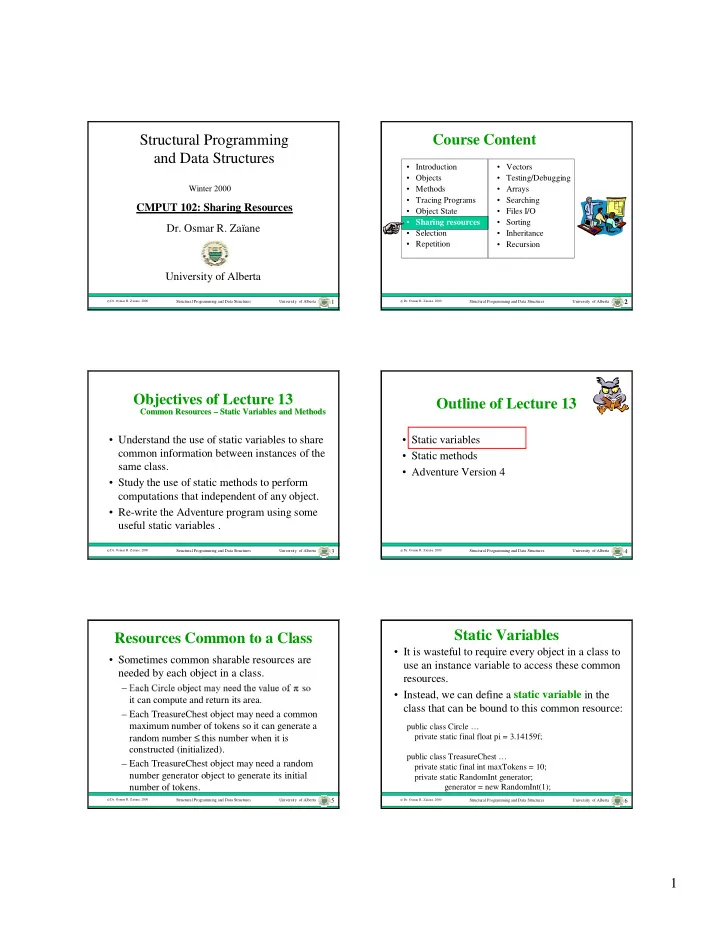
Structural Programming Course Content and Data Structures Introduction Vectors Objects Testing/Debugging Winter 2000 Methods Arrays Tracing Programs Searching CMPUT 102: Sharing Resources Object State


slide-1
SLIDE 1

1

Structural Programming and Data Structures University of Alberta

 Dr. Osmar R. Zaïane, 2000

1

Structural Programming and Data Structures

  • Dr. Osmar R. Zaïane

University of Alberta

Winter 2000

CMPUT 102: Sharing Resources

Structural Programming and Data Structures University of Alberta

 Dr. Osmar R. Zaïane, 2000

2

  • Vectors
  • Testing/Debugging
  • Arrays
  • Searching
  • Files I/O
  • Sorting
  • Inheritance
  • Recursion

2

Course Content

  • Introduction
  • Objects
  • Methods
  • Tracing Programs
  • Object State
  • Sharing resources
  • Selection
  • Repetition

Structural Programming and Data Structures University of Alberta

 Dr. Osmar R. Zaïane, 2000

3

Objectives of Lecture 13

  • Understand the use of static variables to share

common information between instances of the same class.

  • Study the use of static methods to perform

computations that independent of any object.

  • Re-write the Adventure program using some

useful static variables .

Common Resources Common Resources – – Static Variables and Methods Static Variables and Methods

Structural Programming and Data Structures University of Alberta

 Dr. Osmar R. Zaïane, 2000

4

Outline of Lecture 13

  • Static variables
  • Static methods
  • Adventure Version 4

Structural Programming and Data Structures University of Alberta

 Dr. Osmar R. Zaïane, 2000

5

Resources Common to a Class

  • Sometimes common sharable resources are

needed by each object in a class.

– (DFK &LUFOH REMHFW PD\ QHHG WKH YDOXH RI VR it can compute and return its area. – Each TreasureChest object may need a common maximum number of tokens so it can generate a random number ≤ this number when it is constructed (initialized). – Each TreasureChest object may need a random number generator object to generate its initial number of tokens.

Structural Programming and Data Structures University of Alberta

 Dr. Osmar R. Zaïane, 2000

6

Static Variables

  • It is wasteful to require every object in a class to

use an instance variable to access these common resources.

  • Instead, we can define a static variable in the

class that can be bound to this common resource:

public class Circle … private static final float pi = 3.14159f; public class TreasureChest … private static final int maxTokens = 10; private static RandomInt generator; generator = new RandomInt(1);

slide-2
SLIDE 2

2

Structural Programming and Data Structures University of Alberta

 Dr. Osmar R. Zaïane, 2000

7

Outline of Lecture 13

  • Static variables
  • Static methods
  • Adventure Version 4

Structural Programming and Data Structures University of Alberta

 Dr. Osmar R. Zaïane, 2000

8

Object Independent Actions

  • Some actions are not performed by a

specific instance of a class.

– Start an application program. – Perform an operation on some values.

  • In fact, no instance may even need to exist

for these actions to be performed.

Structural Programming and Data Structures University of Alberta

 Dr. Osmar R. Zaïane, 2000

9

Static Methods

  • A static method or class method is code that

can be executed without sending a message to any object:

public class OurProgram … public static void main(String args[]) public class String … public static String valueOf(int i)

  • The syntax of static method calls looks like a

message is being sent to a class:

String.valueOf(3) “3”

  • However, no message is actually involved.

Structural Programming and Data Structures University of Alberta

 Dr. Osmar R. Zaïane, 2000

10

Outline of Lecture 13

  • Static variables
  • Static methods
  • Adventure Version 4

Structural Programming and Data Structures University of Alberta

 Dr. Osmar R. Zaïane, 2000

11

Adventure Version 4

  • We are going to add some functionality to the

Arithmetic Adventure game .

  • We will put treasure chests in rooms.
  • When the adventurer tries to open a chest we

will generate an arithmetic question.

  • The chest will contain a random number of

tokens that will be added or subtracted to the adventurer's total, depending on whether the adventurer answers the question correctly.

Structural Programming and Data Structures University of Alberta

 Dr. Osmar R. Zaïane, 2000

12

Adventure - Code Change Summary

  • In the Adventure class we will:

– replace the method enterRoom(Adventurer)

  • Add a class called Chest.
  • Add a class called Question.
  • Add a class called RandomInt
  • Leave the Adventurer class unchanged.
slide-3
SLIDE 3

3

Structural Programming and Data Structures University of Alberta

 Dr. Osmar R. Zaïane, 2000

13

Running Adventure 4

Structural Programming and Data Structures University of Alberta

 Dr. Osmar R. Zaïane, 2000

14

Program - Adventure 4.1

import java.util.*; public class Adventure { /* Version 4 This program is an arithmetic adventure game … */ /* Constructors */ public Adventure () { /* Initialize an adventure by creating the appropriate

  • bjects.

*/ }

NO CHANGES

Structural Programming and Data Structures University of Alberta

 Dr. Osmar R. Zaïane, 2000

15

Program - Adventure 4.2

/* Main program */ public static void main(String args[]) { Adventure game; game = new Adventure(); game.play(); }

NO CHANGES

Structural Programming and Data Structures University of Alberta

 Dr. Osmar R. Zaïane, 2000

16

Program - Adventure 4.3

/* Private Instance Methods */ private void play() { /* Plays the Adventure game. */ Adventurer adventurer; adventurer = this.greeting(); this.enterRoom(adventurer); this.farewell(adventurer); }

NO CHANGES

Structural Programming and Data Structures University of Alberta

 Dr. Osmar R. Zaïane, 2000

17

Program - Adventure 4.4

private Adventurer greeting() { /* Great the user and answer an Adventurer that represents the user. */ String playerName; System.out.println("Welcome to the Arithmetic Adventure game."); System.out.print("The date is "); System.out.println(new Date()); System.out.println(); System.out.print("What is your name?"); playerName = Keyboard.in.readString();

NO CHANGES

Structural Programming and Data Structures University of Alberta

 Dr. Osmar R. Zaïane, 2000

18

Program - Adventure 4.5

System.out.print("Well "); System.out.print(playerName); System.out.println(", after a day of hiking you spot a silver cube."); System.out.println("The cube appears to be about 5 meters on each side."); System.out.println("You find a green door, open it and enter."); System.out.println("The door closes behind you with a soft whir and disappears."); System.out.println("There is a feel of mathematical magic in the air."); Keyboard.in.pause(); return new Adventurer(playerName); }

NO CHANGES

slide-4
SLIDE 4

4

Structural Programming and Data Structures University of Alberta

 Dr. Osmar R. Zaïane, 2000

19

Program - Adventure 3.6

private void enterRoom(Adventurer adventurer) { /* The given adventurer has entered the first room. */ Integer myTokens; System.out.print("How many tokens would you like, "); System.out.print(adventurer.name()); System.out.print("?"); myTokens = Keyboard.in.readInteger(); adventurer.gainTokens(myTokens.intValue()); }

OLD

Structural Programming and Data Structures University of Alberta

 Dr. Osmar R. Zaïane, 2000

20

Program - Adventure 4.6

private void enterRoom(Adventurer adventurer) { /* The given adventurer has entered the first room. */ Chest chest; chest = new Chest(); chest.display(); chest.open(adventurer); }

NEW

Structural Programming and Data Structures University of Alberta

 Dr. Osmar R. Zaïane, 2000

21

Program - Adventure 4.7

private void farewell(Adventurer adventurer) { /* Say farewell to the user and report the game result. */ System.out.print("Congratulations "); System.out.print(adventurer.name()); System.out.print(" you have left the game with "); System.out.print(adventurer.tokens()); System.out.println(" tokens."); }

NO CHANGES

Structural Programming and Data Structures University of Alberta

 Dr. Osmar R. Zaïane, 2000

22

Class - Chest 4.1

import java.util.*; public class Chest { /* An instance of this class represents a treasure chest in the Adventure game. A Chest contains a number of tokens. */ /* Constructor */ public Chest() { /* Initialize me so that I contain a random number of tokens. */ this.tokens = Chest.generator.next(Chest.maxTokens); }

Structural Programming and Data Structures University of Alberta

 Dr. Osmar R. Zaïane, 2000

23

Class - Chest 4.2

/* Instance Methods */ public void display() { /* Output a description of myself. */ System.out.println("There is a small carved chest in the center of the room."); System.out.println("It appears to be a treasure chest!"); }

Structural Programming and Data Structures University of Alberta

 Dr. Osmar R. Zaïane, 2000

24

Class - Chest 4.3

public void open(Adventurer adventurer) { /* Ask the user an arithmetic question and if a correct answer is given, add tokens to the given Adventurer. If it is answered incorrectly, remove tokens. */ Question question; question = new Question(); question.ask(); // We really want to do only one of the next two // lines, depending on the user’s answer. this.correctAnswer(adventurer); this.wrongAnswer(question, adventurer); }

slide-5
SLIDE 5

5

Structural Programming and Data Structures University of Alberta

 Dr. Osmar R. Zaïane, 2000

25

Class - Chest 4.4

/* Private Static Variables */ private static final int maxTokens = 10; private static final RandomInt generator = new RandomInt(1); /* Private Instance Variables */ private int tokens; /* Private Instance Methods */

Structural Programming and Data Structures University of Alberta

 Dr. Osmar R. Zaïane, 2000

26

Class - Chest 4.5

private void correctAnswer(Adventurer adventurer) { /* Congratulate the adventurer and add some tokens.*/ System.out.println(); System.out.println("A small loudspeaker appears in the air."); System.out.println("You hear the sound of a harp and a pleasant voice says congratulations."); System.out.print("The lid of the chest opens to reveal "); System.out.print(this.tokens); System.out.println(" valuable tokens."); System.out.println("They literally fly into your pocket and the chest disappears."); adventurer.gainTokens(this.tokens); adventurer.reportTokens(); }

Structural Programming and Data Structures University of Alberta

 Dr. Osmar R. Zaïane, 2000

27

Class - Chest 4.6

private void wrongAnswer(Question question, Adventurer adventurer) { /* Report the correct answer and remove some tokens from the given adventurer. */ int loss; System.out.println(); System.out.println("A small loudspeaker appears in the air."); System.out.println("You hear the sound of a deep gong and a pleasant voice says:"); System.out.print("Sorry, the correct answer is "); System.out.print(question.answer()); System.out.println(".");

Structural Programming and Data Structures University of Alberta

 Dr. Osmar R. Zaïane, 2000

28

Class - Chest 4.7

loss = Math.min(this.tokens, adventurer.tokens()); System.out.print("You see "); System.out.print(loss); System.out.println(" valuable tokens fly out of your pocket and fall to the floor."); System.out.println("A small vacuum cleaner appears, sweeps up your scattered tokens and disappears."); adventurer.loseTokens(loss); adventurer.reportTokens(); } }

Structural Programming and Data Structures University of Alberta

 Dr. Osmar R. Zaïane, 2000

29

Class - Question 4.1

import java.util.*; public class Question { /* An instance of this class represents an arithmetic problem in the Arithmetic Adventure game. */ /* Constructor */ public Question() { /* Initialize me so that I have two operands. */

this.leftOperand = Question.generator.next(Question.maxOperand); this.rightOperand = Question.generator.next(Question.maxOperand);

}

Structural Programming and Data Structures University of Alberta

 Dr. Osmar R. Zaïane, 2000

30

Class - Question 4.2

/* Instance Methods */ public void ask() { /* Pose myself. Eventually I would like to indicate whether the user’s response was correct or not. */ Integer answer; System.out.print(this.leftOperand); System.out.print(" + "); System.out.print(this.rightOperand); System.out.print(" = "); answer = Keyboard.in.readInteger(); }

slide-6
SLIDE 6

6

Structural Programming and Data Structures University of Alberta

 Dr. Osmar R. Zaïane, 2000

31

Class - Question 4.3

public int answer() { /* Answer my correct answer. */ return this.leftOperand + this.rightOperand; } /* Private Static Variables */ private static final int maxOperand = 9; private static final RandomInt generator = new RandomInt(2); /* Private Instance Variables */ private int leftOperand; private int rightOperand;

Structural Programming and Data Structures University of Alberta

 Dr. Osmar R. Zaïane, 2000

32

Class - RandomInt 4.1

import java.util.*; public class RandomInt { /* An instance of this class represents a generator that can generate a series of random positive ints. */ /* Contsructor */ public RandomInt(int seed) { /* Initialize me so that I use the given seed. */ this.generator = new Random(seed); }

Structural Programming and Data Structures University of Alberta

 Dr. Osmar R. Zaïane, 2000

33

Class - RandomInt 4.2

/* Instance Methods */ public int next(int max) { /* Answer a Random int between 1 and the given max. */ return Math.round(max * this.generator.nextFloat() - 0.5f) + 1; } /* Private Instance Variables */ private Random generator;

Structural Programming and Data Structures University of Alberta

 Dr. Osmar R. Zaïane, 2000

34

No Changes to End of Lecture

  • The rest of the Adventure program is

included for completeness.

  • There are no changes from the last version

in the rest of these slides.

Structural Programming and Data Structures University of Alberta

 Dr. Osmar R. Zaïane, 2000

35

Class - Adventurer 4.1

public class Adventurer { /* An instance of this class represents a player of the Adventure game. */ /* Constructors */ public Adventurer(String name) { /* Initialize me with the given name and zero tokens. */ this.name = name; this.tokens = 0; }

NO CHANGES

Structural Programming and Data Structures University of Alberta

 Dr. Osmar R. Zaïane, 2000

36

Class - Adventurer 4.2

/* Instance Methods */ public String name() { /* Answer a String representing my name. */ return this.name; } public int tokens() { /* Answer my number of Tokens. */ return this.tokens; }

NO CHANGES

slide-7
SLIDE 7

7

Structural Programming and Data Structures University of Alberta

 Dr. Osmar R. Zaïane, 2000

37

Class - Adventurer 4.3

public void gainTokens(int anInt) { /* Add the given number of tokens to my total. */ this.tokens = this.tokens + anInt; } public void loseTokens(int anInt) { /* Remove the given number of tokens from my total. */ this.tokens = this.tokens - anInt; }

NO CHANGES

Structural Programming and Data Structures University of Alberta

 Dr. Osmar R. Zaïane, 2000

38

Class - Adventurer 4.4

public void reportTokens() { /* Output the number of tokens I have. */ System.out.print("You have "); System.out.print(this.tokens); System.out.println(" tokens in your pocket."); } /* Private Instance Variables */ private String name; private int tokens;

NO CHANGES