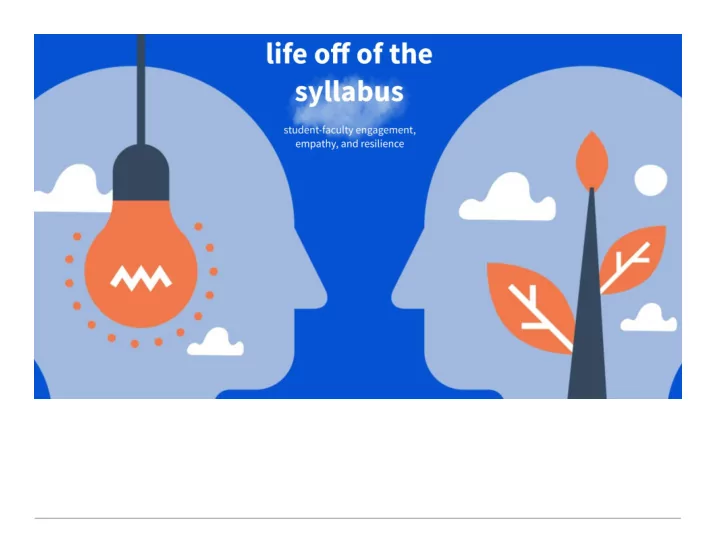
good teachers are able to weave a complex web of connections between - - PowerPoint PPT Presentation

good teachers are able to weave a complex web of
SMART_READER_LITE
LIVE PREVIEW

good teachers are able to weave a complex web of connections between - - PowerPoint PPT Presentation

good teachers are able to weave a complex web of connections between themselves, their subjects, and their students, so that students can learn to weave a world for themselvesthe connections made by good teachers are held not in their


slide-1
SLIDE 1
slide-2
SLIDE 2

“good teachers …are able to weave a complex web of connections between themselves, their subjects, and their students, so that students can learn to weave a world for themselves…the connections made by good teachers are held not in their methods but in their hearts— meaning heart in its ancient sense, the place where intellect and emotion and spirit and will converge in the human self.” parker palmer, the courage to teach (p. 11)

slide-3
SLIDE 3

disclaimer

  • i am a sociologist
  • social relationships
  • social construction of reality
  • knowing and learning and interactive processes
  • i do not claim to know the psychology or neuroscience
  • i have no formal training in teaching
  • i care about the whole life of my students
slide-4
SLIDE 4

what are informal interactions?

  • actions that happen outside of the formal confines of the class period
  • r other academic oriented / center activities
  • social – department student organizations, formal associations
  • situational – before and after class
  • happenstance – in the community
  • planned and cultivated – specific programming, volunteering, cultural

and education events

slide-5
SLIDE 5

what does the research say?

  • informal student-faculty relationships account for higher levels of academic

performance, intellectual development, and personal development (pascarella & terenzini, 1978; woodside, wong, & weist, 1999)

  • nonclassroom interactions have an influence on students’ motivation for

academic achievement (pascarella, terenzini, & hibel, 1978)

  • develop the academic self-concept of students, grows student motivation,

engagement, and actively involved in the learning process (komarraju, et. al 2010)

  • faculty bridge the student and the institution, interactions contribute to

intellectual and social congruence and persistence (cox & orehovec, 2007; tinto, 1993)

slide-6
SLIDE 6

what does the research say?

  • students report high levels of engagement and learning at schools

where faculty members interacted more often with students (umbach & wawrzynski, 2005)

  • the quality of faculty contact – including interest in personal growth,

career goals, and students’ family and social relationships – embolden student persistence and motivation (trolian, et. al 2016)

slide-7
SLIDE 7

what does the research say?

  • students from marginalized backgrounds (first generation students,

racial and ethnic minorities, women, gender and sexually diverse students, student disability community, low-socioeconomic backgrounds) benefit more from informal interactions (cho & auger, 2013)

  • substantive interactions boost academic outcomes like knowledge

acquisition and skill development; informal interactions promote engagement, persistence, and progress (cox, et. al 2010; meyers, et. al, 2019)

slide-8
SLIDE 8

why does this matter?

“…our study suggests that virtually every type of interaction between faculty members and students can have positive effects. while our findings confirm the value of functional interaction, they also indicate that incidental contacts, personal interactions, and mentoring can be meaningful to students. even the most fleeting out-of-class interactions with faculty members (i.e. incidental contact) can help students

  • vercome professional distance implicit in a classroom setting.

moreover, incidental contact, though often unintentional and superficial, can serve as a stepping stone to more substantial interactions later.” bradley e. cox & elizabeth orehovec, (2007, pp. 359-60)

slide-9
SLIDE 9

verstehen

  • empathic understanding of human behavior.
  • the "interpretive or participatory" examination of social phenomena
  • understanding the meaning of action from the actor's point of view.
  • entering into the shoes of the other, and adopting this stance requires
  • treating the other as a subject, rather than an object
  • implies that unlike objects in the natural world humans are not the passive

product of the pulls and pushes of external forces

  • individuals are seen to create the world by organizing their own understanding of it and

giving it meaning

slide-10
SLIDE 10

contact, mindsets, and empathy

  • concerted contact  exposure to others’ perspectives
  • concerted exposure  understanding others’ experiences
  • concerted understanding of others  empathy mindset
  • “you first need to show genuine interest in them, listen to what they

have to say, and then maybe after a while find something to hold on to.” (zaki 2019, pp. 70-1)

slide-11
SLIDE 11

what about faculty outcomes?

  • verstehen and empathy
  • internal empathy: faculty can come to know the internal state of their

students and be motivated to respond with care (batson, 2009)

  • social empathy: faculty can understand students by perceiving and

experiencing their lived situations and develop an insight into structural, social, and personal conditions, inequalities, and disparities impact their ability to engage with coursework (segal, 2011; meyers, et. al, 2019)

slide-12
SLIDE 12

“remember what you were like at 18 or 19 or 20 years old. then remember what it was like to have a powerful emotional experience at that age, especially a negative or distracting one…so the best advice i can offer here, even in small teaching terms, would be this: whenever you are tempted to come down hard on a student for any reason whatsoever, take a couple of minutes to speculate on the possibility that something in the background of that student’s life has triggered emotions that are interfering with their motivation or their learning.” james lang (2016, p. 189)

slide-13
SLIDE 13

‘universal learning’ for faculty

  • students are people, too, with lives and experiences that impact who

they are in class and their ability to engage fully with the material.

  • informal interactions with any student helps appreciate the potential

experiences of all students:

  • positive
  • authentic
  • well-intentioned
slide-14
SLIDE 14

“teaching from a place of radical hope means that we believe every one

  • f our students can succeed in accomplishing what our courses ask of

them, and that we commit to acting on that belief. for some of our students, an instructor who actually believes they can not only pass but do well is a novel occurrence, and we shouldn’t underestimate the power that being an advocate for our students holds. to be an advocate for student learning, i think we need to be advocates for both students and learning.” kevin m. gannon (2020, p. 36).

slide-15
SLIDE 15

teacher empathy

  • the degree to which instructors:
  • work to deeply understand students’ personal and social situations
  • feel caring and concern in response to students’ positive and negative

emotions

  • communicate through their caring and understanding to students through

their behavior (kaufman and schipper 2018; meyers, et al. 2019)

slide-16
SLIDE 16

teacher empathy

  • cognitive
  • taking the students’ perspectives / understanding situations
  • affective
  • similar, attributable emotions
  • i.e. student anxiety  care and compassion for a negative emotion
  • behavioral
  • show compassion
  • encourage and support
  • foster a growth mindset
slide-17
SLIDE 17

teacher empathy

  • understanding students’ contexts
  • social: first generation status; employment; parenting; co-curricular activities;
  • emotional health: anxiety; mental health;
  • physical health
  • understanding professor / student dynamics
  • implicit biases
  • stereotype threat
  • belonging uncertainty
slide-18
SLIDE 18

a model of empathy (zaki 2019)

sharing with caring about thinking about

slide-19
SLIDE 19

strategies

  • small learning-inspired
  • show up early to class
  • small talk is productive talk to build rapport
  • promote growth and compassion
  • change your practices
  • consider alternative places for office hours
  • eat lunch in public spaces on campus
  • take a walk
slide-20
SLIDE 20

strategies

  • get involved
  • advise student organizations
  • join social activities on campus
  • volunteer
  • know who you are
  • what are you comfortable doing?
  • how does would this intersect with your teaching/faculty philosophy
  • know your limits, but avoid building walls
slide-21
SLIDE 21

and then, a pandemic

  • empathy, care, and compassion are needed more than ever

“teaching must be an act of imagination, hope, and possibility. education must be a practice done with hearts as much as heads, with hands as much as books. care has to be at the center of this work.” jesse stommel, chris friend, and sean Michael morris (2020, introduction)

  • teaching in higher ed podcast, episode 320 :
  • “how to be together in learning online”

https://teachinginhighered.com/podcast/how-to-be-together-in-learning-online/#transcriptcontainer

slide-22
SLIDE 22

check in!

  • harvard university making caring common project
  • check-in survey for student, or anyone
  • how are you doing today?
  • https://mcc.gse.harvard.edu/resources-for-educators/covid-check-in-

survey

slide-23
SLIDE 23

physically distanced, socially connected

  • virtual coffee hours
  • virtual game night
  • volunteer activities
  • campus-based programming (eiu reads, student organizations,

residence life programs)

  • social media scavenger hunts (#hashtag searches, scholar searches)
  • hobby chats (create channels in teams, for example, and group

people based on interests)

slide-24
SLIDE 24

conclusion: resilience and empathy

  • students who have strong social supports and feel connected campus

exude higher levels of resilience – the ability to persevere in the face

  • f adversities (pidgeon, et. al 2014).
  • faculty can play a unique role in building this resilience:
  • empathy  empower resilience in struggling students
  • faculty can benefit from an empathetic relationship with their

students

  • student resilience  empower resilience in our teaching
slide-25
SLIDE 25

7 ways to respond to students with empathy

1. follow the ‘platinum rule’, not the ‘golden rule’

treat students the way they want to be treated

2. ask open-ended questions

don‘t assume you know how the student is feeling

3. set aside your own reaction

focus on understanding the student’s experience

4. use ‘I’ statements (not ‘you’ statements)

state ‘I feel’ or ‘I’m concerned’

5. actively listen to what the student is saying

full attention is reciprocal

6. don‘t jump into ‘fix it’ mode

sometimes students just want to be heard or need a safe space

7. validate students’ feelings

let students know they have the right to feel the way they feel

adapted from: understood for all, inc.