1 OVERVI OVERVIEW OF OF ASSE ASSESSMEN ENTS Special ecial E - - PDF document

1 overvi overview of of asse assessmen ents
SMART_READER_LITE
LIVE PREVIEW

1 OVERVI OVERVIEW OF OF ASSE ASSESSMEN ENTS Special ecial E - - PDF document

Legal gally D y Defensible nsible Assessme sessments ts Sept September er 2 27, 20 2017 Presen esented b by: : Marcy G Guti tierre rrez Marcy G rcy Gutierre rrez, z, A Attorn rney a at Law Marcy Gutierrez is a Partner in


slide-1
SLIDE 1

1

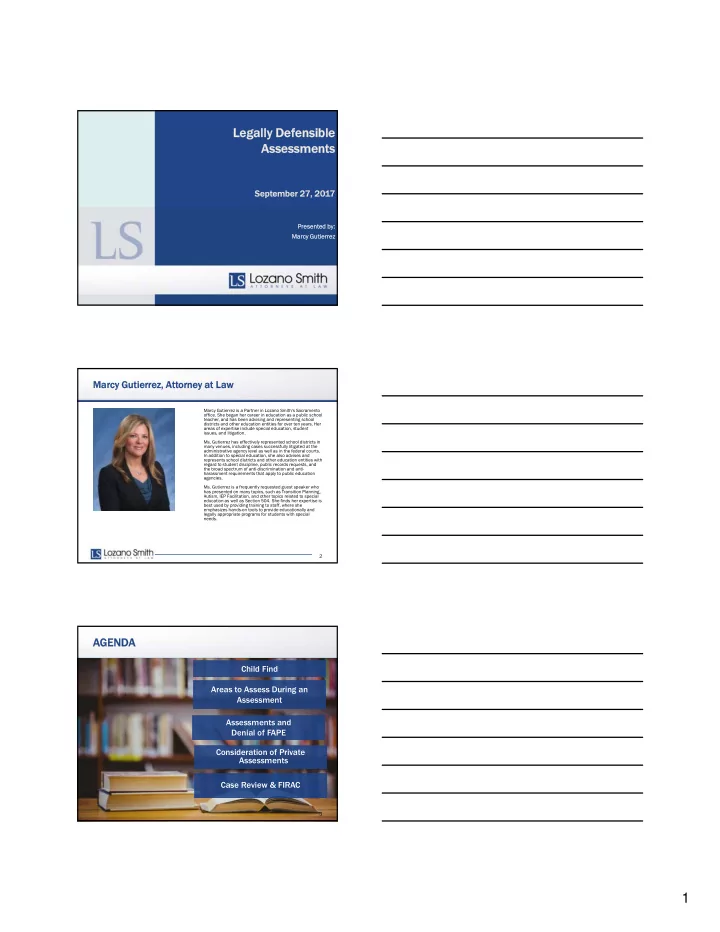
Legal gally D y Defensible nsible Assessme sessments ts

Sept September er 2 27, 20 2017

Presen esented b by: : Marcy G Guti tierre rrez

Marcy G rcy Gutierre rrez, z, A Attorn rney a at Law

Marcy Gutierrez is a Partner in Lozano Smith's Sacramento

  • ffice. She began her career in education as a public school

teacher, and has been advising and representing school districts and other education entities for over ten years. Her areas of expertise include special education, student issues, and litigation.

  • Ms. Gutierrez has effectively represented school districts in

many venues, including cases successfully litigated at the administrative agency level as well as in the federal courts. In addition to special education, she also advises and represents school districts and other education entities with regard to student discipline, public records requests, and the broad spectrum of anti-discrimination and anti- harassment requirements that apply to public education agencies.

  • Ms. Gutierrez is a frequently requested guest speaker who

has presented on many topics, such as Transition Planning, Autism, IEP Facilitation, and other topics related to special education as well as Section 504. She finds her expertise is best used by providing training to staff, where she emphasizes hands-on tools to provide educationally and legally appropriate programs for students with special needs. 2

AG AGENDA DA

Child Find Areas to Assess During an Assessment Assessments and Denial of FAPE Consideration of Private Assessments Case Review & FIRAC

3

slide-2
SLIDE 2

2 OVERVI OVERVIEW OF OF ASSE ASSESSMEN ENTS

Special ecial E Educ ucation A ation Asses sessmen ments

  • Assessments:

– They are the fo foundation for eligibility, services and placement.

5

Referral f for Asses r Assessmen ent

  • When is it time to refer a child for a special education

assessment? Question:

6

slide-3
SLIDE 3

3

Child Find Child Find - Oppor pportunit ity

  • Legal benefits of good assessment include:

– First look at a student. – Legally defensible report in file. – Independent Education Evaluation (IEE) issues.

…next two years

___

7

Child F Find - Reasse ssessme ssment

  • Duty to identify children where there

is reason to ‘suspect’ disbility

  • Obligation to assess not extinguished

by completion of initial assessment:

– Reassess every three years

(Ed. Code § 56381(a)(2))

  • If conditions warrant reassessment.

8

Asses Assessmen ents ts – – Areas reas t to Assess Assess

  • The IDEA obligates districts to assess students in all areas
  • f suspected disabilities.

(20 U.S.C. § 1414(b)(3)(B) and Ed. Code, § 56320(f).)

  • Unique needs are to be broadly construed.

9

slide-4
SLIDE 4

4 Talk t lk to a a Pa Partner: ner: Ho How do y w do you det u determine rmine what what areas y areas you will asses u will assess?

Watc tch O h Out fo t for D r Displa layed S d Symp mptoms ms

  • Social emotional difficulties
  • Attendance issues
  • Low academic skills
  • Slow progress
  • Atypical development
  • Behavior that may be triggered by

disability

– Speech disorder leads to frustration leads to behavior problems

11

What What Ar Area eas Do Do We Asses Assess?

Often overlooked areas:

  • Behavior
  • Attention
  • Medical
  • Social/Emotional
  • Sensory
  • Executive Functioning

Assess i ss in a all areas r s relat lated t to a suspec spected d d disabi bility lity. .

12

slide-5
SLIDE 5

5

Options W tions When D en Disagreeing W greeing With Suspicion o icion of Disabili bility ty

  • Pre-referral procedures;
  • Deny assessment and provide prior

written notice; or

  • Assess.*

*Most conservative and defensible approach

13

ASSESSM ASSESSMENT REQUI REQUIREM EMENTS ENTS Talk t lk to a a Pa Partner: ner: Wha What is re is required b quired by 34 C.F 34 C.F.R.

  • R. 300.305(a)(1)

300.305(a)(1)

slide-6
SLIDE 6

6

Asses Assessmen ents ts – – IDEA DEA Regs gs

  • Definition of Assessment - 34 CFR 300.15
  • Procedures - 34 CFR 300.304
  • Existing Data - 34 CFR 300.305 (a) (1)
  • Basic Requirements – 34 CFR

– 300.301 – 300.303

16

Asses Assessmen ents ts

  • A legally defensible assessment includes:

– review of records – standardized testing – observations in multiple settings – parent/teacher interview – student interview – analysis

17

Asses Assessmen ents ts R Require quiremen ents – – The Big he Big 6 6

Tests and other assessments must be:

  • In the language and form most

likely to yield accurate information

  • Used for valid and reliable

purposes

(Ed. Code § 56320)

18

slide-7
SLIDE 7

7

Asses Assessmen ent t Requir quirem ements -

  • The Big 6

he Big 6

  • Administered by trained and

knowledgeable personnel and in accordance with the instructions

  • Cannot be racially, culturally,
  • r sexually discriminatory

(Ed. Code § 56320)

19

Asses Assessmen ent t Requir quirem ements -

  • The Big 6

he Big 6

  • Tailored to assess the specific

areas of educational need and not just a single general intelligence quotient

  • Do not use a single measure
  • r assessment as the sole

criterion

(Ed. Code § 56320)

20

Subs Substantive and Pr and Procedural Vio Violatio ions: Asses Assessments

Substance vs. Procedure

Su Subs bstance Procedure dure

Assessed in all areas of need Report and IEP meeting to review report within 60 days Contains all legally required elements Contains all legally required elements No single instrument was used/not discriminatory Protocols were followed in administration of assessment instruments Includes review of records, interviews and

  • bservations

Assessment instruments proper for use Summarizes disability categories and recommendation regarding eligibility Protocols were completed Contains no errors (typographical or

  • therwise)

Protocols were completed correctly (i.e. no errors)

21

slide-8
SLIDE 8

8

Ro Role O le Obser servations ations

  • Observations are critical – and

mandatory!

  • Who should observe?
  • Where?
  • How many times?

22

Asses Assessmen ents ts

  • Playground
  • Lunch room
  • Assembly/auditorium
  • Video from home, in

some cases

  • Bus

Observations in other relevant areas:

23

Asses Assessmen ents ts

  • Failure to observe and

consult will seriously weaken the credibility of a district assessment Observation:

24

slide-9
SLIDE 9

9

When Do en Do Pro Procedura edural V Violations = ations = Su Substantiv bstantive De e Denial nial

  • f F

FAPE? PE?

  • Case Examples:

– Waiting too long to conduct assessment – Failing to timely convene an IEP meeting – Failing to timely fund

  • r file on IEE

25

Case Ex Case Exam ampl ple: e: Timothy O

  • O. v.
  • v. P

Paso R Robles U USD

Fa Facts

  • Receiving speech and OT from Regional Center
  • Parents requested District assessment
  • AP was for:

– Academic/pre-academic; – Sensory/motor development; – Communication development; and – Health issues

26

Case Ex Case Exam ampl ple: e: Timothy O

  • O. v.
  • v. P

Paso R Robles U USD

Fa Facts

  • Unsuccessful in administering standardized assessments

due to “compliance” issues

  • RSP and SLP tried to engage in play unsuccessfully
  • Psychologist observed for 30-40 minutes
  • Psychologist determined no need to assess for autism

27

slide-10
SLIDE 10

10

Case Ex Case Exam ampl ple: e: Timothy O

  • O. v.
  • v. P

Paso R Robles U USD So So w what ha happened? ppened?

  • What was the reasoning

behind decision not to assess further for autism?

28

ASSESSM ASSESSMENT REPORTS REPORTS

Assessme ssment Re Reports – s – The B Big 8 8

The report shall include, but is not limited to:

(1) Need for special education and related services (2) Basis for determination (3) Relevant behavior observed,

(Ed. Code § 56327)

30

slide-11
SLIDE 11

11

Assessme ssment Re Reports – s – The B Big 8 8

(4) Relationship between the behavior and student’s academic and social functioning (5) Health and development, and medical findings (6) Discrepancy between achievement and ability that cannot be corrected without special education (for students with learning disabilities)

(Ed. Code § 56327)

31

Assessme ssment Re Reports – s – The B Big 8 8

(7) The effects of environmental, cultural, or economic disadvantage, (8) The need for specialized services, materials, and equipment for students with low incidence disabilities.

(Ed. Code § 56327)

32

Asses Assessmen ent R t Repo ports

  • Assessors must prepare a

written report and provide to parents.

  • Report translated into the

parent’s primary language.

(Ed. Code § 56329)

33

slide-12
SLIDE 12

12

Asses Assessmen ent R t Repo ports

Should assessment reports summarize disability categories and whether the student qualifies for special education?

34

ASSESSM ASSESSMENT INSTR INSTRUMENTS

Asses Assessmen ent Inst t Instrum rument nts

  • Assessors must use

“technically sound instruments that may assess the relative contribution of cognitive and behavioral factors, in addition to physical or developmental factors.”

(20 U.S.C. § 1414(b)(2)(C); 34 C.F.R. § 300.304 (b)(3).)

36

slide-13
SLIDE 13

13

Asses Assessmen ent Inst t Instrum rument nts

  • “Technically sound instruments” generally refers to

assessments that have been shown through research to be valid and reliable.

(Assistance to States for the Education of Children With Disabilities and Preschool Grants for Children With Disabilities, 71 Fed. Reg. 46540-46541, 46642 (Aug. 14, 2006).)

37

Asses Assessmen ent Inst t Instrum rument nts

  • Common err

errors rs in selection of assessment instruments:

– Outdated assessment instruments. – Standardized cognitive assessments for African-American students.

38

Asses Assessmen ent Inst t Instrum rument nts

  • Common err

errors rs in selection of assessment instruments:

– Using same instrument less than a year after previous administration. – Screening assessments, instead of full-scale, standardized assessments. – Using instrument outside normed ages.

39

slide-14
SLIDE 14

14

Asses Assessmen ent Inst t Instrum rument nts

  • Review results for correct scoring:

The D e District’s a strict’s assessor’s ssor’s “scoring e ring errors r rs raised ed qu quest estions

  • ns

about about the int the integrity and v and validi lidity of

  • f the asses

the assessment as as a a wh whole

  • le.”

(Anaheim City Sch. Dist. v. Student, OAH No. 2010010357)

40

Prot

  • toco
  • cols
  • Administer assessments in accordance with the instructions

provided.

(Ed. Code § 56320(b)(3))

41

Potential Blin l Blind Spo Spots

Oth Other Pr Problem Are Areas:

  • Failing to assess all areas of suspected disability.
  • Poor choice of assessment instruments.
  • Improperly completed protocols – basal/ceiling, added

incorrectly.

42

slide-15
SLIDE 15

15

Potential Blin l Blind Spo Spots

Oth Other Pr Problem Are Areas:

  • Failing to observe student and consult with teachers and service

providers.

  • Failing to consider information from outside medical/mental

health providers.

  • Unimpressive assessment reports.
  • Lack of analysis.

43

Potential Blin l Blind Spo Spots

Oth Other Pr Problem Are Areas:

  • Appearance of bias.
  • Embarrassing or substantive typos.
  • Not providing

the entire picture.

44

Potential Blin l Blind Spo Spots

Oth Other Pr Problem Are Areas:

  • An assessment can be substantively outstanding, but

typographical and grammatical errors will impact its credibility.

  • Substantive errors, such as incorrect test scores, can call

the entire assessment report into question.

45

slide-16
SLIDE 16

16

But, W What S Should We We Do If…

  • Parent asks for specific tools
  • Parent will not consent to certain tools
  • Parent asks to be present during testing
  • Timeline concerns
  • Lack of cooperation re: rating scales/interviews

46

CONSID IDERA ERATION ION O OF PRIV PRIVATE ASSESSM E ASSESSMENTS

Risk of

  • f Impr

Improper or N

  • r No Asses

Assessmen ents: IEEs : IEEs

  • A parent may request an IEE at

public expense if the parent disagrees with a school district’s evaluation

  • In response to an IEE request, the

district must without undue delay:

– Initiate due process; OR – Provide an IEE at public expense

(Ed. Code § 56329(b), (c))

48

slide-17
SLIDE 17

17

Pr Priv ivat ate Asses e Assessmen ent Consid Consider erat ation ion

  • If the parent obtains an

IEE/or assessment at private expense: – Results must be considered, and – May be presented as evidence at a due process hearing

49

Pr Priv ivat ate Asses e Assessmen ent Consid Consider erat ation ion

  • Analyze private

assessment report with District professional

  • Craft questions to ask at

the IEP meeting Bef Before re IEP IEP mee eeti ting:

50

Pr Priv ivat ate Asses e Assessmen ent Consid Consider erat ation ion

  • Have District school

psychologist attend

  • Encourage discussion

regarding recommendations

  • Encourage meaningful

parental participation

  • Get to the “why”

During ring I IEP meeting ting:

51

slide-18
SLIDE 18

18

Ta Takeaways

  • Assessments set the foundation.
  • Carefully review assessment reports.
  • Consider whether assessments are defensible.

52

Endre Endrew F.

Qu Questions

54