1.4 Intercepts and Graphing The general form of a line is: where A, - - PowerPoint PPT Presentation

1 4 intercepts and graphing
SMART_READER_LITE
LIVE PREVIEW

1.4 Intercepts and Graphing The general form of a line is: where A, - - PowerPoint PPT Presentation

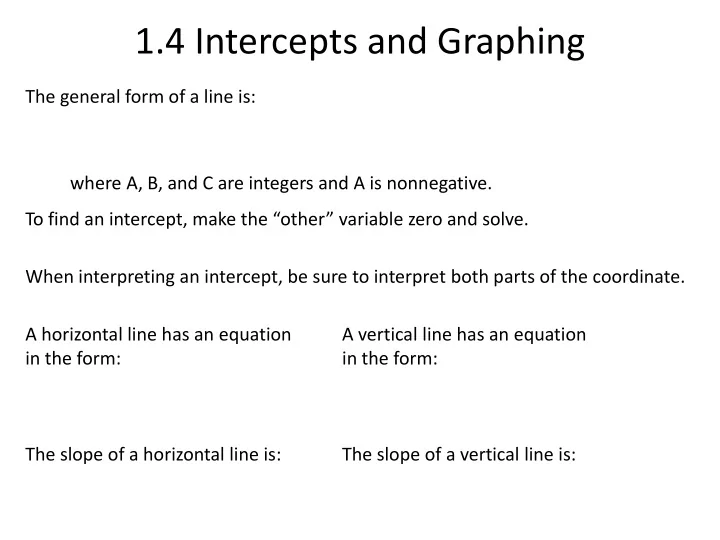
1.4 Intercepts and Graphing The general form of a line is: where A, B, and C are integers and A is nonnegative. To find an intercept, make the other variable zero and solve. When interpreting an intercept, be sure to interpret both parts of


slide-1
SLIDE 1

1.4 Intercepts and Graphing

The general form of a line is: where A, B, and C are integers and A is nonnegative. To find an intercept, make the “other” variable zero and solve. When interpreting an intercept, be sure to interpret both parts of the coordinate. A horizontal line has an equation in the form: The slope of a horizontal line is: A vertical line has an equation in the form: The slope of a vertical line is:

slide-2
SLIDE 2

Find the vertical and horizontal intercepts, and explain their meaning in the given situation. Let be the percentage of adults aged 18 years old and over in the United States that have been diagnosed with diabetes, t years since 2000. Source: CDC.

1.4-2

0.28 5.95 D t  

2

Back to Table of Contents

slide-3
SLIDE 3

Find the horizontal and vertical intercepts of

1.4-3

6 5 42 x y  

3

Back to Table of Contents

slide-4
SLIDE 4

Find the intercepts and graph the line

1.4-4

2 3 18 x y  

4

Back to Table of Contents

slide-5
SLIDE 5

Sketch the graph of the following lines a.

1.4-5

5

Back to Table of Contents

4 x  

slide-6
SLIDE 6

Sketch the graph of the following lines b.

1.4-5

1.5 y  

6

Back to Table of Contents

slide-7
SLIDE 7

1.5 Finding Equations of Lines

Besides general form, an equation of a line can also be written using either slope-intercept form: y=mx + b or point-slope form: When asked to write ‘the equation’ you will typically be writing your final answer in slope-intercept form. To find the equation of a line using the point-slope formula:

  • 1. Use any two points to calculate the ___________ .
  • 2. Substitute the slope and a point into the _________________.
  • 3. Write the equation in slope-intercept form.
  • 4. Check the equation by plugging in the points to be sure they are

solutions. To find the equation of a line using slope-intercept form: 1. Use any two points to calculate the ___________. 2. Use the slope and a point to find the value of b. 3. Write the equation in slope-intercept form. 4. Check the equation by plugging in the points to be sure they are a solutions.

slide-8
SLIDE 8

1.5 Finding Equations of Lines

Parallel lines have the ________ slopes and never intersect. Perpendicular lines have __________________ slopes and intersect at a right angle.

slide-9
SLIDE 9

Use the point slope formula to write the equation of the line that passes through the points and .

1.5-4

(6, 13) 

(18, 31) 

9

Back to Table of Contents

slide-10
SLIDE 10

A business purchased a production machine in 2005 for $185,000. For tax purposes, the value of the machine in 2011 was $129,500. If the business is using straight line depreciation, write the equation of the line that gives the value of the machine based on the age of the machine in years.

1.5-2

10

Back to Table of Contents

slide-11
SLIDE 11
  • a. Write the equation of the line that passes through the points in

the table.

1.5-5

x y 5 13 7 15.8 15 27 18 31.2

11

Back to Table of Contents Back to Table of Contents

slide-12
SLIDE 12
  • b. Write the equation of the line shown in the graph.

1.5-5

12

Back to Table of Contents

slide-13
SLIDE 13
  • a. Write the equation of the line that goes through the point

and is perpendicular to the line .

1.5-6

4 23 y x  

( 12,8) 

13

Back to Table of Contents

slide-14
SLIDE 14
  • b. Write the equation of the line that goes through the point (8,11)

and is parallel to the line .

1.5-6

5 2 30 x y  

14

Back to Table of Contents

slide-15
SLIDE 15

Using the value of the production machine equation we found earlier, answer the following:

  • a. What is the slope of the equation? What does it represent in

regards to the value of the machine?

  • b. What is the vertical intercept of the equation? What does it

represent in this situation?

1.5-7

9250 185,000 v a   

15

Back to Table of Contents

slide-16
SLIDE 16

Using the value of the production machine equation we found earlier, answer the following:

  • c. What is the horizontal intercept of the equation? What does it

represent in this situation?

1.5-7

16

Back to Table of Contents

9250 185,000 v a   

slide-17
SLIDE 17

1.6 Finding Linear Models

Modeling steps:

  • 1. Find the variables and adjust the data if needed.
  • 2. Create a scatter plot.

2nd stat (to enter data), turn Stat Plot on, may need to adjust Window or do a Zoom stat

  • 3. Is the model linear? If yes, select two points (that

best fit the line) and calculate the slope.

  • 4. Find the equation of the line.
slide-18
SLIDE 18

The total revenue for GE is given in the table. Source: GE 2008 annual report

  • a. Find an equation for a model of these data.

1.6-3

Year Revenue (billions $) 2004 124 2005 136 2006 152 2007 172 2008 183

18

Back to Table of Contents

slide-19
SLIDE 19

The total revenue for GE is given in the table.

  • b. Using your model estimate GE’s revenue

in 2010.

  • c. What is the slope of your model? What does it mean in regards

to GE’s revenue?

  • d. Determine a reasonable domain and range for the model.

1.6-3

Year Revenue (billions $) 2004 124 2005 136 2006 152 2007 172 2008 183

19

14.75 65 R t  

Back to Table of Contents

slide-20
SLIDE 20

1.7 Functions

  • For every input value, there is only one unique
  • utput value. For each input value in the

domain, you must have one and only output value in the range.

  • If a vertical line intersects the graph at no

more than one point, the graph is a function.

  • Most linear functions (with the exception of

horizontal lines or application problems) have a Domain and Range of all real numbers.

slide-21
SLIDE 21

Determine whether the following descriptions of relations are functions or not.

  • a. The set

b.

  • c. Weekly salaries during the mth month of the year.

1.7-1

 

(2,5),(4,8),(10,8),(20,15) A 

Day of week Monday Wednesday Saturday Monday Temperature degrees Fahrenheit 90 88 91 93

21

Back to Table of Contents

slide-22
SLIDE 22
  • a. Is the equation a function or not?
  • b. Is the graph a function or not?

1.7-2

7 20 y x  

22

Back to Table of Contents

slide-23
SLIDE 23

= The height of a toy rocket in feet t second after launch. Interpret the mathematical statement .

1.7-3

( ) H t

(3) 12 H 

23

Back to Table of Contents

slide-24
SLIDE 24

The population of Wisconsin, in millions, is given in the table.

Source: www.census.gov Let P(t) be the population of

Wisconsin, in millions, t years since 2000.

  • a. Find an equation for a model
  • f these data. Write your

model in function notation.

  • b. Determine a reasonable domain and range for your model.

1.7-4

Year Population (in millions) 2003 5.47 2004 5.51 2005 5.54 2006 5.57 2007 5.60 2008 5.63

24

Back to Table of Contents

slide-25
SLIDE 25

The population of Wisconsin, in millions, is given in the table.

Source: www.census.gov

  • c. Find P(14) and interpret its

meaning in regard to the population of Wisconsin.

  • d. Find when P(t) = 5.75 and interpret its meaning in regard to

the population of Wisconsin.

1.7-4

Year Population (in millions) 2003 5.47 2004 5.51 2005 5.54 2006 5.57 2007 5.60 2008 5.63

25

( ) 0.03 5.39 P t t  

Back to Table of Contents

slide-26
SLIDE 26

Let Find the following. a.

1.7-5

2

( ) 7 2 ( ) 1.25 14 ( ) 2 10 f x x g x x h x x       

(3) f

26

Back to Table of Contents

slide-27
SLIDE 27

Let Find the following. b.

1.7-5

2

( ) 7 2 ( ) 1.25 14 ( ) 2 10 f x x g x x h x x       

(5) h

27

Back to Table of Contents

slide-28
SLIDE 28

Let Find the following.

  • c. x such that

1.7-5

2

( ) 7 2 ( ) 1.25 14 ( ) 2 10 f x x g x x h x x       

( ) 15 g x 

28

Back to Table of Contents

slide-29
SLIDE 29

Use the graph to estimate the following. a.

  • b. x such that

1.7-6

(2) f

( ) 5 f x 

29

Back to Table of Contents

slide-30
SLIDE 30

Determine the domain and range of the following functions a. b.

1.7-7

( ) 3 7 f x x   

( ) 8 g x 

30

Back to Table of Contents