
SLIDE 1
1/3 Maths: Teaching for Mastery Ciara Sutton Fitzpatrick and Gemma - - PowerPoint PPT Presentation
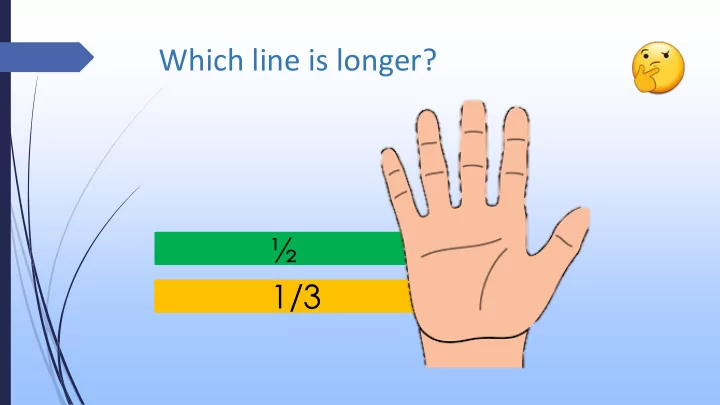
Which line is longer? 1/3 Maths: Teaching for Mastery Ciara Sutton Fitzpatrick and Gemma Field Which line is longer? 1/3 What does it mean to master something? I know how to do it It becomes automatic and I dont need to
Ciara Sutton Fitzpatrick and Gemma Field
Teaching for mastery rejects the idea that lots of people “can’t do” maths. Background – Singapore and Shanghai maths teaching. Teaching maths in a way that children gain a solid understanding of each concept they are learning before moving onto the next one. Each lesson has one clear objective. Children moving at broadly the same pace. Frequent use of concrete and pictorial resources Procedural fluency and conceptual understanding are emphasised. Key skills are taught for longer and deeper. Immediate interventions for any children falling behind.
Mastery Teaching – our aims. Different types of mathematical knowledge Microscopic Progression Concrete – Pictorial – Abstract Approach A typical lesson: Variation, questioning, ‘ping-pong’ teaching and talk for maths. Supporting all learners in a mastery classroom.
The background is in Singapore and Shanghai. It has been noticed that children in Singapore and Shanghai keep learning maths for longer and feel more confident than their UK counterparts. We have noticed, not just in our school, gaps appearing from an early age in children’s mathematical understanding. Children who were quick graspers were being accelerated quickly through the curriculum without allowing them to secure a deep understanding of each concept. Children who struggled with maths were given easier tasks and did not always access all of the curriculum that the quick graspers did. We aim through teaching for mastery for all children to become confident mathematicians and feel that they can do maths.
Teaching for mastery involves the development of three forms of knowledge:
Factual – I know that Procedural – I know how Conceptual – I know why Factual knowledge: I know that ½ of 10 is 5 Procedural knowledge: If I divide 10 by 2 I will get 5 Conceptual knowledge: I understand to find half of a number you need to divide it into 2 equal parts because a half is something divided into 2 equally. If I divide 10 into 2 equal parts I’ll have 5 in each. Look I can prove it!
Factual – I know that Procedural – I know how Conceptual – I know why Factual knowledge: I know that 0.25 x 100 = 25 Procedural knowledge: I can do this by moving the digits two places to the left. Conceptual knowledge: Each place value position gets 10 times bigger as you go to the left. So to make 0.2 100 times bigger I’ll have to move the digits two jumps to the left.
Children are frequently asked to prove their answers. We never just tell the children to use a method without explaining why. Children are often led to come up with the method by themselves. Concrete and pictorial resources are used to help support their understanding. Teachers are always asking “Why?”, “How do you know?” and “Are you sure?!”
Children explaining understanding
The first element of teaching for mastery that we introduced to WPPS. What is the end point you want the children to reach? What are the tiny (microscopic) steps that a child would need to take to reach this? We aim to start at the very beginning and then identify any gaps in their understanding as we go. Organise immediate intervention for children who struggle with a step. Move through the steps at a speed appropriate for your children but not missing any step. All children move through the same set of steps regardless of speed or ability.
What is the end point you want the children to reach? What prior knowledge would a child need to be able to begin working
What small steps would they need to take to fully achieve this target? How long do you think it would take a class to achieve this target fully?
Understand what an angle is Know that angles are measured in degrees To understand that a full turn is 360 degrees To understand that a half turn 180 degrees To understand that a quarter turn is 90 degrees
To recognise a right angle and that it measures 90 degrees To recognise an acute angle and know that it measures between 0 and 90 degrees To recognise an obtuse angle and know that it measures between 90 and 180 degrees To recognise a reflex angle and to know that it is between 180 and 360 degrees. Identify a type of angle and explain how it fits the criteria. Know why an angle is not a certain type of angle.
Recognise a protractor Understand the terms origin, baseline and scale Know how to line up a protractor to measure angles on a line How to read the scale on the protractor Know when to use the internal or external scale
Measure angles that are in tens from the left Measure angles that are in tens from the right Measure angles that are in fives from the left Measure angles that are in fives from the right Measure angles in ones from the left Measure angles in ones from the right Estimate the measurement of angles
What small steps would you need to take to be able to solve this problem?
What possible misconceptions might a child have?
digit from the tens column to the ones column.
they could line up the numbers incorrectly they could carry the 5 instead of the ten they could add the numbers incorrectly.
Children can use pictures to represent a problem. This often helps them see the answer. Drawing a picture is a really helpful resource to fall back on when you are not sure how to approach a problem. It is important to get the children comfortable with drawing bar models and other representations.
Explaining understanding pictorially
Explaining understanding pictorially
When we present a collection of examples or exercises related to some mathematical idea to our pupils what do we want them to be looking for? What do we want them to pay attention to?
concept.
it in any context
what it isn’t To find out what something is, we need to look at it from different angles – then we will know what it really looks like!
You will often hear teachers ask the question: “What’s the same, what’s different?”
Procedural variation occurs within the process of doing mathematics Characteristics are small steps are made with slight variation This can be in the context of : A mathematics lesson An activity/practice exercise Within the process of solving a problem
Small steps that draw attention to one idea
Lessons are well paced with clear progression of learning throughout the lesson. Activities move rapidly from teacher to children and back throughout the lesson. Teacher leads back and forth interaction, including questioning, short tasks, explanation, demonstration, and discussion. Teacher uses carefully thought out questions including “What’s the same, what’s different?”, “How do you know?” and “Can you prove it?” to lead pupil discussion. Children have time to explore some concepts themselves or with their partners in the form of short “talk tasks”.
All children will be taught and expected to use correct mathematical vocabulary consistently across the school. Children are expected to back up their answers by reasoning and proof. Correct vocabulary is modelled and prompted by the teacher. Children will be encouraged to explain their methods – if they cannot explain how to do it they have not mastered it. Books provide evidence of reasoning.
Same input for all children Ping pong style teaching – all children get a chance to respond Group work and talk tasks Scaffolds – word bank, extra concrete resources, TA in small group Carefully planned questions to address misconceptions Carefully planned questions to challenge quick graspers
Children work on the same independent questions which will be a mix of fluency, problem solving and reasoning. The tasks typically get more challenging as the children move through them. Children who are struggling may be in a small group to work on one
Children who are comfortable with the learning will be able to choose a “Greater Depth” challenge which will challenge them further while still focusing on the same learning objective.
Fluency
Reasoning: Talk for Maths
Extending confident learners
Although the different maths classes might move at different speeds they all follow the same microscopic steps and all children access the same learning. The same independent tasks are given to all three classes.
Pupils are securing concepts and procedures that have been covered in class. The aim is not to set ‘new’ work. Work on securing knowledge, fluency and automaticity