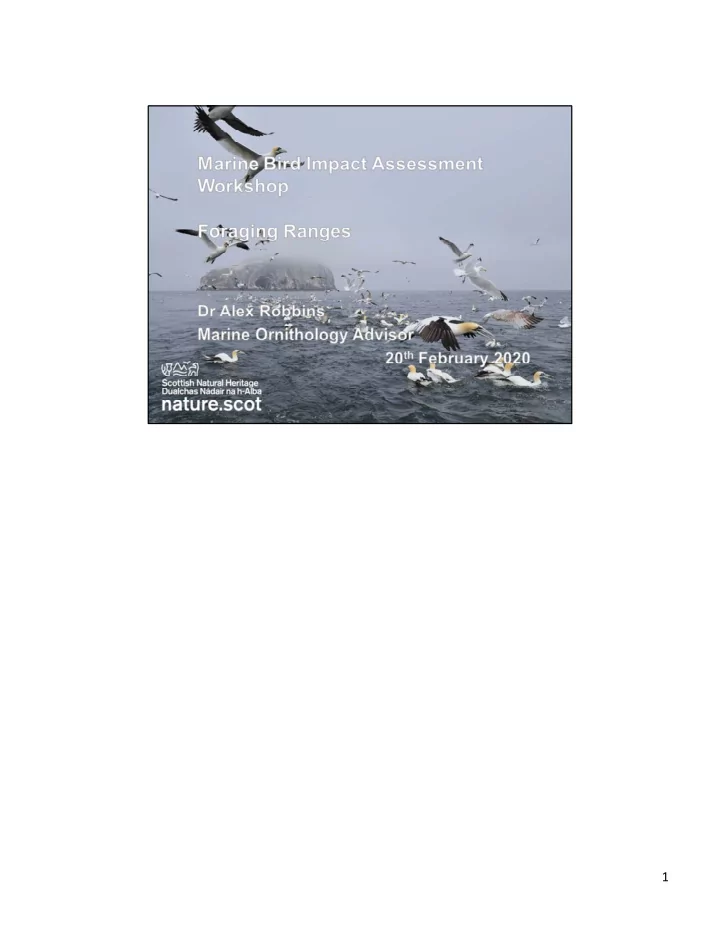
1 2 Crown estate funded an update to Thaxter et al 2012. Thaxter - - PDF document

1 2 crown estate funded an update to thaxter et al 2012
SMART_READER_LITE
LIVE PREVIEW

1 2 Crown estate funded an update to Thaxter et al 2012. Thaxter - - PDF document

1 2 Crown estate funded an update to Thaxter et al 2012. Thaxter reviewed foraging range info for 25 species, however since it was published there has been a huge growth in the number of tracking studies and improvements in technology, such as


slide-1
SLIDE 1

1

slide-2
SLIDE 2

2

slide-3
SLIDE 3

Crown estate funded an update to Thaxter et al 2012. Thaxter reviewed foraging range info for 25 species, however since it was published there has been a huge growth in the number of tracking studies and improvements in technology, such as remote download which have enabled a greater number of species to be studied. Report includes FAME, RSPB STAR and BTO tracking datasets Focuses on the breeding season interactions of 27 species. This now includes black guillemot and great black‐backed gull 3

slide-4
SLIDE 4

4

slide-5
SLIDE 5

5

slide-6
SLIDE 6

6

slide-7
SLIDE 7

7

slide-8
SLIDE 8

8

slide-9
SLIDE 9

9

slide-10
SLIDE 10

10

slide-11
SLIDE 11

Mean of maximum foraging ranges recorded at each site. Site specific foraging ranges have been produced as a part of the Woodward et al report, this enables us to explore site‐specific variation to estimates. We are still in the process of considering how best to use these estimates (given they only exist for a few species) however, at this stage we are reviewing whether the this is of more use when exploring core foraging ranges and apportioning. In terms of the lower threshold of connectivity the mean max is likely to provide a better threshold for the assessing the ‘long list’ and likely significant effect. 11

slide-12
SLIDE 12

12

slide-13
SLIDE 13

13

slide-14
SLIDE 14

14

slide-15
SLIDE 15

15

slide-16
SLIDE 16

16

slide-17
SLIDE 17

17

slide-18
SLIDE 18

Note that the wording for breeding seabirds does not reference a population number. We’re acknowledging that birds could be from any colony within range and could also include non‐breeders, sabbaticals & juveniles for which we don’t have connectivity info for. The assessment on the population is made through the assessment of the breeding colony. Once sites are designated there will be documentation that published that includes a list (although not exclusive) of colonies within foraging range of the marine SPA. 18

slide-19
SLIDE 19

Points to consider here are the buffers around developments and likely displacement

  • distances. A development outside might cause disruption to birds inside for example

vessel route through sites etc. Also worth thinking about data obtained from surveys with flight directions, do they show any commuting routes? 19

slide-20
SLIDE 20

Cabling route going through marine SPAs for example may have LSE but outwith they would not. 20

slide-21
SLIDE 21

21

slide-22
SLIDE 22

22