1. 1.#INTRODUCTIONS# - - PDF document

1 1 introductions
SMART_READER_LITE
LIVE PREVIEW

1. 1.#INTRODUCTIONS# - - PDF document

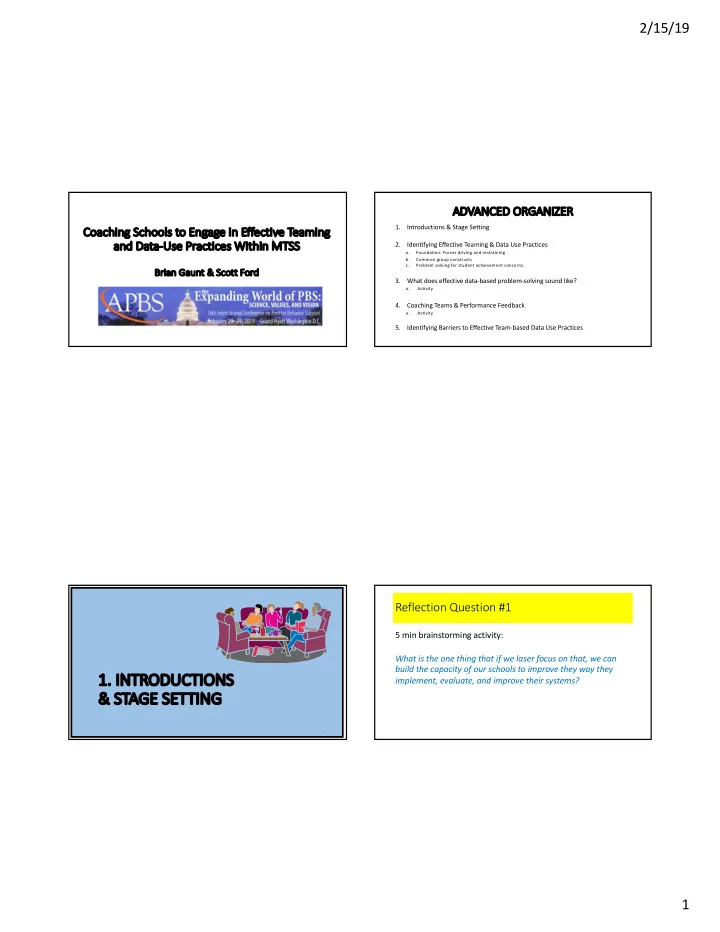
2/15/19 AD ADVAN ANCE CED'ORGAN ANIZER 1. Introductions-&-Stage-Setting Coaching)School Coa ools)to) o)Engage)in)Effective)Teaming) and)Data6Us an Use)Practices)Within)MT MTSS 2.


slide-1
SLIDE 1

2/15/19 1

Coa Coaching)School

  • ols)to)
  • )Engage)in)Effective)Teaming)

an and)Data6Us Use)Practices)Within)MT MTSS

Br Brian)Gaunt)&)Scot

  • tt)For
  • rd

AD ADVAN ANCE CED'ORGAN ANIZER

1. Introductions-&-Stage-Setting 2. Identifying-Effective-Teaming-&-Data-Use-Practices

a. Foundation:-Forces-driving-and-restraining b. Common-group-constructs- c. Problem-solving-for-student-achievement-concerns.

3. What-does-effective-dataFbased-problemFsolving-sound-like?

a. Activity

4. Coaching-Teams-&-Performance-Feedback

a. Activity-

5. Identifying-Barriers-to-Effective-TeamFbased-Data-Use-Practices

1. 1.#INTRODUCTIONS# &# &#STAGE GE#SETTING

3

Reflection*Question*#1

5"min"brainstorming"activity: What%is%the%one%thing%that%if%we%laser%focus%on%that,%we%can% build%the%capacity%of%our%schools%to%improve%they%way%they% implement,%evaluate,%and%improve%their%systems?

slide-2
SLIDE 2

2/15/19 2

Data Decisions

HA HAVING'DATA'IS'INSUF UFFICIENT'FOR'IMPROVEMENT!

”The%mere%presence%of%data%does% not%automatically%imply%that%usable% information%is%available.%%Educators% need%support%to%use%these%data%to% the%fullest%extent.”

! W aym an,(J.(C.((2005).((Involving(teachers(in(data!driven(decision!m aking:( Using(com puter(data(system s(to(support(teacher(inquiry(and(reflection.( Journal(of(Education(for(Students(Placed(At!Risk,(10,(295!308.

Coaching%and%leading%should%(a)%provide%direct%training% and%technical%assistance%to%classroom%teachers%and% students;%and%(b)%ensure%organizational%sufficiency%and% alignment%to%sustain%those%training%supports%over%time. @ Fullan,%M.%&%Knight,%J.%%(2011)

ACT CTIVITY:((Gallery(Walk

  • In#a#small#group#of#three#to#four,#identify#and#list#variables#that#
  • bstruct#effective#team8based#data#use/analysis#on#your#campus
  • Once#completed,#identify#your#members#by#first#name#on#your#list#

and#post#the#list#on#the#wall

  • Everyone#take#a#moment#to#wander#around#the#room#and#look#at#

each#other’s#list.##Notice#similarities#and#differences.##What#are#some#

  • f#the#most#common#similarities?

AC ACTIVITY:((Gallery(Walk

What%are%some%of%the%most%common%similarities? What%themes%or%groups%of%variables%seem%to%appear%frequently?

slide-3
SLIDE 3

2/15/19 3

Data gathering and interpretation are not value-free, but freighted with emotional predispositions and cognitive preconceptions.

!Joanna&Macy The&Dharma&of&Natural&Systems

SY SYST STEM&VARIABLES&&AFFECTING&DATA&USE LE LEADERSH SHIP*RESP SPONSI SIBILI LITIES

The The*followi

  • wing

ng*ar are*correlated* d*wi with* h*impr prov

  • ved*

d*stude udent*out utcomes:

  • 1. Establish*and*articulate*a*cl

clear&vi visi sion&wi with*a*sense*

  • f
  • f*urgency*for*change,*maintain*focus*and*deliver*

a*consistent&message&of&implementation over* time* 2.

  • 2. Fo

Focus&on&schools&(districts*are*successful*when* schools*are*successful) 3.

  • 3. Cr

Create&relationships&with*stakeholders*based* upon*mutual*respect*and*shared*responsibility

  • 4. Engage*in*expert*pr

probl blem&solving& ng&

  • 5. Invest*in*pr

professional nal&de developm pment

11 (Barnhardt,*2009;*Crawford*&*Torgeson,*2007;*Leithwood,* 2010;*Louis*et*al.,*2010;) 12

CO COACHING( RE RESPONSIBI BILITIES

March(&(Gaunt,(2013;(Fullan &(Knight,( 2011;(Marsh(et(al.,(2008;(King(et(al.,( 2004;(Kowal &(Steiner,(2007

slide-4
SLIDE 4

2/15/19 4

LE LEADING(+(COACHING

Leadership*Characteristics

  • Vision,'focus,'consistent'

message'of' implementation

  • Focus'on'schools
  • Relationships'based'on'

respect'&'shared' responsibility

  • Expert'problem<solving
  • Investment'in'PD

Coaching*Responsibilities

  • Effective'interpersonal'

communication'

  • Data<based'problem<

solving

  • Content'Knowledge
  • Team'Facilitation
  • Supportive'leadership
  • Provide'PD
  • Evaluate'impacts

13

“D “DATA% A%COACH CH”

  • Specific'dimensions'of'a'data/coach'include:
  • Procedural'assistance'in'identifying'and'addressing'data'quality'

and'improving'the'use'of'data'for'planning'and'improvement.

  • Modeling'and'skill/building'assistance'in'focusing'data'use'around'

critical'questions'and'using'data'to'monitor'progress'of'students'

  • n'multiple'measures'and'areas'of'need.

Lachat,'M.'A.,'&'Smith,'S.'(2005).''Practices'that'support'data'use'in'urban'high' schools.'Journal'of'Education'for'Students'Placed'At/Risk,'10,'333/349. State

LE LEADERS'…AS'COACH CHES'…AS'LE LEADERS…

Leaders Leaders Leaders Leaders

(District) (Principals2&2 Coaches) (Teachers)

Students2&2Parents

(State)

who2Coach who2Coach who2Coach

District Building Classroom Student 15

who2Coach

LE LEADE DERS'…AS'COACHE HES'…AS'LE LEADE DERS…

Leaders Leaders Leaders Leaders

(District) (Principals1&1 Coaches) (Teachers)

Students1&1Parents

(State)

who1Coach who1Coach who1Coach

16

who1Coach

State District Building Classroom Student

slide-5
SLIDE 5

2/15/19 5

Coa Coaching)teams)for

  • r)mor
  • re)effective)data2ba

based) d) de decision2ma making,)requires)us)to…

  • Learn&to&identify&and&observe&for&5&teaming&constructs
  • Discuss&using&a&problem8solving&process&to&provide&structure&to&team8

based&data&use&practices.

  • Learn&to&identify&teams’&communication&barriers&to&discussing&data.
  • Learn&how&to&analyze&forces&that&push/pull&on&teams’&productivity.
  • Learn&how&to&provide&performance&feedback&to&improve&teaming&and&

data&use&practices

2. 2.#IDENTI TIFYI FYING#EFFE FFECTI TIVE#TE TEAMING# &# &#DATA#USE#PRACTICES

Overview'of'Force'Field'Analysis,'Group'Constructs,'and'Problem'Solving'Procedures

DIFFERENT SAME+

slide-6
SLIDE 6

2/15/19 6

PROBLEM( SOLVING

Force&Field&Analysis

FO FORCE&FIELD

Sociologist)Kurt)Lewin)developed)his)'force)field)analysis')model)(1951)

  • Describes)current)level)of)performance)as a"state"of"equilibrium"

between"the"driving"forces"that"encourage"development"and"the" restraining"forces"that"discourage"it

FO FORCE&FIELD

Equilibrium)exists)because)forces)acting)for)development)are) balanced)by)forces)acting)against)change

RESTRAINING FORCES DRIVING) FORCES

slide-7
SLIDE 7

2/15/19 7

FO FORCE&FIELD

Increasing*driving*forces*is*not*enough*for*change

  • restraining*forces*remain*in*place,*and*as*long*as*they*remain*in*place*it*becomes*

harder*to*use*the*driving*forces

RESTRAINING FORCES DRIVING* FORCES

FO FORCE&FIELD

Decreasing*restraining*forces*becomes*the*focus

  • specific*strategies*are*developed*to*lessen*their*force

RESTRAINING FORCES DRIVING* FORCES

FO FORCE&FIELD&ANALYSIS&AS&PROBLEM&SOLVING

CLARIFY(CONTEXT(AND IDENTIFY(OBJECTIVE( FOR(CHANGE IDENTIFY(DRIVING/ RESTRAINING FORCES CHANGE(STRATEGY(TO( REDUCE(RESTRAINING( FORCES MONITOR/ EVALUATE

  • What&is&the&

current&state?

CONTEXT

  • What&needs&to&

be&developed?

CHANGE

  • What&

encourages& development?

DRIVING

  • What&

discourages& development?

RESTRAIN

  • How&should&

restraints&be& addressed?

STRATEGY

  • Does&the&

current&state& change?&&If&so,& how?

MONITOR

Define&the&Problem Problem&Analysis Develop& and& Implement&Plan Evaluate

FO FORCE&FIELD&ANALYSIS&AS&PROBLEM&SOLVING

slide-8
SLIDE 8

2/15/19 8

LE LEADERS'…AS'COACH CHES'…AS'LE LEADERS…

Leaders Leaders Leaders Leaders

(District) (Principals1&1 Coaches) (Teachers)

Students1&1Parents

(State)

who1Coach who1Coach who1Coach

29

who1Coach

State District Building Classroom Student

Group&Constructs

ID IDENTIF IFYIN ING)HIG IGH+FUNCT CTIONING)GROUPS

WHAT%DO%THEY%LOOK%LIKE%AND%SOUND%LIKE

FI FIVE%GROUP%CONSTRUCTS

Norm Goal Role Structure Cohesion

THE6VISIBLE6AND6INVISIBLE6GROUP Yvonne6Agazarian and6Richard6Peters

slide-9
SLIDE 9

2/15/19 9

STRUCT CTURE

WHAT%YOU%ALREADY%KNOW

Frameworks*that*the*group*uses* to*organize*and*communicate* information

  • Meeting agenda
  • Individuals invited to meeting

(members)

  • Amount of time set for meeting
  • Specific models used by the group
  • Datawise
  • Response to Intervention
  • Team Initiated Problem Solving

(TIPS)

BUT,%CONSIDER%THIS… Correcting*weak*structure*is*one*of*the* easiest*and*most*common*group* constructs*to*address,*however…

Norm Goal Role

Structure

Cohesion

ST STRUCTURE:((Consideration

A"struggling"PLC"group"is"coached"by"an"administrator"to"use"the" Datawise data"analysis"process.""The"administrator"trains"the"group"in"the" model.""Within"three"weeks"the"PLC"stops"meeting"altogether"because"of" time"constraints"and"conflicts"within"the""group.

…"ADDRESSING"STRUCTURE"ALONE"IS"TYPICALLY"NOT" ENOUGH"TO"ASSIST"WITH"GROUP"DEVELOPMENT

STRUCT CTURE:((Recommendation

  • Meeting'structure'is'clear'and'relevant
  • Agenda/notes
  • Time
  • Action'items
  • The'information'structure'is'well'understood,'

supports'the'work'of'the'group,'and'can'be'used'with' some'level'of'skill'by'all'members

  • Structure'is'addressed'in'concert'with'all'other'

constructs

NO NORMS

WHAT%YOU%ALREADY%KNOW

Determines)the)range)and)type)of) behavior)that)the)group)considers) ‘acceptable’

BUT,%CONSIDER%THIS…

Norm

Goal Role Structure Cohesion

Every group)norms

  • Intentionally
  • Unintentionally
slide-10
SLIDE 10

2/15/19 10

NO NORMS:''Cons nside deration

At#the#start#of#the#school#year,#a#grade1level#PLC#adopts#a#set#of#‘norms’#that#one#of# the#members#saw#at#a#training#she#attended#during#the#summer,#and#the#group# never#looks#at#them#again#for#the#rest#of#the#year. NORMING'IS'NOT'AN'EVENT- IT#IS#AN#ONGOING#PROCESS#THAT#TAKES#PLACE#IN#EVERY GROUP

NO NORMS:''Recommendations

  • Intentional)and)continuous)consideration
  • Representative)of)and)unique)to)the)current group
  • A)cookie8cutter,)one8size8fits8all)approach)misses)the)point
  • Established)through)discussion)and)consensus)of)all)members
  • Monitored)and)reviewed)regularly

GO GOALS

WHAT%YOU%ALREADY%KNOW

Describes(the intended(outcomes(

  • f(group(interactions

BUT,%CONSIDER%THIS…

Two(types(of(goals(are(always(in( place(

!Explicit(Goal

  • The(goal(the(group(says it(has

!Implicit(Goal

  • The(goal(the(group(acts like(it(has

Norm

Goal

Role Structure Cohesion

GO GOALS:''Consideration

A"PLC"meets"to"common"assessment"data.""However,"the"group"spends" it’s"time"expressing"frustration"with"district"expectations EXPLICIT"GOAL:"" process"information"to"assist"campus"development IMPLICIT"GOAL:"" support"one"another"around"frustration

IMPLICIT'GOALS'TRUMP'EXPLICIT'GOALS ! Without'alignment'it'is'unlikely'explicit'goals'will'be'met

slide-11
SLIDE 11

2/15/19 11

GO GOALS:''Recommenda ndations ns

  • Pay$attention$to$implicit$goals$(how$the$group$behaves)$in$relation$to$

explicit$goals$(why$the$group$says$it$has$come$together)

  • The$closer$implicit$goals$align$with$explicit$goals$the$more$likely$the$group$will$

involve$itself$in$productive$work

RO ROLES

WHAT%YOU%ALREADY%KNOW

Specific'types'of'behavior' associated'with'members'within'a' group

BUT,%CONSIDER%THIS…

Members'in'a'group'typically'

  • ccupy'more'than'one'role'at'a'

time

Norm Goal

Role

Structure Cohesion

RO ROLES:''Consideration

The$Department$Chair$functions$as$the$PLC$group$facilitator$and$ typically$organizes$and$summarizes$all$the$data$for$the$committee$ members

  • GROUP$ROLE:$$

Department$Chair;$PLC$Facilitator

  • PERSON$ROLE:

Caretaker

ALL ROLES'SHOULD'SUPPORT'GROUP'DEVELOPMENT

RO ROLES:''Recommendation

  • GROUP&ROLES&should&be&clear&and&relevant&to&the&work&of&the&group
  • PERSON&ROLES&should&support&group&development
slide-12
SLIDE 12

2/15/19 12

CO COHESION

WHAT%YOU%ALREADY%KNOW

The$strength$of$bonding$within$ the$group$system

BUT,%CONSIDER%THIS…

Cohesion,$or$lack$of$cohesion,$can$ be$clearly$seen$and$heard$at$the$ close$of$meetings$

Norm Goal Role Structure

Cohesion

CO COHESION:))Considerat ation

Members'have'been'waiting'for'the'PLC'lead'to'close'the'meeting.''They' already'have'gathered'their'things'gathered'together'and'ready'to'go.''AS'soon' as'the'PLC'lead'acknowledges'the'meeting'is'over,'members'rush'out'of'the' door.'' AN#UNCOHESIVE#GROUP#IS#A#SIGN#THAT#THE#GROUP# NEEDS#ATTENTION ! Canary#in#a#coal#mine!

CO COHESION:))Take)Aw Away

  • Commitment(to(the(task-at-hand
  • Energy(of(members(to(do(the(work
  • Support(for(each(other’s(efforts
  • Sense(of(development/moving(ahead

PR PROFILE(OF(PR PROBL BLEM(SOLVING NG(GROUP

Norm Goal Role Structure Cohesion

Norm Goal Role Structure Cohesion

slide-13
SLIDE 13

2/15/19 13

CONSTRUCT DESCRIPTION NORM Norms)emerge)through)trial)and)error GOAL Alignment)of)implicit)to)explicit)goals)is)weak)or)non=existent ROLE Roles)are)unclear)and/or)do)not)support)the)development)of)the)group STRUCTURE Structure)doesn’t)exist,)isn’t)well)understood,)not)used)with)skill)or)is)the)only)construct)that) gets)addressed COHESION Weak)or)nonexistent)cohesion)

  • people)can’t)wait)to)get)out)of)the)meeting)and)on)to)what)they)want)to)do)outside)of)the)

group

ST STEREOTYPICAL, GR GROUP

CONSTRUCT DESCRIPTION NORM Norms)are)focused)on)and)unique)to)the)current)group;)regularly)monitored)and)regularly) reviewed GOAL Goals)are)aligned:))the)group)interacts)(implicit))in)accordance)to)the)stated)reason)for)coming) together)(explicit) ROLE All)roles)support)the)development)of)the)group STRUCTURE Structure)is)clear,)wellIunderstood,)wellIused)and)facilitates)the)flow)of)information COHESION Energy)exists)within)the)group)to)stay)with)the)work

HI HIGH GH$FU FUNCTIONING+ GR GROUP

Norm Goal Role Structure Cohesion

ACT CTIVITY:((Think/Pair/Share

Norm Goal Role Structure Cohesion

Think&of&a&professional&group&with& which&you’ve&had&direct&experience&that& you&would&identify&as&‘high: functioning’.

  • What4was4the4group?
  • What4was4the4work4you4were4

involved4in4with?

  • Why4would4you4consider4it4to4be4

high>functioning?4 ! Try4to4talk4about4the4strengths4

  • f4the4group4using4the4five4

constructs.

Problem(Solving(Procedures

slide-14
SLIDE 14

2/15/19 14

WA WARNING!

Training'school'teams'on'effective'problem'solving'procedures'requires' a'long7term'commitment'to'comprehensive'professional'learning' supports'involving'a'continuous'improvement'approach.

For'our'purposes'and'Workshop'Objectives:

  • Demonstrates'what'a'structured'problem'

solving'process'can'involve?

  • Gives'us'a'chance'to'reflect'on'our'own'

practices'at'our'own'sites.

  • Allows'us'to'consider'the'teaming'

practices'and'leadership/coaching' supports'needed'to'ensure'effective' problem'solving'practices.

EV EVER ER$TR TRY$ Y$TH THIS…?

Take%a%large%family%of% about%8%or%more%people% including%kids%to%a% theme%park?

HO HOW$ABOUT UT$THI HIS…?

  • Your%team%of%8%people%convenes%to%review%quarterly%data%for%a%

particular%grade%level%with%no%advanced%preview%of%the%multiple% sources%of%data%(6%different%sources,%involving%5%different%types%of% report%formats)%and%you%have%45%minutes%to%decide%what%to% recommend%to%leadership%to%improve%student%outcomes.

  • The%data%is%placed%in%front%of%the%team%in%a%pile.
  • What%typically%happens%next%...in%your%opinion%or%experience?

OB OBSTACLES)TO) O)CON ONSENSUS US)ABOUT OUT) DA DATA)USE)&)INTERPRETATION

  • Different)conceptions)about)“data”)
  • (Coburn)&)Talbert,)2006).
  • Timely)Access)
  • (Lachat &)Smith,)2005)
  • Lack)of)appropriate)data)
  • (Coburn)&)Talbert,)2006;)Kerr)et)al.,)2006;)Protheroe,)2001)
  • Limited)Tech)Capacity)or)Not)UserQFriendly)
  • (Chen)et)al.,)2005)
  • Inefficient)or)incorrect)entry)and)mgmt
  • (Lachat &)Smith,)2005)
  • Lack)of)Educator)Skills)
  • (Kerr)et)al.,)2006)

RESTRAINING FORCE

How we collaborate as a team about the interpretation and use

  • f our data will either

facilitate or restrain our solutions.

slide-15
SLIDE 15

2/15/19 15

DI DIFFERENT NT(MODE DELS(OF(PS

  • Tilly,&2002;&
  • Behavioral(Consultation((Kratochwill &(Bergan,(1990;(Sheridan(et(al.,(1996).
  • IDEAL(problem(solving(model((Bransford &(Stein,(1984).
  • Functional(Analysis(of(Behavior/Functional(Behavioral(Assessment((Repp &(Horner,(1999;(Tilly(et(al.,(

1998).

  • Scientist(Practitioner(Model((Barlow,(Hayes(&(Nelson,(1984).
  • CurriculumUbased(Measurement((Deno,(1995;(Shinn,(1989).
  • Applied(Behavior(Analysis((Baer,(Wolf,(Risley,(1968)
  • Action(Research((Calhoun,(1994).
  • Heartland(AEA’s(ProblemUsolving(Model((Reschly &(Ysseldyke,(1995).
  • Team(Initiated(Problem(Solving((TIPS)(((Todd(et(al.,(2011)
  • Al

All&have&same&4&thematic&questions: 1. 1. Wh What(is(the(problem? 2. 2. Wh Why(is(the(problem(occurring? 3. 3. Wh What(will(we we(do(about(it? 4. 4. Is Is(the(plan(working?

DRIVING' FORCE Florida'Adopted'Model'for'Instructional'Data< Based'Decision<Making:'http://www.florida< rti.com/gtips/index.html

CR CROSSWAL ALK) K)OF) F)3) 3)MODELS

Handout

LE LEVELS% LS%OF%PROBLE LEM%SO SOLVING

  • District%(PK712)%Focused%(Organizational,Consultation)
  • (Barriers%affecting%all%schools)
  • School%Building%Focused%(Problem,Solving,at,Tier,1)
  • (Barriers%affecting%a%whole%school)
  • Classroom%Focused%(Problem,Solving,at,Tier,1,or,2)
  • (Barriers%affecting%a%class/grade%level%of%students)
  • Student%Focused%(Problem,Solving,at,Tier,2,or,3),
  • (Barriers%affecting%a%student)

Impact for Investment

Increasing*Scope*

  • f*Problem3

Solving

59

(B (BASI SIC)( )(GUIDING(QUESTIONS: S:

1. What'is'the'specific'problem'to'be'addressed?

  • What%is%the%problem?%(Define%in%very%specific%and%measurable%terms)
  • What%source(s)%of%data%were%used%to%identify/recognize%this%problem?
  • What%is%the%scope%of%the%problem%> (school>wide;%grade>wide;%classroom;%small%group;%individual?)
  • Do%we%have%a%specific%goal%for%these%students%to%reach?

2. What'are'some'possible'reasons'why'students'are'not'meeting'Tier'1'expectations'for' behavior?

  • Consider%different%”whys”%(e.g.,%curriculum,%instruction,%skill%deficits,%motivation,%etc).
  • Which%of%those%reasons%are%”valid”%and%“alterable”?%%
  • Do%we%have%evidence%for%our%hypotheses?

3. What'intervention(s)'will'we'select'and'implement?

  • What%intervention%options%exist%to%match%the%students’%need(s)?
  • Who%will%provide%the%intervention
  • Who%will%support%the%interventionist%to%ensure%fidelity?
  • How%will%we%evaluate%success%of%the%plan?%…and%what%is%the%goal%of%the%intervention?

4. Is'the'intervention'plan'working?

  • Do%we%see%progress%to%to%the%goal(s)%of%our%intervention?
  • Do%we%see%improvement%in%the%Tier%1%data%sources%that%triggered%a%need%for%interventions?
slide-16
SLIDE 16

2/15/19 16 3. 3.#What#doe

  • es#Effective#Data2ba

based# ed# Pr Problem#Solving#Sound#Like?

Problem(Solving(Procedures(&(Team5based(Communication(Profiles

Reflection*Question*#2

5"min:" For"each"of"the"steps"of"problem"solving,"what"do"you"see"or" hear"missing"from"your"teams’"data"conversations?

PR PROBLEM(SOLVING(PR PROCESS

DEFINE THE PROBLEM: Context and Change Objective What Do We Want Students to KNOW and Be Able to DO? PROBLEM ANALYSIS: Driving/Restraining Forces Why Can’t They DO It? IMPEMENT THE PLAN: Change Strategy What Are WE Going To DO About It? EVALUATE: Monitor Is It Working?

64

slide-17
SLIDE 17

2/15/19 17

St Step%1:%Identi tifying%a%“Problem”

  • Purpose(of(this(step:"establish"the"priority"for"problem"solving"and"verify"

the"scope"of"problem"to"be"solved"in"relation"to"expectation"or"goal

  • Outcome(of(this(step:"develop"a"measurable"and"objective"statement"of"

the"problem"and"a"goal"or"expectation"statement."

  • (Problem"="the"difference"between"expected"and"occurring).

65

Tier%1%Problem%Identification:% Guiding%Questions

1. What'are'the'trends'in'our'discipline'referral'rates'for'the'past'355'years? 2. How'effective'is'our'overall'Tier'1'for'behavior? 3. What'are'the'current'student'behavior'performance'patterns? 4. What'will'be'our'priority'for'problem'solving'or'planning? 5. What'will'be'our'observable'and'measurable'statement'of'the'problem?

66

Non$Examples

  • Problem(Statement:
  • Students(are(non1compliant(and(

disruptive.

  • Goal(Statement:
  • Students(will(follow(teacher(

directions. Good/Examples

  • Problem(Statement:
  • When(asked(to(engage(in(classwork(in(

their(classrooms,(the(students(engage( in(disruptive(behaviors(to(avoid( completing(classwork.

  • Goal(Statement:
  • By(the(end(of(the(second(semester,(

students(will(complete(at(least(80%(of( all(classwork(assigned(across(all( classes.

DEVEL DEVELOPING* NG*A*STATEM EMENT ENT*OF*THE* E*PROBLEM EM* AN AND*A* A*GOAL AL

Im Implementing*PBIS IS*in*the*Classroom:*Go Goal als

Support' Teachers

Implementing' effective'classroom' management' practices Address'groups'of' students'with' challenging'behavior

Increase'or' Enhance

Instructional'Time Student'Engagement Classroom'Climate

Decrease

Classroom'''' Problem'''' Behaviors

slide-18
SLIDE 18

2/15/19 18

St Step%2:%An

Analyzing Wh

Why%the%Problem%Exists

  • Different(ways(to(organize(all(the(evidence5based(reasons(to(

consider(“why”.

  • Functional*academic*behaviors**(e.g.,*Daly*et*al.*1997).
  • Instructional*Hierarchy*(Haring*&*Eaton,*1978;*Ardoin &*Daly,*2007)
  • FunctionFbased*behavior*analysis*(Cooper*et*al.,*2007;*Iwata,*1982)*
  • Ecological*variables*(e.g.*ICEL*F Upah &*Tilly,*2002;*Ysseldyke et*al.,*2012)
  • Don’t&get&hung&up&on&which&to&choose…

St Step%2:%Analyzi zing%Why%the%Problem%Exists

  • Focus&on&“alterable”,&“actionable”,&and&“valid”
  • Consider:
  • Do&teams&have&a&content&expert&to&help&develop&potential&reasons?
  • Which&hypotheses&are&alterable?&Valid?&Why&is&this&important?
  • Which&hypotheses&should&be&prioritized?
  • See&Handouts:&Ecological&Factors&and&ICEL/RIOT&Matrix
  • Note:&think&of&this&step&as&searching&for&“barriers”&or&“obstacles”&to&

students&reaching&their&learning&and&socialNemotional/behavioral&goals?

ICEL/RIOT)Matrix

  • Many%different%ways%to%organize%

variables%that%can%impact%student% learning%or%behavior.

  • ICEL:%Variable%domains%or%categories%

to%develop%hypotheses

  • RIOT:%Validation%options%or%methods%

to%test%out%our%hypotheses

72

Special(Thanks:( Wake(County,(VA(and(Chicago(Public(Schools

slide-19
SLIDE 19

2/15/19 19

Data gathering and interpretation are not value-free, but freighted with emotional predispositions and cognitive preconceptions.

!Joanna&Macy The&Dharma&of&Natural&Systems GEN GENER ERATING( G(HY HYPO POTHE HESES(. IN INDIV IVID IDUAL(STUDENT(EXAMPLE

Problem(ID:( !Problem(statement(- When(disembarking(the(school(bus(on(campus,(Brian( physically(pushes(or(verbally(teases(other(students…because…

  • a. Statement(of(why((hypothesis):
  • Consider(variables(in(the(“Ecological(Factors”(handout.
  • Hypothesis:(

GE GENERATI TING( G(HYP YPOTH THESES(. TI TIER(1( 1(EXAMPLE

Problem(ID:( !43% 43%$of$stude udents$ar are$receiving$ ng$2$ 2$or$more$referral als$for$di disrup uption$ n$in$ n$ma many cl classr ssrooms$ s$during$large$group$instruct ction$because se…

  • a. Statement$of$why$(hypothesis):
  • Use$handout$again…but$focus$on$systemic$factors$and$schoolwide$conditions$

that$adults$influence$(e.g.,$fidelity$of$practices).

  • Hypothesis:

Problem Analysis Intervention Design

The$desired$goal$is$not$occurring$because$______________. If$___________$would$occur,$then$the$problem$would$be$reduced.

slide-20
SLIDE 20

2/15/19 20

GE GENE NERATING( NG(AND( ND(VALIDATING( NG(HY HYPOTHE HESES

  • Statement(of(the(problem
  • 47%$of$all$students$in$the$school$are$receiving$2$or$more$referrals$for$disruption$in$classroom$locations…
  • Brainstorm(statements(about(“why”.
  • …because$teachers$are$not$recognizing$students$for$engaging$in$classroom$rules.
  • Change(statements(into(prediction(statements.
  • IF$teachers$provided$higher$amounts$of$positive$attention$and$rewards$to$students$for$engaging$in$

classroom$rules,$THEN$students$in$those$classrooms$will$follow$classroom$rules$more$consistently$resulting$ in$fewer$referrals$for$disruption.

  • Turn(prediction(statements(into(assessment(questions.
  • Are$teachers$providing$sufficient$positive$attention$for$engaging$in$classroom$rules?
  • Determine(appropriate(method(to(test(questions((validate).
  • Review$Records?$$$$$$Observe?$$$$$$$Interview?$$$$$$$$Test?

FO FORMAT'FO FOR'HYPOTHESIS'VALIDATION

Do#we#have#evidence#to#support#our#hypothesis?: …because teachers are not recognizing students for engaging in classroom rules. If teacher provided higher amounts of positive attention and rewards to students for engaging in classroom rules, then students in those classrooms will follow classroom rules more consistently resulting in fewer referral for disruption. Hypothesis Prediction

Assessment'Question(s):

Are$teachers$not$recognizing$students$for$engaging$in$classroom$rules?

Interviews?$$Focus$Groups?$$Surveys?$$Written$documents?$ Observations? What'answers'did'we'find?: Where'are'the'answers?: Ex.$$Students$report$that$they$have$been$taught$the$classroom$ rulesC$Teachers$of$targeted$students$were$observed$to$use$ reward$system$to$recognize$students$following$rules 43%$of$students$are$receiving$2$or$more$referrals$for$disruption$in$many classrooms$during$large$group$instruction$ because… Expectations,-rules-and-routines-are-not-taught-consistently

slide-21
SLIDE 21

2/15/19 21

43%$of$students$are$receiving$2$or$more$referrals$for$disruption$in$many classrooms$during$large$group$instruction$ because…Expectations,-rules-and-routines-are-not-taught-consistently

Don’t&Forget&Interactions…

  • Important)to)also)consider)academic)and)behavior)interactions.

Only%38%%of%6th grade%students%are%proficient%on%the%state%language%arts% assessment EXAMPLES:

  • (ACCESS)TO)INSTRUCTION):))…because%non<proficient%students%are%

chronically%absent%(absent%10%%or%more%days).

  • (BEHAVIOR):)…because%non<proficient%students%are%disruptive%during%

classroom%instruction.

Hypothesis*1:*Attendance

Only%38%%of%6th grade%students% are%proficient%on%the%state% language%arts%assessment… …because%non;proficient% students%are%chronically%absent% (absent%10%%or%more%days).

6th Grade)Students % Proficient)on) State)LA) Assessment %)Non8Proficient on) State)LA) Assessment 0"9 days(absent 37% 41% 10"18 days(absent 1% 10% 19+(days(absent 0% 11%

Hypothesis*2:*Behavior

Only%38%%of%6th grade%students% are%proficient%on%the%state% language%arts%assessment… because%non;proficient%students% are%disruptive%during%classroom% instruction.

6th Grade)Students % Proficient)on) State)LA) Assessment %)Non8Proficient

  • n)State)LA)

Assessment 0"1$Classroom Referrals 32% 6% 2+$Classroom$ Referrals 1% 61%

slide-22
SLIDE 22

2/15/19 22

Validated(Hypotheses:(Links(to(Tier(1( Improvements

!43%$of$students$are$receiving$2$or$more$ referrals$for$disruption$in$many classrooms$during$large$group$ instruction$because…

  • Instruction
  • Very%few%opportunities%to%respond%(OTRs)%

are%provided%to%students%during%large% group%instruction

  • Curriculum
  • Curriculum%is%at%students’%frustrational

level%rather%than%instructional%level

  • Environment
  • Expectations,%rules%and%routines%are%not%

taught%consistently

! Tier%1%Improvement%Strategy:% General%Ideas

  • Instruction

– Increase%Opportunities%to%Respond

  • Who,(what,(how,(when,(eval?
  • Curriculum

– Utilize%curricular%materials%that%are%at% students’%instructional%levels

  • Who,(what,(how,(when,(eval?
  • Environment

– Teach%the%expectations,%rules%and% routines%consistently

  • Who,(what,(how,(when,(eval?

QU QUESTION) N)3:)WHAT)WILL)WE)DO DO)ABOUT)IT?)

  • YOUR%PLAN%SHOULD%CONTAIN:
  • 1. Specific%details%on%who%will%provide%the%intervention%and%what%it%will%involve%

a. e.g.,%materials,%procedures,%schedule,%transition%practices,%etc.

  • 2. Specific%details%on%who%will%support%the%interventionist%to%ensure%fidelity%of%

the%intervention%and%what%that%support%will%involve.

a. Needs%of%the%interventionist%will%drive%all%of%these%details.

  • 3. Specific%details%on%how%you%will%measure%successfulness%of%the%plan.

1. What%measures%for%tracking%student%progress?%%When?%How%often?%By%whom?%Etc. 2. What%methods%used%to%observe%and%document%fidelity%of%intervention?%% 3. What%criteria%is%needed%to%determine%the%intervention%worked? 4. What%decisions%will%you%make%based%on%potential%data%outcomes?%(i.e.,%decisionRrules)

Decision(Rules:(Why,(What(for?

Evidence(based(intervention(linked(to( verified(hypothesis(planned Evidence(based(intervention( implemented Student( Outcomes((SO)( Assessed Treatment( Fidelity((TF)( Assessed Data?based( Decisions Continue(Intervention Implement(strategies(to(promote( treatment(fidelity Modify/change(Intervention

+SO((((((+TF ?SO((((((+TF ? S O ( ( ( ( ( ( ? T F

From(Lisa(Hagermoser(Sanetti,(2008(NASP(Convention

QU QUESTION) N)4:)IS)THE)PLAN) N)WORKING? NG?

  • Recall:'Step'3'of'PS
  • Plan'Components:
  • Intervention'implementation'and'use
  • Supports'to'ensure'fidelity'of'plan'design
  • Methods'and'procedures'to'determine'progress'and'success.
  • Here'we'want'to'look'at'two'data'sources:'
  • Progress'monitoring'data'(e.g.,'good,'questionable,'or'poor'student'

response)

  • Intervention'fidelity'data'(e.g.,'acceptable'or'unacceptable).
  • Let’s'focus'on'how'to'develop'“decision'rules”'and'why.
slide-23
SLIDE 23

2/15/19 23

NOTE:&&This&is&an& example.&&Districts& are&encouraged&to& develop&one&that& is&agreeable&to& leadership&at&the& district&and&school& levels&to&promote& cross<school& consistency&of& decision<making& with&data.

How to communicate comes before what to communicate

!Yvonne'Agazarian Autobiography'of'a'Theory

GR GROUP&COMMUNI NICATION

WHAT%DOES%A%PROBLEM%SOLVING%GROUP%SOUND%LIKE?

“Any%statement%we%make%is%relative%to%our%position%and%perspective,%our% project%and%purpose.%%No%statement%is%exempt%from%the%particularity%of% experience.”

!Joanna&Macy The&Dharma&of&Natural&Systems

slide-24
SLIDE 24

2/15/19 24

TYPE TYPES&OF&COMMUNICATI TION

!blame,(defense,(complaint !discount,(interrupt,(yes!but( !personal(experience,( personal(beliefs( !joking(around,(social/polite(talk !opinion,(proposal !inner!feelings !agreements,(builds(on(

  • thers(ideas

!facts(and(figures,(broad(and( narrow(questions !paraphrase,(summary,( answer(question

SYSTEM&FOR& ANALYZING& VERBAL& INTERACTION

!Yvonne&Agazarrian

  • Anita&Simon

Uneven& distribution An&even& distribution& throughout A&way&to&operationalize& group&interaction&in& concrete&terms&to&assist& with&group&development& PRODUCTIVE+WORK+GROUP

RECOGNIZING)WHAT)GROUP)PROBLEM) SOLVING)SOUNDS)LIKE

FIGHTING OBSCURING COMPETING RESONATING** INDIVIDUALIZING FACT+FINDING INFLUENCING RESPONDING INTEGRATING There+is+nothing+ ‘wrong’+or+‘right’+ about+any form+of+ communication+ from+a+systems+ perspective+ It’s+all+a+matter+of+ FUNCTION **+RESONATING+is+‘person’+related+rather+than+‘topic’ FIGHTING OBSCURING COMPETING INFLUENCING FACT+FINDING RESONATING** RESPONDING INTEGRATING COUNSEL/ADVICE+SESSION FIGHTING COMPETING RESONATING** INFLUENCING OBSCURING RESPONDING INTEGRATING INDIVIDUALIZING NEW+SOCIAL+SETTING INDIVIDUALZING

RE REFLECTION

  • Take%a%moment%and%individually%reflect%on%the%interaction%you%

experienced%with%other%group%members%during%the%PREDICTION% STATEMENT%activity%earlier%in%the%workshop

  • How%would%you%rate%the%productivity of%the%group?
  • How%would%you%characterize%the%morale?
slide-25
SLIDE 25

2/15/19 25

ACT CTIVITY:((Conversation(Rewind

  • Count&off&by&‘three’
  • Form&small&groups&with&others&so&that&each&group&has&the&following
  • Member&One
  • Member&Two
  • Member&Three

AC ACTIVITY:((Conversation(Rewi wind

  • The$handout$for$this$activity$has$a$front$side$‘A’$and$a$back$side$‘B’
  • Make$sure$you$have$a$‘script’$for$each$member
  • Stay%on%side%‘A’/ please%do%NOT%turn%the%sheet%over%to%side%‘B’%until%asked%to%

do%so!

WHO’S$TALKING WHAT$TO$SAY SAVI$ANALYSIS Read$through$the$dialogue$

  • n$side%‘A’,$using$the$script$

that$you$have$for$your$ specific$membership$role$ (i.e.,$one,$two$or$three)

ACT CTIVITY:((Conversation(Rewind

  • Once%completed,%please%rate%both%‘productivity’%and%‘morale’%within%

the%group%on%a%scale%of%one%to%five:

ONE$ LOW TWO THREE FOUR FIVE$ HIGH PRODUCTIVITY MORALE

AC ACTIVITY:((Conversation(Rewi wind

  • Read%through%the%dialogue%on%side%‘B’,%using%the%script%that%you%have%

for%your%specific%membership%role%(i.e.,%one,%two%or%three)

  • Once%completed,%please%rate%both%‘productivity’%and%‘morale’%within%

the%group%on%a%scale%of%one%to%five:

ONE, LOW TWO THREE FOUR FIVE, HIGH PRODUCTIVITY MORALE

slide-26
SLIDE 26

2/15/19 26

REFLECT CTION*FOLLOW,UP UP

  • Talk%briefly%with%your%partner%about%your%group%interaction%during%the%

PREDICTION%STATEMENT%activity%in%terms%of%productivity+and%morale.

  • What%seemed%‘right’%about%the%interaction?
  • What%could%have%helped%improve%productivity+and%morale?

PR PROFILE(OF(PR PROBL BLEM(SOLVING NG(GROUP

Norm Goal Role Structure Cohesion

FACT6FINDING

INTEGRATING RESPONDING INFLUENCING

4. 4.#Coa

  • ach

ching#Teams#and# Pe Performance#Feedback

Coaching)Groups)Toward)More)Effective)Problem)Solving)Behavior

A leader is best when people barely know he exists. When his work is done and his aim is fulfilled they will say, “We did it ourselves.”

!Lao%Tzu Chinese%philosopher

slide-27
SLIDE 27

2/15/19 27

BO BOUNDARI ARIES

A"threshold"that"either"lets"in"formation"in"or"keeps"information"out

PE PERMEABLE(BOUNDARIES

Open%or%relatively%low%threshold

INFORMATION INFORMATION INFORMATION INFORMATION

PE PERMEABLE(BOUNDARIES((

AMBIGUITY CONTRADICTION REDUNDANCY

IM IMPERMEABLE)BOUNDARIE IES

Norm Goal Role Structure Cohesion

FIGHT COMPETE BLAME/ATTACK

INFORMATION INFORMATION

slide-28
SLIDE 28

2/15/19 28

Norm Goal Role Structure Cohesion

NO NO/WEAK(BOUND NDARIES

JOKING'AROUND STORY'TELLING INDIVIDUALIZING

INFORMATION INFORMATION

PR PROBLEM(SOLVING(GROUPS PS

Norm Goal Role Structure Cohesion

FACT6FINDING

INFLUENCING INTEGRATING RESPONDING INFORMATION INFORMATION INFORMATION)IS) ACCESSED)AND)USED AMBIGUITIES)AND) CONTRADICTIONS)ARE) RESOLVED REDUNDANCIES)ARE MINIMIZED

  • What&is&the&

current&state?

CONTEXT

  • What&needs&to&

be&developed?

CHANGE

  • What&

encourages& development?

DRIVING

  • What&

discourages& development?

RESTRAIN

  • How&should&

restraints&be& addressed?

STRATEGY

  • Does&the&current&

state&change?&&If& so,&how?

MONITOR

WHAT%IS%THE%PROBLEM? WHY%IS%THE%PROBLEM% OCCURRING? WHAT%ARE%WE GOING%TO%DO ABOUT%IT? IS%IT WORKING?

FO FORCE&FIELD&ANALYSIS&AS&PROBLEM&SOLVING

slide-29
SLIDE 29

2/15/19 29

ID IDENTIF IFYIN ING)DRIV IVIN ING/R /RESTRAIN ININ ING)FORCES

CONSTRUCTS

Norms Goals Roles Structure Cohesion

COMMUNICATION

FACT6FINDING

INFLUENCING INTEGRATING RESPONDING

Not$all$ideas$are$heard$during$our$meetings$because$of$interruptions If$we$learn$to$monitor$for$and$decrease$use$of$interruptions,$then$more$ideas$can$be$ brought$into$our$meeting Our$group$already$has$well:established$norms Our$norms$do$not$address$‘interrupting$behavior’ Our$group$does$not$regularly$monitor$our$norms Do$all$members$of$the$group$have$a$clear$understanding$the$ importance$of$‘norms’? We$will$revisit$our$group$norms$and$re:emphasize$their$ importance We$will$establish$a$norm$specifically$around$‘interrupting$behavior’ We$will$start$monitoring$our$group$performance$for$each$meeting

LEADING(TEAMS:((J.(Richard(Hackman

“BAD”&COACHING

Identifying*a*team’s*problems*and* telling*members*exactly*what*they* should*do*to*fix*them

“GOOD”&COACHING

Helping*a*team*develop*a*task< appropriate*strategy

Not$all$ideas$are$heard$during$our$meetings$because$of$interruptions If$we$monitor$for$interruptions,$then$more$ideas$can$be$brought$into$our$meeting Our$group$already$has$well:established$norms Our$norms$do$not$address$‘interrupting$behavior’ Our$group$does$not$regularly$monitor$our$norms Do$all$members$of$the$group$have$a$clear$understanding$the$ importance$of$‘norms’? We$will$revisit$our$group$norms$and$re:emphasize$their$ importance We$will$establish$a$norm$specifically$around$‘interrupting$ behavior’ We$will$start$monitoring$our$group$performance$for$each$ meeting

slide-30
SLIDE 30

2/15/19 30

PR PROBLEM(SOLVING(GROUPS PS

Norm Goal Role Structure Cohesion

FACT6FINDING

INFLUENCING INTEGRATING RESPONDING INFORMATION INFORMATION INFORMATION)IS) ACCESSED)AND)USED AMBIGUITIES)AND) CONTRADICTIONS)ARE) RESOLVED REDUNDANCIES)ARE MINIMIZED

AC ACTIVITY:((Fish(Bowl

  • wl((

Take%a%moment%and%use%your%handout%to%review%the%elements%of%an% effective%PLC.

A"five'member"PLC"is"working"through"a"data'analysis"protocol"that"MEMBER" ONE"learned"about"at"this"year’s"APBS"conference:""DEFINE,"ANALYZE," IMPLEMENT,"EVALUATE.""They"are"at"the"stage"where,"after"defining"the"Problem" Statement"they"are"to"develop"a"Hypothesis"Statement"to"start"identifying"why" the"problem"is"occurring.

Please%listen%in%on%the%PLC%meeting…%%

ACT CTIVITY:((Fish(Bowl((

In#groups#of#two#to#three,#use#the#force1field#analysis#template#to#focus#

  • n#one#of#the#elements#that#you#feel#could#assist#the#group#if#they#were#

to#develop#that#element#more#extensively.#

5. 5.#Identifyi ying#Barriers#to#

  • #Effect

ctive# Da Data6bas based# d#Decision6ma making.

LEADING(A(DATA(CULTURE(TO(SUPPORT(EFFECTIVE(DATA2BASED(DECISION2MAKING

slide-31
SLIDE 31

2/15/19 31

Data gathering and interpretation are not value-free, but freighted with emotional predispositions and cognitive preconceptions.

!Joanna&Macy The&Dharma&of&Natural&Systems

SY SYST STEM&VARIABLES&&AFFECTING&DATA&USE

Leadership*&*Data* Culture*(School* Climate) Data*System* Operations*&* Procedures Effective*Teaming*&* Data*Use*Practices Data*Coaching*&* Professional* Learning*Supports Educator*Beliefs,* Knowledge*&*Skills* Interpreting*Data ! Teams&approach& success&or&avoid& failure? ! Conditions&that& promote&“cherry& picking”&data ! Conditions&that& reduce& accountability ! Expectations& without&Supports ! UserAfriendly&tech ! Interactive&data& ! Running&queries ! Systems&design& driven&by&user& questions,&not&

  • ther&way&around

! Reporting&vs.& problem&solving ! Student&vs.&

  • rganizational&

problem&solving ! 5&effective& teaming& constructs ! Problem&solving& provides& ”structure” ! Team& communication& profiles ! JobAembedded ! Coaching&data& use&through& guiding&questions ! Feedback&to& teams’&for& improvement ! Individual&vs.& group&prof.& learning&plans ! Interpreting& multiple&sources& and&types&of&data ! “thinking”&in&a& problem&solving& way. ! SelfAefficacy&and& accountability&for& student&barriers ! Perceptions&of& supports&available

Gr Groups'that'Approach'Success'or'Avoid' Fa Failure

Avoid& Failure Approach& Success

slide-32
SLIDE 32

2/15/19 32

  • Evade'concerns'of'either'failure'or'success
  • Seek'means'to'sidestep'unfavorable'consequences
  • Stick'to'same'goals/expectations'(status'quo),'or'lower'them
  • Evaluate'their'group'with'low'approval;'less'attracted'to'their'own'group
  • Activities/tasks'associated'with'goal'deemed'less'important
  • Judge'the'group'in'relation'to'past'performance'rather'than'on'future'

goal'attainment

  • Gladly'abandon'the'practice'of'setting'aspiration'levels
  • Dismiss'or'discount'data

GROUPS'TRYING'TO'AVOID'FAILURE

Motives'and'Goals'in'Groups ! Alvin'Zander'(1996)

  • Perceives)that)the)future)promises)a)greater)likelihood)of)success
  • Raise)their)anticipated)level)of)aspiration
  • Develop)feeling)of)pride)in)their)group
  • Assign)favorable)evaluation)to)their)group’s)performance
  • Attribute)greater)value)to)future)success
  • Develop)a)disposition)to)seek)future)success
  • Perceive)their)group)to)be)attractive
  • Become)committed)to)the)process)of)setting)future)goals
  • Clarify)data)points)for)better)understanding)in)order)to)build)and)improve)

performance

GROUPS'TRYING'TO'APPROACH'SUCCESS

Motives)and)Goals)in)Groups ! Alvin'Zander'(1996)

US USE$DATA$$VS.$$US USED$BY$DATA

“Many of these [school] improvements were possible because teachers trusted that data were used for school improvement. This is important in light of research that shows teacher suspicion of data (Ingram, et al., 2004); principals in this study ensured that data were used for diagnostic purposes that were seen by teachers as beneficial and non-threatening. We may characterize this by suggesting that practice was improving because these schools were helping teachers use data rather than be used by data.”

Wayman,'J.'C.,'&'Stringfield,'S.''(2006).'Technology>supported'involvement'of' entire'faculties'in'examination'of'student'data'for'instructional' improvement.'American)Journal)of)Education,'112,'549>571.

AC ACTIVITY:((Gallery(Walk(Revisited

  • Please&revisit&the&list&of&variables&that&you&and&your&other&training&

participants&generated&at&the&start&of&the&session.&&Retrieve&your&list& from&it’s&place&on&the&wall&and&bring&it&back&to&do&some&further&work.

  • Once&back&together,&help&identify&some&‘next&steps’&that&you&could&

take&when&you&return&to&your&campus&to&address&some&of&the& ‘restraining&forces’&you&identified.&&Think&about&how&you&could&use& some&of&the&information&from&this&session&to&help.

slide-33
SLIDE 33

2/15/19 33

Thank You! & Enjoy the Conference

INSERT'SCREENSHOT'OF' WORKSHOP'EVALUTION' SURVEY'FRONT'PAGE'5 HERE

Contact'Emails:

  • Brian'Gaunt'5 bgaunt@usf.edu
  • Scott'Ford'5 scottalanford@outlook.com

2017